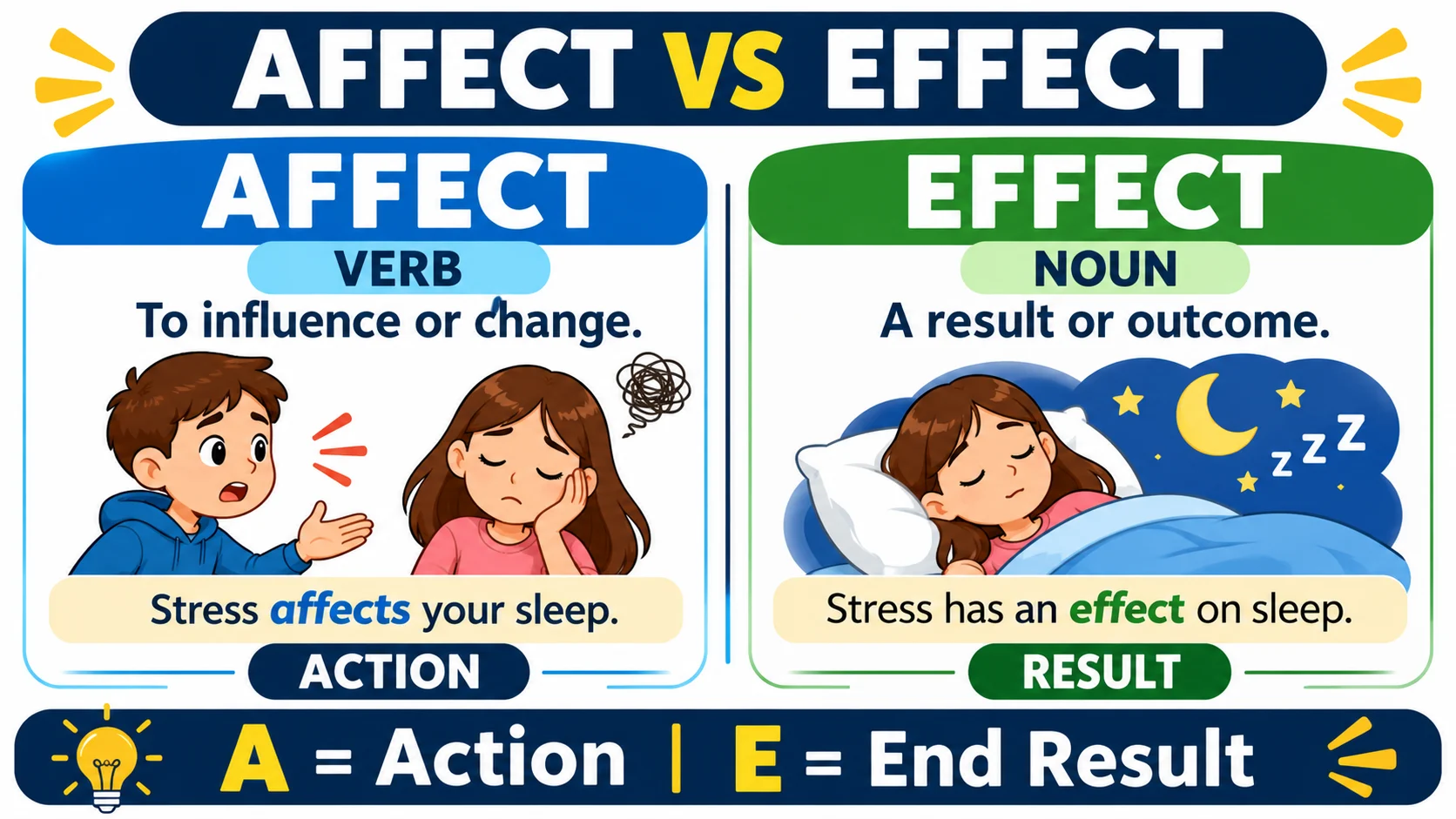
Affect is usually a verb that means to influence or change something. Effect is usually a noun that means a result or outcome. For example, bad weather can affect your mood, while its effect may be a change in your energy or behavior.
Have you ever stopped while writing because you were unsure whether to use affect or effect? You are not alone. These two words confuse many English learners, students, writers, and even native speakers. They look almost the same and sound very similar. However, they have different meanings and grammatical roles.
Understanding Affect vs Effect is important because using the wrong word can change the meaning of a sentence. For example, saying that stress can effect your health is usually incorrect. The correct sentence is that stress can affect your health. On the other hand, saying that stress has a strong affect on your health is also incorrect in standard everyday English. You should use effect because you are talking about a result.
The good news is that you do not need to memorize many difficult grammar rules. A simple trick can help you remember the difference. Affect is usually an action, while effect is usually a result. In this guide, you will learn their definitions, grammar rules, examples, common mistakes, and practical ways to use both words correctly.
Quick Answer: Affect vs Effect
The main difference between affect and effect is their part of speech and meaning.
- Affect: Usually a verb that means to influence, change, or have an impact on something.
- Effect: Usually a noun that means the result, outcome, or consequence of an action.
Consider these examples:
- The lack of sleep can affect your memory.
- The effect of poor sleep is reduced concentration.
In the first sentence, affect describes an action. It explains how poor sleep influences memory.
In the second sentence, effect identifies a result. It explains what happens because of poor sleep.
Affect vs Effect at a Glance
Affect
Usually a verb
Meaning: To influence
Example: Exercise affects your health.
Effect
Usually a noun
Meaning: A result
Example: Exercise has positive effects.
Easy memory trick:
Affect = Action
Effect = End result
Definition and Explanation of Affect
Affect is most commonly used as a verb. It means to influence, change, or make a difference to someone or something.
When one thing affects another, it has an impact on it. The change may be positive, negative, or neutral.
For example:
- Heavy rain can affect traffic.
- Stress may affect your sleep.
- Your daily habits affect your health.
- A teacher’s advice can affect a student’s future.
- Rising prices affect family budgets.
In each example, affect describes how one thing influences another.
What Does Affect Mean?
The word affect means to have an influence on something or someone.
It does not always mean that something changes completely. Sometimes, it describes a small impact.
For example:
“Your words affected me.”
This sentence means that someone’s words had an emotional impact on the speaker.
Similarly:
“The new policy affected several employees.”
This means the policy had an impact on those employees. It may have changed their work, responsibilities, or conditions.
Affect as a Verb
Affect is an action word in most everyday sentences. It often appears after the subject and before the object.
Common sentence structure:
Subject + Affect + Object
Examples:
| Subject | Affect | Object |
|---|---|---|
| Weather | affects | Travel plans |
| Stress | affects | Mental focus |
| Exercise | affects | Physical health |
| Technology | affects | Communication |
| Education | affects | Career choices |
Notice that the word changes slightly depending on the subject.
- I affect.
- You affect.
- We affect.
- They affect.
- He affects.
- She affects.
- It affects.
When the subject is singular and uses he, she, or it, add an s to affect.
Affect as a Noun
Although affect is usually a verb, it can also function as a noun in psychology and related fields.
In this context, affect refers to the visible expression of someone’s emotions or feelings.
For example:
“The patient showed a flat affect during the interview.”
This means the patient showed little visible emotional expression.
Psychologists and mental health professionals may use terms such as:
- Flat affect
- Blunted affect
- Restricted affect
- Broad affect
- Inappropriate affect
These terms describe different patterns of emotional expression.
This use is more specialized than the everyday verb meaning. Most general writing uses affect as a verb.
Examples of Affect in Different Sentences
Here are more examples to help you understand how to use affect naturally.
| Sentence | Meaning |
|---|---|
| Noise affects my concentration. | Noise influences my ability to focus. |
| The decision affected everyone. | The decision had an impact on everyone. |
| Lack of water affects plant growth. | Water shortages influence growth. |
| Her kindness affected his life. | Her kindness made a difference in his life. |
| The cold weather affects my skin. | Cold weather changes or influences my skin. |
| New laws affect small businesses. | New laws influence business operations. |
The key idea is simple: use affect when you want to describe an influence or an action that causes a change.
Definition and Explanation of Effect
Effect is most commonly used as a noun. It means a result, outcome, or consequence of an action, event, or situation.
An effect happens because something else has occurred.
For example:
- The effect of exercise is better physical health.
- The medicine had a positive effect.
- Climate change has serious effects on the environment.
- The new law had an unexpected effect on businesses.
- Poor sleep can have a negative effect on concentration.
In these sentences, effect identifies the result of something.
What Does Effect Mean?
Effect refers to what happens after an action or event.
Think about a simple example.
You study for an exam every day. As a result, you improve your knowledge and perform better.
Your daily study affects your exam preparation. Better performance is the effect.
This relationship can be understood as:
Cause → Action or Influence → Effect
For example:
- Cause: Heavy rainfall.
- Influence: Roads become wet and traffic slows down.
- Effect: Longer travel times.
Effect as a Noun
A noun is a word that names a person, place, thing, or idea.
Effect is a noun because it names a result or outcome.
It can appear in several common sentence structures.
Structure 1: The effect of something
- The effect of exercise is improved fitness.
- The effect of stress can be serious.
- The effect of pollution is visible in many cities.
Structure 2: Have an effect on something
- Smoking has a harmful effect on health.
- Good communication has a positive effect on teamwork.
- Social media has a strong effect on modern culture.
Structure 3: Produce an effect
- The new strategy produced a positive effect.
- The medicine produced the desired effect.
- The changes produced unexpected effects.
Effect as a Verb
Effect can also be used as a verb, although this use is less common in everyday conversation.
As a verb, effect means to bring about, cause, or accomplish something.
For example:
- The new manager hopes to effect positive changes.
- The organization plans to effect major reforms.
- The government wants to effect improvements in public services.
Here, effect does not mean influence. It means to make something happen.
Compare these two sentences:
- The new manager wants to affect company policies.
- The new manager wants to effect company policy changes.
The first sentence means the manager wants to influence existing policies.
The second means the manager wants to bring about policy changes.
This is an important distinction in formal and professional English.
Examples of Effect in Different Sentences
| Sentence | Meaning |
|---|---|
| The medicine had a positive effect. | The medicine produced a good result. |
| The effects of pollution are harmful. | Pollution creates harmful results. |
| Her advice had a lasting effect. | Her advice created a long-term impact. |
| The new rules took effect yesterday. | The new rules became active yesterday. |
| The treatment produced the desired effect. | The treatment achieved the intended result. |
| The company wants to effect change. | The company wants to bring about change. |
Affect vs Effect: Main Differences
The easiest way to understand affect vs effect is to compare their meanings, grammatical roles, and sentence structures.
Although both words relate to change and influence, they do not usually perform the same job.
Comparison Table
| Feature | Affect | Effect |
|---|---|---|
| Main use | Verb | Noun |
| Basic meaning | To influence | A result |
| Grammatical role | Action | Outcome |
| Common structure | Affect something | Effect of something |
| Example | Sleep affects mood. | Sleep has an effect on mood. |
| Question it answers | What influences it? | What is the result? |
| Common phrases | Affect health | Have an effect |
| Other use | Noun in psychology | Verb meaning to bring about |
Difference in Meaning
Affect describes an influence.
Effect describes the result of that influence.
For example:
“Technology affects education.”
This means technology influences the way people learn and teach.
“Technology has changed the effect of traditional teaching methods.”
This sentence discusses the results or consequences of that change.
Another example:
“Exercise affects your heart.”
This describes how exercise influences your heart.
“The effect of exercise is a healthier heart.”
This describes the result.
Difference in Grammar
Grammar is one of the easiest ways to identify the correct word.
Affect is normally used as a verb. It often follows a subject.
Examples:
- The weather affects my mood.
- Music affects my emotions.
- Education affects society.
Effect is normally used as a noun. It often follows words such as the, an, a, or its.
Examples:
- The effect was unexpected.
- Exercise has an effect on health.
- The effects of stress can be serious.
These patterns are not absolute because affect can be a noun and effect can be a verb. However, they work well in most everyday writing.
Difference in Sentence Structure
Look at the following examples.
| Incorrect or Less Natural | Correct | Reason |
|---|---|---|
| Stress effects my sleep. | Stress affects my sleep. | Influence is needed. |
| Exercise has a positive affect. | Exercise has a positive effect. | A result is needed. |
| The weather had an affect on travel. | The weather had an effect on travel. | Effect is a noun here. |
| The changes will effect our routine. | The changes will affect our routine. | The meaning is influence. |
Remember that effect can be correct as a verb when it means to bring about something. The correct choice depends on the intended meaning.
The Easiest Ways to Remember Affect vs Effect
You do not need to study complicated grammar rules every time you use these words. A few simple memory tricks can help you make the right choice.
Remember A for Action
Affect starts with the letter A.
Think of A as Action.
When you want to describe an action that influences something, use affect.
Examples:
- The heat affects the plants.
- Your attitude affects your performance.
- Poor communication affects teamwork.
The word describes what something does to another thing.
Remember E for End Result
Effect starts with the letter E.
Think of E as End Result.
When you want to describe an outcome or consequence, use effect.
Examples:
- The effect of heat is dry soil.
- The effect of practice is better performance.
- Poor communication has a negative effect on teamwork.
The word describes what happens because of something.
Use the Verb and Noun Test
Ask yourself whether the sentence needs an action or a result.
If you need an action, affect is usually correct.
If you need a result, effect is usually correct.
For example:
“Does exercise _____ your energy?”
The sentence needs a verb. Therefore, use affect.
“Does exercise have an _____ on your energy?”
The sentence needs a noun. Therefore, use effect.
Use the Replace Test
Another helpful trick is to replace the word with a simpler expression.
For affect, try replacing it with:
- Influence
- Change
- Have an impact on
For effect, try replacing it with:
- Result
- Outcome
- Consequence
Examples:
“Noise affects my sleep.”
Replace affect with influence:
“Noise influences my sleep.”
The sentence still makes sense.
“The effect of noise was poor sleep.”
Replace effect with result:
“The result of noise was poor sleep.”
The sentence still makes sense.
This simple method can help you choose between affect and effect quickly.
Advantages and Disadvantages of Understanding Affect vs Effect
Understanding the difference between these words offers several benefits. It also helps you avoid common writing problems.
Strictly speaking, affect and effect do not have advantages or disadvantages themselves. However, learning how to use them correctly improves communication.
Advantages of Using Affect and Effect Correctly
Improves writing accuracy
Correct word choice makes your writing grammatically accurate. It also shows that you understand how English words work.
Makes communication clearer
The reader can understand whether you are describing an influence or a result.
For example:
- Stress affects performance.
- Stress has an effect on performance.
Both sentences communicate a similar idea, but they use different grammatical structures.
Builds professional credibility
Correct grammar is important in emails, reports, essays, applications, and business documents.
A small mistake may not change your entire message, but repeated errors can reduce the reader’s confidence in your writing.
Helps English learners
Learning these words improves vocabulary and grammar skills. It also helps learners understand the difference between verbs and nouns.
Supports academic writing
Students often use affect and effect when discussing research findings, social changes, health conditions, and scientific results.
Correct usage makes academic writing easier to follow.
Disadvantages of Confusing Affect and Effect
Changes sentence meaning
Using the wrong word can make a sentence unclear or incorrect.
For example:
“The policy effected employees.”
If you mean the policy influenced employees, the correct sentence is:
“The policy affected employees.”
Reduces writing quality
Grammar mistakes can make professional writing appear less polished.
Creates confusion for readers
Readers may need to stop and interpret a sentence when the wrong word is used.
Causes problems in formal documents
Affect and effect appear frequently in academic papers, workplace reports, and business communication. Incorrect usage can weaken an otherwise strong document.
Real-World Examples of Affect vs Effect
The best way to understand affect vs effect is to see how these words work in real situations.
Here are examples from everyday life, education, health, business, technology, and communication.
Affect vs Effect in Everyday Life
Everyday situations provide simple ways to understand these words.
| Situation | Affect Example | Effect Example |
|---|---|---|
| Weather | Rain affects my plans. | The effect is a delayed trip. |
| Sleep | Poor sleep affects my mood. | The effect is tiredness. |
| Food | Healthy food affects energy levels. | The effect is better energy. |
| Exercise | Exercise affects physical fitness. | The effect is improved strength. |
| Music | Music affects my emotions. | The effect is a calmer mood. |
Example:
“Watching television late at night affects my sleep.”
Here, watching television influences sleep.
“The effect of watching television late at night is poor sleep.”
Here, poor sleep is the result.
Affect vs Effect in Education
Students and teachers use these words when discussing learning, performance, and academic success.
Examples of affect:
- Classroom conditions affect student performance.
- Regular practice affects exam results.
- A supportive teacher affects student confidence.
- Technology affects the learning process.
Examples of effect:
- Regular practice has a positive effect on exam results.
- A supportive teacher can have a lasting effect on student confidence.
- Classroom conditions may have an effect on concentration.
Consider this example:
“Studying regularly affects academic performance.”
This describes how regular study influences academic performance.
“The effect of regular study is better academic performance.”
This describes the result of studying regularly.
Affect vs Effect in Health and Medicine
Health professionals often use both words when discussing diseases, treatments, symptoms, and lifestyle choices.
Examples of affect:
- Smoking affects lung health.
- Stress affects blood pressure.
- Exercise affects heart function.
- Poor nutrition affects physical development.
Examples of effect:
- Smoking has harmful effects on the lungs.
- Stress can have an effect on blood pressure.
- Exercise has positive effects on heart health.
- Poor nutrition may have long-term effects on development.
In medical and scientific writing, the distinction is especially important.
For example:
“The treatment affected the patient’s symptoms.”
This means the treatment influenced the symptoms.
“The treatment had a positive effect on the patient’s symptoms.”
This describes the result of the treatment.
Writers should also avoid suggesting that an observed effect proves a cause. Scientific studies often distinguish between an association and a causal relationship.
Affect vs Effect in Business
Business professionals use affect and effect when discussing decisions, policies, productivity, and market conditions.
Examples of affect:
- Inflation affects consumer spending.
- Employee motivation affects productivity.
- Competition affects market prices.
- Leadership decisions affect company growth.
Examples of effect:
- Inflation has an effect on consumer spending.
- Employee motivation has a positive effect on productivity.
- Competition can have a major effect on market prices.
- Leadership decisions may have long-term effects on company growth.
Example:
“The new marketing strategy affects customer behavior.”
This means the strategy influences customer decisions.
“The effect of the new marketing strategy is increased sales.”
This identifies the outcome.
Affect vs Effect in Technology
Technology changes how people communicate, work, study, and share information.
Examples of affect:
- Artificial intelligence affects modern workplaces.
- Social media affects communication habits.
- Cybersecurity problems affect business operations.
- Software updates affect system performance.
Examples of effect:
- Artificial intelligence has a major effect on employment.
- Social media has changed the effect of digital communication.
- Cybersecurity problems can have serious effects on businesses.
- Software updates may have an unexpected effect on performance.
Example:
“Artificial intelligence affects how students complete assignments.”
This describes an influence.
“The effect of artificial intelligence on education includes new learning opportunities and challenges.”
This describes the outcomes.
Regional and Global Usage of Affect vs Effect
Affect and effect are widely used in English-speaking countries. Their basic meanings and grammar rules remain largely the same in American English, British English, Canadian English, and Australian English.
There is no major regional difference in the standard everyday distinction.
American English
In American English, affect is generally used as a verb meaning to influence.
Effect is generally used as a noun meaning a result.
Examples:
- The new law affects small businesses.
- The new law has an effect on small businesses.
American writers also use effect as a verb in formal expressions such as:
- Effect change.
- Effect reform.
- Effect improvements.
These expressions mean to bring about change, reform, or improvement.
British English
British English follows the same basic rules.
Examples:
- The weather affects travel plans.
- The weather has an effect on travel plans.
British English also uses the formal verb effect in expressions such as “effect change.”
The difference between affect and effect is not based on British or American spelling. Both forms are spelled the same way in these varieties.
Canadian English
Canadian English also uses affect and effect according to the same grammatical principles.
Examples:
- Cold weather affects road conditions.
- Cold weather has an effect on road conditions.
Both words are common in Canadian education, business, and everyday communication.
Australian English
Australian English follows the same standard distinction.
Examples:
- Heavy rain affects outdoor activities.
- Heavy rain has an effect on outdoor activities.
The words are used in the same way in Australian professional and academic writing.
Global English Usage
English is used around the world in education, business, science, technology, and international communication.
People learning English as a second language often confuse affect and effect because the words:
- Look almost identical.
- Have similar pronunciations.
- Are closely related in meaning.
- Can both relate to influence and change.
For international English learners, focusing on sentence structure is more useful than trying to memorize regional differences.
Common Mistakes When Using Affect vs Effect
Even experienced writers sometimes confuse these words. The best way to avoid mistakes is to understand the meaning of each sentence.
Here are common errors and their corrections.
Mistake 1: Using Effect Instead of Affect
Incorrect:
“Stress effects your health.”
Correct:
“Stress affects your health.”
Why?
The sentence describes how stress influences health. Therefore, affect is the correct verb.
Mistake 2: Using Affect Instead of Effect
Incorrect:
“The new medicine had a positive affect.”
Correct:
“The new medicine had a positive effect.”
Why?
The sentence describes the result of the medicine. Effect is the correct noun.
Mistake 3: Confusing an Effect With an Influence
Incorrect:
“The effect of noise can affect my concentration.”
This sentence is not grammatically wrong, but it may sound repetitive or unclear.
Better:
“Noise can affect my concentration.”
Or:
“Noise can have a negative effect on my concentration.”
Both sentences communicate the idea clearly.
Mistake 4: Forgetting the Verb Form
Incorrect:
“Poor sleep affect my performance.”
Correct:
“Poor sleep affects my performance.”
Why?
“Poor sleep” is a singular subject. The verb needs an s.
Mistake 5: Using Affect When You Mean Bring About
Incorrect:
“The company plans to affect major changes.”
Correct:
“The company plans to effect major changes.”
Why?
The company wants to bring about changes, not simply influence existing changes.
Mistake 6: Assuming Effect Is Always a Noun
Incorrect understanding:
“Effect can never be a verb.”
Correct understanding:
“Effect is usually a noun, but it can also be a verb meaning to bring about or accomplish.”
Example:
“The new director hopes to effect improvements.”
Mistake 7: Ignoring the Psychology Meaning of Affect
Incorrect understanding:
“Affect is only a verb.”
Correct understanding:
“Affect can also be a noun in psychology, where it refers to visible emotional expression.”
Example:
“The patient displayed a restricted affect.”
Commonly Confused Expressions
| Expression | Correct Meaning |
|---|---|
| Affect someone’s health | Influence someone’s health |
| Have an effect on health | Produce a result related to health |
| Cause an effect | Produce a result |
| Effect change | Bring about change |
| Take effect | Become active or start working |
| Side effects | Additional or unintended results |
| Emotional affect | Visible expression of emotion in psychology |
Important Expressions and Phrases With Effect
Effect appears in many common English expressions. Learning these phrases can help you understand the word in different contexts.
Take Effect
“Take effect” means to become active or start producing a result.
Examples:
- The new rules will take effect next month.
- The medicine usually takes effect within an hour.
- The changes took effect yesterday.
Side Effect
A side effect is an additional result of something, especially a medicine or treatment. It may be unwanted.
Examples:
- The medicine caused mild side effects.
- Drowsiness is a possible side effect.
- The treatment has fewer side effects than the previous option.
Cause and Effect
Cause and effect describe the relationship between an event and the result it produces.
Examples:
- Scientists study cause and effect.
- The lesson explains the relationship between pollution and climate change.
- Understanding cause and effect helps students improve their reasoning skills.
In Effect
“In effect” can mean actually or practically.
Examples:
- The new policy is, in effect, a major change.
- The agreement is still in effect.
For Effect
“For effect” means doing something to create a particular impression.
Examples:
- The speaker paused for effect.
- The advertisement used dramatic music for effect.
Special Cases: When Affect and Effect Break the Usual Rules
The simple rule of affect as a verb and effect as a noun works in most situations. However, there are exceptions.
Learning these exceptions will help you understand advanced English and write more accurately.
Affect as a Noun in Psychology
In psychology, affect describes the outward expression of emotion.
It is different from the internal feeling itself.
For example:
“A person may report feeling sad but display a neutral affect.”
This means the person’s reported emotion and visible emotional expression may differ.
Common psychological terms include:
| Term | Meaning |
|---|---|
| Flat affect | Very little visible emotional expression |
| Blunted affect | Reduced emotional expression |
| Restricted affect | Limited range of emotional expression |
| Broad affect | Wide range of visible emotional expression |
| Inappropriate affect | Emotional expression that does not fit the situation |
These terms are mainly used in clinical and psychological settings.
Effect as a Verb in Formal English
Effect can be a verb when it means to cause something to happen.
It often appears with words such as:
- Change
- Reform
- Improvement
- Transformation
- Resolution
Examples:
- The government wants to effect reform.
- The organization hopes to effect meaningful change.
- The new leadership plans to effect improvements.
This use is more formal than the everyday verb affect.
Affected vs Effected
The past forms of these words also have different meanings.
Affected means influenced or changed.
Examples:
- The storm affected several towns.
- Her health was affected by stress.
- The decision affected the entire team.
Effected means brought about or accomplished.
Examples:
- The organization effected major changes.
- The new director effected a complete transformation.
- The agreement effected a peaceful resolution.
A useful comparison:
“The new rules affected the employees.”
The rules influenced the employees.
“The new rules effected major changes.”
The rules brought about major changes.
Affect vs Effect in Academic and Professional Writing
Choosing the correct word is especially important in formal writing.
Students, researchers, teachers, managers, and professionals frequently use these words when describing relationships, results, and changes.
In Academic Essays
Academic essays often discuss how one factor influences another.
Examples:
- Social media affects communication among teenagers.
- Economic conditions affect educational opportunities.
- Family support affects student achievement.
When discussing outcomes, use effect.
Examples:
- Social media has a significant effect on communication.
- Economic conditions have a direct effect on educational opportunities.
- Family support can have a positive effect on student achievement.
In Research Papers
Research writing often includes discussions of variables, relationships, and outcomes.
Examples:
“The study examined how sleep duration affects memory performance.”
Here, affect describes the influence being investigated.
“The researchers observed an effect of sleep duration on memory performance.”
Here, effect describes the observed outcome.
Writers should be careful when describing research findings. If a study only identifies an association, it may be inaccurate to claim that one variable directly affects another.
In Business Reports
Business reports use these words to describe organizational decisions and their outcomes.
Examples:
- Changes in customer demand affect revenue.
- New regulations affect business operations.
- The new strategy had a positive effect on revenue.
- Staff training produced measurable effects on productivity.
In Professional Emails
Both words appear naturally in workplace communication.
Examples:
Using affect:
“Please let me know whether the schedule change will affect your availability.”
Using effect:
“The schedule change will take effect on Monday.”
These examples show how the correct word makes a message more precise.
Related Concepts and Comparisons
Affect and effect are not the only English words that confuse learners. Several other word pairs have similar spelling, pronunciation, or meanings.
Understanding these comparisons can improve your overall grammar and vocabulary.
Affect vs Influence
Both words can describe the ability to change or shape something.
However, affect is generally more direct and can be used in many different sentence structures.
| Affect | Influence |
|---|---|
| Usually a verb | Usually a verb or noun |
| Means to have an impact | Means to shape or guide |
| Stress affects health. | Stress influences health choices. |
| The weather affected our plans. | The weather influenced our decision. |
Example:
“Friends can affect your decisions.”
This means friends can have an impact on your decisions.
“Friends can influence your decisions.”
This means friends can help shape the choices you make.
Effect vs Impact
Effect and impact are closely related nouns.
However, impact often emphasizes the strength or importance of an influence.
| Effect | Impact |
|---|---|
| Result or outcome | Strong influence or effect |
| The effect was positive. | The impact was significant. |
| The medicine had an effect. | The medicine had a major impact. |
Example:
“The policy had a positive effect on employment.”
“The policy had a significant impact on employment.”
Both are correct, but impact often emphasizes the importance or strength of the change.
Effect vs Result
Both words can describe what happens because of an action.
However, result is often more direct and general.
| Effect | Result |
|---|---|
| Consequence or outcome | Outcome of an action |
| The effect was unexpected. | The result was unexpected. |
| Pollution has harmful effects. | Pollution results in environmental damage. |
Affect vs Change
Affect means to influence something. Change means to make something different or become different.
For example:
“The weather affects my mood.”
This means weather influences how I feel.
“The weather changes my mood.”
This suggests that weather makes my mood different.
The meanings are similar, but they are not always interchangeable.
Effect vs Consequence
A consequence is a result that often carries a sense of importance or responsibility.
Effect is more neutral and can describe positive, negative, or neutral outcomes.
Examples:
- The effect of exercise is improved fitness.
- The consequences of breaking the rules may include a penalty.
Exercises: Test Your Understanding of Affect vs Effect
Practice is one of the best ways to learn the difference between affect and effect.
Try completing the following sentences before checking the answers.
Exercise 1: Fill in the Blanks
Choose either affect or effect.
- Lack of sleep can ______ your concentration.
- The ______ of the storm was severe.
- Social media can ______ people’s opinions.
- The new rules will take ______ next week.
- Exercise has a positive ______ on mental health.
- The weather may ______ our travel plans.
- The medicine had an unexpected ______.
- Stress can ______ your ability to focus.
- The company hopes to ______ meaningful changes.
- The new policy will ______ all employees.
Exercise 2: Choose the Correct Word
Select the correct option.
- Poor nutrition can (affect/effect) physical development.
- The (affect/effect) of the treatment was positive.
- Noise can (affect/effect) your sleep.
- The new law will take (affect/effect) tomorrow.
- The manager wants to (affect/effect) organizational change.
- Pollution has harmful (affects/effects) on the environment.
- The decision (affected/effected) everyone in the office.
- The organization (affected/effected) major reforms.
Exercise 3: Correct the Mistakes
Each sentence contains an incorrect word choice or grammatical error. Rewrite it correctly.
- Stress effects my health.
- The medicine had a positive affect.
- Poor sleep affect my memory.
- The company wants to affect major changes.
- The new rules will take affect tomorrow.
- The weather had a negative affect on our plans.
Exercise 4: Identify the Part of Speech
Decide whether the bold word is used as a noun or verb.
- Exercise affects physical health.
- The effect was unexpected.
- The medicine may affect sleep.
- The changes had several effects.
- The company plans to effect reform.
- The patient displayed a flat affect.
Exercise Answers and Explanations
Use these answers to check your understanding.
Answers to Exercise 1
| No. | Answer | Explanation |
|---|---|---|
| 1 | Affect | Sleep influences concentration. |
| 2 | Effect | The sentence describes a result. |
| 3 | Affect | Social media influences opinions. |
| 4 | Effect | The expression is “take effect.” |
| 5 | Effect | The sentence needs a noun. |
| 6 | Affect | Weather influences travel plans. |
| 7 | Effect | The medicine produced a result. |
| 8 | Affect | Stress influences concentration. |
| 9 | Effect | Effect means bring about. |
| 10 | Affect | The policy influences employees. |
Answers to Exercise 2
- Affect
- Effect
- Affect
- Effect
- Effect
- Effects
- Affected
- Effected
Why?
The first three answers use affect as a verb or effect as a noun. The fourth uses the expression “take effect.” The fifth and eighth use effect as a verb meaning to bring about. The sixth uses effects as a plural noun. The seventh uses affected to describe people who experienced an influence.
Answers to Exercise 3
1. Incorrect: Stress effects my health.
Correct: Stress affects my health.
Explanation: Stress influences health, so use affect.
2. Incorrect: The medicine had a positive affect.
Correct: The medicine had a positive effect.
Explanation: The sentence describes the result of the medicine.
3. Incorrect: Poor sleep affect my memory.
Correct: Poor sleep affects my memory.
Explanation: The singular subject requires the verb affects.
4. Incorrect: The company wants to affect major changes.
Correct: The company wants to effect major changes.
Explanation: Effect means to bring about changes.
5. Incorrect: The new rules will take affect tomorrow.
Correct: The new rules will take effect tomorrow.
Explanation: “Take effect” means become active.
6. Incorrect: The weather had a negative affect on our plans.
Correct: The weather had a negative effect on our plans.
Explanation: The sentence needs a noun describing the result.
Answers to Exercise 4
| No. | Word | Part of Speech |
|---|---|---|
| 1 | Affects | Verb |
| 2 | Effect | Noun |
| 3 | Affect | Verb |
| 4 | Effects | Noun |
| 5 | Effect | Verb |
| 6 | Affect | Noun |
The fifth sentence uses effect as a verb meaning to bring about. The sixth uses affect as a noun in its psychological meaning.
Frequently Asked Questions About Affect vs Effect
What is the main difference between affect and effect?
Affect is usually a verb meaning to influence or change something. Effect is usually a noun meaning a result or outcome. For example, stress affects sleep, while poor sleep is an effect of stress.
Is affect a verb or a noun?
Affect is usually a verb. It means to influence or have an impact on something. However, affect can also be a noun in psychology, where it describes the visible expression of emotions.
Is effect a verb or a noun?
Effect is usually a noun meaning a result or consequence. It can also be a verb meaning to bring about or accomplish something. For example, “The organization plans to effect change.”
How do I remember affect vs effect easily?
Remember A for Action and E for End Result. Affect usually describes an action that influences something. Effect usually describes the result of that action.
Is it affect or effect on someone?
Use affect as a verb and effect as a noun in this structure. For example, “Your words affect me” and “Your words have an effect on me.” Both are correct.
Should I write affect or effect my life?
Use affect when you mean that something influences your life. For example, “Education can affect my life.” Use effect when describing the result, as in “Education has a positive effect on my life.”
What is the difference between affected and effected?
Affected means influenced or changed. Effected means brought about or accomplished. For example, “The storm affected the city” means the storm influenced the city. “The organization effected change” means it brought about change.
Is it side effects or side affects?
The correct expression is side effects. Effect is a noun in this phrase. Side effects are additional results of a medicine, treatment, or other action.
Is it take effect or take affect?
The correct expression is take effect. It means that something becomes active or starts working. For example, “The new policy will take effect next month.”
Can affect and effect be used in the same sentence?
Yes. For example, “Stress can affect your sleep, and its effect may be reduced concentration.” Affect describes the influence, while effect describes the result.
Is affect or effect correct in formal writing?
Both are correct in formal writing, but the choice depends on meaning. Use affect when describing influence and effect when describing a result. In formal English, effect can also mean to bring about something.
What are some examples of affect and effect in everyday English?
Examples include “Rain affects traffic” and “Rain has an effect on traffic.” The first sentence uses affect as a verb. The second uses effect as a noun. Both describe the relationship between rain and traffic.
Conclusion: Affect vs Effect
Understanding the difference between affect and effect can make your writing clearer, stronger, and more professional. Although these words look and sound similar, they usually serve different purposes in a sentence.
Affect is generally a verb that means to influence, change, or have an impact on something. Effect is generally a noun that means a result, outcome, or consequence. For example, stress can affect your health, while its effect may be poor sleep or reduced concentration.
The easiest way to remember the difference is to think of A for Action and E for End Result. You should also remember the special cases. Affect can be a noun in psychology, while effect can be a verb meaning to bring about change.
The best way to improve is to read examples, practice sentence construction, and check the meaning before choosing a word. With regular practice, you will be able to use affect and effect correctly in everyday conversations, academic essays, professional emails, and business reports.