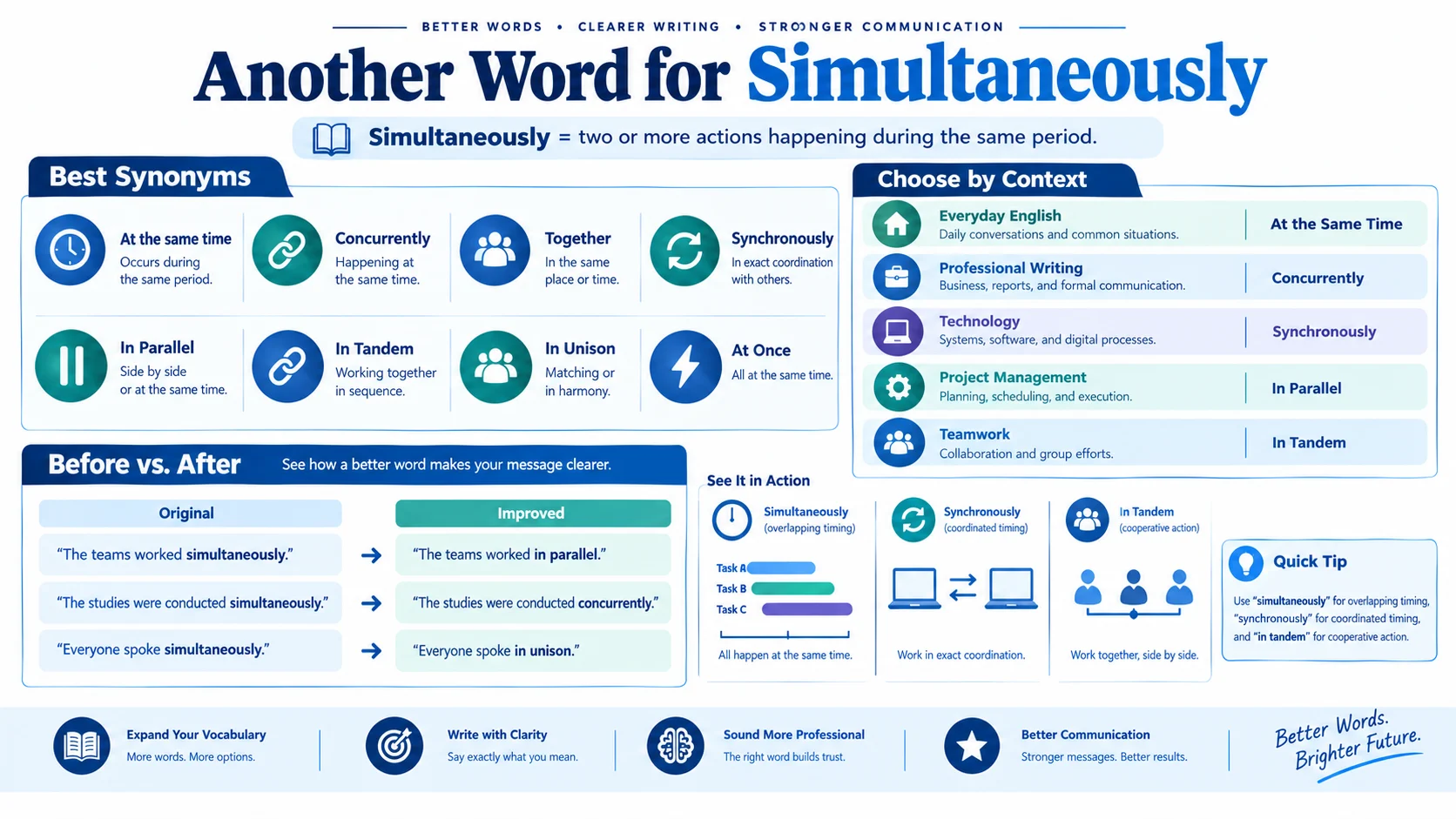
Another word for simultaneously is at the same time, meaning that two or more actions or events happen together. Other useful synonyms include concurrently, together, synchronously, concurrently, and in unison. Use concurrently in professional writing, in unison for coordinated actions, and at the same time for clear, everyday communication.
What Does Simultaneously Mean?
Definition
Simultaneously is an adverb that means two or more actions, events, or processes happen at the same time. It emphasizes that the activities overlap in time rather than occurring one after another.
For example, “The two teams worked simultaneously on different parts of the project” means both teams worked during the same period.
The word is common in academic research, business reports, technical documentation, and everyday communication. Although it is precise, it can sound formal or unnecessarily long in simple sentences.
Common Uses
Simultaneously is used in several contexts:
- Business: Two departments handle separate tasks simultaneously.
- Technology: A device processes multiple requests simultaneously.
- Education: Students read and take notes simultaneously.
- Science: Researchers observe multiple reactions simultaneously.
- Entertainment: Several characters speak simultaneously.
- Daily life: She was cooking and listening to music simultaneously.
The word does not necessarily mean that actions begin and end at exactly the same moment. They may simply overlap for some period.
Best Synonyms for Simultaneously
The best replacement depends on whether you want to emphasize timing, coordination, parallel activity, or shared action.
| Synonym | Meaning | Best Used When | Example |
|---|---|---|---|
| At the same time | During the same period | Everyday writing | She answered emails and attended a meeting at the same time. |
| Concurrently | Happening during the same period | Professional and academic writing | Two studies were conducted concurrently. |
| Together | In association or at one time | General communication | The teams worked together on the assignment. |
| In unison | Acting or speaking in coordination | Group actions | The audience applauded in unison. |
| Synchronously | Happening at precisely coordinated times | Technology and technical contexts | The devices transmitted data synchronously. |
| In parallel | Taking place along separate but overlapping paths | Business, computing, and research | Both development tasks ran in parallel. |
| At once | Immediately or at the same time | Everyday English | The lights came on at once. |
| All at once | Happening together or suddenly | Informal descriptions | Several questions came up all at once. |
| Side by side | Existing or operating alongside each other | Comparisons and collaborative work | The teams worked side by side. |
| Concurrently with | During the same period as something else | Formal writing | The trial ran concurrently with another study. |
| In tandem | Working together in a coordinated way | Professional communication | Marketing and sales worked in tandem. |
| Coincidentally | Happening by chance at the same time | Unexpected events | They coincidentally arrived at the same time. |
Important distinction: These words are not interchangeable in every sentence. Concurrently emphasizes overlapping time, in unison emphasizes coordinated action, and in tandem emphasizes cooperation. Coincidentally suggests that events occur together by chance, not necessarily through coordination.
Synonyms for Simultaneously by Context
Formal Writing
Formal writing often benefits from precise language that describes the relationship between events.
Useful alternatives include:
- Concurrently: Best for activities or processes occurring during the same period.
- Synchronously: Best when timing or coordination is important.
- At the same time: Clear and appropriate for most formal audiences.
- In parallel: Useful when separate activities proceed during overlapping periods.
Example:
Original: The researchers simultaneously evaluated both treatment methods.
Revised: The researchers concurrently evaluated both treatment methods.
The revised sentence maintains a formal tone while avoiding repetition. However, concurrently is most appropriate when the evaluations overlap in time.
Professional Writing
In business communication, the best synonym depends on the work being described.
Business example
Original: Our departments are working simultaneously to complete the project.
Revised: Our departments are working in parallel to complete the project.
Another option: Our departments are working in tandem to complete the project.
The difference matters. In parallel emphasizes separate activities progressing during the same period. In tandem emphasizes coordination between departments.
For emails, proposals, and reports, at the same time and concurrently are also effective choices.
Academic Writing
Academic writing frequently describes experiments, observations, analyses, and research activities that overlap in time.
Useful alternatives include concurrently, synchronously, and in parallel.
Academic example
Original: The researchers simultaneously analyzed data from three groups.
Revised: The researchers concurrently analyzed data from three groups.
Alternative: The researchers analyzed data from three groups in parallel.
Choose concurrently when the analyses took place during the same period. Choose in parallel when the emphasis is on separate analytical processes running alongside one another.
Use synchronously only when the timing is coordinated or synchronized, rather than merely overlapping.
Daily Conversation
Everyday English usually sounds more natural when you use familiar expressions instead of long adverbs.
| Instead of Simultaneously | Use | Example |
|---|---|---|
| Simultaneously eating and watching | At the same time | He was eating and watching TV at the same time. |
| Simultaneously arriving | Arriving together | We arrived together. |
| Simultaneously reacting | Reacting at once | They reacted at once. |
| Simultaneously speaking | Speaking in unison | Everyone spoke in unison. |
| Simultaneously doing separate tasks | Doing tasks in parallel | We worked on the tasks in parallel. |
For ordinary conversations, at the same time is often the most natural and universally understood alternative.
Professional Alternatives for Simultaneously
The following alternatives are especially useful for workplace documents, reports, and formal communication.
1. Concurrently
Meaning: During the same period as another activity.
Best used for: Projects, research, operations, and overlapping processes.
Tone: Formal and professional.
Difficulty: Medium.
Usage frequency: Common.
Best for: Business writing, academic essays, professional emails, and reports.
- Business example: The finance and operations teams reviewed the proposal concurrently.
- Academic example: Two experiments were conducted concurrently to compare the outcomes.
- Daily conversation example: I was taking two online courses concurrently.
2. In Parallel
Meaning: Through separate activities or processes that proceed alongside one another.
Best used for: Project management, software development, research, and planning.
Tone: Professional and technical.
Difficulty: Medium.
Usage frequency: Common.
Best for: Resumes, business writing, technical reports, and project updates.
- Business example: Managed three projects in parallel while meeting all deadlines.
- Academic example: The two models were evaluated in parallel.
- Daily conversation example: We worked in parallel to finish the presentation.
Resume tip: “Managed multiple projects in parallel” can describe the ability to coordinate separate responsibilities. Use it only when it accurately reflects your work.
3. Synchronously
Meaning: At the same time with coordinated timing.
Best used for: Digital communication, computing, synchronized systems, and coordinated activities.
Tone: Technical and formal.
Difficulty: Advanced.
Usage frequency: Less common in general conversation.
Best for: Technical writing, academic research, and software documentation.
- Business example: The platform synchronously updated connected records.
- Academic example: The sensors collected synchronously timed measurements.
- Daily conversation example: The dancers moved synchronously to the music.
Note that in technical contexts, synchronously may have a specific meaning that should not be replaced casually.
4. In Tandem
Meaning: Working together in a coordinated or complementary way.
Best used for: Teams, departments, systems, and connected activities.
Tone: Professional and collaborative.
Difficulty: Medium.
Usage frequency: Common.
Best for: Business writing, marketing copy, project reports, and professional communication.
- Business example: The product and marketing teams worked in tandem during the launch.
- Academic example: The two analytical methods were used in tandem.
- Daily conversation example: We cleaned the house in tandem.
Unlike simultaneously, in tandem emphasizes coordination or cooperation. Two activities can happen simultaneously without being connected.
Simple Alternatives for Simultaneously
If you want your writing to sound clear and natural, consider these options.
At the same time: The closest everyday alternative.
Example: The students completed the test simultaneously.
Simpler: The students completed the test at the same time.
Together: Best when people act or participate collectively.
Example: The team members presented simultaneously.
Simpler, if they presented as a group: The team members presented together.
At once: Useful when events occur together, although it can also mean immediately.
Example: The alarms sounded simultaneously.
Simpler: The alarms sounded at once.
All at once: Useful for several events happening together or for describing a sudden occurrence.
Example: Several notifications appeared simultaneously.
Simpler: Several notifications appeared all at once.
Remember that together, at once, and all at once may change the emphasis or meaning of the original sentence.
Stronger Alternatives for Simultaneously
Some alternatives communicate a more specific relationship between events.
- Concurrently: Highlights overlapping time periods.
- Synchronously: Highlights coordinated timing.
- In unison: Highlights people or things acting together in coordination.
- In parallel: Highlights separate processes proceeding alongside each other.
- In tandem: Highlights cooperation or complementary action.
- Coincidentally: Highlights events that happen together by chance.
Examples:
- The two departments operated concurrently during the transition.
- The clocks displayed the time synchronously.
- The students answered in unison.
- Two software processes ran in parallel.
- Research and development worked in tandem.
- The friends coincidentally selected the same destination.
The strongest word is the one that expresses the intended relationship accurately, not necessarily the most complicated word.
Difference Between Similar Synonyms
Understanding these distinctions can help you avoid awkward or misleading substitutions.
| Word | Main Difference | Example |
|---|---|---|
| Simultaneously | General term for overlapping actions or events | The systems operated simultaneously. |
| Concurrently | Formal emphasis on overlapping periods | The trials ran concurrently. |
| Synchronously | Emphasis on coordinated timing | The devices operated synchronously. |
| Together | Emphasis on collective action or association | The researchers worked together. |
| In unison | Emphasis on coordinated, matching actions | The crowd shouted in unison. |
| In parallel | Emphasis on separate processes proceeding alongside one another | Two teams developed the features in parallel. |
| In tandem | Emphasis on cooperation or complementary action | The departments worked in tandem. |
| Coincidentally | Emphasis on events happening together by chance | They coincidentally chose the same date. |
Simultaneously vs. Concurrently
Both words describe events that occur during the same period. Concurrently is often preferred in formal, technical, and professional writing, while simultaneously works across a wider range of contexts.
Example: Two applications ran concurrently during testing.
Simultaneously vs. Synchronously
Simultaneously means actions overlap in time. Synchronously suggests that the timing is coordinated or synchronized.
For example, two people may work simultaneously on separate tasks without starting at precisely the same moment. Synchronized devices, by contrast, may need to follow coordinated timing.
Simultaneously vs. Coincidentally
These words express different relationships. Simultaneously describes timing, while coincidentally suggests that events happen together by chance.
Example: Two colleagues arrived simultaneously.
Different meaning: Two colleagues coincidentally chose the same vacation destination.
The first sentence describes timing. The second highlights an unexpected coincidence.
Opposite Words for Simultaneously
Simultaneously has no single perfect antonym in every context. Words that contrast with it generally indicate that actions happen one after another rather than during overlapping periods.
| Antonym or Contrast | Meaning | Example |
|---|---|---|
| Sequentially | In a particular order, one after another | The steps were completed sequentially. |
| Subsequently | After a previous event | The team subsequently reviewed the results. |
| Separately | Apart from one another | The two applications were tested separately. |
| One at a time | Individually, rather than together | Participants entered one at a time. |
| Successively | Following one another in a sequence | The samples were examined successively. |
| Alternately | Taking turns or switching between options | The lights flashed alternately. |
Sequentially and one at a time are particularly useful when you need to contrast simultaneous activities with activities performed in order.
FAQs
1. What is the best synonym for simultaneously?
At the same time is the clearest general alternative. Concurrently is suitable for formal writing, while in unison works for coordinated actions.
2. What is a formal synonym for simultaneously?
Concurrently is a strong formal synonym. Synchronously is appropriate when coordinated timing matters, especially in technical or scientific writing.
3. What is a professional alternative for simultaneously?
Use concurrently, in parallel, or in tandem, depending on the context. These expressions are useful in reports, project updates, and business communication.
4. What word can replace simultaneously in an essay?
Consider concurrently, at the same time, or in parallel. Choose the word that accurately describes how the events relate to one another.
5. Is simultaneously the same as concurrently?
They are very similar and often interchangeable. Both describe activities occurring during the same period, although concurrently is common in formal and technical contexts.
6. Is together a synonym for simultaneously?
Sometimes. Together can mean at the same time, but it can also mean jointly or in cooperation. Use it when the context supports that meaning.
7. What is a simple way to say simultaneously?
Say at the same time. This phrase is easy to understand and works in conversations, emails, and most general writing.
8. What is the difference between simultaneously and synchronously?
Simultaneously means that activities overlap in time. Synchronously suggests coordinated timing, which can be important in technical systems or organized group activities.
9. What is the opposite of simultaneously?
Useful contrasts include sequentially, one at a time, and separately. The best choice depends on whether you mean a sequence, individual actions, or activities that are not connected.
10. Can simultaneously be used in professional writing?
Yes. It is appropriate for business reports, technical documents, and academic work. However, concurrently or in parallel may be more precise in specific professional contexts.
Conclusion
The best word to replace simultaneously depends on the context. Choose at the same time for everyday communication, concurrently for formal writing, synchronously for coordinated timing, in parallel for separate processes, and in tandem for collaborative activities.
For clear American English, focus on the relationship between the actions rather than choosing a synonym simply to sound more formal. The right word makes your meaning precise and your writing easier to understand.