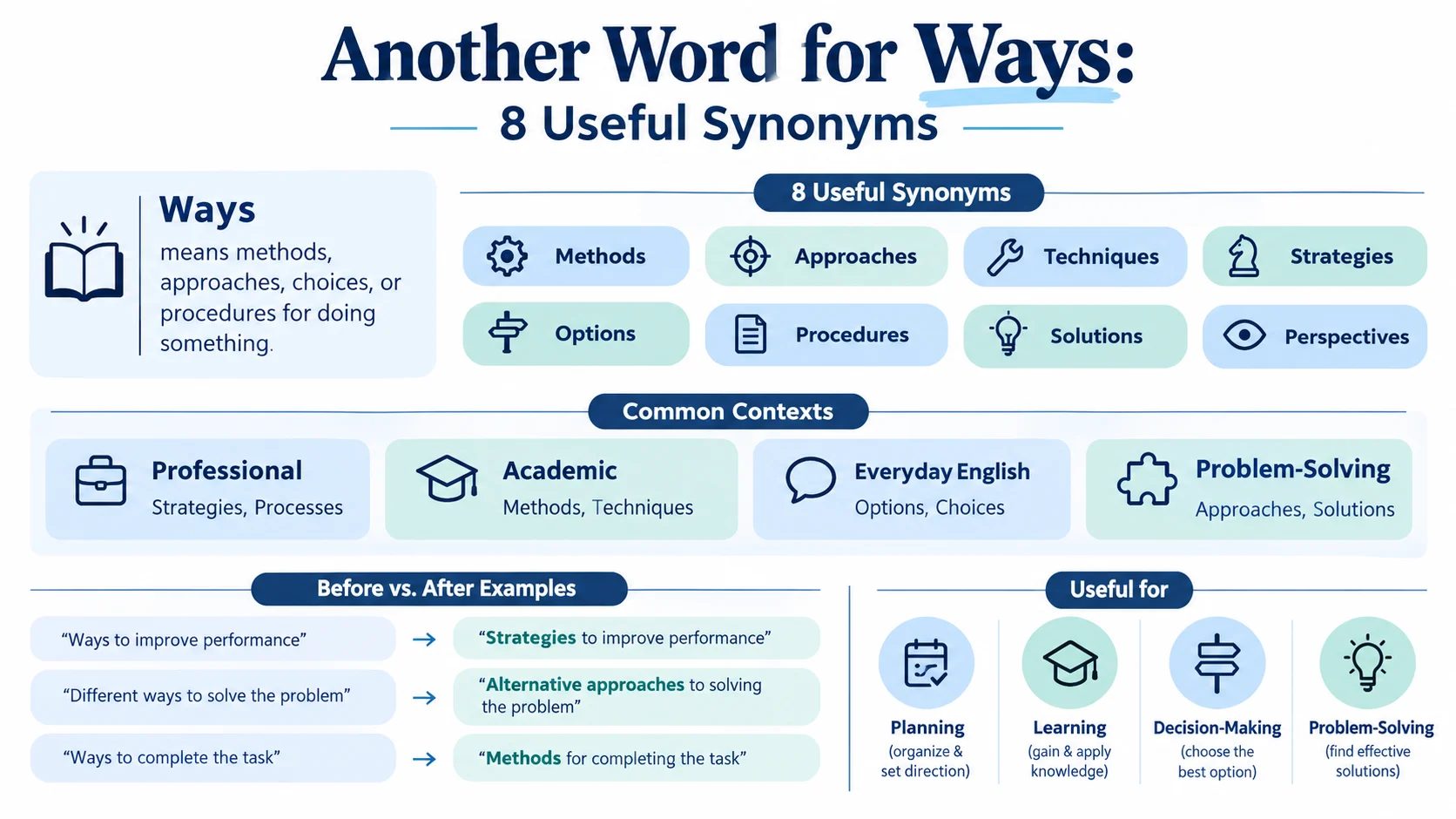
Another word for ways depends on the meaning of the sentence. Common synonyms include methods, approaches, techniques, strategies, means, options, and procedures. Use methods for organized processes, approaches for different ways of handling a situation, and options when referring to available choices.
What Does Ways Mean?
Definition
The word ways is the plural form of way. It can refer to methods of doing something, different approaches to a problem, available choices, directions, habits, or personal behavior.
Because ways has several meanings, the best synonym depends on the context. For example, “ways to save money” refers to methods or strategies, while “different ways of thinking” refers to perspectives or approaches.
In the sentence “There are several ways to solve this problem,” the word describes different possible methods. In “I admire her ways,” it may refer to her behavior or manner.
Common Uses
The word ways appears in everyday conversations, academic writing, business communication, and creative content.
- Methods: Ways to improve productivity.
- Approaches: Ways to solve a difficult problem.
- Strategies: Ways to achieve business goals.
- Options: Ways to pay for a purchase.
- Techniques: Ways to perform a specific task.
- Behaviors: Ways of treating other people.
- Perspectives: Ways of understanding an issue.
- Directions or routes: Ways to reach a destination.
Understanding these meanings helps you choose a synonym that preserves the original message.
Best Synonyms for Ways
The following table covers common alternatives for different contexts.
| Synonym | Meaning | Best Used When | Example |
|---|---|---|---|
| Methods | Organized ways of doing something | Processes and tasks | We tested several methods to improve efficiency. |
| Approaches | Different ways of handling a situation | Problems and decisions | The team considered new approaches to marketing. |
| Techniques | Specific skills or procedures | Practical tasks | She learned techniques for managing stress. |
| Strategies | Planned actions designed to achieve a goal | Business and planning | The company developed strategies for growth. |
| Means | Resources or methods used to achieve something | Formal writing | Education is a means of personal development. |
| Options | Available choices | Decisions and alternatives | Customers have several payment options. |
| Procedures | Established steps for completing a task | Workplace processes | Employees must follow safety procedures. |
| Solutions | Answers to problems | Problem-solving | We explored several solutions to the issue. |
| Alternatives | Other possibilities or choices | Comparing possibilities | We considered alternatives to the original plan. |
| Practices | Repeated actions or customary methods | Work habits and routines | The business adopted better management practices. |
| Processes | Connected steps that produce a result | Workflows and systems | The new processes reduced delays. |
| Tactics | Specific actions used to achieve an objective | Short-term planning | The team changed its sales tactics. |
| Paths | Routes or courses toward an outcome | Personal development | There are many paths to success. |
| Routes | Physical or figurative ways to reach a destination | Travel and progress | We explored different routes to the city. |
| Approximations | Rough estimates rather than exact results | Limited mathematical contexts | This is one way to approximate the answer. |
| Mannerisms | Distinctive habits or gestures | Personal behavior | His mannerisms made him easy to recognize. |
Best general replacements: methods, approaches, techniques, and strategies work well when ways means methods of doing something. Use options or alternatives when it refers to choices.
Synonyms for Ways by Context
Formal Writing
In formal writing, choose words that express the intended meaning precisely.
Useful alternatives include methods, means, procedures, approaches, and practices.
Examples:
- Original: Researchers explored different ways to collect data.
- Revised: Researchers explored different methods of collecting data.
Another example:
- Original: There are several ways to address the issue.
- Revised: There are several approaches to addressing the issue.
Use means when discussing how an outcome can be achieved. Use procedures when the process involves defined steps or rules.
Professional Writing
Business communication often uses strategies, methods, processes, approaches, and options instead of the general word ways.
Examples:
- Original: We need better ways to communicate with customers.
- Revised: We need better communication strategies for engaging customers.
- Original: The company introduced new ways to handle complaints.
- Revised: The company introduced new procedures for handling complaints.
- Original: We discussed different ways to reduce costs.
- Revised: We discussed different approaches to cost reduction.
For resumes, replace vague statements such as “Found ways to improve performance” with specific achievements, such as “Developed strategies that improved team productivity.” Only include measurable results when they are accurate.
Academic Writing
Academic writing benefits from precise terms that identify the nature of a process, argument, or investigation.
Useful alternatives include methods, approaches, techniques, procedures, and perspectives.
Examples:
- Original: The study examined different ways to teach mathematics.
- Revised: The study examined different teaching methods.
- Original: Students have different ways of understanding the concept.
- Revised: Students have different perspectives on the concept.
- Original: Researchers developed new ways to analyze the data.
- Revised: Researchers developed new analytical techniques.
Choose methods for research designs, techniques for specific procedures, and perspectives for viewpoints or interpretations.
Daily Conversation
In everyday English, the simplest replacement is often the most natural.
| Original Phrase | Natural Alternative |
|---|---|
| Ways to do something | Methods to do something |
| Different ways to solve it | Different approaches to solving it |
| Ways to get there | Routes to get there |
| Ways to pay | Payment options |
| Ways to make money | Ways to earn money or income sources |
| Ways of behaving | Behaviors or habits |
| Ways to improve | Methods to improve |
For casual conversations, options, choices, methods, and ideas are useful alternatives. However, ideas refers to possible suggestions, not necessarily proven methods.
Professional Alternatives for Ways
Some alternatives are particularly useful in workplace documents, presentations, and business reports.
1. Methods
Meaning: Organized or identifiable procedures for doing something.
Best used for: Research, operations, problem-solving, and task completion.
Tone: Neutral and professional.
Difficulty: Easy.
Usage frequency: Very common.
Best for: Resumes, email writing, essays, and business writing.
- Business example: We evaluated methods for improving customer retention.
- Academic example: The researchers compared two methods of data collection.
- Daily conversation example: What methods do you use to stay organized?
2. Approaches
Meaning: Particular ways of dealing with a problem, task, or situation.
Best used for: Decision-making, planning, communication, and analysis.
Tone: Professional and flexible.
Difficulty: Medium.
Usage frequency: Very common.
Best for: Business writing, marketing copy, academic essays, and professional emails.
- Business example: Our team explored alternative approaches to customer service.
- Academic example: The paper compares two approaches to language learning.
- Daily conversation example: We tried different approaches to fixing the problem.
3. Strategies
Meaning: Planned actions designed to achieve a particular goal.
Best used for: Long-term planning, business growth, marketing, and career development.
Tone: Professional and goal-oriented.
Difficulty: Medium.
Usage frequency: Very common.
Best for: Resumes, marketing copy, business writing, and presentations.
- Business example: The company adopted strategies to expand its customer base.
- Academic example: The study evaluates strategies for improving reading comprehension.
- Daily conversation example: We need better strategies for saving money.
4. Techniques
Meaning: Specific skills or procedures used to complete a task.
Best used for: Practical work, training, research, and specialized activities.
Tone: Neutral and technical.
Difficulty: Medium.
Usage frequency: Common.
Best for: Academic essays, professional reports, and instructional content.
- Business example: The sales team learned techniques for handling objections.
- Academic example: The researchers applied statistical techniques to the dataset.
- Daily conversation example: She taught me techniques for remembering names.
Simple Alternatives for Ways
If you want clear, accessible language, consider these alternatives:
Options: Use when several choices are available.
Example: We have several ways to complete the project.
Simpler: We have several options for completing the project.
Choices: Use when someone must select between possibilities.
Example: There are different ways to approach the assignment.
Simpler: There are different choices for approaching the assignment.
Ideas: Use when referring to suggestions or possible solutions.
Example: We need new ways to promote the event.
Simpler: We need new ideas for promoting the event.
Steps: Use when referring to individual actions in a process.
Example: There are several ways to set up the software.
Simpler: There are several steps to setting up the software.
Paths: Use when describing routes, career directions, or progress toward a goal.
Example: There are many ways to build a successful career.
Alternative: There are many paths to a successful career.
Stronger Alternatives for Ways
The word ways can sometimes sound vague. More specific words make writing clearer and more persuasive.
- Strategies: Best for planned actions toward a goal.
- Procedures: Best for established rules or step-by-step processes.
- Techniques: Best for specific skills or practical methods.
- Frameworks: Best for structured systems used to guide decisions or analysis.
- Mechanisms: Best for explaining how a system or process works.
- Solutions: Best for answers that address a particular problem.
- Pathways: Best for routes toward personal, educational, or professional outcomes.
- Methodologies: Best for organized systems of methods, particularly in research or specialized work.
Examples:
- Vague: We found ways to improve the system.
- More precise: We developed strategies to improve the system.
- Vague: The company changed its ways of handling orders.
- More precise: The company revised its order-processing procedures.
- Vague: Researchers explored ways to study the problem.
- More precise: Researchers evaluated alternative methodologies.
Remember that stronger vocabulary is not automatically better. Select the word that accurately reflects what you mean.
Difference Between Similar Synonyms
Several synonyms for ways overlap in meaning but serve different purposes.
| Word | Key Difference | Example |
|---|---|---|
| Methods | General procedures for doing something | We tested three methods. |
| Approaches | Broad ways of handling a situation | We considered three approaches. |
| Techniques | Specific skills or procedures | We practiced three techniques. |
| Strategies | Planned actions directed toward a goal | We developed three strategies. |
| Procedures | Established steps or rules | We followed three procedures. |
| Options | Available choices | We considered three options. |
| Solutions | Answers intended to resolve problems | We evaluated three solutions. |
| Perspectives | Viewpoints or ways of understanding something | We discussed three perspectives. |
Methods vs. Approaches
A method usually refers to a particular way of performing a task. An approach is often broader and describes how someone handles a situation.
For example, a teacher may use a particular teaching method within a broader student-centered approach.
Strategies vs. Tactics
A strategy is a broader plan for achieving an objective. Tactics are specific actions used to carry out that plan.
For example, a business might use a customer-retention strategy supported by tactics such as loyalty discounts and follow-up emails.
Ways vs. Means
Ways is a broad everyday term for methods or possibilities. Means often emphasizes the method, resource, or instrument used to achieve an outcome.
For example, “Education is a means of improving opportunities” emphasizes education as a resource for achieving a goal.
Opposite Words for Ways
The word ways does not have one universal antonym because it has several meanings. When it refers to methods or possibilities, contextual opposites may include:
| Word or Phrase | Meaning | Example |
|---|---|---|
| Dead ends | Routes or efforts that lead nowhere | The investigation reached several dead ends. |
| Barriers | Obstacles that prevent progress | Financial barriers limited their options. |
| Restrictions | Rules that limit available choices | New restrictions reduced the available methods. |
| Impediments | Factors that obstruct progress | Technical impediments delayed the project. |
| Limitations | Conditions that restrict what is possible | The system has several limitations. |
These are contextual opposites rather than direct antonyms. The correct choice depends on whether ways refers to methods, routes, choices, or behavior.
FAQs
1. What is another word for ways?
Common alternatives include methods, approaches, techniques, strategies, means, options, and procedures. Choose the word that best matches your intended meaning.
2. What is a formal synonym for ways?
Methods, means, procedures, and methodologies are useful formal alternatives. Use procedures for established steps and methodologies for organized systems of methods.
3. What is a professional alternative for ways?
Strategies, approaches, processes, and methods work well in professional writing. The most suitable word depends on whether you mean a plan, a process, or a general approach.
4. What word can replace ways in an essay?
Use methods for processes, approaches for ways of handling a topic, perspectives for viewpoints, and techniques for specific procedures.
5. What is another word for ways to improve?
Useful alternatives include improvement strategies, methods for improvement, techniques for enhancing, and approaches to development.
6. What is another word for different ways?
Depending on the context, use various methods, alternative approaches, multiple options, or different strategies.
7. What is another word for ways of thinking?
Common alternatives include perspectives, viewpoints, mindsets, and patterns of thought. Each term emphasizes a slightly different aspect of how people understand or interpret information.
8. What is another word for ways of doing things?
Useful alternatives include methods, procedures, practices, and processes. Use practices for customary or repeated behavior and procedures for defined steps.
9. Can ways be replaced with strategies?
Yes, when ways refers to planned actions for achieving a goal. However, strategies may be too specific if you simply mean available choices or ordinary methods.
10. Is ways formal or informal?
Ways is neutral and appropriate in both formal and informal writing. However, more specific alternatives can improve precision in academic and professional documents.
Conclusion
The best synonym for ways depends on the sentence. Use methods for general processes, approaches for handling situations, techniques for specific skills, strategies for planned actions, and options for available choices.
For academic and professional writing, replacing vague language with a precise alternative can make your message clearer and more credible. In everyday conversation, simple words such as methods, choices, and ideas are often sufficient.