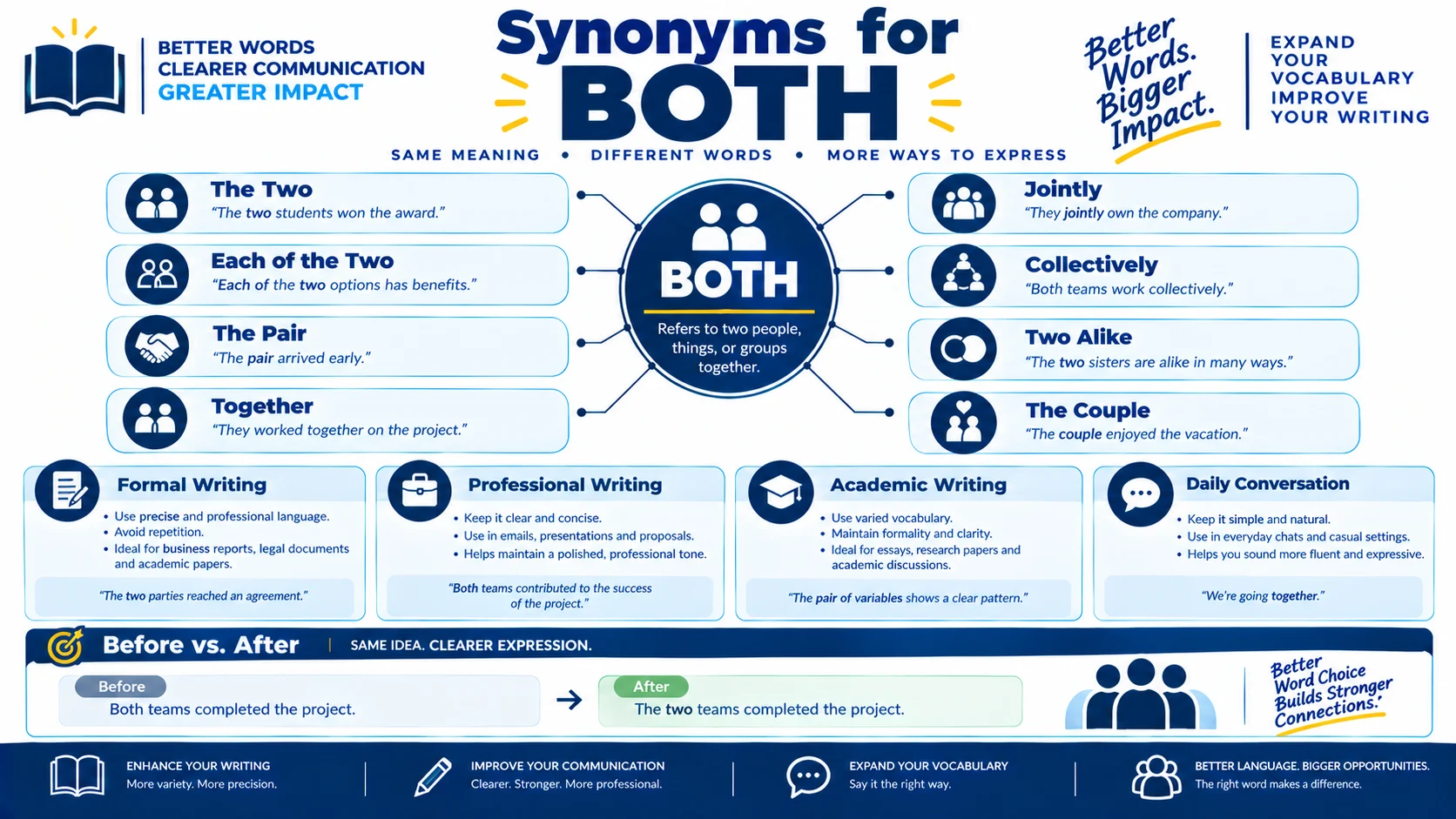
What is another word for both? Common alternatives include the two, each of the two, the pair, two alike, together, and as well as each other, depending on the sentence. The best replacement depends on whether you’re referring to two people, two things, or two ideas being considered together.
What Does Both Mean?
Definition
The word both refers to two people, objects, ideas, or groups taken together. It emphasizes that each of the two items is included.
Examples:
- Both employees attended the meeting.
- Both solutions could solve the problem.
- She likes both coffee and tea.
Common Uses
In American English, both is frequently used to:
- Refer to two people or things together
- Show inclusion of two options
- Compare two related subjects
- Emphasize that neither item is excluded
Examples:
- Both teams played well.
- Both candidates answered the question.
- The software works on both Windows and Mac.
Best Synonyms for Both
| Synonym | Meaning | Best Used When | Example |
|---|---|---|---|
| The Two | Refers specifically to two items | Simple replacement | The two students completed the project. |
| Each of the Two | Emphasizes individual inclusion | Formal writing | Each of the two proposals was reviewed. |
| The Pair | Two items viewed as a unit | Objects or people together | The pair arrived early. |
| Together | Acting collectively | Group actions | The two departments worked together. |
| Two Alike | Similar treatment of both items | Comparisons | The policy affects the two alike. |
| Either One and the Other | Formal inclusion of both | Legal or academic contexts | The rule applies to either one and the other. |
| The Couple | Two people considered together | Informal contexts | The couple attended the event. |
| Jointly | Shared participation | Business writing | The project was managed jointly. |
Synonyms by Context
Formal Writing
Formal documents often require alternatives that sound precise and professional.
Useful options include:
- Each of the two
- The two
- Jointly
- Either one and the other
Example:
Instead of:
- Both reports were approved.
You can write:
- Each of the two reports was approved.
Professional Writing
Business communication benefits from clear wording.
Professional alternatives include:
- The two
- Jointly
- Together
- The pair
Example:
- The two departments collaborated on the initiative.
- The project was managed jointly by both teams.
Academic Writing
Academic writing often prefers precise language.
Suitable alternatives include:
- Each of the two
- The two groups
- Both parties
- The pair
Example:
- Each of the two experimental groups showed improvement.
Daily Conversation
In everyday speech, simpler alternatives sound more natural.
Examples:
- The two
- The pair
- Together
- You two
Example:
- The two of them are coming tonight.
- The pair looked happy together.
Professional Alternatives for Both
When writing emails, reports, proposals, or workplace documents, these alternatives can improve clarity.
The Two
Meaning:
Refers directly to two people or things.
Best Used For:
Business reports and professional communication.
Example:
- The two vendors submitted competitive bids.
Jointly
Meaning:
Together or in cooperation.
Best Used For:
Corporate and legal writing.
Example:
- The agreement was signed jointly by both organizations.
Each of the Two
Meaning:
Highlights individual consideration of both items.
Best Used For:
Formal reports and evaluations.
Example:
- Each of the two candidates met the requirements.
Simple Alternatives for Both
If you want straightforward language, consider these options.
The Two
Very common and easy to understand.
Example:
- The two friends traveled together.
The Pair
Useful when discussing a set of two.
Example:
- The pair won the competition.
Together
Works when emphasizing collective action.
Example:
- They completed the project together.
Stronger Alternatives for Both
Sometimes a stronger or more specific word improves readability.
Jointly
Meaning:
Working collectively.
Tone:
Professional
Example:
- The departments jointly developed the strategy.
Collectively
Meaning:
As a group.
Tone:
Formal
Example:
- The two organizations collectively funded the research.
Equally
Meaning:
To the same extent for both parties.
Tone:
Neutral
Example:
- The policy applies equally to the two groups.
Detailed Synonym Analysis
The Two
Meaning: Refers directly to two items or people.
Best Used For: General replacement.
Tone: Neutral
Difficulty: Easy
Usage Frequency: Very Common
Best For:
- Resume Writing
- Email Writing
- Essay Writing
- Business Writing
Business Example:
The two departments coordinated their efforts.
Academic Example:
The two variables were analyzed separately.
Daily Conversation Example:
The two of us will go together.
Each of the Two
Meaning: Emphasizes individual inclusion.
Best Used For: Formal and academic contexts.
Tone: Formal
Difficulty: Medium
Usage Frequency: Common
Best For:
- Essays
- Research Papers
- Business Reports
Business Example:
Each of the two proposals was evaluated.
Academic Example:
Each of the two samples produced similar results.
Daily Conversation Example:
Each of the two options sounds good.
The Pair
Meaning: Two people or objects viewed together.
Best Used For: Describing connected items.
Tone: Neutral
Difficulty: Easy
Usage Frequency: Common
Best For:
- General Writing
- Marketing Copy
- Conversations
Business Example:
The pair of products generated strong sales.
Academic Example:
The pair of observations supported the hypothesis.
Daily Conversation Example:
The pair looked great together.
Jointly
Meaning: Together in action or responsibility.
Best Used For: Professional and legal writing.
Tone: Formal
Difficulty: Medium
Usage Frequency: Common
Best For:
- Business Writing
- Contracts
- Reports
Business Example:
The initiative was jointly funded.
Academic Example:
The study was jointly conducted by researchers.
Daily Conversation Example:
They jointly organized the event.
Difference Between Similar Synonyms
Many alternatives to both are not interchangeable in every situation.
Both vs The Two
- Both emphasizes inclusion.
- The two identifies the specific pair.
Examples:
- Both employees attended. (Focus on inclusion)
- The two employees attended. (Focus on identification)
Both vs Together
- Both refers to inclusion.
- Together refers to shared action.
Examples:
- Both students passed the exam.
- The students studied together.
Both vs Jointly
- Both is general.
- Jointly highlights cooperation.
Examples:
- Both companies participated.
- The companies jointly developed the product.
Opposite Words
Depending on context, antonyms of both may include:
| Opposite | Meaning |
|---|---|
| Neither | Not one nor the other |
| Either | One or the other |
| Single | Only one |
| Individual | Separate person or thing |
| One | A single item |
Examples:
- Neither proposal was accepted.
- Either option will work.
FAQs
What is another word for both?
Common alternatives include the two, each of the two, the pair, together, and jointly.
What is a formal synonym for both?
Formal alternatives include each of the two, jointly, and either one and the other.
What is a professional alternative for both?
Business writers often use the two, jointly, or collectively.
Can I replace both with together?
Sometimes. However, together focuses on shared action, while both focuses on inclusion.
Is the pair a synonym for both?
Yes, when referring to two people or objects considered as one unit.
What is the academic alternative to both?
Academic writing commonly uses each of the two or the two groups.
Is jointly the same as both?
Not exactly. Jointly emphasizes cooperation, while both simply indicates inclusion.
What word can replace both in an essay?
Good essay alternatives include the two, each of the two, and collectively, depending on context.
Is both formal or informal?
Both is neutral and acceptable in formal, academic, and informal writing.
What is the opposite of both?
The most common opposite is neither, which means not one nor the other.
Conclusion
The best synonym for both depends on context. In most situations, the two works as the closest replacement. For formal and academic writing, each of the two provides greater precision. Professional writers may prefer jointly or collectively when discussing cooperation. Understanding these differences helps you choose the most natural and effective word for your audience and purpose.