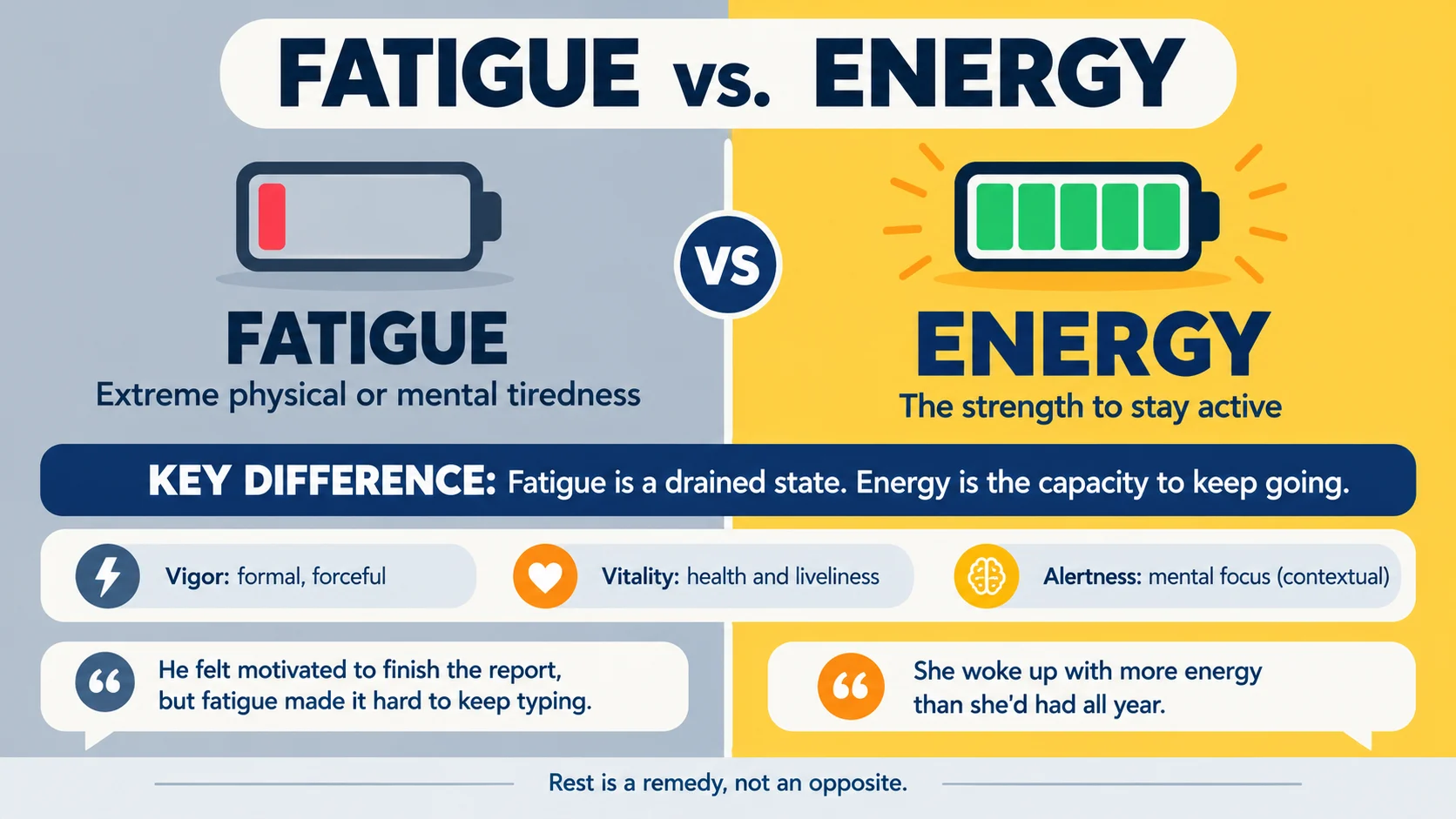
The opposite of fatigue is energy. Fatigue means extreme physical or mental tiredness, so energy, meaning the strength to stay active, is its strongest contextual opposite. Vigor, vitality, and alertness also work depending on context. English has no single perfect antonym for fatigue, so the best choice depends on the sense.
Part of speech: Noun (fatigue also works as a verb)
Primary opposite: Energy
When fatigue refers to a state of physical or mental exhaustion, energy is the strongest opposite. Fatigue describes a drained condition. Energy describes the capacity to keep going.
Dictionaries do not agree on one fixed antonym for fatigue, so this is a practical match rather than a perfect mirror. Energy is the most natural and widely used choice. It fits everyday speech, health writing, and workplace communication.
Direct and Strong Antonyms
These words oppose fatigue on a gradable scale, from drained to fully charged. The first three are nouns. The last two are verbs that oppose fatigue used as a verb.
| Antonym | Tone or Nuance | Example Sentence |
|---|---|---|
| Energy | Neutral and most common | After a week at the lake, she woke up with more energy than she’d had all year. |
| Vigor | Formal, suggests strong physical force | The coach praised the team for playing with vigor in the fourth quarter. |
| Vitality | Warm, tied to overall health | Her doctor said the new routine had improved her vitality. |
| Energize (verb) | Casual to neutral | A short walk can energize a sluggish afternoon. |
| Invigorate (verb) | Formal, slightly literary | The cold morning air invigorated the hikers. |
For comparison, here is fatigue as a verb: “Long meetings fatigue everyone by three o’clock.” Energize and invigorate reverse that effect.
Contextual and Subtle Opposites
Fatigue has several senses, so the best opposite changes with the situation. The words below are contextual opposites, not direct antonyms.
| Context | Best Opposite | Why It Fits |
|---|---|---|
| Mental tiredness at work | Alertness | It names the sharp focus that mental fatigue removes. |
| Feeling renewed after a break | Freshness | It captures a restored, recovered state. |
| Engineering (metal fatigue) | Strength or durability | The material resists weakening from repeated stress. |
| Compassion fatigue | Resilience | It describes staying emotionally steady while caring for others. |
| Describing a person (fatigued) | Rested | It marks recovery after sleep or a break. |
Here is how those choices sound in real sentences:
- “By noon, the team’s alertness had faded, and the budget review dragged on.” Here alertness is the clearest contrast.
- “The bridge inspector tested the steel for fatigue and confirmed its durability.” Here the opposite is physical, not personal.
- “Nurses who build resilience cope better with compassion fatigue.” Here resilience works only because the phrase is specific.
Outside these contexts, none of these words is a general antonym for fatigue. Alertness, for example, does not describe a tired body, and durability does not describe a tired person.
Words That Seem Opposite But Are Not
Common Grammatical or Semantic Confusions
Rest. Many people assume rest is the opposite of fatigue. It is actually the remedy. Rest is something you do, while fatigue is something you feel. A person can rest all afternoon and still feel fatigue afterward. The state that opposes fatigue is energy, not the action that may restore it.
Motivation. Motivation describes the desire to act, while fatigue describes the physical or mental ability to act. They can exist together. “He felt motivated to finish the report, but fatigue made it hard to keep typing.” Because someone can be both motivated and exhausted, motivation is a related contrast, not an antonym.
Subtle Tone Differences
Choosing among energy, vigor, and vitality changes how a sentence feels.
Energy is the everyday option. It works in a text message or a medical pamphlet. “I have no energy today” is natural in almost any setting.
Vigor adds force and intensity. It often appears in professional or formal writing, especially about effort or enthusiasm. “She defended her proposal with vigor” sounds stronger than “with energy.”
Vitality points to overall health and liveliness, not just short bursts of effort. A doctor might say a patient has regained vitality after surgery, while a coach would rarely say it about a single play.
Alertness is narrower still. It is about mental sharpness, and it can exist without real energy. “Coffee made him alert, but the fatigue was still there.” That sentence shows why alertness is a contextual opposite and energy is the broader one.
Rested works as an adjective contrast to fatigued. “She felt rested after the long weekend” fits better than “she felt energetic” when sleep is the point.
Frequently Asked Questions
What word means the opposite of fatigue?
Energy is the most widely used opposite of fatigue. It describes the strength and drive to stay active, which is exactly what fatigue takes away. Vigor and vitality also work, though they sound more formal and more health-focused.
What is the opposite of fatigue in medicine or engineering?
In medical writing, energy or vitality fits best. In engineering, metal fatigue means weakening from repeated stress, so strength or durability works as a contextual opposite. No single standardized antonym exists for either field.
Can I use “rested” as the opposite of “fatigued”?
Yes, as a contextual adjective pair. Fatigued describes a worn-out person, while rested describes someone who has recovered. Use rested when sleep or a break is the point, and use energy when you need a noun.
Practical Word Choice
Identify the intended meaning first. Ask whether fatigue means personal tiredness, mental burnout, or material weakness. Each sense calls for a different opposite, and the wrong pairing can confuse readers.
Match the context, tone, strength, and formality. Use energy for casual and general writing. Choose vigor or vitality for formal or health-related prose. Reach for alertness when mental focus is the issue, and rested when recovery is the point.
Final Thoughts
The clearest opposite of fatigue is energy, but English offers no single perfect antonym. Fatigue covers physical tiredness, mental strain, and even weakened materials, so the best opposite shifts with each sense. Words like rest and motivation come close in conversation, yet they describe remedies or desires, not the opposing state.
Context is what makes the choice precise. Vigor sounds forceful, vitality sounds healthy, and alertness sounds sharp. Each carries a slightly different message, even when all of them contrast with exhaustion.
A useful habit is to say aloud what you want to emphasize: strength, health, focus, or recovery. Then pick the word that carries that exact idea. What sentence have you written where the right opposite of fatigue made all the difference?