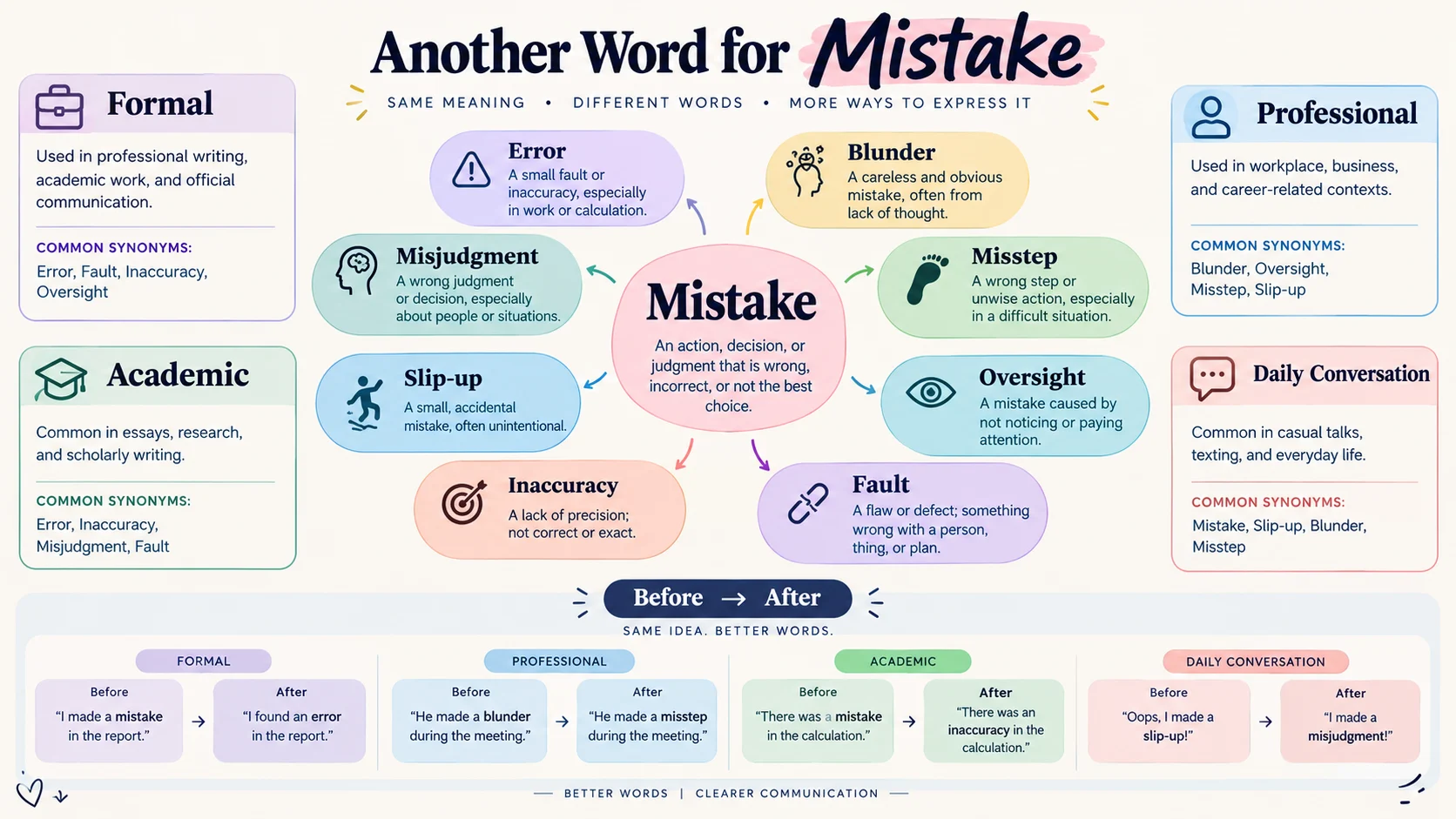
Another word for mistake is error, blunder, misstep, oversight, fault, or inaccuracy. The best choice depends on context. Error is the most general and professional option, while blunder suggests a serious mistake, oversight means something was accidentally missed, and misstep often describes a poor decision or action.
What Does Mistake Mean?
Definition
A mistake is an action, decision, statement, or judgment that is incorrect or produces an unwanted result. It can happen because of carelessness, misunderstanding, poor judgment, lack of information, or simple human error.
For example:
- I made a mistake on the application.
- The accountant found an error in the report.
- Missing the deadline was an oversight.
- His decision to ignore the warning was a serious misstep.
The word mistake is broad, so the best synonym depends on what kind of mistake you mean.
Common Uses
Mistake commonly appears when talking about:
- Incorrect information
- Poor decisions
- Careless actions
- Missed details
- Errors in writing or calculations
- Professional problems
- Personal misunderstandings
- Failures caused by poor judgment
Best Synonyms for Mistake
| Synonym | Meaning | Best Used When | Example |
|---|---|---|---|
| Error | Something incorrect | General or professional situations | There was an error in the report. |
| Blunder | A serious or careless mistake | Major errors or poor judgment | The manager made a costly blunder. |
| Misstep | A poor action or decision | Decisions, behavior, or strategy | The policy was a political misstep. |
| Oversight | Something accidentally missed | Forgotten details or omissions | The missing signature was an oversight. |
| Fault | A mistake or responsibility for a problem | Responsibility or blame | The delay was partly my fault. |
| Inaccuracy | Incorrect information or detail | Facts, data, writing, or research | The article contained several inaccuracies. |
| Slip-up | A small accidental mistake | Casual conversation | I made a small slip-up at work. |
| Misjudgment | An incorrect judgment | Decisions and assessments | Hiring him was a serious misjudgment. |
Synonyms by Context
Formal Writing
For formal writing, error, inaccuracy, misjudgment, and oversight are usually better choices than casual terms such as slip-up.
Examples:
- Mistake → error
- Mistake in data → inaccuracy
- Mistake in judgment → misjudgment
- Missed detail → oversight
Example:
The researcher identified an error in the original calculation.
This sounds more precise and professional than:
The researcher found a mistake in the calculation.
Professional Writing
In business and workplace communication, choose a synonym based on the type and seriousness of the problem.
Error works well for technical or factual problems:
The report contains an error in the financial figures.
Oversight is appropriate when something was unintentionally forgotten:
The missing attachment was an oversight.
Misstep works when discussing a poor business decision:
The company acknowledged the decision as a strategic misstep.
Blunder is stronger and can sound critical:
The pricing decision was a major business blunder.
For workplace emails, error and oversight are often safer and more neutral than blunder.
Academic Writing
Academic writing often requires precise alternatives to mistake.
Use error for incorrect calculations, methods, or results:
The analysis contained an error in the statistical model.
Use inaccuracy for incorrect facts or information:
The study included several factual inaccuracies.
Use misinterpretation when evidence or information has been understood incorrectly:
The conclusion resulted from a misinterpretation of the findings.
Use miscalculation when the problem specifically involves calculations:
The original estimate was based on a mathematical miscalculation.
Daily Conversation
Casual conversations allow more informal alternatives.
Common choices include:
- Slip-up
- Blunder
- Mess-up
- Goof
- Error
- Mix-up
For example:
I made a little slip-up when I entered the address.
Or:
Sorry, I messed up the schedule.
These sound more natural in everyday speech than formal terms such as inaccuracy or misjudgment.
Professional Alternatives for Mistake
If you need a professional replacement for mistake, these are among the strongest choices:
Error
Meaning: Something that is incorrect.
Best Used For: Reports, data, calculations, procedures, and workplace communication.
Tone: Neutral and professional
Difficulty: Easy
Usage Frequency: Very Common
Best for: Resume, email writing, essay writing, business writing
Business Example:
We identified an error in the quarterly report.
Academic Example:
The researcher corrected the error before publication.
Daily Conversation Example:
I noticed an error in the document.
Oversight
Meaning: Something unintentionally forgotten or missed.
Best Used For: Missed details, omissions, and administrative problems.
Tone: Professional and neutral
Difficulty: Medium
Usage Frequency: Common
Business Example:
The missing invoice was an oversight.
Academic Example:
The omission appears to have been an oversight.
Daily Conversation Example:
Forgetting to call her was an oversight.
Misstep
Meaning: An incorrect or unwise action, decision, or judgment.
Best Used For: Strategy, behavior, politics, management, and personal decisions.
Tone: Professional, critical
Difficulty: Medium
Usage Frequency: Common
Business Example:
The product launch was considered a strategic misstep.
Academic Example:
This methodological choice represents a significant misstep.
Daily Conversation Example:
Quitting without another job was probably a misstep.
Simple Alternatives for Mistake
If you want an easy word that most readers immediately understand, use:
- Error
- Fault
- Slip-up
- Problem
- Wrong choice
- Misstep
Error is usually the best all-purpose replacement.
For example:
I found a mistake in the document.
can become:
I found an error in the document.
For a more conversational tone:
I made a slip-up in the document.
Stronger Alternatives for Mistake
Some synonyms communicate that the mistake was serious, careless, or damaging.
Blunder
A blunder is a serious or embarrassing mistake, often caused by poor judgment or carelessness.
The executive’s decision was a costly blunder.
Misjudgment
A misjudgment is an incorrect assessment or decision.
Hiring the inexperienced candidate was a misjudgment.
Fault
Fault emphasizes responsibility or blame.
The failure was not entirely her fault.
Miscalculation
A miscalculation suggests an incorrect estimate, calculation, or assessment.
The company suffered losses because of a serious miscalculation.
These words are stronger than the general word mistake, so use them when the context supports that meaning.
Difference Between Similar Synonyms
The most important distinction is that these words are not always interchangeable.
Mistake vs. error:
Mistake is broader and more conversational. Error often sounds more precise or professional.
Mistake vs. blunder:
A blunder is usually more serious, obvious, or embarrassing than an ordinary mistake.
Mistake vs. oversight:
An oversight happens when someone accidentally fails to notice, remember, or include something.
Mistake vs. misstep:
A misstep often refers to a poor decision or action rather than a simple factual error.
Mistake vs. inaccuracy:
An inaccuracy specifically involves information, facts, measurements, or statements that are not correct.
Mistake vs. fault:
Fault can indicate responsibility for a problem, while mistake focuses on the incorrect action or decision itself.
Choosing the right synonym makes your writing more precise.
Opposite Words
Common opposites of mistake include:
- Correctness
- Accuracy
- Success
- Achievement
- Precision
- Wisdom
- Good judgment
- Correct decision
For example:
The analyst corrected the mistake.
The opposite idea would be:
The analyst demonstrated accuracy.
FAQs
What is another word for mistake?
Common alternatives include error, blunder, misstep, oversight, fault, inaccuracy, slip-up, and misjudgment. The best synonym depends on whether you mean an incorrect fact, poor decision, forgotten detail, or serious error.
What is a formal synonym for mistake?
Error is the most common formal synonym for mistake. Inaccuracy, oversight, misjudgment, and miscalculation can also work when they describe the specific type of mistake.
What is a professional word for mistake?
Error is usually the safest professional alternative. Oversight works for something accidentally missed, while misstep is useful for a poor decision or strategy.
What is a stronger word for mistake?
Blunder is a strong alternative when the mistake is serious, careless, costly, or embarrassing. Misjudgment and miscalculation can also communicate serious errors in decision-making.
What is a simple word for mistake?
Error is the simplest widely useful alternative. In casual conversation, slip-up and mess-up are also common.
Is error the same as mistake?
Not always. Error usually refers to something incorrect, while mistake has a broader everyday meaning. In many situations, however, the two words can be used interchangeably.
What is another word for a small mistake?
Slip-up, minor error, oversight, and misstep can describe a small mistake. Slip-up is particularly natural in casual American English.
What is another word for a serious mistake?
Blunder, major error, misjudgment, miscalculation, or serious misstep can describe a significant mistake.
What is another word for mistake in academic writing?
Error, inaccuracy, misinterpretation, and miscalculation are useful academic alternatives. The best option depends on exactly what went wrong.
What word can replace mistake on a resume?
Error, oversight, or a more specific term is usually better than mistake. Resume writing often benefits from explaining the correction or lesson rather than simply labeling something a mistake.
Conclusion
The best another word for mistake depends on your meaning and audience. Error is the strongest general and professional choice. Use oversight when something was accidentally missed, misstep for a poor decision, inaccuracy for incorrect information, and blunder for a serious or careless mistake.
Choosing a precise synonym can make your writing clearer, more professional, and more natural. Instead of replacing mistake automatically, consider what actually happened and select the word that communicates that meaning most accurately.