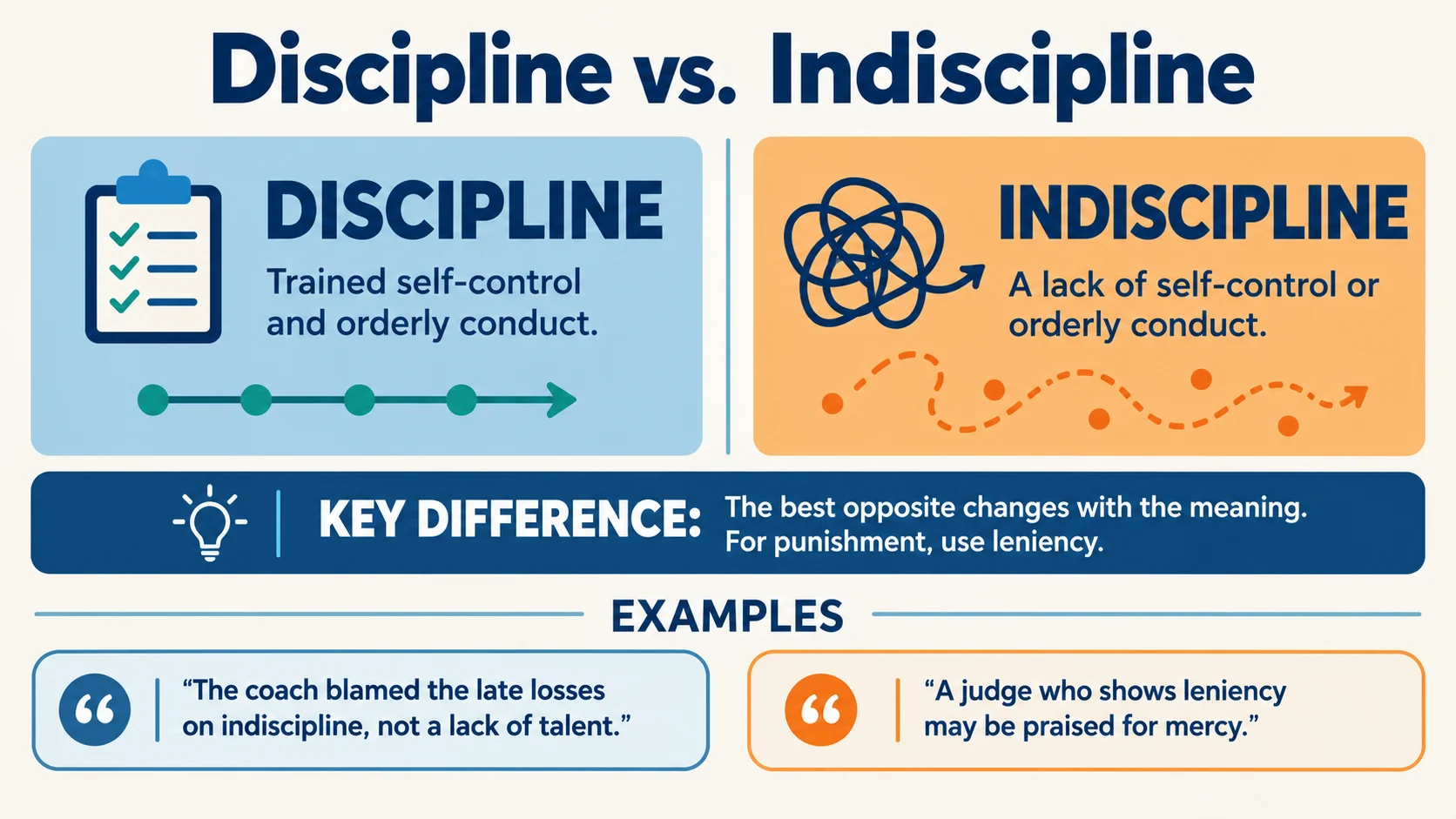
The opposite of discipline is indiscipline, meaning a lack of self-control or orderly conduct. Discipline refers to trained self-control or enforced order, and it can also mean punishment or correction. In that second sense, leniency or permissiveness works better as the opposite. No single word fits every context.
Part of speech: Noun (it also works as a verb)
Primary opposite: Indiscipline
Discipline most often means the ability to control your impulses and follow rules or routines. When discipline means self-control or orderly behavior, indiscipline is the strongest direct opposite. It names the absence of that control, whether in a person, a team, or a classroom.
Discipline has no single perfect antonym, because it carries several meanings. It can describe a personal trait, a system of order, a form of punishment, or a field of study. Each meaning calls for a different opposite, and the academic sense (as in “the discipline of history”) has no real opposite at all.
Direct and Strong Antonyms
| Antonym | Tone or Nuance | Example Sentence |
|---|---|---|
| Indiscipline | Formal and critical; common in sports, military, and school settings | The coach blamed the late losses on indiscipline, not a lack of talent. |
| Lack of discipline | Plain and neutral; the most natural everyday phrasing | Her lack of discipline showed in a dozen half-finished projects. |
| Unruliness | Describes disorderly group behavior, especially among children or crowds | The substitute teacher struggled with the class’s unruliness. |
Indiscipline is the closest single word. “Lack of discipline” is a phrase rather than a dictionary antonym, but it is what most speakers actually say. Unruliness fits only when the focus is on behavior that resists control.
Contextual and Subtle Opposites
The best opposite depends on which meaning of discipline you intend. These alternatives are contextual, not direct antonyms.
| Context | Best Opposite | Why It Fits |
|---|---|---|
| Self-control and habits | Self-indulgence | It describes giving in to desires instead of restraining them. |
| Orderly group behavior | Disorder | It names the breakdown of structure. |
| Punishment or correction (noun) | Leniency | It describes going easy where discipline would apply a penalty. |
| Strict parenting or management style | Permissiveness | It describes allowing behavior that others would restrict. |
| To discipline someone (verb, punish) | Pardon or excuse | Both mean letting an offense pass without penalty. |
| To discipline a child (verb, train) | Spoil | It describes giving in to a child’s wishes with no limits. |
Consider how the meanings differ. A person with great discipline might train at 5 a.m. every day. A school with strict discipline might enforce a dress code. A manager might impose discipline after repeated violations. Each sentence points toward a different opposite: self-indulgence, disorder, or leniency.
Words That Seem Opposite But Are Not
Freedom. Many people assume discipline and freedom are opposites. They are better understood as related contrasts. A disciplined musician often gains more creative freedom through practice. Someone can be both free and disciplined, so the two words do not exclude each other.
Laziness. Laziness is a common companion of low discipline, but it is not the same thing. A person can work very hard and still lack discipline, such as an energetic employee who cannot stick to a plan. A person can also be lazy by choice while having plenty of self-control. Laziness describes unwillingness to work, while indiscipline describes weak self-regulation.
A third word worth noting is chaos. It is a result of widespread indiscipline, not an opposite quality. You can say “Poor discipline led to chaos in the hallways,” but chaos does not mean the absence of discipline.
Subtle Tone Differences
Choosing among these words changes how your sentence sounds.
Indiscipline sounds formal and official. It fits news reports, performance reviews, and sports commentary: “The team was fined for repeated acts of indiscipline.”
Lack of discipline sounds direct and conversational. It suits casual speech: “I know my problem is a lack of discipline with snacks.”
Permissiveness usually carries mild criticism. Calling a parent permissive suggests the limits are too loose.
Leniency can be positive or neutral. A judge who shows leniency may be praised for mercy.
Laxity is critical and often applies to rules or oversight: “Laxity in safety checks led to the recall.” It is stronger and more formal than permissiveness.
The strength also varies. Self-indulgence suggests a pleasure-seeking choice, while indiscipline suggests a broader failure of control.
Frequently Asked Questions
What is the direct antonym of discipline?
Indiscipline is the closest direct antonym. It means a lack of self-control or orderly behavior. Dictionaries do not agree on one perfect opposite, so “lack of discipline” is often the most natural everyday substitute.
What is the opposite of discipline when it means punishment?
In the sense of punishment or correction, leniency is the clearest opposite. It means mildness or mercy where a penalty would normally apply. Permissiveness also works when the focus is on an overall relaxed approach to rules.
Can I use “freedom” as the opposite of discipline in a sentence?
It is risky, because freedom is a related contrast and not a true antonym. Use it only when you contrast strict control with open choice. For personal habits, indiscipline or self-indulgence is more accurate.
Practical Word Choice
- Identify the intended meaning. Decide whether you mean personal self-control, group order, punishment, or a field of study. Pick your opposite after that, not before.
- Match the context, tone, strength, and formality. Use indiscipline for official writing, lack of discipline for conversation, and leniency or permissiveness when the topic is how rules are enforced.
Final Thoughts
The main distinction is simple. Indiscipline is the strongest opposite when discipline means self-control or orderly conduct. When discipline means punishment, leniency takes over, and when it means a style of strict parenting or management, permissiveness often fits better.
Context matters because discipline is a word with several jobs. One antonym cannot cover all of them without bending the meaning, which is why the same word can sound precise in one sentence and wrong in another.
A good final test is to swap your chosen antonym into the sentence and ask whether it opposes the exact idea you wrote. If it does, you have the right word. What sentence have you used where the opposite of discipline made the difference?