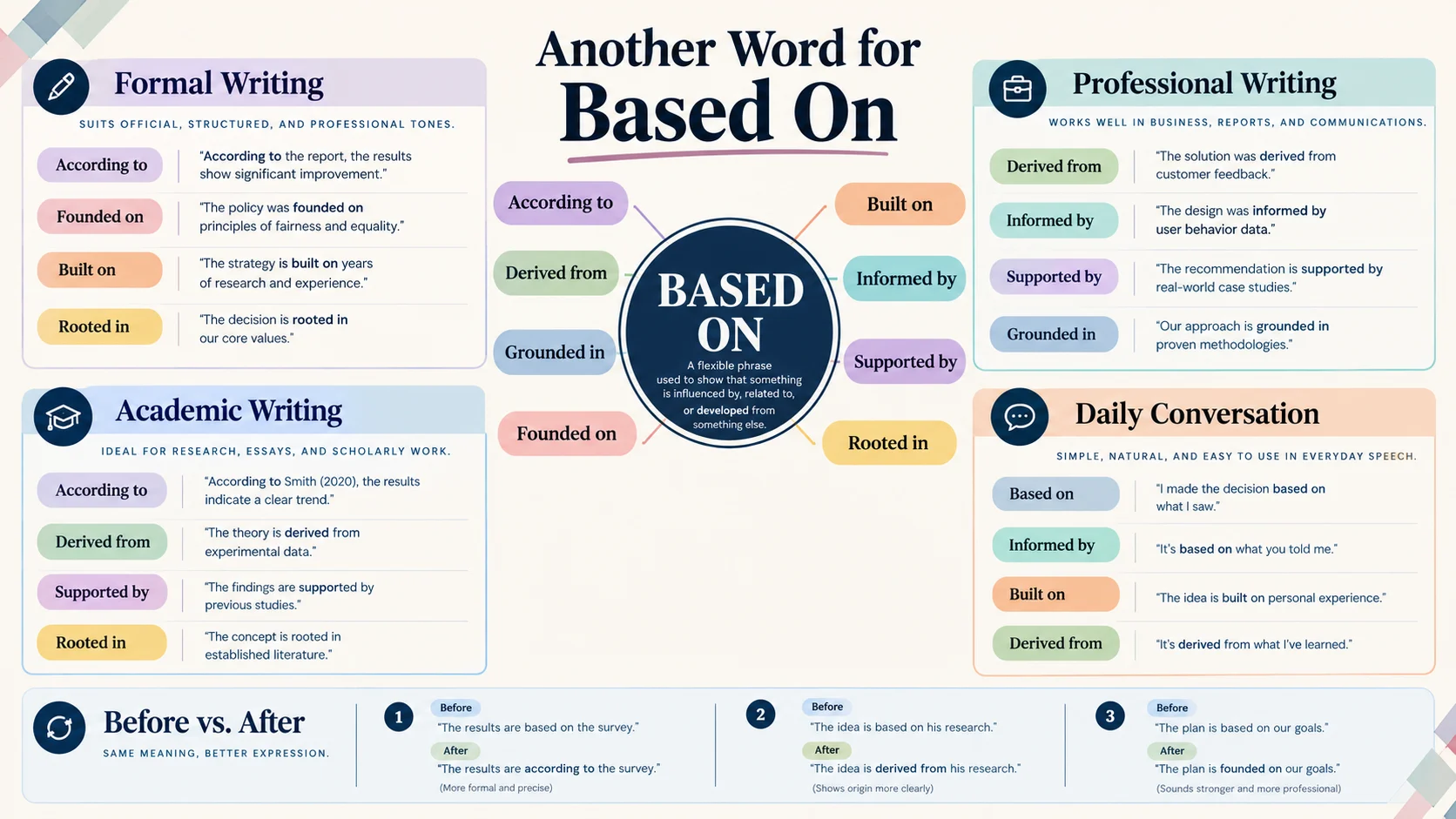
Another word for based on is according to, derived from, grounded in, founded on, built on, or informed by. The best replacement depends on context. For formal and academic writing, “grounded in” or “derived from” often works well, while “according to” is useful when referring to information or a source.
What Does “Based On” Mean?
Definition
Based on means that something is developed, decided, created, or supported using a particular fact, idea, source, experience, or piece of information as its foundation.
For example:
The report was based on recent survey results.
Here, the survey results provide the information or evidence used to create the report.
The phrase can describe everything from decisions and opinions to research, predictions, designs, and conclusions. Because its meaning changes slightly with context, there is no single perfect synonym for every sentence.
Common Uses
“Based on” commonly appears when discussing:
- Evidence or research
- Facts and information
- Sources and references
- Personal experience
- Rules or standards
- Decisions
- Opinions
- Predictions
- Designs or ideas
For example:
- The recommendation was based on customer feedback.
- The movie was based on a true story.
- Her decision was based on experience.
- The conclusion was based on scientific evidence.
Best Synonyms for “Based On”
| Synonym | Meaning | Best Used When | Example |
|---|---|---|---|
| According to | As stated or reported by a source | Referring to information | According to the report, sales increased. |
| Derived from | Developed or obtained from something | Research, data, ideas | The findings were derived from survey data. |
| Grounded in | Strongly supported by something | Evidence or principles | The argument is grounded in evidence. |
| Founded on | Established on a particular basis | Principles, beliefs, ideas | The policy is founded on fairness. |
| Built on | Developed using something as a foundation | Ideas, progress, systems | The program was built on earlier research. |
| Informed by | Influenced by information or experience | Decisions and strategies | The decision was informed by expert advice. |
| Supported by | Backed by evidence or information | Claims and conclusions | The theory is supported by recent studies. |
| Rooted in | Deeply connected to an origin or principle | Beliefs, traditions, ideas | The practice is rooted in tradition. |
| Determined by | Decided or influenced by something | Rules, conditions, factors | The price is determined by demand. |
| Drawn from | Taken or obtained from a source | Information, examples, ideas | The examples were drawn from real cases. |
| Dependent on | Relying on a particular factor | Conditions or outcomes | Success is dependent on preparation. |
| Established on | Created or set using something as a foundation | Formal systems or principles | The standards were established on scientific findings. |
Synonyms by Context
Formal Writing
For formal writing, choose alternatives that clearly explain the relationship between an idea and its foundation.
Best choices:
- Grounded in
- Founded on
- Derived from
- Supported by
- Informed by
- Established on
Example:
Original:
The policy was based on extensive research.
More formal:
The policy was grounded in extensive research.
Grounded in works particularly well when the research provides strong support for the policy.
Professional Writing
In business communication, clarity is usually more important than using complicated vocabulary.
Good alternatives include:
- Informed by
- Based upon
- Supported by
- Guided by
- Derived from
- Determined by
Example:
Our strategy was informed by customer feedback.
This sounds natural in business reports, presentations, emails, and strategy documents.
Academic Writing
Academic writing often requires precision about where information, findings, or conclusions come from.
Useful alternatives include:
- Derived from
- Grounded in
- Supported by
- Drawn from
- Informed by
- Founded on
Example:
The conclusion was derived from data collected during the experiment.
“Derived from” is especially useful when something is directly obtained from a source, dataset, process, or analysis.
Daily Conversation
In casual English, simple alternatives are usually better.
Try:
- From
- According to
- Using
- Built from
- Guided by
- Based upon
Example:
I made my decision based on what she told me.
Casually, you could say:
I made my decision from what she told me.
However, “based on” remains more natural in many everyday sentences, so replacing it is not always necessary.
Professional Alternatives for “Based On”
1. Informed By
Meaning: Influenced by information, evidence, or experience.
Best Used For: Business decisions, strategies, recommendations, policies.
Tone: Professional
Difficulty: Easy
Usage Frequency: Common
Best For: Resume, Email Writing, Business Writing, Marketing Copy
Examples:
Business:
Our marketing strategy was informed by customer behavior.
Academic:
The recommendations were informed by previous research.
Daily Conversation:
My choice was informed by what I learned yesterday.
2. Grounded In
Meaning: Strongly supported by a particular foundation, evidence, or principle.
Best Used For: Research, arguments, theories, policies, and professional analysis.
Tone: Formal
Difficulty: Medium
Usage Frequency: Common
Best For: Essay Writing, Academic Writing, Business Writing
Examples:
Business:
The proposal is grounded in current market data.
Academic:
The argument is grounded in established psychological theory.
Daily Conversation:
Her opinion is grounded in personal experience.
3. Derived From
Meaning: Obtained, developed, or produced from something else.
Best Used For: Data, research findings, information, formulas, concepts, and products.
Tone: Formal
Difficulty: Medium
Usage Frequency: Common
Best For: Essay Writing, Academic Writing, Business Writing
Examples:
Business:
The forecast was derived from historical sales data.
Academic:
The results were derived from three independent studies.
Daily Conversation:
The idea was derived from something I saw online.
4. Supported By
Meaning: Backed by evidence, facts, research, or another source.
Best Used For: Claims, arguments, conclusions, and recommendations.
Tone: Professional
Difficulty: Easy
Usage Frequency: Very Common
Best For: Essay Writing, Email Writing, Business Writing
Example:
The conclusion is supported by substantial evidence.
This is often stronger than simply saying something is “based on” evidence because it emphasizes support.
Simple Alternatives for “Based On”
If you want plain, easy-to-understand English, consider:
- From
- Using
- According to
- Guided by
- Built on
- Taken from
- Drawn from
For example:
Original:
The decision was based on customer feedback.
Simple:
The decision used customer feedback.
However, the meaning can change slightly. “Used” emphasizes the information employed, while “based on” emphasizes the foundation of the decision.
Stronger Alternatives for “Based On”
When you want to make the relationship more precise or authoritative, use:
- Grounded in
- Supported by
- Derived from
- Founded on
- Rooted in
- Determined by
Compare:
The recommendation was based on research.
versus:
The recommendation was grounded in extensive research.
The second version emphasizes that research provides a strong foundation.
Difference Between Similar Synonyms
“Based On” vs. “According To”
These phrases are not always interchangeable.
Based on means something was created, decided, or concluded using information.
The decision was based on the available evidence.
According to means information is attributed to a particular source.
According to the report, the company increased its revenue.
Use based on for foundations and according to for sources.
“Based On” vs. “Derived From”
Derived from suggests that something was obtained or developed from another thing.
The statistics were derived from government data.
“Based on” is broader:
The report was based on government data.
“Based On” vs. “Grounded In”
Grounded in usually emphasizes strong support or a firm foundation.
The argument is grounded in scientific evidence.
It often sounds more formal and authoritative than “based on.”
“Based On” vs. “Built On”
Built on is more metaphorical and often describes development or progress.
The new system was built on existing technology.
It suggests that something new developed from an earlier foundation.
“Based On” vs. “Informed By”
Informed by emphasizes influence rather than direct foundation.
The decision was informed by expert advice.
This does not necessarily mean the decision depended entirely on that advice.
Opposite Words
There is no perfect single antonym for based on, because its opposite depends on context. Possible contrasting expressions include:
- Unrelated to
- Independent of
- Unsupported by
- Unconnected to
- Unfounded
- Without evidence
- Arbitrary
- Speculative
For example:
The claim was based on evidence.
Opposite:
The claim was unsupported by evidence.
Or:
The decision was based on careful analysis.
Opposite:
The decision was arbitrary.
FAQs
What is another word for “based on”?
Common alternatives include according to, derived from, grounded in, founded on, built on, informed by, supported by, and rooted in. The best choice depends on whether you are referring to a source, evidence, foundation, influence, or origin.
What is a formal synonym for “based on”?
Grounded in, derived from, founded on, and supported by are strong formal alternatives. “Grounded in” is especially useful when describing an argument, policy, theory, or conclusion supported by evidence.
What is a professional alternative for “based on”?
Informed by is a natural professional alternative, particularly for decisions, strategies, recommendations, and business plans. Supported by and derived from also work well in professional reports.
What word can replace “based on” in an essay?
Depending on the sentence, use grounded in, derived from, supported by, founded on, or drawn from. For example, “The conclusion was based on the findings” can become “The conclusion was derived from the findings.”
Is “according to” the same as “based on”?
No. “According to” identifies the source of information, while “based on” describes what something was developed or decided from. They can sometimes appear in similar sentences, but they do not have exactly the same meaning.
What is another word for “based on evidence”?
Good alternatives include supported by evidence, grounded in evidence, backed by evidence, and substantiated by evidence.
What is another word for “based on research”?
Use grounded in research, supported by research, derived from research, or informed by research, depending on the intended meaning.
What is a simple way to say “based on”?
In simple English, you can sometimes use from, using, or according to. However, the correct replacement depends on the sentence.
What is another word for “based on experience”?
Good choices include informed by experience, rooted in experience, and derived from experience. “Informed by experience” is especially natural in professional writing.
What is a stronger word than “based on”?
Grounded in or supported by can sound stronger because they suggest a firm foundation or evidence. Substantiated by is even more precise when discussing claims supported by evidence.
Conclusion
The best alternative to based on depends on what you want to emphasize. Use according to when identifying a source, derived from when something comes from another source or dataset, grounded in when emphasizing strong support, and informed by when describing influence on a decision. For everyday writing, based on itself is often the clearest choice.