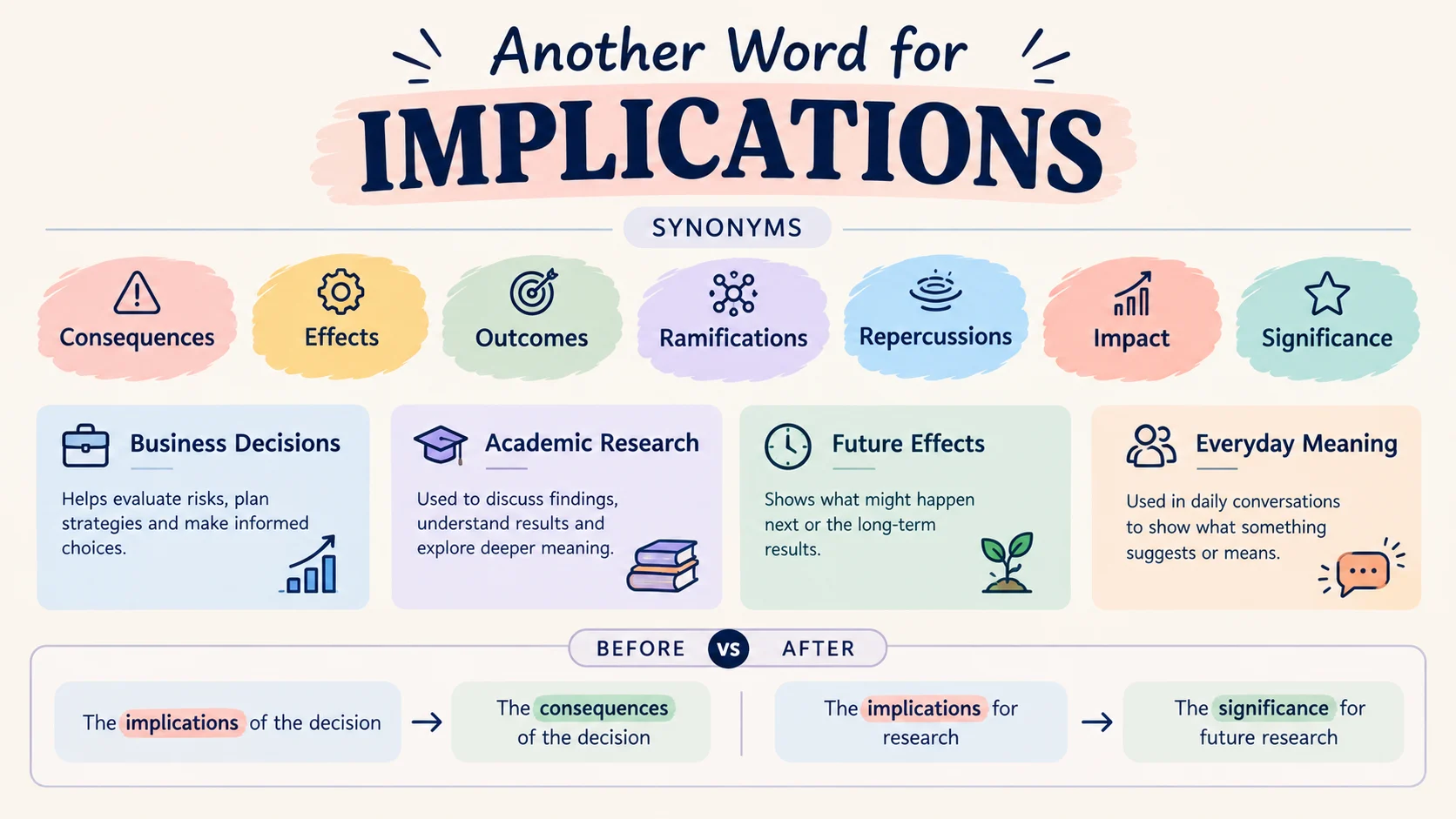
Another word for implications depends on the context. Common synonyms include consequences, effects, outcomes, repercussions, ramifications, significance, and results. Use consequences for what happens because of an action, ramifications for wider or more complex effects, and significance when discussing the meaning or importance of something. The best alternative depends on whether you mean effects, meaning, or possible outcomes.
What Does Implications Mean?
Definition
The word implications is the plural form of implication and has two main meanings in American English.
First, it refers to the possible effects, consequences, or results of an action, decision, event, or situation. These effects may be immediate or may develop over time.
Second, it refers to the meaning or suggestion contained in a statement, action, or piece of evidence, even when that meaning is not expressed directly.
For example:
- The policy changes could have serious implications for small businesses.
- Researchers discussed the implications of their findings.
- Her statement carried the implication that the project was incomplete.
- The decision has long-term financial implications.
The best synonym depends on the intended meaning. If you mean what happens afterward, consequences or effects may work. If you mean what something suggests, meaning or suggestion may be more accurate.
Common Uses
The word implications commonly appears in these contexts:
- Academic research: What research findings mean for a theory, practice, or future study.
- Business decisions: How a decision may affect profits, employees, customers, or operations.
- Legal matters: The potential effects or significance of an action or decision.
- Everyday conversation: What might happen because of a choice.
- Communication: What a statement suggests without saying directly.
Understanding these contexts helps you choose a word that conveys the right meaning without changing your sentence.
Best Synonyms for Implications
| Synonym | Meaning | Best Used When | Example |
|---|---|---|---|
| Consequences | Effects that follow an action | Decisions and their results | The decision had serious consequences. |
| Effects | Changes caused by something | Research, health, and business | The study examined the effects of stress. |
| Outcomes | Results of an event or process | Projects, research, and decisions | The policy produced positive outcomes. |
| Results | Things that happen because of an action | General and professional contexts | The results were unexpected. |
| Ramifications | Wider or complex consequences | Decisions with far-reaching effects | The merger had major financial ramifications. |
| Repercussions | Often negative effects that follow an action | Mistakes, controversies, and decisions | The error had serious repercussions. |
| Significance | Importance or meaning | Research findings and discoveries | The findings have practical significance. |
| Meaning | What something communicates or represents | Statements and interpretations | I understood the meaning of her comment. |
| Suggestions | Ideas or meanings indirectly communicated | Conversation and interpretation | His words carried several suggestions. |
| Inferences | Conclusions drawn from evidence | Research, reasoning, and analysis | The data support several inferences. |
| Interpretations | Explanations of meaning | Texts, statements, and research | Different interpretations emerged from the results. |
| Influences | Factors that affect something | Behavior, decisions, and systems | The report examined social influences. |
| Impact | A strong or noticeable effect | Business, policy, and social issues | The changes had a significant impact. |
| Relevance | Connection or importance to a subject | Academic and professional writing | The findings have relevance to public health. |
| Consequences for the future | Effects that may emerge later | Planning and forecasting | The decision has consequences for the future. |
Synonyms by Context
Formal Writing
In formal writing, consequences, ramifications, significance, implications for practice, and repercussions can be useful alternatives.
Consequences is suitable when discussing what follows from an action or decision.
Example: The report evaluates the consequences of the proposed legislation.
Ramifications emphasizes broader or more complex effects.
Example: The agreement may have significant ramifications for international trade.
Significance is appropriate when you mean the importance or meaning of a finding rather than the events it may cause.
Example: The researcher discussed the significance of the findings for future studies.
Choose the word according to whether you are discussing results, broader effects, or importance.
Professional Writing
Business communication often uses impact, effects, outcomes, consequences, and ramifications.
Impact works well when describing how a decision affects an organization or its stakeholders.
Business example: The company assessed the impact of the new pricing strategy on customer retention.
Outcomes is useful when discussing the results a team expects or achieves.
Business example: The management team reviewed the outcomes of the restructuring plan.
Ramifications is appropriate when a decision may create several connected effects.
Business example: Leaders considered the long-term ramifications of entering a new market.
For a professional report, specifying the actual effect often makes a sentence clearer than using implications alone.
Academic Writing
Academic writing frequently uses consequences, effects, significance, interpretations, and inferences.
Effects is useful when describing changes observed in an experiment or study.
Academic example: The study investigated the effects of sleep deprivation on memory.
Significance refers to the importance of a finding. In statistics, statistical significance has a specific technical meaning and should not be replaced casually.
Academic example: The authors discussed the significance of their findings for educational policy.
Inferences refers to conclusions drawn from available evidence.
Academic example: The researchers explained the inferences that could reasonably be drawn from the data.
In research papers, implications is often appropriate when discussing what findings may mean for theory, practice, or future research.
Daily Conversation
In everyday English, effects, results, consequences, meaning, and what it means are often more natural than implications.
Examples:
- Instead of “What are the implications of this decision?” say “What could happen because of this decision?”
- Instead of “The change has serious implications,” say “The change could have serious effects.”
- Instead of “I understood the implications of her comment,” say “I understood what her comment suggested.”
- Instead of “Consider the implications,” say “Think about what might happen.”
These alternatives make complicated ideas easier to understand.
Professional Alternatives for Implications
The most suitable professional synonym depends on the purpose of your document.
Consequences
Meaning: Effects or results that follow an action, event, or decision.
Best Used For: Business decisions, policies, legal matters, and risk assessments.
Tone: Neutral to formal
Difficulty: Easy
Usage Frequency: Very Common
Best For: Resume, Email Writing, Essay Writing, Business Writing
- Business example: The team evaluated the consequences of delaying the product launch.
- Academic example: The researchers examined the consequences of prolonged exposure to noise.
- Daily conversation example: We need to think about the consequences before deciding.
Ramifications
Meaning: The wider or more complex effects of a decision or event.
Best Used For: Strategic planning, policy discussions, legal issues, and long-term analysis.
Tone: Formal
Difficulty: Advanced
Usage Frequency: Common
Best For: Essay Writing, Academic Writing, Business Writing
- Business example: Executives reviewed the financial ramifications of the acquisition.
- Academic example: The article explores the ethical ramifications of artificial intelligence.
- Daily conversation example: We hadn’t considered all the ramifications of moving.
Impact
Meaning: A noticeable or important effect that something has on a person, organization, or situation.
Best Used For: Performance, business strategy, public policy, and social change.
Tone: Neutral to professional
Difficulty: Easy
Usage Frequency: Very Common
Best For: Resume, Marketing Copy, Email Writing, Business Writing
- Business example: The team measured the impact of the campaign on sales.
- Academic example: The study assessed the impact of remote learning on student participation.
- Daily conversation example: The decision had a big impact on our plans.
Significance
Meaning: The importance or meaning of something.
Best Used For: Research findings, evidence, discoveries, and interpretation.
Tone: Formal
Difficulty: Medium
Usage Frequency: Common
Best For: Essay Writing, Academic Writing, Business Writing
- Business example: The report explains the significance of the new market data.
- Academic example: The authors discussed the significance of their findings.
- Daily conversation example: I didn’t realize the significance of that detail.
Simple Alternatives for Implications
If you want a clear, easy-to-understand word, consider these alternatives:
- Effects: The effects of the new policy.
- Results: The results of the decision.
- Consequences: The consequences of ignoring the warning.
- Meaning: The meaning behind a statement.
- Impact: The impact of a change.
- Outcomes: The outcomes of the project.
- What might happen: What might happen if we delay?
- What it suggests: What the evidence suggests.
For example, “We need to understand the implications of this change” could become “We need to understand the effects of this change.”
Stronger Alternatives for Implications
Some alternatives are more precise or forceful than implications.
Repercussions emphasizes effects that are often negative or unwelcome.
Example: The company faced serious repercussions after violating the regulations.
Ramifications highlights complex or far-reaching effects that may not be immediately obvious.
Example: The policy could have lasting ramifications for the education system.
Consequences clearly connects an action to what follows from it.
Example: The decision had unexpected consequences for the entire team.
Impact emphasizes the effect something has on a person, organization, or situation.
Example: The new law had a substantial impact on local businesses.
Inferences is more precise when discussing conclusions drawn from evidence rather than actual effects.
Example: The available evidence supports several inferences about consumer behavior.
A stronger word is not always a better word. Select the alternative that accurately represents the type and strength of the effect or meaning you intend to describe.
Difference Between Similar Synonyms
Implications vs. Consequences: Implications can refer to possible effects or suggested meanings. Consequences usually refers to results that follow from an action or event.
Implications vs. Effects: Effects describes changes caused by something. Implications can include those effects but may also cover what they mean for future decisions or research.
Implications vs. Ramifications: Both can refer to wider effects. Ramifications often emphasizes complex, far-reaching, or interconnected consequences.
Implications vs. Repercussions: Repercussions usually suggests negative or unwelcome consequences. Implications is more neutral.
Implications vs. Significance: Significance means importance or meaning. Implications often refers to what a finding means for a particular situation or what may follow from it.
Implications vs. Inferences: An inference is a conclusion drawn from evidence. An implication may be a suggested meaning or a possible consequence.
Implications vs. Outcomes: Outcomes are the results of a process or event. Implications may include what those results mean for future action, research, or policy.
Opposite Words
The word implications does not have one exact antonym because it can refer to both effects and suggested meanings.
| Meaning of Implications | Possible Opposite or Contrast | Example |
|---|---|---|
| Consequences of an action | Causes or origins | The report examined the causes rather than the consequences. |
| Possible effects | No effect or no consequence | The change had no noticeable effect. |
| Importance or significance | Insignificance | The detail was considered insignificant. |
| Indirect suggestion | Explicit statement | She made an explicit statement rather than relying on implication. |
| Potential future effects | Immediate facts | The analysis separated future possibilities from immediate facts. |
These are contextual contrasts, not universal antonyms. The right choice depends on the intended meaning.
FAQs
What is another word for implications?
Common synonyms include consequences, effects, outcomes, results, ramifications, repercussions, impact, and significance. Use consequences for results, ramifications for wider effects, and significance for importance.
What is a formal synonym for implications?
Formal alternatives include ramifications, consequences, repercussions, significance, and implications for practice. Choose the term that matches whether you mean effects, importance, or practical meaning.
What is a professional alternative for implications?
In business writing, use impact, consequences, outcomes, effects, or ramifications. For example, “The team assessed the impact of the proposed changes” is clear and professional.
What word can replace implications in academic writing?
Useful academic alternatives include effects, consequences, significance, outcomes, and inferences. Use inferences only when referring to conclusions drawn from evidence.
What is another word for negative implications?
Possible alternatives include negative consequences, adverse effects, harmful repercussions, and unfavorable outcomes. The best option depends on the seriousness and nature of the effect.
What is another word for positive implications?
Consider positive effects, beneficial consequences, favorable outcomes, or positive significance. Use beneficial consequences when emphasizing advantages that follow from an action.
What is another word for future implications?
Useful alternatives include long-term effects, future consequences, potential outcomes, and future ramifications. These phrases are particularly helpful in planning and forecasting.
Are implications and consequences the same?
They overlap but are not identical. Consequences usually refers to results that follow from an action. Implications can refer to those results or to what a statement, finding, or decision suggests.
What is the difference between implications and impact?
Impact refers to the effect something has. Implications may include the broader meaning, possible consequences, or future significance of that effect.
What is another word for implications of a study?
Common alternatives include research significance, effects of the findings, consequences for practice, and implications for future research. The best choice depends on whether you are explaining the importance of the results or their possible applications.
Conclusion
The best another word for implications depends on what you want to express. Use consequences for results, effects for changes caused by something, ramifications for far-reaching outcomes, repercussions for often-negative effects, and significance for importance or meaning.
In academic writing, the word implications remains useful when explaining how findings may influence theory, practice, or future research. In professional communication, impact and outcomes can make your message more direct. For everyday conversation, effects or what might happen may sound more natural.
Choose the synonym that preserves your intended meaning and gives readers the clearest understanding of the situation.