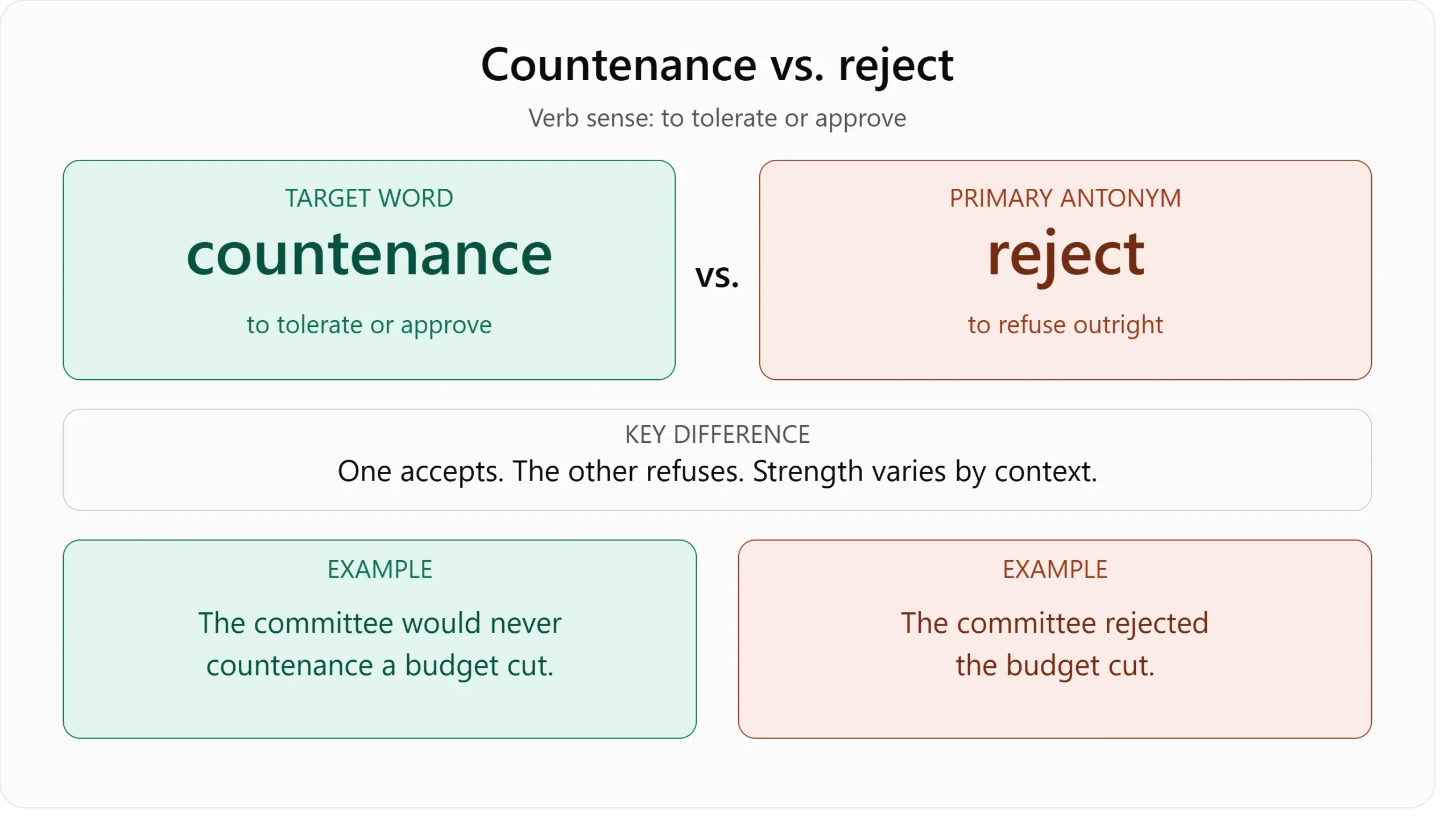
When countenance is a verb meaning to approve or tolerate, the strongest opposite is reject, with disapprove, forbid, and condemn as close alternatives. As a noun meaning face or facial expression, countenance has no true antonym. As a noun meaning approval, the best contextual opposite is disapproval.
Part of speech: verb and noun
Primary opposite: reject (verb sense)
Countenance is most often a verb meaning to allow, approve, or tolerate something, usually behavior or an idea. Speakers use it mostly in the negative, as in “I won’t countenance cheating on this team.”
When countenance means to tolerate or approve, reject is the strongest contextual opposite. It names a flat refusal to accept the thing at all.
One caveat matters here. Dictionaries do not pair countenance with one fixed antonym, so the words below are opposites in specific senses rather than universal ones. The noun sense meaning “face” has no true antonym.
Direct and Strong Antonyms
These words come closest to reversing the verb countenance. Each one replaces acceptance with refusal, but they differ in strength.
| Antonym | Tone or Nuance | Example Sentence |
|---|---|---|
| Reject | Firm, neutral refusal of an idea or offer | The committee would never countenance a budget cut, so it rejected the proposal. |
| Disapprove | Milder, personal, often unspoken | Her parents disapproved of the move, though they kept quiet about it. |
| Forbid | Rule-based, authoritative | The lease forbids subletting without written permission. |
| Prohibit | Formal, legal or institutional | State law prohibits texting while driving. |
| Condemn | Strong, public, moral | Several senators condemned the remarks within hours. |
| Oppose | Active resistance, often political | Most residents oppose the new parking rules. |
Notice the range. Disapprove is quiet and personal, while condemn is loud and moral. Pick the one that matches how strongly your subject pushes back.
Contextual and Subtle Opposites
Countenance has several senses, so the best opposite changes with meaning. The table below organizes them by context. Every pairing is contextual rather than a universal antonym.
| Context | Best Opposite | Why It Fits |
|---|---|---|
| Verb: to tolerate or approve | Reject | It refuses the thing outright. |
| Verb: to permit or allow | Forbid | It blocks the action by rule. |
| Noun: approval or moral support | Disapproval | It withholds the support. |
| Noun: composure, as in “kept his countenance” | Agitation (contextual) | It describes a loss of calm. |
| Noun: face or facial expression | None | Faces have no opposite. |
The approval sense is formal and a little old-fashioned. A writer might say, “The expedition went ahead without the governor’s countenance.” Here disapproval is the natural contrast: “The expedition went ahead despite the governor’s disapproval.”
The composure sense appears in phrases like “she kept her countenance during the hearing.” The idiom “out of countenance” means flustered or embarrassed, so a contextual contrast is flustered or disconcerted. Treat these as contextual choices, not dictionary-established antonyms.
When countenance simply means someone’s face, as in “a kindly countenance,” no word reverses it. Describing a “harsh countenance” instead of a “kindly” one changes the quality of the expression, but that is a contrast of adjectives, not an antonym of the noun.
Words That Seem Opposite But Are Not
Two words often get offered as opposites even though they miss the mark.
Ignore. To ignore something is to pay it no attention. That is different from refusing it. A manager can ignore a minor rule violation without ever rejecting it formally, and in practice ignoring can quietly tolerate the behavior, which is close to countenance rather than opposite to it.
Criticize. Criticizing something does not mean you refuse to accept it. A parent might criticize a teenager’s driving and still allow the teen to drive. Criticism points out flaws, while the opposite of countenance denies permission or approval.
Subtle Tone Differences
Choosing among the real opposites is mostly a matter of strength and register.
Reject sounds businesslike. “We rejected the offer” tells readers a decision was made, with no emotion attached.
Disapprove is gentler and more personal. “My editor disapproved of the headline” suggests a private opinion, not a ruling.
Forbid and prohibit shift the focus to rules. Forbid feels direct and personal (“I forbid it”), while prohibit sounds official and fits policies and statutes.
Condemn carries the most moral weight. “The mayor condemned the vandalism” signals public outrage. Using it for a minor workplace preference would sound overblown.
For formality, “will not countenance” is already elevated. A natural plain-English reversal is “will not allow,” while a formal reversal is “will not tolerate” or “categorically rejects.”
Frequently Asked Questions
What is the opposite of countenance as a verb?
The strongest opposite is reject, meaning to refuse something outright. Depending on the situation, disapprove, forbid, or condemn may fit better. Dictionaries do not list one fixed antonym, so choose by how strongly someone resists.
What is the opposite of countenance when it means face?
There is no true opposite. Countenance in the sense of a face or expression names a thing, not a quality or action. You can describe contrasting expressions, such as stern versus friendly, but those words are not antonyms of the noun.
Can I replace “will not countenance” with “will not reject”?
No. That would reverse the meaning. “Will not countenance” means will not accept. To state the opposite, write “will reject,” “will forbid,” or “will condemn,” depending on whether you mean refusal, a ban, or public disapproval.
Practical Word Choice
1. Identify the intended meaning. Ask whether countenance means tolerate, approve, support, composure, or face. Only the verb and approval senses have workable opposites.
2. Match the context, tone, strength, and formality. Use disapprove for mild personal reactions, forbid or prohibit for rules, reject for decisions, and condemn for strong public judgment.
Final Thoughts
The main distinction is simple. Countenance as a verb means to accept or allow, and reject is its strongest contextual opposite. The noun senses behave differently, with disapproval working for approval and no antonym for the face.
Context matters because countenance covers several ideas at once. A word that fits one sense can be wrong in another, and the strength of your choice changes how the sentence lands.
When you are unsure, test the sentence by replacing countenance with a plain synonym like tolerate, then choose the opposite of that. Have you used countenance or one of its opposites in a sentence that surprised you? Share your example in the comments.