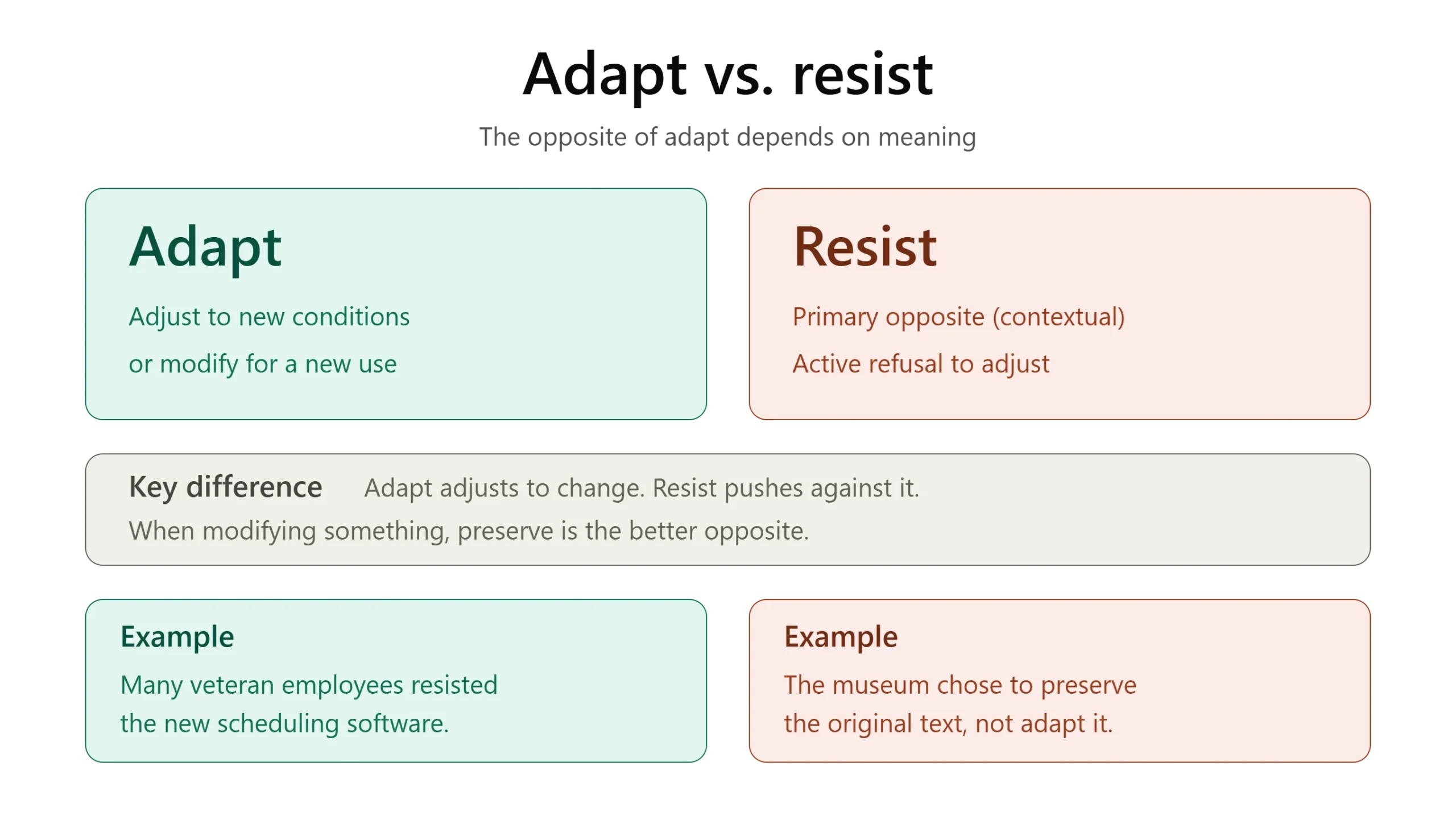
The strongest contextual opposite of adapt is resist. Adapt means to adjust to new conditions or change something for a new use. English has no single perfect antonym, so the best choice depends on meaning: resist, refuse to change, and hold firm fit adjusting to change, while preserve fits modifying something.
Part of speech: Verb (transitive and intransitive)
Primary opposite: Resist (contextual)
Adapt is a verb with two main senses. It can mean to adjust to new conditions, as in adapting to a new city. It can also mean to modify something for a new purpose, as in adapting a novel for the screen.
Adapt describes a process, so its opposites describe behaviors rather than a single mirror word. When adapt means adjusting to change, resist is the strongest contextual opposite because it names the active refusal to adjust. When adapt means modifying something for a new use, preserve works better.
Direct and Strong Antonyms
Strictly speaking, adapt has no fixed one-word direct antonym. The words below are the closest functional opposites when adapt means adjusting to change. Each carries a different tone.
| Antonym | Tone or Nuance | Example Sentence |
|---|---|---|
| Resist | Neutral to critical, suggests active pushback | Several veteran employees resisted the new scheduling software. |
| Refuse to change | Direct and plain, can sound stubborn | After the merger, he refused to change how he ran his team. |
| Hold firm | Often positive, suggests principled steadiness | The board held firm on its policy despite the public backlash. |
| Stand pat | Informal idiom, suggests a deliberate choice to do nothing new | After two strong quarters, management decided to stand pat. |
Notice that resist and hold firm are not perfect synonyms of each other. Resist emphasizes opposition to something. Hold firm emphasizes staying put.
Contextual and Subtle Opposites
The best opposite shifts with the meaning of adapt. Here is how the two main senses break down.
| Context | Best Opposite (Contextual) | Why It Fits |
|---|---|---|
| Adjusting to a new job, city, or routine | Resist | It names the refusal to adjust. |
| Staying with an established plan | Stand pat or hold firm | It describes choosing no change. |
| Modifying a text, recipe, or product | Preserve | It means keeping something in its original form. |
| Formal or academic writing | Leave unchanged or keep intact | It is neutral and precise. |
In the second sense, the contrast is between changing something and protecting it. A museum might say, “We chose to preserve the original text rather than adapt it for younger readers.” Here preserve is the natural opposite, and resist would sound odd.
Context also changes strength. “She resisted the new system” implies effort and friction. “She stuck with the old system” simply reports a choice.
Words That Seem Opposite But Are Not
Adopt
Adopt looks and sounds like adapt, so writers often assume the two sit at opposite ends. They do not. To adopt means to take something up as your own, such as a policy, habit, or child. Adapt means to adjust. Adopt is a commonly confused word, not an antonym.
A company might adopt a policy and then adapt it to fit local needs. The words work together in that sentence, which shows they are not opposites.
Stagnate
Stagnate means to stop growing or developing. It is tempting to treat it as the opposite of adapt, but it describes a result rather than an action. A business that refuses to adapt may stagnate, yet stagnation can also happen for reasons that have nothing to do with refusing change. Stagnate is a related contrast, not a direct opposite.
Subtle Tone Differences
Choosing among these opposites changes how your sentence lands.
Resist vs. hold firm. Resist can sound negative when the change is reasonable. Hold firm can sound admirable when the position is principled. “Residents resisted the new bike lanes” and “Residents held firm on the zoning rules” paint different pictures of the same people.
Refuse to change vs. stand pat. Refusing to change sounds personal and sometimes stubborn. Standing pat sounds strategic and a little casual. A manager who “refuses to change” reads as inflexible. A manager who “stands pat” reads as cautious.
Preserve vs. keep intact. Preserve carries a protective, almost reverent tone. Keep intact is plainer and fits workplace or technical writing, such as “Keep the original formatting intact.”
Frequently Asked Questions
Is there one direct antonym for adapt?
No single word is established as the direct antonym. Resist is the strongest contextual opposite when adapt means adjusting to change. Preserve works better when adapt means modifying something for a new purpose.
What is the opposite of adapt in a work setting?
In a workplace, the opposite of adapt is usually resist or stand pat. Resist fits someone pushing back on a new process. Stand pat fits a team deliberately keeping its current approach.
Is adopt the opposite of adapt?
No. Adopt means to take something up as your own, while adapt means to adjust or modify. They are often confused because of their similar spelling, but they are not opposites and often appear together.
Practical Word Choice
Identify the intended meaning. Ask whether you mean adjusting to a situation or modifying an object, text, or plan. The first points to resist or hold firm. The second points to preserve or keep intact.
Match context, tone, and formality. Use stand pat in casual or business conversation, preserve in formal or academic writing, and resist when you want to stress active opposition.
Final Thoughts
The main lesson is that adapt has no single mirror word. Its opposite depends on whether you mean adjusting to change or modifying something. Resist captures the first, and preserve captures the second.
Context matters because each option carries its own tone and strength. Resist suggests friction, hold firm suggests resolve, and stand pat suggests a calm decision to leave things as they are. The same behavior can sound admirable or stubborn depending on the word you choose.
Before you write, decide what the subject is actually doing, then pick the word that describes that action. What sentence have you used where resist or preserve was the perfect opposite of adapt?