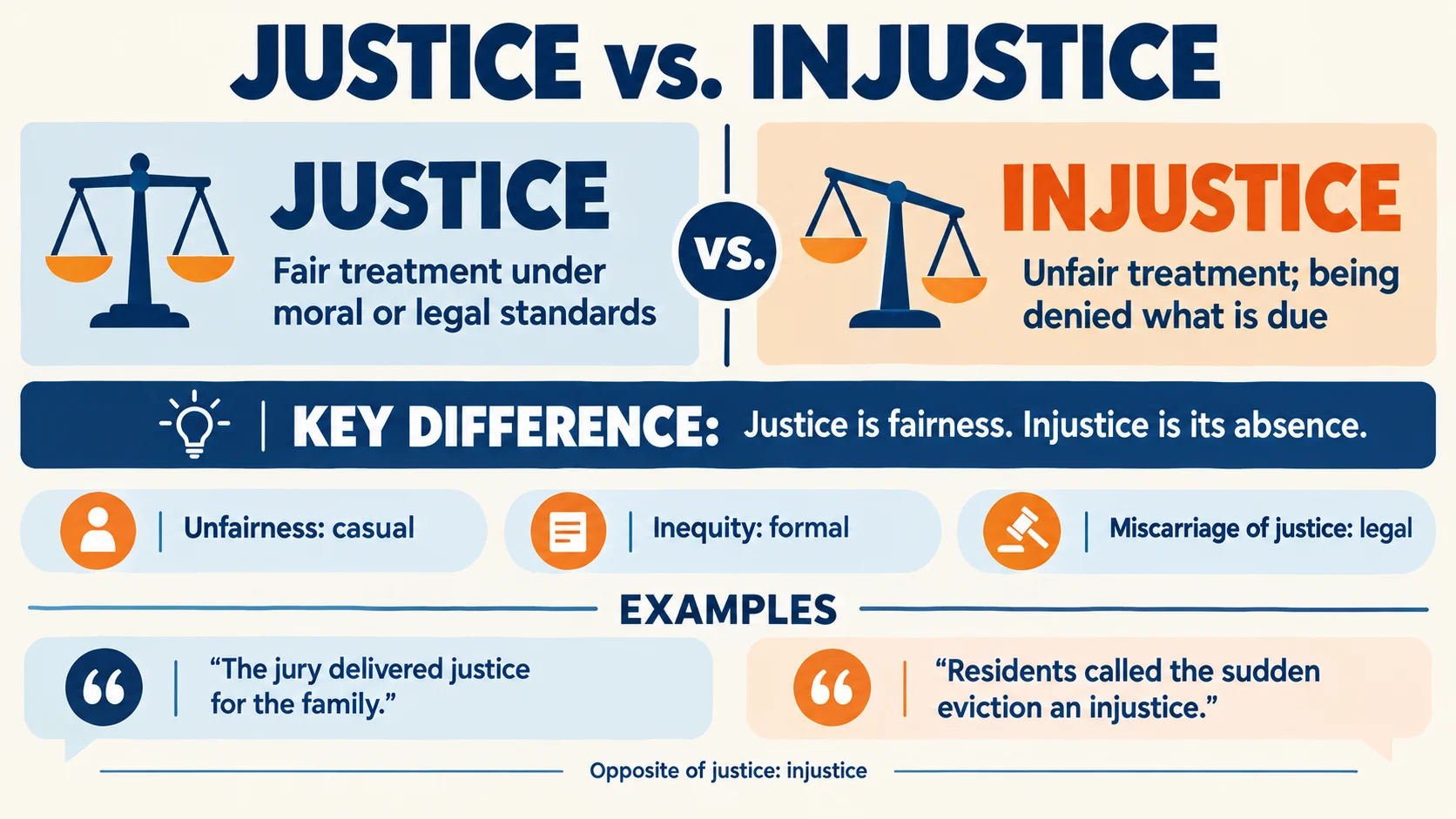
The opposite of justice is injustice. Justice means fairness, or the fair treatment of people under moral or legal standards. When it refers to a legal system, miscarriage of justice or lawlessness can work as contextual opposites, but injustice remains the strongest and most widely recognized antonym in everyday American English.
Part of speech: noun
Primary opposite: injustice
Justice most often means fairness: treating people according to what is right, deserved, and lawful. When justice means fairness or moral rightness, injustice is the strongest direct opposite. It describes a situation where someone is treated unfairly or denied what they are due.
Injustice is the established dictionary opposite, so it fits almost every context. Still, justice has no single perfect antonym in every sense. When it refers to a court system or the rule of law, a phrase like “miscarriage of justice” or a noun like “lawlessness” may fit better. When Justice is a title, as in “Justice Sotomayor,” the word has no antonym at all.
Direct and Strong Antonyms
These words are genuine opposites of justice in its core sense of fairness.
| Antonym | Tone or Nuance | Example Sentence |
|---|---|---|
| Injustice | Strongest and most general. Works in moral, legal, and social settings. | Residents called the sudden eviction an injustice that no one bothered to explain. |
| Unfairness | Plain and everyday. Lighter in weight than injustice. | My brother complained about the unfairness of the new chore chart. |
| Inequity | Formal. Often used for systems, funding, or access. | The report highlighted inequity in school funding across the state. |
Justice and injustice are best understood as gradable in practice. A coach cutting a player for no reason might be an unfairness. A wrongful conviction is a grave injustice. The words share a root, but the weight you choose should match the harm.
Contextual and Subtle Opposites
Justice has several senses, so the best opposite shifts with the meaning. The options below are contextual, not direct antonyms.
| Context | Best Opposite | Why It Fits |
|---|---|---|
| Fairness and moral rightness | Injustice | It names the absence of fair treatment in general. |
| Courts and legal process | Miscarriage of justice | It describes a legal outcome that is wrong or unfair, such as a wrongful conviction. |
| Law and order in a society | Lawlessness (contextual) | It contrasts with a functioning system of justice, though it describes missing rules rather than unfair treatment. |
| A title, as in “Chief Justice” | None | A title for a judge has no antonym. |
Consider two sentences. “The jury delivered justice for the family” uses the fairness sense, so injustice is the natural contrast. “Without courts or police, the region slid into lawlessness” uses a broader sense, and lawlessness captures the breakdown of order better than injustice would.
Tone and formality matter too. Injustice carries moral force and suits speeches, news writing, and academic work. Unfairness suits casual conversation. Inequity belongs in policy papers and professional reports.
Words That Seem Opposite But Are Not
Some words feel like the reverse of justice but fail as antonyms. They are related contrasts, not true opposites.
Mercy. Mercy means compassion shown to someone who could be punished. It is not the opposite of justice because a merciful decision can still be fair. A judge who reduces a sentence for a first-time offender may be acting justly and mercifully at once. The two ideas often work together, with mercy tempering strict punishment.
Vengeance. Vengeance means punishment driven by personal anger or a desire to get even. People sometimes call revenge a distorted form of justice, which makes it a contrast rather than a clean opposite. “She wanted vengeance, not a fair trial” shows the difference in motive. Vengeance and justice can even overlap in the mind of an angry speaker, which is exactly why they are not antonyms.
Subtle Tone Differences
Choosing among close options changes how your sentence lands.
“The layoffs felt like an unfairness” sounds oddly mild and slightly awkward. “The layoffs felt unfair” is more natural, while “The layoffs were an injustice” signals serious moral harm. Use injustice when you want weight and condemnation.
Compare “inequity” and “injustice” in workplace writing. “Pay inequity between departments” sounds measured and analytical, and it fits a report. “The pay injustice enraged the staff” sounds emotional and accusatory, and it fits a news story or an op-ed.
“Miscarriage of justice” is more specific than either. It points to a failure of a legal process, so use it when a verdict, trial, or investigation went wrong.
Frequently Asked Questions
What is the direct antonym of justice?
Injustice is the direct antonym. It means a lack of fairness or the unfair treatment of a person or group. Unfairness and inequity are close alternatives, but injustice is the strongest and most commonly accepted choice in American English.
What is the opposite of justice in a legal context?
In legal settings, “miscarriage of justice” is the most precise contextual opposite. It describes a wrongful or unfair legal outcome, such as convicting an innocent person. Lawlessness can also contrast with justice when no working legal system exists.
Is mercy the opposite of justice?
No. Mercy is a related contrast, not an antonym. Mercy softens or withholds deserved punishment, but a merciful decision can still be fair. Writers often pair the two words to show balance, so avoid using mercy as a direct opposite.
Suggested Reading and Internal Links
- Antonyms for fairness
- Words that describe moral wrongdoing
Practical Word Choice
Identify the intended meaning. Ask whether you mean fairness, a legal process, or a title. Fairness points to injustice, a legal failure points to “miscarriage of justice,” and a title has no opposite.
Match the context, tone, strength, and formality. Use unfairness in casual speech, injustice for serious moral or social harm, and inequity in formal or policy writing.
Final Thoughts
Injustice is the clearest opposite of justice, especially when justice means fairness. Other words, such as unfairness, inequity, and “miscarriage of justice,” are useful but narrower. Mercy and vengeance contrast with justice without opposing it.
Context decides which word works best. A courtroom, a classroom, and a policy report each call for a different level of weight and formality. If you are unsure, start with injustice and adjust the strength from there.