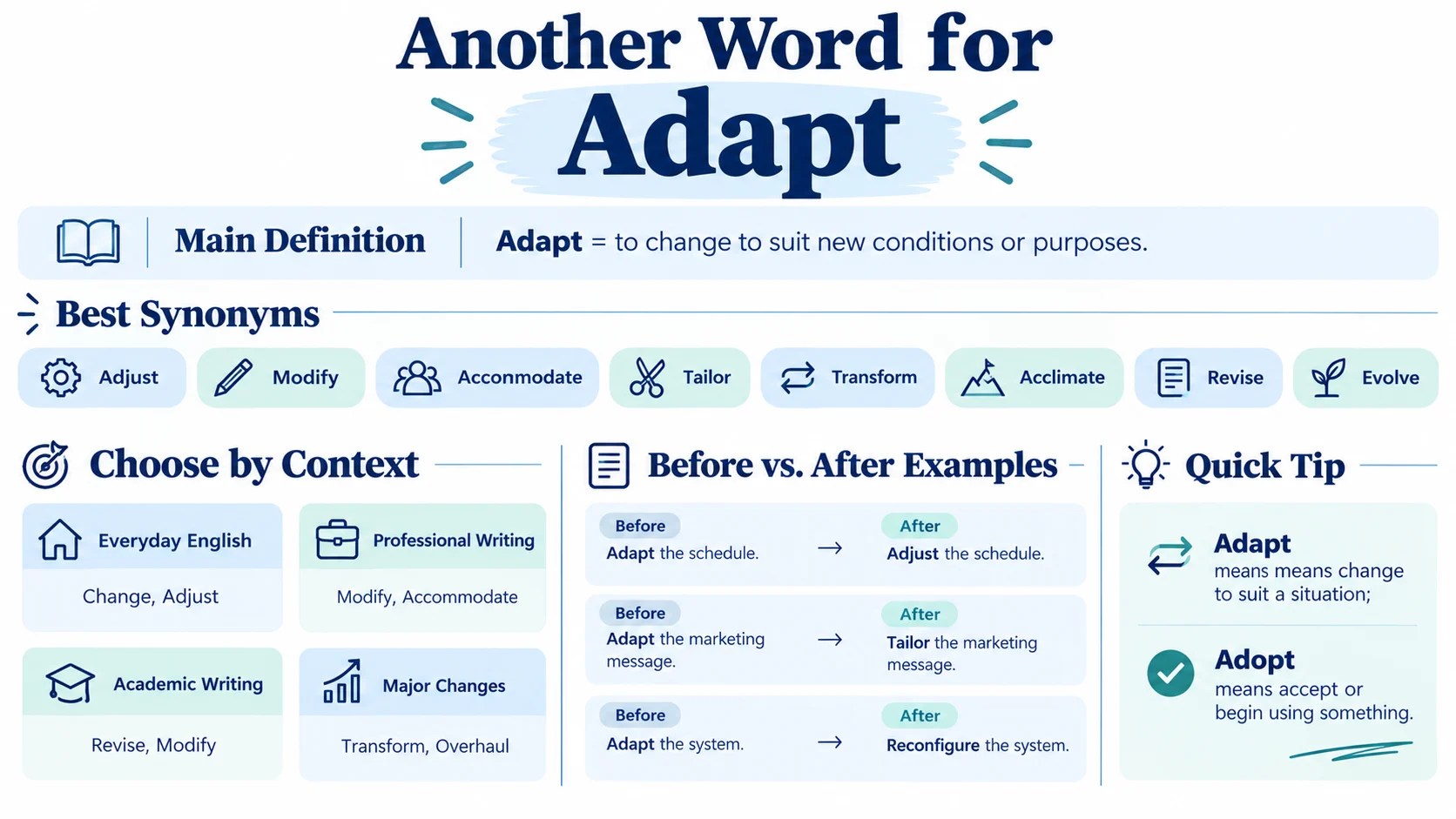
Another word for adapt is adjust, which means to change something to fit new conditions or circumstances. Other useful synonyms include modify, accommodate, alter, tailor, transform, and acclimate. The best choice depends on context. Use adjust for general changes, modify for specific alterations, and acclimate when becoming accustomed to a new environment.
What Does Adapt Mean?
Definition
Adapt is a verb that means to change something or yourself to suit new conditions, requirements, environments, or situations. It can describe changing a method, adjusting a behavior, modifying a product, or learning to live in unfamiliar circumstances.
For example, “Employees must adapt to new technology” means employees need to adjust their skills or working methods to accommodate technological changes.
The word can also mean changing something so it works for a different purpose or audience. For instance, a filmmaker might adapt a novel into a movie.
Common Uses
The word adapt appears in several contexts:
- Personal growth: Adapt to new responsibilities or life changes.
- Business: Adapt strategies to changing market conditions.
- Education: Adapt teaching methods to students’ needs.
- Technology: Adapt software to different devices.
- Biology: Adapt to environmental conditions.
- Creative work: Adapt a book into a screenplay.
Although these uses share the idea of change, their meanings differ slightly. A person may adapt by learning new habits, while a business may adapt by changing its strategy. A writer may adapt an existing work into another format.
Best Synonyms for Adapt
The best synonym depends on whether you mean making a small change, responding to circumstances, becoming accustomed to something, or converting something for another purpose.
| Synonym | Meaning | Best Used When | Example |
|---|---|---|---|
| Adjust | Make a change to improve fit or suitability | Everyday situations | We adjusted our schedule. |
| Modify | Change specific features | Plans, products, or processes | The team modified the design. |
| Alter | Make something different | General changes | They altered the original proposal. |
| Accommodate | Make room for needs or differences | People, requirements, or schedules | The policy accommodates different learning styles. |
| Change | Make or become different | General conversation | We changed our approach. |
| Tailor | Customize for a particular purpose | Services, content, or solutions | We tailored the presentation to the audience. |
| Transform | Change significantly | Major improvements or changes | The company transformed its operations. |
| Acclimate | Become accustomed to a new environment | Climate or surroundings | She acclimated to the colder weather. |
| Assimilate | Become integrated into a group or culture, or absorb information | Social or learning contexts | New employees assimilated into the team. |
| Revise | Improve or change something after review | Documents, plans, or ideas | We revised the proposal. |
| Reconfigure | Arrange something differently | Systems, equipment, or processes | The engineers reconfigured the network. |
| Customize | Modify for individual preferences or needs | Products and services | The software can be customized. |
| Evolve | Develop gradually over time | Strategies, ideas, or organisms | The business evolved with customer needs. |
| Accommodate oneself to | Adjust one’s behavior or expectations to a situation | Formal or reflective writing | He accommodated himself to the new routine. |
Synonyms for Adapt by Context
Formal Writing
Formal writing benefits from precise alternatives that explain what kind of change has occurred.
Useful words include modify, alter, accommodate, revise, and reconfigure.
Example
Original: The organization adapted its procedures to meet new requirements.
Alternative: The organization modified its procedures to meet new requirements.
The revised sentence emphasizes deliberate changes to specific procedures. If the organization changed its entire operating model, transformed might be more appropriate.
Professional Writing
In the workplace, adjust, modify, tailor, and accommodate are especially useful.
Business example
Original: We adapted our marketing strategy to reach a younger audience.
Alternative: We tailored our marketing strategy to reach a younger audience.
Tailored emphasizes customization for a particular audience, making it effective in marketing plans, proposals, and business reports.
Other examples include:
- Resume: Adapted team workflows to improve project delivery.
- Email: We can adjust the schedule to accommodate your availability.
- Business report: The department modified its procedures to reduce delays.
Academic Writing
Academic writing often requires distinctions between changing a method, responding to conditions, and developing over time.
Useful alternatives include modify, adjust, revise, acclimate, and evolve.
Academic example
Original: Researchers adapted the experimental procedure to control external variables.
Alternative: Researchers modified the experimental procedure to control external variables.
Here, modified clearly describes deliberate changes to the research method.
In a biological study, however, adapt may refer to traits that help organisms survive and reproduce in particular environments. Replacing it with modify could change the scientific meaning.
Daily Conversation
Everyday conversation usually sounds more natural with simple words.
| Instead of Adapt | Use | Example |
|---|---|---|
| Adapt to a schedule | Adjust to a schedule | I adjusted to my new schedule. |
| Adapt a recipe | Change a recipe | We changed the recipe slightly. |
| Adapt to a new place | Get used to a new place | She got used to living in Chicago. |
| Adapt a plan | Change a plan | We changed our plan because of the rain. |
| Adapt a design | Modify a design | He modified the design for his room. |
For casual conversations, adjust, change, and get used to are often clearer than adapt.
Professional Alternatives for Adapt
These alternatives are particularly useful in resumes, workplace communication, reports, and business writing.
1. Adjust
Meaning: To make a change so something works better or fits a situation.
Best used for: Work schedules, strategies, processes, and personal behavior.
Tone: Neutral and professional.
Difficulty: Easy.
Usage frequency: Very common.
Best for: Resume writing, email writing, essays, and business writing.
- Business example: We adjusted the delivery schedule to meet customer demand.
- Academic example: Students adjusted their study methods to improve performance.
- Daily conversation example: I adjusted to my new routine.
2. Modify
Meaning: To change certain parts or features of something without necessarily replacing the whole thing.
Best used for: Procedures, designs, plans, products, and research methods.
Tone: Professional and precise.
Difficulty: Medium.
Usage frequency: Common.
Best for: Resumes, academic essays, business reports, and technical writing.
- Business example: The team modified the workflow to reduce processing time.
- Academic example: Researchers modified the questionnaire before collecting data.
- Daily conversation example: I modified the recipe by adding less sugar.
3. Tailor
Meaning: To customize something for a particular person, purpose, or audience.
Best used for: Marketing, presentations, services, applications, and communication.
Tone: Professional and purposeful.
Difficulty: Medium.
Usage frequency: Common.
Best for: Resume writing, email writing, marketing copy, and business writing.
- Business example: We tailored our services to meet each client’s needs.
- Academic example: The instructor tailored the assignments to students’ skill levels.
- Daily conversation example: She tailored her outfit to the occasion.
4. Accommodate
Meaning: To make adjustments or provide space for someone’s needs, preferences, or requirements.
Best used for: Workplace arrangements, accessibility, scheduling, and diverse needs.
Tone: Formal and considerate.
Difficulty: Medium.
Usage frequency: Common.
Best for: Business writing, professional emails, academic writing, and policy documents.
- Business example: The company accommodated employees’ flexible scheduling requests.
- Academic example: The course accommodates students with different learning needs.
- Daily conversation example: We can accommodate your request to meet earlier.
5. Transform
Meaning: To change something substantially in form, character, or function.
Best used for: Major improvements, organizational change, and significant personal development.
Tone: Strong and impactful.
Difficulty: Medium.
Usage frequency: Common.
Best for: Marketing copy, resumes, business writing, and persuasive essays.
- Business example: The new platform transformed the customer experience.
- Academic example: Digital tools transformed how researchers analyzed the data.
- Daily conversation example: Moving abroad transformed her outlook on life.
Simple Alternatives for Adapt
If you want to make a sentence easier to understand, choose the simplest word that preserves its meaning.
Change: A general replacement when something becomes different.
Example: We adapted the original plan.
Simpler: We changed the original plan.
Adjust: A good choice for small or practical changes.
Example: He adapted his position.
Simpler: He adjusted his position.
Get used to: A natural phrase for becoming comfortable with a new situation.
Example: She adapted to her new school.
Simpler: She got used to her new school.
Fit: Useful when something needs to match a purpose or requirement.
Example: The team adapted the design to the available space.
Simpler: The team changed the design to fit the available space.
Remember that fit does not replace adapt in every sentence. Use it when the central meaning involves suitability.
Stronger Alternatives for Adapt
Some alternatives emphasize the scale or purpose of a change.
- Transform: Make a major or fundamental change.
- Reinvent: Develop a substantially new version of yourself, a product, or an organization.
- Overhaul: Make extensive improvements or changes to a system or process.
- Reconfigure: Change the arrangement or structure of something.
- Evolve: Develop gradually in response to changing conditions.
- Customize: Change something to meet specific requirements.
Examples:
- The company overhauled its outdated recruitment process.
- The designer reinvented the product for a new market.
- The team reconfigured the system to improve performance.
- The organization evolved to meet changing customer expectations.
These alternatives are not interchangeable. Overhaul suggests extensive revision, reconfigure emphasizes arrangement, and evolve often describes gradual development.
Difference Between Similar Synonyms
Choosing the correct synonym means understanding the type of change being described.
| Word | Key Difference | Example |
|---|---|---|
| Adapt | Change to suit new conditions or purposes | We adapted to remote work. |
| Adjust | Make a change to improve suitability | We adjusted the meeting time. |
| Modify | Change specific features | We modified the application. |
| Alter | Make something different | They altered the agreement. |
| Accommodate | Make room for needs or requirements | The schedule accommodates both teams. |
| Tailor | Customize for a specific purpose | We tailored the message to customers. |
| Transform | Change significantly | Technology transformed the industry. |
| Acclimate | Become accustomed to an environment | She acclimated to the heat. |
| Assimilate | Become integrated into a group or absorb information | He assimilated into the new team. |
| Evolve | Develop gradually over time | The strategy evolved over several years. |
Adapt vs. Adopt
These words are frequently confused.
Adapt means to change something or yourself to suit new conditions.
Example: The company adapted its strategy to changing customer needs.
Adopt means to accept, begin using, or take something as one’s own.
Example: The company adopted a new marketing strategy.
A company might adopt a new system and then adapt its procedures to use it effectively.
Adapt vs. Acclimate
Adapt has a broad meaning and can describe changes in behavior, methods, systems, or environments. Acclimate specifically means to become accustomed to new environmental conditions.
Example: A person can adapt to a new job but acclimate to the heat of a desert climate.
Adapt vs. Modify
Adapt often emphasizes suitability for new conditions or a new purpose. Modify emphasizes making particular changes.
Example: A teacher adapts a lesson for younger students by modifying its vocabulary and activities.
Opposite Words for Adapt
Antonyms for adapt depend on the intended meaning. If you mean changing to suit circumstances, the opposite may involve resisting change or remaining inflexible.
| Antonym | Meaning | Example |
|---|---|---|
| Resist | Oppose a change | He resisted the new procedures. |
| Preserve | Keep something in its existing condition | They preserved the original design. |
| Maintain | Keep something at the same level or state | The company maintained its existing approach. |
| Retain | Keep rather than change or replace | The team retained its original strategy. |
| Resist change | Refuse or oppose adjustments | The organization continued to resist change. |
| Remain unchanged | Stay in the same condition | The policy remained unchanged. |
There is no single opposite that fits every use of adapt. For example, preserve can be the opposite of changing an object, while resist may be the opposite of adjusting to a new situation.
FAQs
1. What is the best synonym for adapt?
Adjust is one of the best general synonyms. Use modify for specific changes, tailor for customization, and acclimate for becoming accustomed to a new environment.
2. What is a formal synonym for adapt?
Modify, accommodate, and reconfigure are useful formal alternatives. The right choice depends on whether you mean changing features, meeting requirements, or rearranging a system.
3. What is a professional alternative for adapt?
Adjust, modify, and tailor work well in professional writing. For major organizational changes, transform or overhaul may be more accurate.
4. What word can replace adapt in a resume?
Use adjusted, modified, customized, transformed, or reconfigured when these words accurately describe your accomplishments. For example, “Customized reporting processes to improve team efficiency” is more specific than “Adapted reporting processes.”
5. What is another word for adapt to change?
Useful alternatives include adjust to, accommodate, respond to, and evolve with. For example, “The company adjusted to changing market conditions.”
6. What is a simple word for adapt?
Change and adjust are simple alternatives. The phrase get used to works well when describing a person becoming comfortable with a new situation.
7. Is adjust the same as adapt?
They are similar but not identical. Adjust often refers to a particular change, while adapt can describe a broader process of becoming suitable for new conditions.
8. What is the opposite of adapt?
Possible antonyms include resist, preserve, maintain, and remain unchanged. The best choice depends on the sentence.
9. What is another word for adapt in academic writing?
Modify, adjust, revise, and acclimate may work in academic contexts. In scientific writing, choose carefully because these words describe different processes.
10. What is the difference between adapt and adopt?
Adapt means to change to suit a situation. Adopt means to accept or begin using something. For example, a business can adopt new software and adapt its workflow to use it effectively.
Conclusion
The best alternative to adapt depends on what kind of change you want to describe. Use adjust for practical changes, modify for specific alterations, tailor for customization, accommodate for meeting needs, and transform for substantial change. When describing a person becoming accustomed to unfamiliar surroundings, acclimate may be the most precise choice.
Good synonym selection is not about choosing the most complicated word. It is about communicating the intended meaning clearly and naturally in the right context.