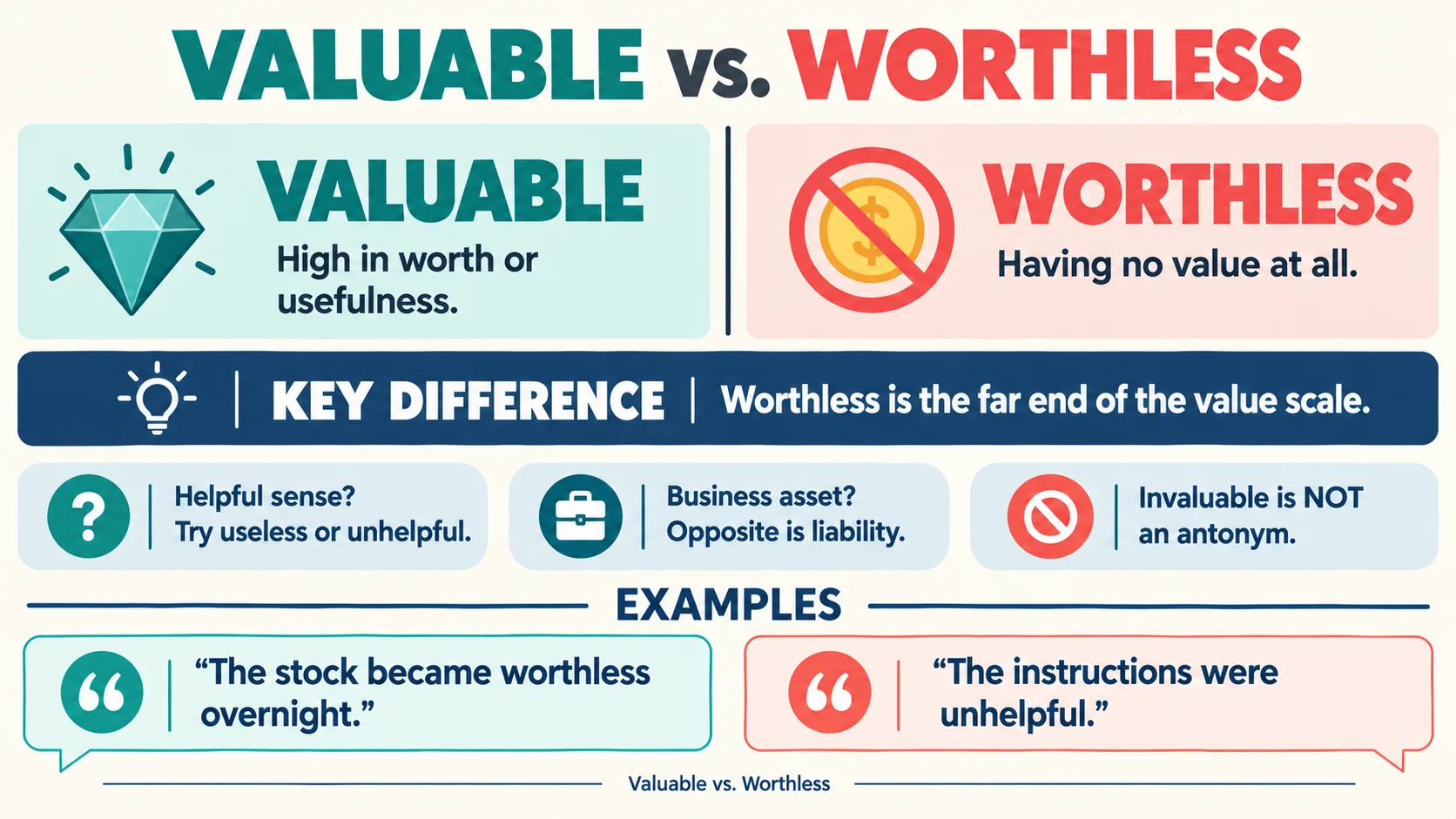
The opposite of valuable is worthless when valuable means worth a lot of money or importance. Valuable describes something with high monetary worth or real usefulness. When it means helpful or beneficial, useless or unhelpful fits better. Context decides which opposite sounds natural.
Part of Speech: Adjective. (The plural noun valuables, meaning items of worth, also exists, but this guide focuses on the adjective.)
Primary Opposite: Worthless
Valuable means having great monetary worth, or being useful, important, or beneficial. When it describes money or material worth, worthless is the strongest direct opposite, because it means having no value at all.
Valuable is a gradable adjective. Something can be slightly valuable, fairly valuable, or extremely valuable. Worthless sits at the far end of that scale. No single antonym covers every sense of the word, so the best choice shifts with meaning. For the “useful or helpful” sense, useless is often more natural than worthless.
Direct and Strong Antonyms
These two words are established opposites of valuable in both its money sense and its broader sense of worth.
| Antonym | Tone or Nuance | Example Sentence |
|---|---|---|
| Worthless | Strong and absolute. Can sound harsh when applied to people or ideas. | The stock became worthless overnight after the company filed for bankruptcy. |
| Valueless | Formal and literal. Less common in everyday speech. | Without verification, the survey data was valueless to the research team. |
Worthless is the everyday choice. Valueless works in academic, legal, or technical writing where you want a more measured tone.
Contextual and Subtle Opposites
The best opposite changes with the meaning of valuable. The words below are contextual opposites. They work in specific situations but are not universal antonyms.
| Context | Best Opposite (Contextual) | Why It Fits |
|---|---|---|
| Money, collectibles, property | Worthless | Describes something with no market worth. |
| Advice, tips, information | Useless or unhelpful | The focus is practical benefit, not price. |
| A person’s contribution at work | Ineffective or unhelpful | Describes a lack of positive impact. |
| A “valuable asset” in business | Liability | An asset adds worth. A liability costs or burdens. |
Consider the difference. A coupon that expired last year is worthless. A long meeting with no decisions is useless. A teammate who creates extra work is a liability. Each word contrasts with valuable, but each one targets a different sense.
Strength matters too. If a colleague’s feedback was not very helpful, unhelpful is accurate and polite. Worthless would be an extreme judgment.
Words That Seem Opposite But Are Not
Invaluable
This is the most common mix-up. The prefix in- often signals negation, as in incapable or inactive. Here it does not. Invaluable means so valuable that its worth cannot be measured. It is a stronger synonym of valuable, not an antonym.
- Correct: “Her mentorship was invaluable during my first year as a nurse.”
- Incorrect: Using invaluable to mean “without value.”
Cheap
Cheap and inexpensive describe low price, not low worth. Something can be cheap and still valuable, such as a $2 tool that saves an hour of work. Something can also be expensive and not valuable, such as a pricey gadget that breaks in a week.
Cheap can also carry a negative sense of poor quality, as in “a cheap imitation.” Even then, it describes quality or cost, not a complete absence of value, so it is a related contrast rather than a true antonym.
Subtle Tone Differences
Related words can change the meaning, strength, and formality of a sentence. Here is how the main options compare.
Worthless is blunt. In a report, “The old software license is worthless” is a clear statement of fact. Said about a person’s work, it can feel like an insult.
Valueless is quieter and more clinical. “The unsigned document was valueless as evidence” sounds appropriate in a legal or academic setting.
Useless focuses on function. “The charger was useless because it didn’t fit my phone” tells the reader exactly what failed.
Unhelpful is the softest. “The instructions were unhelpful” criticizes without condemning, which works well in customer reviews and workplace feedback.
Notice that all four sentences are about a lack of worth, but only some are about money. Choosing the right one signals that you understand what kind of value is missing.
Frequently Asked Questions
What is the direct antonym of valuable?
The most direct antonym is worthless, meaning having no value. Valueless is a more formal alternative. Both oppose valuable in its core sense of worth, whether financial or practical.
What is the opposite of valuable when it means helpful?
When valuable means helpful or beneficial, as in “valuable advice,” the best opposites are useless and unhelpful. Useless is stronger, while unhelpful is milder and more polite in workplace writing.
Is invaluable the opposite of valuable?
No. Invaluable means extremely valuable, so valuable that its worth is hard to measure. It is a stronger version of valuable, despite the in- prefix. Use worthless or valueless for the true opposite.
Practical Word Choice
- Identify the intended meaning. Ask whether valuable refers to money, usefulness, or someone’s contribution. Money points to worthless, usefulness points to useless or unhelpful, and a business asset points to liability.
- Match the context, tone, strength, and formality. Use worthless when you mean a total absence of value. Use unhelpful when you want to stay diplomatic. Reserve valueless for formal writing.
Final Thoughts
The core distinction is simple. Valuable describes worth, and its strongest direct opposite is worthless. The challenge is that worth comes in different forms. Price, usefulness, and contribution each have their own opposites, which is why one word never fits every situation.
Context shapes the best choice because these words differ in strength and tone. Worthless is absolute, useless is practical, and unhelpful is gentle. The wrong pick can sound too harsh or too vague.
One last tip: before you reach for an opposite, check the word you are contrasting. If it starts with in-, as in invaluable, it may not be a negative at all. What is a sentence where choosing between worthless and useless changed your meaning?