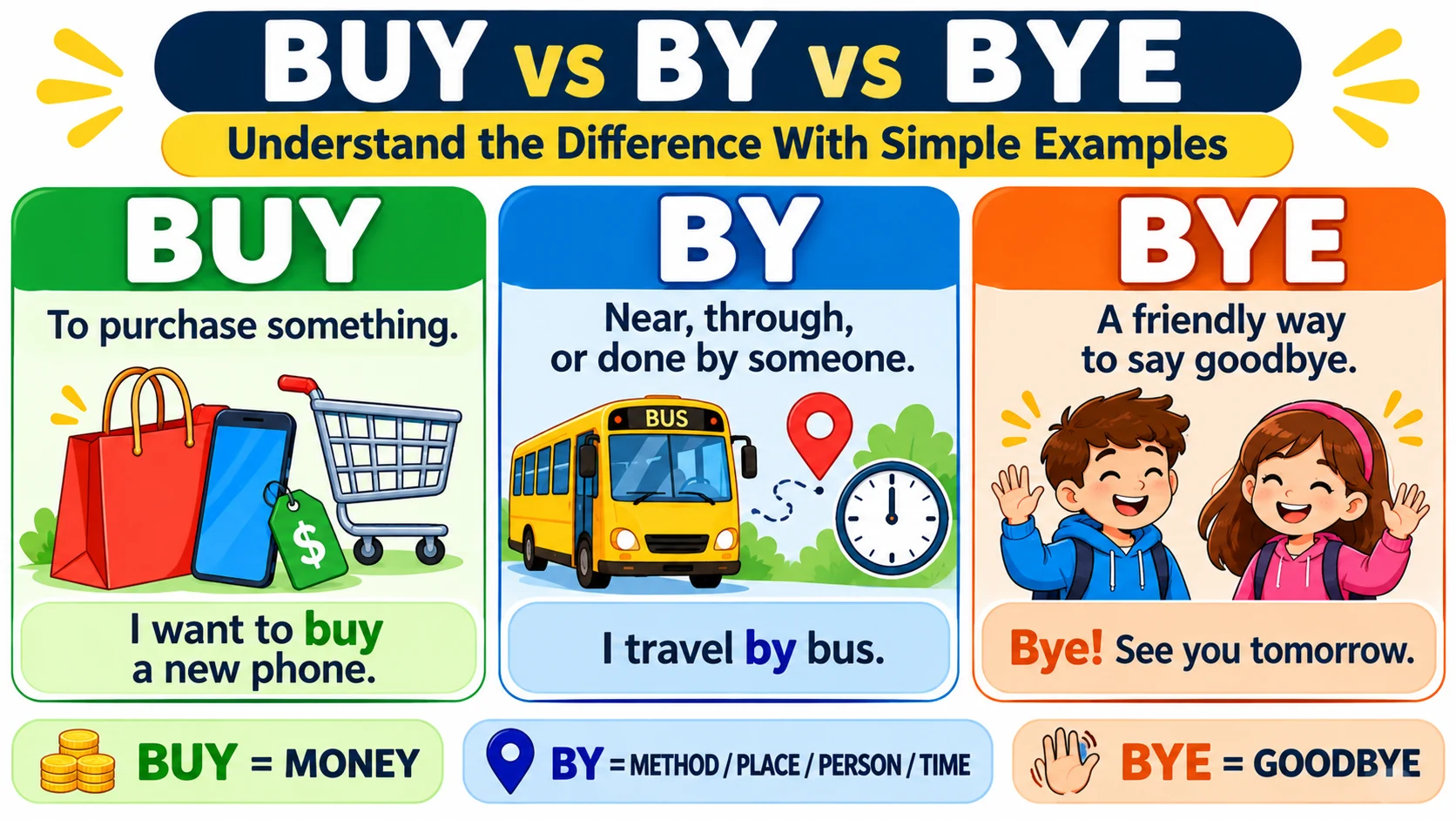
Buy, by, and bye sound the same, but they have different meanings and uses. Buy means to get something by paying money, by shows who did something, how something happens, or where something is, and bye is a friendly way to say goodbye or a term used in sports for skipping a round.
Have you ever stopped while writing because you were unsure whether to use buy, by, or bye? You are not alone. These three words sound exactly the same, but they have very different meanings. Using the wrong one can change the meaning of a sentence.
For example, consider these three sentences: “I want to buy a new phone,” “The book was written by her,” and “I said bye to my friend.” Each sentence uses a different word, even though all three sound alike when spoken.
This type of word confusion is common in English. It happens because English has many words with the same pronunciation but different spellings and meanings. These words are called homophones.
Understanding the difference between buy, by, and bye can help you write better emails, school assignments, social media posts, and everyday messages. The good news is that learning these words is simple. Each word has a clear purpose, and a few easy examples can help you remember when to use it.
In this guide, you will learn the meaning of each word, how to use it, common mistakes to avoid, and simple ways to remember the difference.
Quick Answer: Buy vs By vs Bye
The easiest way to understand buy vs by vs bye is to remember what each word does in a sentence.
| Word | Meaning | Part of Speech | Example |
|---|---|---|---|
| Buy | To get something by paying money | Verb | I want to buy a new laptop. |
| By | Near, through, before, or done by someone | Preposition and adverb | She traveled by bus. |
| Bye | A way to say goodbye | Interjection and noun | Bye! See you tomorrow. |
The Simple Difference
- Buy: Use it when you purchase something.
- By: Use it when you talk about a person, method, place, or deadline.
- Bye: Use it when you leave or say goodbye.
Easy memory trick:
- Buy = Money
- By = Method, person, place, or time
- Bye = Goodbye
Although these words sound the same, their meanings are not interchangeable.
What Does Buy Mean?
WORD 1: BUY
Ley Federal del Trabajo: ¿Se descuentan de tu sueldo los vales de despensa?
The word buy means to get something by paying money for it. It is a common English verb used when someone purchases a product, service, or item.
Whenever you spend money to own or receive something, you use the word buy.
For example:
- I want to buy a new phone.
- She will buy a dress for the party.
- We need to buy some food.
- He plans to buy a house next year.
- They buy fresh vegetables every morning.
In each sentence, buy describes the action of purchasing something.
Buy as a Verb
Buy is an irregular verb. This means its past form does not follow the regular rule of adding “-ed.”
Here are its main forms:
| Verb Form | Word | Example |
|---|---|---|
| Base form | Buy | I buy books. |
| Third-person singular | Buys | She buys shoes. |
| Past tense | Bought | He bought a car. |
| Past participle | Bought | I have bought a gift. |
| Present participle | Buying | They are buying food. |
Notice that the past tense of buy is bought, not buyed.
Incorrect: She buyed a new bag.
Correct: She bought a new bag.
Different Uses of Buy
The word buy has several uses in everyday English.
Buying products
This is the most common meaning. It describes paying money for something.
Examples:
- I will buy a laptop.
- She bought a pair of shoes.
- We buy milk every week.
Buying services
You can also use buy when paying for a service.
Examples:
- I need to buy a gym membership.
- They bought tickets for the concert.
- She wants to buy an online course.
Buying something for another person
Buy can also describe purchasing something as a gift.
Examples:
- I will buy my mother some flowers.
- He bought his friend a birthday present.
- They bought their children new toys.
Buying an idea or explanation
In informal English, buy can mean to believe or accept something as true.
Examples:
- I do not buy his excuse.
- She bought the explanation.
- Nobody bought that story.
In this context, buy does not mean spending money. It means accepting an idea or believing a statement.
Advantages and Disadvantages of Using Buy
Buy is a useful and direct word. It clearly explains that someone is paying for something.
Advantages:
- It makes purchasing actions easy to understand.
- It works in formal and informal writing.
- It can describe products, services, and ideas.
- It is common in business and daily conversations.
Limitations:
- It does not always explain how much something costs.
- It can have different meanings depending on context.
- It should not replace words such as rent, borrow, or receive when no purchase takes place.
Real-World Examples of Buy
| Situation | Example Sentence |
|---|---|
| Shopping | I need to buy a new shirt. |
| Online shopping | She will buy a phone online. |
| Business | The company plans to buy new equipment. |
| Education | He bought a book for his class. |
| Travel | We bought tickets for the flight. |
| Gifts | I bought my sister a birthday gift. |
| Daily life | My father buys groceries every Sunday. |
What Does By Mean?
WORD 2: BY
The word by is a preposition and can also function as an adverb. It has several meanings depending on how it is used in a sentence.
It can describe who performs an action, how something happens, where something is located, or when something must be completed.
Unlike buy, by does not mean purchasing something. Unlike bye, it is not used to say goodbye.
Examples:
- The letter was written by Sarah.
- I travel to work by bus.
- She lives by the river.
- Please finish the work by Monday.
- He stood by the door.
Each sentence uses by in a different way.
By to Show Who Performs an Action
Use by to identify the person or thing responsible for an action. This is especially common in passive sentences.
Examples:
- The book was written by John.
- The cake was made by my mother.
- The house was designed by an architect.
- The song was performed by a famous singer.
In these examples, by tells us who completed the action.
By to Show a Method or Way
Use by when explaining how someone does something or how they travel.
Examples:
- I go to school by bus.
- She contacted me by email.
- He learned English by reading books.
- They paid by credit card.
- You can improve your skills by practicing daily.
Here, by introduces the method used to complete an action.
By to Show Location
By can also mean near, beside, or next to something.
Examples:
- She is standing by the window.
- There is a small shop by the road.
- We sat by the lake.
- He left his bag by the door.
In these sentences, by describes the location of a person or object.
By to Show Time or Deadline
By can mean before or no later than a particular time.
Examples:
- Please submit your assignment by Friday.
- I will return by 6 p.m.
- The report must be ready by tomorrow.
- She promised to call me by noon.
A useful distinction is that “by Friday” generally means the task should be completed no later than Friday.
By to Show Measurement or Difference
By can also describe an amount, measurement, or difference.
Examples:
- The price increased by 10%.
- He won the race by two seconds.
- The room measures 12 feet by 15 feet.
- The company reduced its costs by $500.
By to Describe an Action or Process
By often introduces an action that explains how a result is achieved.
Examples:
- You can save money by planning ahead.
- She improved her writing by reading daily.
- He solved the problem by asking for help.
- We stayed healthy by eating fresh food.
This structure is useful in academic, professional, and everyday writing.
Different Meanings of By at a Glance
| Use | Meaning | Example |
|---|---|---|
| Person | Who performs an action | Written by Anna |
| Method | How something happens | Travel by train |
| Location | Near or beside | Sit by me |
| Deadline | No later than | Finish by Friday |
| Measurement | Amount or difference | Increased by 5% |
| Process | The way something is done | Learn by practicing |
Real-World Examples of By
At school:
- The homework was checked by the teacher.
- Please finish your project by Monday.
- I improved my English by reading books.
At work:
- The report was prepared by the manager.
- Send the document by email.
- Please complete the task by 5 p.m.
During travel:
- We traveled by train.
- The hotel is by the beach.
- I will arrive by noon.
In daily conversations:
- Come and sit by me.
- I will contact you by phone.
- She learned to cook by watching videos.
What Does Bye Mean?
WORD 3: BYE
Man waving goodbye to his friend in park, back view
The word bye is a common and friendly way to say goodbye when leaving someone or ending a conversation.
It is used in everyday speaking, text messages, phone calls, emails, and casual conversations.
Examples:
- Bye! See you tomorrow.
- I have to go now. Bye!
- She said bye to her friends.
- Bye, take care!
- We waved bye before leaving.
Bye is usually informal and friendly. It is common among friends, family members, classmates, and coworkers.
Bye as an Interjection
An interjection is a word that expresses a feeling or reaction. Bye works as an interjection when someone uses it to say goodbye.
Examples:
- Bye! Have a nice day.
- Okay, bye!
- Bye, see you soon.
- Bye! Take care of yourself.
It can appear at the beginning or end of a conversation.
Bye as a Noun
Bye can also work as a noun in sports. It describes a situation in which a player or team does not have to compete in a particular round.
For example:
- Our team received a bye in the first round.
- The player advanced because of a first-round bye.
- The team had a bye week during the season.
A bye may be given because of the tournament structure or the number of competitors.
Common Expressions With Bye
| Expression | Meaning | Example |
|---|---|---|
| Say bye | Say goodbye | I went to say bye to my teacher. |
| Bye for now | Goodbye temporarily | Bye for now. Talk later. |
| Bye-bye | A friendly or playful goodbye | Bye-bye, see you soon! |
| Kiss goodbye | Accept that something is lost or unavailable | You can kiss that opportunity goodbye. |
| First-round bye | Skip the first round of a competition | The team earned a first-round bye. |
Bye vs Goodbye
Bye and goodbye have almost the same meaning, but they are used slightly differently.
| Bye | Goodbye |
|---|---|
| Short and casual | More complete expression |
| Common in daily conversations | Common in casual and formal situations |
| Often used with friends | Can be used with almost anyone |
| Example: Bye, see you later! | Example: Goodbye, and thank you for your help. |
Both words are correct. Your choice depends on the situation and tone.
Real-World Examples of Bye
With friends:
- Bye! See you tomorrow.
- I said bye before leaving.
- Bye, have fun!
At school:
- The students said bye to their teacher.
- Bye, see you in class.
- She waved bye to her classmates.
At work:
- Bye, everyone. Have a great weekend.
- I said bye to my coworkers.
- Goodbye, and thank you for your time.
In sports:
- The team received a bye in the opening round.
- A first-round bye gave the player extra rest.
- The club has a bye week this season.
Buy vs By vs Bye: Complete Comparison
Now that you understand the meaning of each word, it is helpful to compare them side by side.
All three words have the same pronunciation, but their spelling, grammar, and meanings are different.
Buy vs By vs Bye: Main Differences
| Feature | Buy | By | Bye |
|---|---|---|---|
| Meaning | Purchase something | Near, through, or done by someone | Say goodbye |
| Pronunciation | /baɪ/ | /baɪ/ | /baɪ/ |
| Main grammatical role | Verb | Preposition | Interjection |
| Other grammatical role | Noun in some contexts | Adverb | Noun |
| Common use | Shopping | Method, place, person, time | Leaving or farewell |
| Past tense | Bought | No past tense | No past tense |
| Formality | Neutral | Neutral and formal | Mostly informal |
| Example | I buy food. | I travel by bus. | Bye, see you! |
Why Do Buy, By, and Bye Sound the Same?
Buy, by, and bye are called homophones.
Homophones are words that have the same pronunciation but different spellings and meanings.
For example:
- Buy refers to purchasing something.
- By describes a relationship, method, place, or time.
- Bye is a way to say goodbye.
The pronunciation of all three words is /baɪ/. This is the same sound you hear in the word “eye.”
Other common English homophones include:
- See and sea
- Write and right
- There, their, and they’re
- Pair and pear
- One and won
- Flour and flower
Homophones can make English writing confusing because you cannot always identify the correct spelling by listening to a sentence. You need to understand its meaning.
Buy vs By vs Bye in One Sentence
You can use all three words in a single sentence to understand their differences.
Example:
“I will buy a gift for my friend by Friday, then say bye before leaving.”
Let’s break it down:
- Buy means purchasing a gift.
- By means completing the purchase no later than Friday.
- Bye is the farewell when leaving.
This example shows why context is important when choosing the correct word.
How to Remember Buy, By, and Bye Easily
Learning the definitions is useful, but remembering them while writing is even more important.
Here are some simple techniques that can help you choose the correct word.
Remember Buy With Money
Think about shopping whenever you see the word buy.
If money is being exchanged for a product or service, buy is usually the correct choice.
Examples:
- I want to buy a computer.
- She needs to buy groceries.
- We bought a new television.
Memory trick: Buy has the letter “U.” Think, “You buy things.”
Remember By With a Person or Method
Think of by as a word that explains how, where, when, or by whom something happens.
Examples:
- Written by Sarah.
- Travel by plane.
- Sit by the window.
- Complete it by Monday.
Memory trick: If you can replace by with “near,” “through,” “using,” or “before,” it may be the correct word. However, always check the sentence meaning.
Remember Bye With Goodbye
The word bye is the easiest to remember because it is already part of the expression goodbye.
Examples:
- Bye, see you later.
- I said bye to my friends.
- Bye for now.
Memory trick: Bye starts the same way as goodbye in sound and is used when leaving.
A Three-Question Test
When you are unsure which spelling to use, ask yourself these questions:
| Question | Correct Word |
|---|---|
| Am I purchasing something? | Buy |
| Am I explaining a person, method, place, or deadline? | By |
| Am I saying goodbye? | Bye |
This quick test can prevent most spelling mistakes.
When to Use Buy, By, and Bye in Everyday Writing
The three words appear in many types of writing. Understanding their uses in real situations can help you communicate more clearly.
In Text Messages
Text messages are often short and informal. People commonly use all three words in everyday chats.
Examples:
Buy:
- Can you buy some milk?
- I want to buy those shoes.
- Did you buy the tickets?
By:
- I will be there by 7.
- Send me the photo by email.
- Please stop by my house.
Bye:
- Okay, bye!
- Bye, talk to you later.
- I have to go. Bye!
A common mistake in texting is writing “by” instead of “bye” when ending a conversation.
Incorrect: Okay, by! See you tomorrow.
Correct: Okay, bye! See you tomorrow.
In Emails
Professional emails require correct spelling because small errors can affect the clarity of your message.
Examples:
Buy:
“I would like to buy the software package for our department.”
By:
“Please send the completed report by Thursday.”
Bye:
“Bye for now, and thank you for your support.”
However, in professional emails, expressions such as “Best regards,” “Kind regards,” or “Sincerely” are often more suitable than bye.
In School Assignments
Students should understand these words because they often appear in grammar tests, spelling exercises, and writing assignments.
Examples:
- I want to buy a dictionary.
- The story was written by a famous author.
- The children said bye to their teacher.
Using the wrong homophone can make a sentence grammatically incorrect or change its intended meaning.
In Business Communication
Buy, by, and bye are also common in business writing.
Examples:
- The company plans to buy new machines.
- The documents must be submitted by the manager.
- Please complete the payment by the end of the month.
- Bye for now, and thank you for attending the meeting.
In business communication, the word by is especially important because it often introduces deadlines, responsibilities, and methods.
In Social Media Posts
Social media uses short sentences, captions, and informal expressions.
Examples:
- Time to buy a new outfit!
- Photo taken by my best friend.
- Bye, Monday. Hello, weekend!
- I will stop by later.
Correct spelling makes posts easier to understand and gives your writing a more polished appearance.
Regional and Global Usage of Buy, By, and Bye
English is spoken in many countries, including the United States, United Kingdom, Canada, Australia, New Zealand, India, and Pakistan.
Although spelling and pronunciation can vary between English-speaking regions, buy, by, and bye generally have the same meanings worldwide.
American English
In American English, all three words are used in the same standard ways.
Examples:
- I need to buy groceries.
- The movie was directed by a famous filmmaker.
- Bye! Have a great day.
Americans commonly use bye in casual conversations, phone calls, and text messages.
British English
British English also uses buy, by, and bye with the same meanings.
Examples:
- I am going to buy a new coat.
- The house is by the river.
- Bye! See you tomorrow.
There is no major spelling difference between British and American English for these three words.
Canadian and Australian English
Canadian and Australian English follow the same basic rules.
Examples:
- She wants to buy a new car.
- We traveled by train.
- Bye, see you next week.
The words are understood in the same way in both countries.
English Usage in Pakistan and India
Buy, by, and bye are also widely used in English communication in Pakistan and India.
They appear in:
- School and university assignments
- Office emails
- Online shopping
- Social media messages
- Everyday conversations
- Business communication
For example:
- I want to buy a new laptop.
- Please submit your assignment by Monday.
- Bye! I will call you later.
Learners in these regions may confuse the words because they sound identical. The best way to avoid mistakes is to focus on the meaning of the sentence rather than pronunciation.
Does the Meaning Change Between Countries?
No. The basic meanings of buy, by, and bye remain the same in standard English.
| Country | Buy | By | Bye |
|---|---|---|---|
| United States | Purchase | Near, method, person, or deadline | Goodbye |
| United Kingdom | Purchase | Near, method, person, or deadline | Goodbye |
| Canada | Purchase | Near, method, person, or deadline | Goodbye |
| Australia | Purchase | Near, method, person, or deadline | Goodbye |
| Pakistan | Purchase | Near, method, person, or deadline | Goodbye |
| India | Purchase | Near, method, person, or deadline | Goodbye |
The main differences are related to accent, speaking style, and local expressions, not the meanings of these words.
Common Mistakes When Using Buy, By, and Bye
Even people who speak English fluently sometimes make homophone mistakes while typing quickly.
The problem is especially common because spell-check tools may not identify the wrong word if it is spelled correctly but used in the wrong context.
For example, a spelling checker may accept “I want to by a phone” because by is a correctly spelled English word. However, it is incorrect in that sentence.
Here are some common mistakes and their corrections.
Using By Instead of Buy
This mistake happens when someone wants to describe a purchase but chooses by.
| Incorrect | Correct |
|---|---|
| I want to by a phone. | I want to buy a phone. |
| She will by a new dress. | She will buy a new dress. |
| We need to by some food. | We need to buy some food. |
| Did you by the book? | Did you buy the book? |
How to avoid it: Ask whether money is being spent to get something. If yes, use buy.
Using Buy Instead of By
This mistake happens when someone wants to describe a method, location, person, or deadline.
| Incorrect | Correct |
|---|---|
| I travel buy bus. | I travel by bus. |
| The book was written buy John. | The book was written by John. |
| Finish the work buy Monday. | Finish the work by Monday. |
| She is standing buy the door. | She is standing by the door. |
How to avoid it: Check whether the sentence describes how, where, when, or by whom something happens.
Using By Instead of Bye
This mistake is common in text messages and informal conversations.
| Incorrect | Correct |
|---|---|
| Okay, by! | Okay, bye! |
| By, see you later. | Bye, see you later. |
| I said by to my friend. | I said bye to my friend. |
| Good by! | Goodbye! |
How to avoid it: If someone is leaving or ending a conversation, use bye.
Using Bye Instead of Buy
This mistake occurs when someone uses the farewell word instead of the purchasing verb.
| Incorrect | Correct |
|---|---|
| I want to bye a car. | I want to buy a car. |
| She will bye some shoes. | She will buy some shoes. |
| They bye groceries every week. | They buy groceries every week. |
How to avoid it: Remember that bye is connected to goodbye, not shopping.
Confusing Buy and Bye in Similar Sentences
These two words can create confusion because they have similar sounds but very different meanings.
Compare:
- I will buy a gift. (I will purchase a gift.)
- I will say bye to my friend. (I will say goodbye.)
The spelling changes the entire meaning of the sentence.
Why Spell-Check Does Not Always Catch These Errors
Modern spelling tools can identify many typing mistakes, but they may not understand the meaning you intend.
For example:
“I will meet you buy the door.”
Every word is spelled correctly, but buy is incorrect because the sentence needs by to describe location.
This is called a contextual spelling error.
To prevent these mistakes:
- Read your sentence slowly.
- Check the meaning of the word.
- Use grammar-checking tools as a second step.
- Read the complete sentence instead of checking individual words.
- Practice with short exercises.
Related Concepts: Buy vs By vs Bye and Other Confusing Words
Buy, by, and bye are not the only English words that sound alike. Many other homophones create similar problems for learners.
Understanding related word pairs and groups can improve spelling, grammar, and writing skills.
Buy vs Purchase
Both words can describe getting something in exchange for money.
| Buy | Purchase |
|---|---|
| Common in everyday English | More formal in tone |
| Simple and conversational | Common in business and legal writing |
| I want to buy a car. | I want to purchase a car. |
Both sentences are correct. Purchase is often preferred in formal business documents, while buy is more natural in everyday conversation.
By vs With
Both words can describe how an action happens, but their grammatical uses are different.
By often introduces a method or means.
- I travel by bus.
- She sent the document by email.
- He improved by practicing.
With often introduces a tool or instrument used to complete an action.
- She cut the paper with scissors.
- He wrote with a pen.
- I opened the door with a key.
Compare:
- I traveled by car.
- I opened the door with a key.
The first describes a method of transportation. The second identifies the tool used.
Bye vs Goodbye
Both expressions communicate that someone is leaving.
| Bye | Goodbye |
|---|---|
| Shorter | Longer |
| Usually casual | Casual or formal |
| Bye, see you soon! | Goodbye, and thank you for coming. |
Bye is a shortened form of goodbye in everyday use.
By vs Bye
These two words are often confused in messages.
Examples:
- Sit by me. (Sit next to me.)
- Bye! See you soon. (A farewell.)
The easiest way to remember the difference is that by describes a relationship or circumstance, while bye ends a conversation.
Buy vs Sell
Buy and sell are opposite actions in a transaction.
- Buy means to get something by paying money.
- Sell means to give something to another person in exchange for money.
Examples:
- I want to buy a car.
- He wants to sell his car.
A buyer pays money, while a seller receives money.
Buy, By, and Bye vs Other Homophones
| Word Group | Meaning |
|---|---|
| Buy, by, bye | Purchase, relation or method, farewell |
| There, their, they’re | Place, possession, they are |
| Your, you’re | Possession, you are |
| To, too, two | Direction or infinitive, also, number |
| Its, it’s | Possession, it is |
| Hear, here | Listen, location |
| See, sea | Look, large body of salt water |
| Right, write | Correct or direction, form words |
| Weather, whether | Atmospheric conditions, choice or possibility |
Learning these groups together can help you recognize patterns in English spelling.
Grammar Rules for Buy, By, and Bye
Knowing the meaning of a word is only one part of using it correctly. You should also understand its grammatical role.
Grammar Rules for Buy
Buy is mainly used as a verb.
It can appear in different tenses:
Present simple:
- I buy fresh fruit.
- She buys fresh fruit.
Present continuous:
- I am buying fresh fruit.
- They are buying groceries.
Past simple:
- I bought a new phone yesterday.
- She bought a gift last week.
Present perfect:
- I have bought a new laptop.
- They have bought their tickets.
Remember that the past forms are bought, not buyed.
Grammar Rules for By
By is most commonly a preposition.
It is usually followed by a noun, pronoun, or noun phrase.
Examples:
- By the window.
- By my friend.
- By train.
- By Friday.
- By working hard.
It can also be used in passive voice.
Examples:
- The letter was written by Sarah.
- The building was designed by an architect.
- The song was sung by the children.
By can also work as an adverb when it indicates passing or movement.
Examples:
- Please let me by.
- He walked by without stopping.
Grammar Rules for Bye
Bye is generally used as an interjection when someone leaves.
Examples:
- Bye!
- Bye, everyone.
- Okay, bye!
It can also be a noun in sports.
Examples:
- The team got a bye.
- She received a first-round bye.
Do not use bye as a verb meaning purchase. The correct verb is buy.
Is It Buy, By, or Bye? A Simple Decision Guide
If you are still unsure, follow this decision guide before writing your sentence.
Step 1: What are you trying to say?
Are you talking about purchasing something?
Use BUY
Example: I want to buy a new watch.
Are you describing a method, person, place, or deadline?
Use BY
Example: Please finish the task by Friday.
Are you saying goodbye?
Use BYE
Example: Bye! Have a wonderful day.
The key is to understand the sentence before selecting the spelling.
Exercises: Practice Buy vs By vs Bye
Practice is one of the best ways to remember the difference between buy, by, and bye.
The following exercises will test your understanding of their meanings and grammatical uses.
Exercise One: Choose the Correct Word
Fill in each blank with buy, by, or bye.
- I want to _____ a new computer.
- She travels to work _____ train.
- _____! See you tomorrow.
- The book was written _____ my teacher.
- We need to _____ some vegetables.
- Please submit your assignment _____ Friday.
- He said _____ to his friends.
- My father plans to _____ a new car.
- The house is _____ the river.
- I will call you before I say _____.
Exercise Two: Identify the Incorrect Word
Each sentence contains an incorrect use of buy, by, or bye. Rewrite it correctly.
- I want to by a new phone.
- She traveled buy bus.
- By! Have a great day.
- The cake was made buy my mother.
- We need to bye some food.
- Please finish the report buy Monday.
- He said by to his sister.
- I will bye a birthday gift.
- She is standing buy the window.
- Good by, everyone!
Exercise Three: Select the Correct Sentence
Choose the grammatically correct sentence from each pair.
Question 1
A. I want to buy a new laptop.
B. I want to by a new laptop.
Question 2
A. She goes to school buy bus.
B. She goes to school by bus.
Question 3
A. Bye! Take care of yourself.
B. Buy! Take care of yourself.
Question 4
A. The painting was created buy an artist.
B. The painting was created by an artist.
Question 5
A. I will buy a gift for my mother.
B. I will bye a gift for my mother.
Exercise Four: Correct the Short Paragraph
Read the paragraph below. Find and correct the five incorrect words.
“I want to by a birthday gift for my sister. I will go to the shopping mall buy bus. I need to complete my shopping by Friday. After buying everything, I will say by to my friends and return home.”
Write the corrected paragraph in your notebook before checking the answers.
Exercise Five: Create Your Own Sentences
Write one sentence using each word.
- Buy
- By
- Bye
Then write one sentence that uses all three words correctly.
This activity helps you understand how the words work together in a real sentence.
Answers to the Exercises
Exercise One: Fill in the Blanks
- Buy
- By
- Bye
- By
- Buy
- By
- Bye
- Buy
- By
- Bye
Exercise Two: Correct the Sentences
- I want to buy a new phone.
- She traveled by bus.
- Bye! Have a great day.
- The cake was made by my mother.
- We need to buy some food.
- Please finish the report by Monday.
- He said bye to his sister.
- I will buy a birthday gift.
- She is standing by the window.
- Goodbye, everyone!
Exercise Three: Correct Options
- A
- B
- A
- B
- A
Exercise Four: Corrected Paragraph
“I want to buy a birthday gift for my sister. I will go to the shopping mall by bus. I need to complete my shopping by Friday. After buying everything, I will say bye to my friends and return home.”
What Your Score Means
You can use this simple guide to check your understanding.
| Correct Answers | Your Understanding |
|---|---|
| 9–10 | Excellent |
| 7–8 | Very good |
| 5–6 | Keep practicing |
| 0–4 | Review the meanings again |
The goal is not just to memorize the spellings. You should be able to recognize the correct word when writing your own sentences.
Frequently Asked Questions About Buy vs By vs Bye
What is the difference between buy, by, and bye?
Buy means to purchase something, by describes a person, method, location, or deadline, and bye means goodbye. All three words sound the same but have different spellings and meanings.
Are buy, by, and bye homophones?
Yes. Buy, by, and bye are homophones because they have the same pronunciation but different spellings and meanings.
When should I use buy instead of by?
Use buy when you are talking about purchasing something with money. Use by when describing how, where, when, or by whom an action happens.
Examples:
- I want to buy a car.
- I travel by car.
Is it buy or bye when purchasing something?
The correct word is buy. For example, “I want to buy a new phone.” Bye is used when saying goodbye to someone.
Is it by or bye when saying goodbye?
The correct word is bye. For example, “Bye! See you tomorrow.” By is a preposition that can describe location, method, time, or the person performing an action.
Can you use buy, by, and bye in one sentence?
Yes. You can use all three words in one sentence.
Example: “I will buy a present by Friday and say bye before leaving.”
Here, buy means purchase, by indicates a deadline, and bye means goodbye.
What is the past tense of buy?
The past tense of buy is bought. It is an irregular verb.
Examples:
- I bought a new dress.
- She bought a laptop yesterday.
- They bought tickets for the concert.
Buyed is not the standard past-tense form.
Is bye a formal or informal word?
Bye is generally informal and friendly. It is suitable for conversations with friends, family, classmates, and coworkers. In formal emails or business letters, expressions such as “Goodbye,” “Kind regards,” and “Sincerely” may be more appropriate.
Does by mean near or beside?
Yes. By can mean near, beside, or next to something.
Examples:
- She is standing by the door.
- We sat by the lake.
- The house is by the road.
However, by has other meanings too, including method, deadline, and the person performing an action.
Why do buy, by, and bye have the same pronunciation?
They have the same pronunciation because English contains many homophones. Their spellings developed from different word histories, but their modern pronunciations became identical.
All three are pronounced /baɪ/.
Which word should I use: buy or by in an email?
It depends on the meaning of your sentence.
Use buy when discussing a purchase:
“I would like to buy the software.”
Use by when discussing a deadline or method:
“Please send the document by email.”
Always check the meaning before selecting the spelling.
Is bye the same as goodbye?
Yes. Bye is a shorter, more casual way to say goodbye. Both words are used when leaving someone or ending a conversation.
Example:
- Bye, see you later!
- Goodbye, have a wonderful evening!
Conclusion:
Understanding the difference between buy, by, and bye is simple once you learn what each word means. Although they sound exactly the same, they have different purposes in English.
Buy is a verb that means to purchase something. By is mainly a preposition that describes a person, method, location, or deadline. Bye is a friendly expression used when saying goodbye or leaving someone.
The easiest way to remember these words is to connect buy with money, by with methods or relationships, and bye with goodbye.
Always consider the meaning of your sentence before choosing a spelling. Do not depend only on pronunciation or automatic spell-check tools. Practice with everyday examples, read your sentences carefully, and use the exercises in this guide to improve your understanding.
Whether you are writing school assignments, professional emails, social media posts, or everyday messages, using buy, by, and bye correctly will make your English clearer and more accurate.