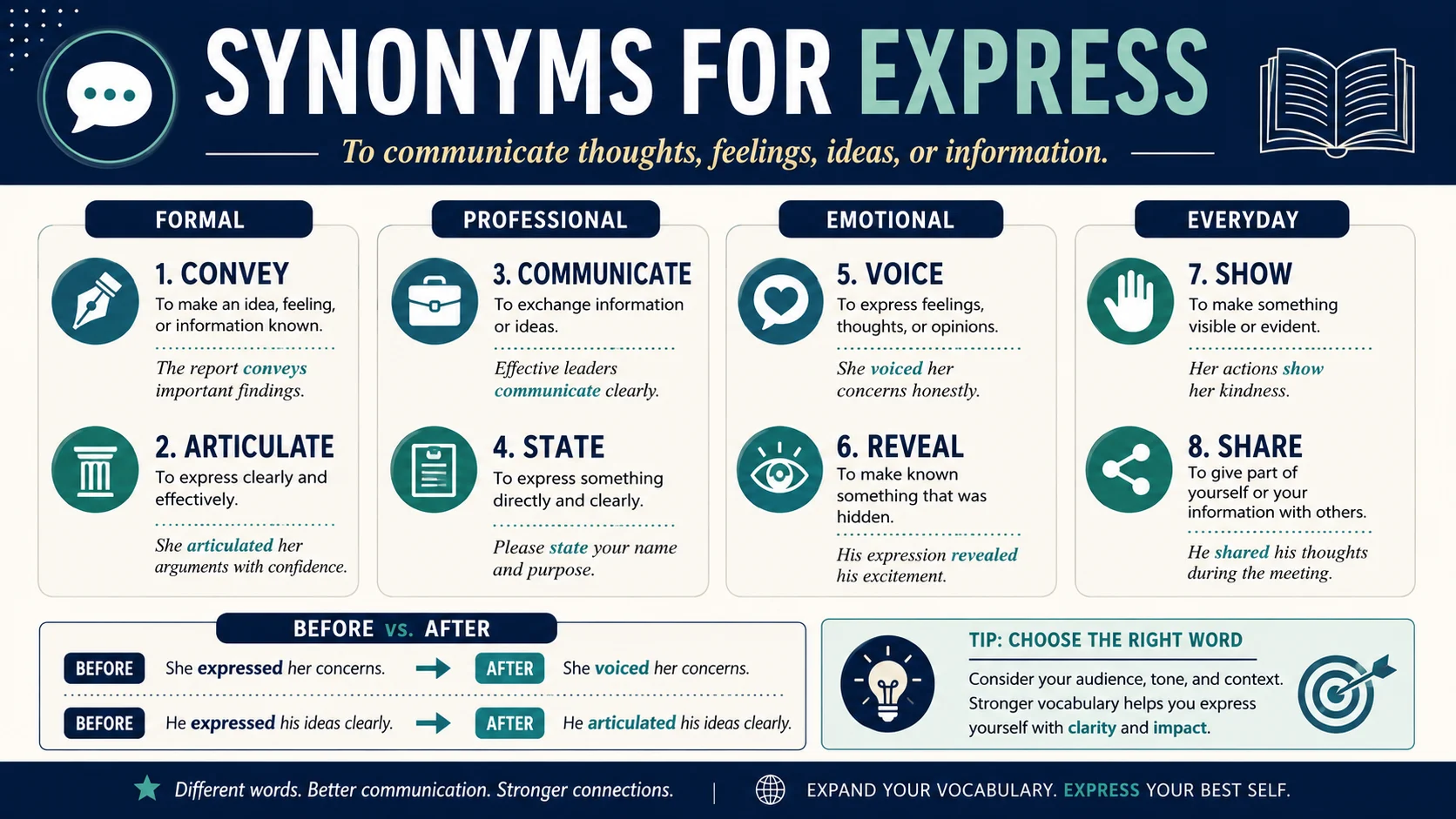
Another word for express depends on the context. Common synonyms include convey, communicate, state, articulate, voice, reveal, demonstrate, and show. Use convey to communicate an idea, articulate to explain something clearly, and voice to share an opinion or feeling.
What Does Express Mean?
Definition
The word express means to communicate a thought, feeling, idea, opinion, or message through words, actions, gestures, or other forms of communication. It can also mean to show something clearly or make an idea known to others.
As a verb, express is commonly used when someone shares emotions, explains opinions, communicates information, or demonstrates a particular attitude.
For example:
- She found it difficult to express her feelings.
- The employee expressed concerns about the new policy.
- His painting expresses a deep sense of sadness.
The word also has other meanings. As an adjective, express can describe something designed to move quickly or provide a direct service, such as an express train or express delivery.
Common Uses
The meaning of express changes depending on the situation.
- Sharing feelings: Express happiness, sadness, anger, or gratitude.
- Communicating opinions: Express an opinion, concern, belief, or disagreement.
- Explaining ideas: Express thoughts, arguments, or information clearly.
- Showing something: Express creativity, confidence, or personality.
- Describing speed: Express delivery or express transportation refers to a faster service.
Understanding these meanings helps you choose a synonym that fits your sentence naturally.
Best Synonyms for Express
The best synonyms for express include convey, communicate, articulate, state, voice, indicate, demonstrate, reveal, and show. However, these words are not always interchangeable.
| Synonym | Meaning | Best Used When | Example |
|---|---|---|---|
| Convey | Communicate or deliver an idea | Sharing information or feelings | Her words conveyed gratitude. |
| Communicate | Share information or thoughts | General communication | He communicated his concerns. |
| Articulate | Express something clearly | Explaining complex thoughts | She articulated her position. |
| State | Say something directly | Presenting facts or opinions | He stated his reasons. |
| Voice | Share an opinion or concern | Speaking about personal views | They voiced their objections. |
| Indicate | Show or suggest something | Giving signs or evidence | The results indicate improvement. |
| Demonstrate | Show through actions or evidence | Proving an idea or quality | She demonstrated confidence. |
| Reveal | Make something known | Sharing hidden information | His expression revealed disappointment. |
| Show | Make something visible or noticeable | Everyday communication | Her actions showed kindness. |
| Declare | Announce something clearly | Making a formal statement | The company declared its position. |
| Describe | Explain the details of something | Giving information about an experience | He described the situation. |
| Illustrate | Explain using examples | Making an idea easier to understand | The chart illustrates the results. |
Synonyms by Context
Choosing the right alternative depends on your audience, purpose, and writing style. A word that works in casual conversation may sound too informal in an academic paper or business report.
Formal Writing
In formal writing, choose words that communicate ideas accurately and professionally.
The best formal synonyms for express include:
- Articulate: To communicate thoughts clearly and effectively.
- Convey: To communicate information, meaning, or emotions.
- State: To present information or an opinion directly.
- Declare: To make an official or formal statement.
- Communicate: To share information with another person or group.
Examples:
- Original: The researcher expressed her concerns about the findings.
- Better: The researcher articulated her concerns about the findings.
- Original: The report expresses the importance of education.
- Better: The report conveys the importance of education.
Articulate works especially well when someone explains a complicated idea clearly.
Professional Writing
In business communication, the best alternatives are clear, direct, and appropriate for workplace situations.
Useful professional synonyms include:
- Communicate: Sharing information with colleagues or clients.
- Present: Introducing an idea, opinion, or proposal.
- Outline: Explaining the main points of a plan.
- State: Giving a direct and clear message.
- Convey: Delivering an important message or impression.
Examples:
- Original: I would like to express my interest in this position.
- Better: I would like to communicate my interest in this position.
- Original: The manager expressed the company’s expectations.
- Better: The manager outlined the company’s expectations.
For resumes and professional profiles, words such as demonstrated, presented, and communicated can also describe achievements and workplace skills.
Academic Writing
Academic writing requires precise language. Instead of repeating express, select a synonym that accurately describes how an argument, result, or idea is presented.
Recommended alternatives include:
- Indicate: To suggest or point toward a finding.
- Demonstrate: To show something through evidence.
- Illustrate: To explain an idea through examples.
- Argue: To present a reasoned position.
- Suggest: To present a possibility or interpretation.
- Articulate: To explain an argument clearly.
Examples:
- Original: The results express a significant change.
- Better: The results indicate a significant change.
- Original: The author expresses the importance of social development.
- Better: The author emphasizes the importance of social development.
Remember that indicate and demonstrate are particularly useful when discussing research findings, evidence, and conclusions.
Daily Conversation
In everyday conversations, simple words often sound more natural than formal alternatives.
Common choices include:
- Say: To communicate something using words.
- Tell: To share information with someone.
- Show: To make a feeling or idea noticeable.
- Share: To communicate personal thoughts or experiences.
- Mention: To refer to something briefly.
- Speak: To communicate verbally.
Examples:
- Original: I want to express how happy I am.
- Better: I want to show how happy I am.
- Original: She expressed her feelings to her friend.
- Better: She shared her feelings with her friend.
Professional Alternatives for Express
If you want to replace express in workplace communication, choose a word that describes exactly what you are trying to accomplish.
| Professional Alternative | Best Application | Example |
|---|---|---|
| Communicate | Sharing information | I communicated the project requirements. |
| Articulate | Explaining ideas | She articulated the team’s objectives. |
| Convey | Delivering a message | The presentation conveyed our vision. |
| Present | Introducing proposals | He presented a new strategy. |
| Outline | Explaining key points | We outlined the project goals. |
| Demonstrate | Showing ability | She demonstrated strong leadership. |
| Emphasize | Highlighting importance | The manager emphasized quality. |
Best choice for professional emails: Use communicate, state, or convey.
Best choice for resumes: Use demonstrated, presented, or communicated, depending on the achievement.
Best choice for business reports: Use indicate, outline, or demonstrate.
Simple Alternatives for Express
If you want easy words that readers can understand immediately, consider these alternatives:
| Simple Word | Meaning | Example |
|---|---|---|
| Say | Speak or communicate | She said what she thought. |
| Tell | Give information | He told me his opinion. |
| Show | Make something noticeable | His actions showed respect. |
| Share | Give information or feelings | She shared her experience. |
| Speak | Communicate verbally | He spoke about his concerns. |
| Mention | Refer to something | She mentioned her idea. |
| Explain | Make something understandable | He explained his feelings. |
These words work well in everyday conversations, simple articles, emails, and beginner-level writing.
Stronger Alternatives for Express
Sometimes express does not communicate enough emphasis. A stronger synonym can make your writing more specific and meaningful.
- Assert: To state something confidently or firmly.
- Proclaim: To announce something publicly or formally.
- Emphasize: To give special importance to an idea.
- Declare: To make a strong or official statement.
- Advocate: To publicly support an idea or cause.
- Demonstrate: To show something clearly through actions or evidence.
- Exclaim: To say something with strong emotion.
Examples:
- Original: She expressed her belief in equal opportunities.
- Stronger: She advocated for equal opportunities.
- Original: He expressed his disagreement.
- Stronger: He firmly asserted his disagreement.
- Original: The organization expressed its commitment to education.
- Stronger: The organization reaffirmed its commitment to education.
Choose stronger alternatives carefully. For example, advocate means actively supporting something, not simply communicating an opinion.
Difference Between Similar Synonyms
Several synonyms for express have similar meanings, but each has a different purpose.
Express vs. Convey
Express generally means communicating a thought, feeling, or idea. Convey focuses more on delivering meaning or information to another person.
- Express: She expressed her happiness.
- Convey: Her smile conveyed happiness.
Express vs. Articulate
Express is a general word for communicating thoughts and feelings. Articulate means explaining something clearly and effectively, particularly through words.
- Express: He expressed his opinion.
- Articulate: He articulated his opinion clearly.
Express vs. Communicate
Express often focuses on sharing personal thoughts or emotions. Communicate has a broader meaning and includes exchanging information, instructions, and messages.
- Express: She expressed her frustration.
- Communicate: The team communicated the project updates.
Express vs. State
Express can involve words, gestures, or actions. State specifically means presenting information or an opinion in words.
- Express: He expressed his disappointment.
- State: He stated that he was disappointed.
Express vs. Demonstrate
Express can describe communicating a feeling or thought. Demonstrate means showing something through actions, examples, or evidence.
- Express: She expressed confidence.
- Demonstrate: She demonstrated confidence during the presentation.
Opposite Words of Express
The opposite of express depends on its meaning. When it refers to communicating thoughts or feelings, useful antonyms include:
| Antonym | Meaning | Example |
|---|---|---|
| Conceal | Keep something hidden | He concealed his feelings. |
| Suppress | Prevent something from being expressed | She suppressed her anger. |
| Hide | Keep something out of sight | He hid his disappointment. |
| Withhold | Refuse to share information | They withheld their opinions. |
| Silence | Prevent someone from speaking | The decision silenced the critics. |
| Suppress | Hold back an emotion or reaction | She suppressed her frustration. |
For example, if someone expresses their feelings, they communicate them openly. If they conceal their feelings, they keep them private.
FAQs
1. What is another word for express?
Common alternatives include convey, communicate, articulate, state, voice, show, reveal, and demonstrate. The best choice depends on whether you are sharing information, describing emotions, or presenting an opinion.
2. What is the most common synonym for express?
Communicate and convey are among the most useful alternatives. Communicate works in general situations, while convey is especially useful for sharing ideas, messages, and emotions.
3. What is a formal synonym for express?
Formal synonyms include articulate, convey, communicate, declare, and state. Articulate is particularly appropriate when describing the clear communication of complex thoughts or opinions.
4. What is a professional alternative for express?
Professional alternatives include communicate, present, outline, convey, and demonstrate. These words work well in business emails, workplace discussions, presentations, and reports.
5. What is another word for express feelings?
You can use share, communicate, reveal, convey, show, or articulate. For example, “She shared her feelings with her family” is a natural alternative to “She expressed her feelings to her family.”
6. What is another word for express an opinion?
Useful alternatives include state, voice, share, communicate, articulate, and assert. Use assert when someone presents an opinion confidently or firmly.
7. What is a stronger word for express?
Words such as proclaim, declare, assert, emphasize, and advocate can communicate stronger meanings. However, each has a slightly different purpose and should match the sentence.
8. What is another word for express interest?
Alternatives include show interest, demonstrate enthusiasm, communicate interest, indicate interest, and convey enthusiasm.
9. What is the opposite of express?
Depending on the context, antonyms include conceal, hide, suppress, withhold, and silence. These words describe keeping information, thoughts, or emotions from being communicated.
10. Can convey and express be used interchangeably?
Sometimes. Both words can describe communicating ideas and emotions. However, convey focuses on delivering meaning, while express more broadly describes making thoughts, feelings, or opinions known.
Conclusion
The best synonyms for express include convey, communicate, articulate, state, voice, demonstrate, reveal, and show. Each alternative has a slightly different meaning, so your choice should depend on the message and writing context.
Use articulate for clearly explaining ideas, convey for delivering meaning, communicate for sharing information, and voice for expressing opinions or concerns. Selecting the right synonym makes your writing more natural, precise, and engaging.