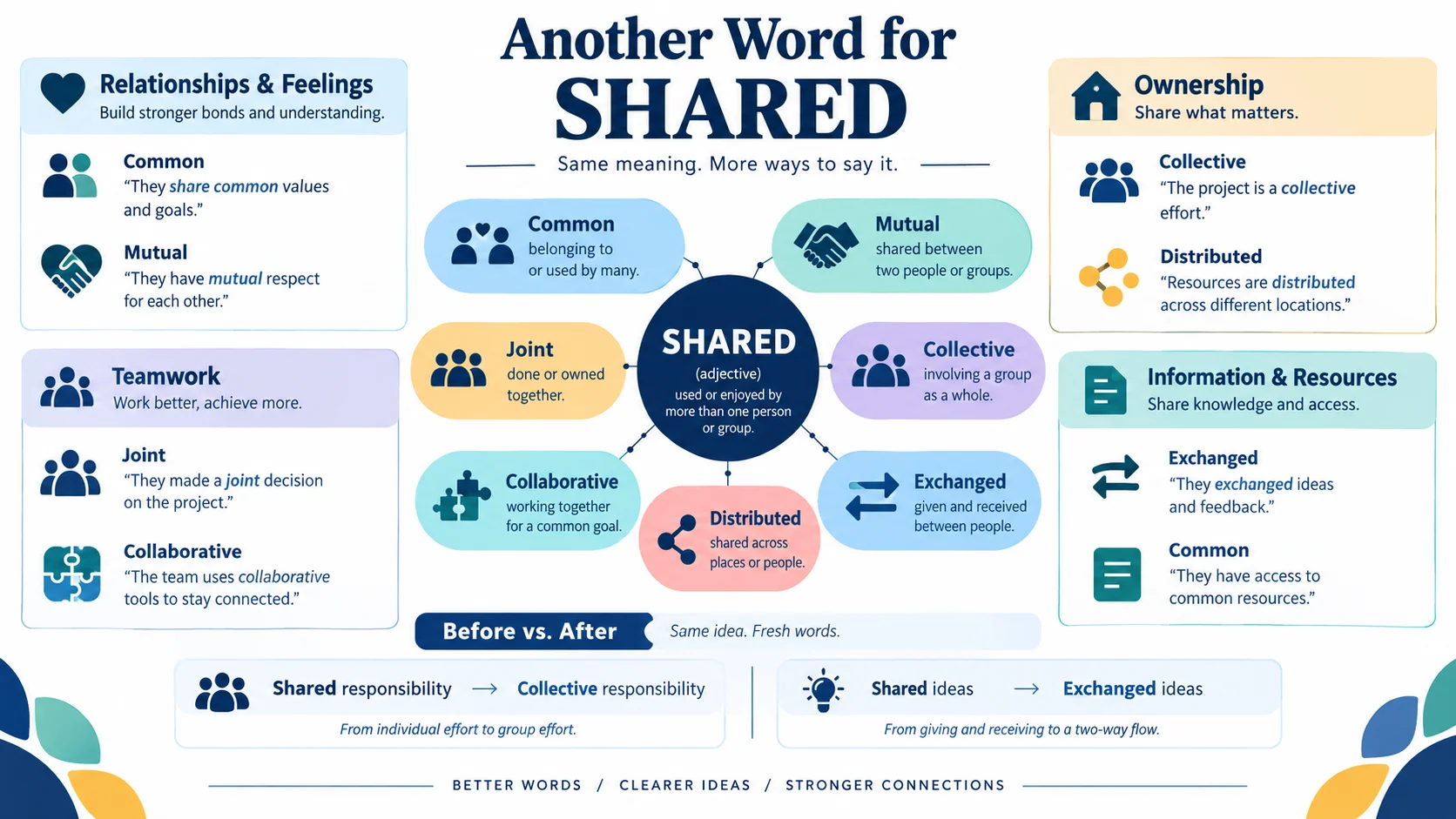
Another word for shared depends on the context. Common synonyms include common, mutual, joint, collective, distributed, exchanged, communicated, and collaborative. Use mutual for feelings or understanding between people, joint for a combined effort, distributed for resources divided among people, and communicated for information passed to others. The best alternative depends on what is being shared.
What Does Shared Mean?
Definition
The word shared is the past tense and past participle of share. It can also function as an adjective. It describes something given, used, experienced, or possessed by two or more people or groups.
For example:
- We shared our ideas during the meeting.
- They have a shared responsibility for the project.
- The siblings use a shared bedroom.
- She shared the document with her colleagues.
The meaning changes according to the context. Sharing information is different from sharing property, responsibilities, emotions, or experiences. Choosing the right synonym makes your writing more specific and natural.
Common Uses
The word shared appears in several situations:
- Information: Shared ideas, news, files, or knowledge.
- Relationships: Shared feelings, interests, values, or experiences.
- Teamwork: Shared goals, duties, resources, or responsibilities.
- Business: Shared data, costs, ownership, or decisions.
- Academic writing: Shared findings, research materials, or perspectives.
- Everyday life: Shared meals, rooms, belongings, or experiences.
Best Synonyms for Shared
| Synonym | Meaning | Best Used When | Example |
|---|---|---|---|
| Common | Belonging to or affecting multiple people | Interests, goals, or characteristics | They have a common interest in science. |
| Mutual | Felt, experienced, or agreed upon by two or more parties | Respect, trust, or understanding | They developed mutual respect. |
| Joint | Done or held together | Projects, ownership, or decisions | They submitted a joint proposal. |
| Collective | Involving a group acting together | Efforts, decisions, or achievements | The team made a collective decision. |
| Distributed | Divided or delivered among people or places | Resources, tasks, or documents | The manager distributed the assignments. |
| Exchanged | Given and received between parties | Ideas, messages, or information | The colleagues exchanged ideas. |
| Communicated | Conveyed information to others | News, instructions, or thoughts | She communicated the results to her team. |
| Collaborative | Created or completed through cooperation | Projects, work, and learning | They developed a collaborative solution. |
| Combined | Joined together into one | Efforts, resources, or skills | Their combined efforts improved the results. |
| Collectively owned | Owned by multiple people as a group | Property, businesses, or assets | The land was collectively owned. |
| Divided | Separated into portions | Costs, tasks, or resources | They divided the expenses equally. |
| Disclosed | Made information known | Records, facts, or confidential information | The company disclosed the findings. |
| Revealed | Made something previously unknown visible or known | Discoveries, details, or results | He revealed the results to the group. |
| Imparted | Passed knowledge or information to someone | Teaching, advice, or expertise | The professor imparted valuable knowledge. |
| Contributed | Given something toward a common purpose | Ideas, money, effort, or resources | Everyone contributed ideas to the discussion. |
Synonyms by Context
Formal Writing
In formal writing, mutual, collective, joint, communicated, and disclosed can replace shared when their meanings fit.
Mutual is appropriate for relationships, agreements, or feelings that exist between parties.
Example: The agreement reflects mutual understanding between the organizations.
Joint works when people or groups formally participate in an activity together.
Example: The departments released a joint statement.
Disclosed is useful when information is officially made known, particularly in business or legal contexts.
Example: The organization disclosed the relevant financial information.
These words are not interchangeable in every sentence. A shared document, for instance, is not necessarily a disclosed document.
Professional Writing
For business communication, useful alternatives include collaborative, joint, distributed, communicated, and combined.
Collaborative emphasizes working together toward a result.
Business example: The departments adopted a collaborative approach to product development.
Distributed is suitable when information, duties, or resources are allocated to multiple recipients.
Business example: The manager distributed the updated guidelines to all employees.
Communicated is more precise when the focus is on delivering information.
Business example: The team communicated its findings to senior management.
For resumes, use specific action verbs such as coordinated, communicated, contributed, or collaborated when they accurately describe your work.
Academic Writing
Academic writing often uses collective, mutual, communicated, exchanged, and contributed.
Collective describes an effort, judgment, or outcome involving a group.
Academic example: The researchers developed a collective understanding of the findings.
Exchanged emphasizes that participants gave and received ideas or information.
Academic example: Students exchanged feedback before submitting their final papers.
Contributed is appropriate when individuals add information, evidence, or ideas to a larger body of work.
Academic example: Each participant contributed observations to the research project.
Daily Conversation
In everyday English, common, mutual, exchanged, gave, and talked about may sound more natural than formal alternatives.
Examples:
- Instead of “We shared similar interests,” say “We had a lot in common.”
- Instead of “We shared our thoughts,” say “We talked about our ideas.”
- Instead of “They shared gifts,” say “They exchanged gifts” when each person gave something to the other.
- Instead of “We shared the cost,” say “We split the cost.”
The best replacement depends on whether people gave something, received something, or simply experienced it together.
Professional Alternatives for Shared
Collaborative
Meaning: Involving people working together to achieve a common result.
Best Used For: Teamwork, projects, planning, and problem-solving.
Tone: Professional
Difficulty: Medium
Usage Frequency: Common
Best For: Resume, Email Writing, Academic Writing, Marketing Copy, Business Writing
- Business example: Led a collaborative project involving three departments.
- Academic example: The students completed a collaborative research assignment.
- Daily conversation example: We used a collaborative approach to plan the event.
Mutual
Meaning: Existing or experienced by two or more parties.
Best Used For: Trust, respect, understanding, agreements, and relationships.
Tone: Neutral to formal
Difficulty: Easy
Usage Frequency: Common
Best For: Email Writing, Essay Writing, Business Writing
- Business example: The partnership is built on mutual respect.
- Academic example: The participants reached a mutual understanding of the study’s objectives.
- Daily conversation example: The feeling was mutual.
Distributed
Meaning: Spread or allocated among multiple people, places, or groups.
Best Used For: Documents, tasks, resources, and information.
Tone: Neutral to professional
Difficulty: Medium
Usage Frequency: Common
Best For: Resume, Email Writing, Business Writing
- Business example: Distributed project responsibilities across the team.
- Academic example: The instructor distributed the study materials to participants.
- Daily conversation example: She distributed the snacks among her friends.
Communicated
Meaning: Conveyed information, thoughts, or instructions to others.
Best Used For: Presentations, announcements, findings, and professional updates.
Tone: Professional
Difficulty: Easy
Usage Frequency: Very Common
Best For: Resume, Email Writing, Academic Writing, Business Writing
- Business example: Communicated project updates to stakeholders.
- Academic example: The researchers communicated their conclusions in a published paper.
- Daily conversation example: He communicated his concerns to me.
Simple Alternatives for Shared
If you want a straightforward replacement, consider these words and phrases:
- Gave: She gave me the document.
- Used together: We used the same workspace.
- Split: We split the bill.
- Exchanged: They exchanged ideas.
- Told: He told us the news.
- Common: They have a common interest.
- Worked together: We worked together on the assignment.
- Had in common: We had many interests in common.
These expressions often sound more natural than shared, especially in casual conversation.
Stronger Alternatives for Shared
Sometimes a more specific word improves your writing.
Collaborated emphasizes active cooperation. Use it when people work together on a project or solution.
Contributed highlights the effort, information, or resources someone adds to a group.
Disclosed emphasizes formally revealing information that was not previously known or available.
Distributed emphasizes delivering or allocating something to multiple recipients.
Communicated focuses on the act of conveying information.
Co-owned specifically describes property or assets legally owned by more than one person.
For example, “We shared responsibility for the project” could become “We jointly managed the project.” The revised sentence describes the actual action more clearly.
Difference Between Similar Synonyms
Shared vs. Common: Shared often describes something people possess, experience, or use together. Common describes something that multiple people have in common or that occurs frequently.
Shared vs. Mutual: Mutual emphasizes a relationship or feeling that goes both ways. Shared is broader and can describe objects, information, responsibilities, or experiences.
Shared vs. Joint: Joint often sounds more formal and emphasizes combined participation or ownership. Shared is more general.
Shared vs. Collective: Collective emphasizes a group as a whole. Shared may describe something involving just two people.
Shared vs. Distributed: Distributed means something has been allocated or delivered to different recipients. Shared does not necessarily mean that something was divided.
Shared vs. Exchanged: Exchanged usually suggests a two-way transfer. Shared can describe giving information or resources without receiving anything in return.
Shared vs. Collaborative: Collaborative describes cooperation in the process of working together. Shared describes something that people have, do, or experience together.
Opposite Words
The opposite of shared depends on the intended meaning.
| Meaning of Shared | Possible Opposite | Example |
|---|---|---|
| Used by multiple people | Private | The document is private. |
| Held in common | Individual | Each person has an individual assignment. |
| Distributed among people | Withheld | The information was withheld. |
| Communicated to others | Concealed | The details were concealed. |
| Completed together | Independent | Each researcher worked independently. |
| Divided among people | Kept | She kept the entire amount. |
These are contextual opposites rather than exact antonyms in every situation.
FAQs
What is another word for shared?
Common alternatives include common, mutual, joint, collective, distributed, exchanged, communicated, and collaborative. The best choice depends on whether you mean sharing information, resources, responsibilities, or experiences.
What is a formal synonym for shared?
Formal alternatives include joint, collective, mutual, disclosed, and communicated. Choose the word that accurately reflects the relationship or action being described.
What is a professional alternative for shared?
In professional writing, consider collaborated, communicated, contributed, distributed, or jointly managed. These words often describe specific workplace actions more clearly.
What is another word for shared responsibility?
Useful alternatives include joint responsibility, collective responsibility, mutual responsibility, and joint accountability. The best choice depends on whether the responsibility belongs to individuals together or to a group as a whole.
What is another word for shared information?
Possible alternatives include communicated information, exchanged information, disseminated information, and distributed information. Disseminated is especially suitable for formal communication involving a broad audience.
What is another word for shared interests?
You can say common interests, mutual interests, similar interests, or interests in common. “Common interests” is often the simplest and most natural alternative.
What is another word for shared feelings?
Depending on the context, use mutual feelings, common emotions, similar feelings, or feelings experienced together. Mutual feelings is particularly useful when describing emotions between two people.
What is another word for shared knowledge?
Useful alternatives include collective knowledge, common knowledge, combined expertise, and knowledge exchanged. These phrases have different meanings, so choose according to whether knowledge is held collectively or actively transferred.
Is shared the same as mutual?
Not exactly. Mutual usually describes something that exists between two or more parties, such as respect or trust. Shared can also describe physical objects, resources, files, duties, and experiences.
What is the opposite of shared?
Possible opposites include private, individual, withheld, concealed, and independent. The correct choice depends on whether shared refers to ownership, information, work, or experiences.
Conclusion
The best another word for shared depends on what people are sharing. Choose mutual for feelings and understanding, joint for combined activities, collective for group efforts, distributed for resources, and communicated for information.
In professional writing, specific alternatives such as collaborated, contributed, and jointly managed can make accomplishments clearer. In everyday conversation, phrases like split the cost and had in common often sound more natural.
The goal is to select a word that accurately communicates the relationship, action, or experience rather than replacing shared with a synonym that only partially fits.