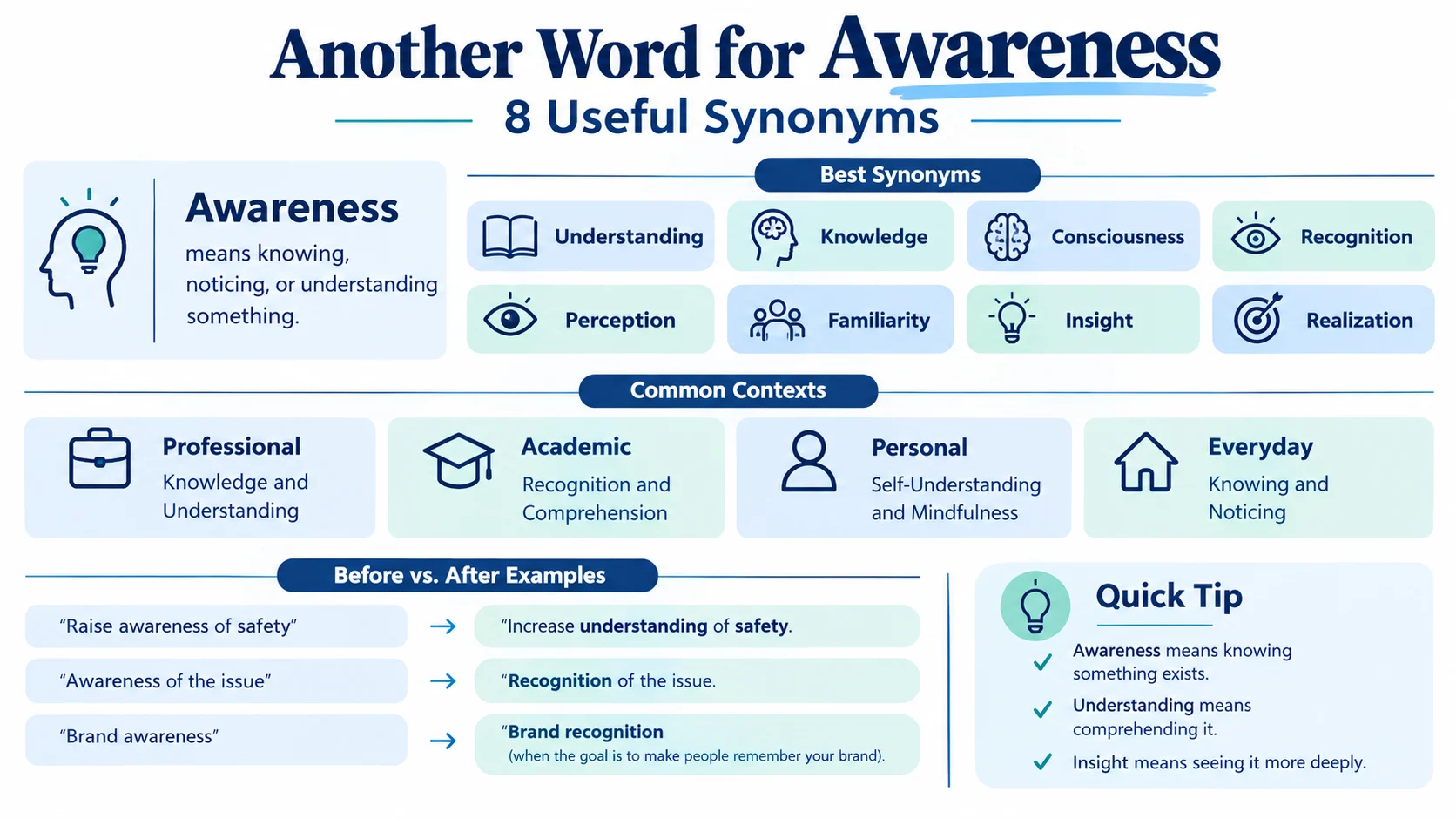
Another word for awareness is understanding, which describes knowing about or recognizing something. Other useful synonyms include knowledge, consciousness, recognition, familiarity, perception, and realization. The best alternative depends on context. Use knowledge for information, recognition for identifying something, and consciousness for being mentally aware of yourself or your surroundings.
What Does Awareness Mean?
Definition
Awareness is the state of knowing, noticing, or understanding something. It can refer to knowledge of a fact, recognition of a situation, consciousness of your surroundings, or understanding of an issue.
For example, “The campaign increased awareness of mental health” means that more people learned about or understood mental health concerns.
Awareness can involve simple recognition or deeper understanding. Someone may be aware of a problem without fully understanding its causes or knowing how to solve it.
Common Uses
The word awareness appears in several contexts:
- Personal awareness: Understanding your own thoughts, emotions, strengths, and behavior.
- Public awareness: Knowledge of social issues, public health, or community concerns.
- Business awareness: Understanding customers, market conditions, and organizational goals.
- Environmental awareness: Recognizing environmental challenges and their effects.
- Academic awareness: Knowledge of research findings, theories, or important concepts.
- Situational awareness: Recognizing what is happening around you and understanding its significance.
Choosing the right synonym helps communicate whether you mean basic knowledge, active recognition, deeper understanding, or conscious attention.
Best Synonyms for Awareness
The best synonym depends on the type of awareness you want to describe.
| Synonym | Meaning | Best Used When | Example |
|---|---|---|---|
| Understanding | Knowledge of a subject or situation | Explaining comprehension | She has a strong understanding of the issue. |
| Knowledge | Information or facts someone possesses | Discussing learned information | The training improved employees’ knowledge of safety rules. |
| Consciousness | The state of being mentally aware | Discussing thoughts or surroundings | He developed a greater consciousness of his habits. |
| Recognition | Identifying or acknowledging something | Noticing a problem or fact | Recognition of the warning signs is important. |
| Familiarity | Knowing something through experience or exposure | Describing experience with a subject | Her familiarity with the software helped the team. |
| Perception | The way someone notices or interprets something | Describing impressions or viewpoints | Public perception of the brand changed. |
| Realization | Becoming aware of a fact or truth | Describing a moment of discovery | The realization changed his priorities. |
| Attention | The act of focusing on something | Discussing focus or notice | The announcement brought attention to the issue. |
| Mindfulness | Paying attention to the present moment | Discussing intentional attention | Mindfulness helped her recognize her stress. |
| Insight | A deeper understanding of a situation | Explaining meaningful understanding | The interview provided insight into customer needs. |
| Acknowledgment | Acceptance or recognition of a fact | Discussing recognition of an issue | The acknowledgment of the risk improved planning. |
| Alertness | Being attentive and quick to notice changes | Safety and immediate surroundings | Alertness helps drivers respond to hazards. |
Synonyms for Awareness by Context
Formal Writing
Formal writing often requires a specific word that communicates the intended meaning precisely.
Useful alternatives include consciousness, recognition, understanding, and acknowledgment.
Example:
Original: The report increased awareness of workplace inequality.
Revised: The report increased recognition of workplace inequality.
Another option: The report improved understanding of workplace inequality.
The first revision emphasizes recognizing the issue, while the second suggests a stronger grasp of it.
Professional Writing
In business communication, awareness often relates to customers, risks, employees, or market conditions.
Useful alternatives include knowledge, understanding, familiarity, and recognition.
Business example
Original: The training improved employee awareness of cybersecurity risks.
Revised: The training improved employee understanding of cybersecurity risks.
Alternative: The training increased employee knowledge of cybersecurity risks.
Use understanding when employees need to comprehend risks and their implications. Use knowledge when the emphasis is on information and facts.
Academic Writing
Academic writing benefits from precise distinctions between knowing a fact, interpreting evidence, and consciously noticing something.
Useful alternatives include consciousness, perception, recognition, understanding, and insight.
Academic example
Original: The study examined public awareness of climate change.
Revised: The study examined public understanding of climate change.
These versions can describe different research goals. Awareness may measure whether people have heard about climate change, while understanding may measure how well they comprehend its causes and effects.
Choose terminology that matches the study’s actual measures.
Daily Conversation
In everyday American English, simple alternatives usually sound natural and clear.
| Instead of Awareness | Use | Example |
|---|---|---|
| Awareness of the problem | Knowing about the problem | More people are now aware of the problem. |
| Self-awareness | Understanding yourself | She has a good understanding of herself. |
| Awareness of the surroundings | Noticing your surroundings | Stay alert to what’s happening around you. |
| Growing awareness | Increasing understanding | There is growing understanding of the issue. |
| Public awareness | Public knowledge | The campaign increased public knowledge of recycling. |
For casual conversations, knowing, understanding, and noticing are often more natural than the noun awareness.
Professional Alternatives for Awareness
The following alternatives are especially useful for resumes, emails, business reports, and professional documents.
1. Understanding
Meaning: Knowledge of the meaning, nature, or importance of something.
Best used for: Demonstrating comprehension of processes, people, policies, or complex subjects.
Tone: Neutral and professional.
Difficulty: Easy.
Usage frequency: Very common.
Best for: Resumes, email writing, essays, and business writing.
- Business example: I developed a strong understanding of customer needs.
- Academic example: The course improved students’ understanding of economic theory.
- Daily conversation example: I have a better understanding of what happened.
2. Knowledge
Meaning: Information, facts, or skills gained through learning or experience.
Best used for: Highlighting expertise, information, and subject familiarity.
Tone: Professional and direct.
Difficulty: Easy.
Usage frequency: Very common.
Best for: Resumes, business writing, academic essays, and marketing copy.
- Business example: My knowledge of data analysis supports informed decision-making.
- Academic example: The research expanded existing knowledge of the subject.
- Daily conversation example: He has extensive knowledge of computers.
3. Insight
Meaning: A deep or clear understanding of a situation, person, or problem.
Best used for: Describing meaningful discoveries, analytical thinking, or deeper understanding.
Tone: Professional and thoughtful.
Difficulty: Medium.
Usage frequency: Common.
Best for: Resumes, business reports, essays, and marketing copy.
- Business example: Customer interviews provided valuable insight into purchasing behavior.
- Academic example: The findings offer insight into the causes of the observed pattern.
- Daily conversation example: Her advice gave me insight into the situation.
4. Recognition
Meaning: The act of identifying, noticing, or acknowledging something.
Best used for: Describing the identification of risks, patterns, needs, or problems.
Tone: Neutral to formal.
Difficulty: Medium.
Usage frequency: Very common.
Best for: Professional emails, academic writing, business reports, and marketing copy.
- Business example: Recognition of emerging market trends helped the company adapt.
- Academic example: Early recognition of the pattern improved the analysis.
- Daily conversation example: Recognition of the problem was the first step toward fixing it.
Simple Alternatives for Awareness
If you want clear, accessible language, consider these options.
Knowing: Use when someone has information about something.
Example: Awareness of the changes is important.
Simpler: Knowing about the changes is important.
Understanding: Use when someone comprehends a subject or situation.
Example: The workshop raised awareness of healthy habits.
Simpler: The workshop improved understanding of healthy habits.
Noticing: Use when someone becomes conscious of something through observation.
Example: Awareness of small changes can be helpful.
Simpler: Noticing small changes can be helpful.
Attention: Use when the focus is on directing interest toward something.
Example: The campaign raised awareness of road safety.
Alternative: The campaign brought attention to road safety.
These words overlap with awareness, but they are not interchangeable in every sentence. Choose the one that best reflects the intended meaning.
Stronger Alternatives for Awareness
When you want to express a deeper or more specific form of awareness, these alternatives can be effective.
- Consciousness: A state of being aware of yourself, your thoughts, or your surroundings.
- Insight: A deep understanding of a subject or situation.
- Perception: The way someone notices or interprets information.
- Mindfulness: Intentional attention to present experiences.
- Acumen: The ability to make good judgments, especially in business or practical matters.
- Comprehension: The ability to understand information or ideas.
Examples:
- Greater self-consciousness is not always the same as greater self-understanding.
- Business acumen helps professionals interpret market conditions.
- Mindfulness can help people notice their thoughts and emotions.
- Better comprehension of the instructions reduced errors.
Use acumen when you mean practical judgment or skill, not simply knowing that something exists. Similarly, comprehension emphasizes understanding rather than basic recognition.
Difference Between Similar Synonyms
Several words associated with awareness have distinct meanings.
| Word | Key Difference | Example |
|---|---|---|
| Awareness | General knowledge or recognition | Public awareness of the issue increased. |
| Knowledge | Information someone possesses | Her knowledge of the law is extensive. |
| Understanding | Comprehension of meaning or significance | He showed an understanding of the problem. |
| Consciousness | A state of being mentally aware | Consciousness of his surroundings helped him react. |
| Recognition | Identifying or acknowledging something | Recognition of the warning signs was essential. |
| Perception | How something is noticed or interpreted | Customer perception of the product improved. |
| Insight | Deep understanding | The report provided insight into customer behavior. |
| Mindfulness | Intentional attention to the present | Mindfulness helped him notice his reactions. |
Awareness vs. Consciousness
Awareness is a broad term for knowing about something. Consciousness can refer to being mentally aware, including awareness of one’s own thoughts or surroundings.
For example, awareness of a health risk means knowing the risk exists. Consciousness of your habits may involve noticing your own behavior and reactions.
Awareness vs. Understanding
Awareness does not necessarily mean complete comprehension. A person can be aware of a new policy without understanding how it works.
Use understanding when you want to emphasize comprehension rather than simply knowing that something exists.
Awareness vs. Perception
Awareness refers to noticing or knowing something, while perception concerns how someone interprets or experiences it.
For example, customers may be aware of a company’s new product but have different perceptions of its quality.
Opposite Words for Awareness
The opposite of awareness depends on the intended meaning. Common antonyms include:
| Antonym | Meaning | Example |
|---|---|---|
| Ignorance | Lack of knowledge | Ignorance of the rules caused confusion. |
| Unawareness | Lack of awareness | Unawareness of the deadline led to a delay. |
| Inattention | Lack of attention | Inattention to detail resulted in errors. |
| Unconsciousness | Lack of conscious awareness | The patient briefly lost consciousness. |
| Obliviousness | Failure to notice or recognize something | His obliviousness to the warning signs was concerning. |
| Misunderstanding | Incorrect or incomplete understanding | A misunderstanding of the instructions caused problems. |
Ignorance is suitable when knowledge is missing. Inattention is better when someone fails to focus, while obliviousness describes a failure to notice something that may be obvious to others.
FAQs
1. What is the best synonym for awareness?
Understanding is a strong general alternative when awareness involves comprehension. Knowledge works for information, recognition for identifying something, and consciousness for mental awareness.
2. What is a formal synonym for awareness?
Consciousness, recognition, acknowledgment, and understanding can work in formal writing. Choose the word that matches the intended meaning.
3. What is a professional alternative for awareness?
Knowledge, understanding, familiarity, and insight are useful in business communication. For resumes, describe a specific skill or area of expertise when possible.
4. What word can replace awareness in an essay?
Depending on the context, use understanding, knowledge, recognition, perception, or consciousness. Academic writing should prioritize accuracy over stylistic variety.
5. What is another word for self-awareness?
Useful alternatives include self-understanding, self-knowledge, and self-consciousness. However, self-consciousness can also mean feeling uncomfortable or overly concerned about how others perceive you.
6. What is another word for public awareness?
Depending on the context, use public knowledge, public understanding, recognition, or public consciousness. Public understanding is useful when the goal is to communicate comprehension rather than simple exposure to information.
7. What is another word for raising awareness?
Useful alternatives include increasing understanding, promoting knowledge, drawing attention to, and encouraging recognition. For example, “The campaign raises awareness” can become “The campaign draws attention to the issue.”
8. Is awareness the same as knowledge?
Not exactly. Awareness means knowing about or noticing something, while knowledge generally refers to information or facts someone possesses. Awareness can exist without detailed knowledge.
9. What is the difference between awareness and realization?
Awareness can be an ongoing state of knowing something. Realization often describes the moment someone comes to understand or recognize a fact.
10. What is the opposite of awareness?
Common opposites include ignorance, unawareness, inattention, and obliviousness. The best choice depends on whether the missing element is knowledge, attention, or recognition.
Conclusion
The best alternative for awareness depends on what you want to communicate. Use understanding for comprehension, knowledge for information, recognition for identifying an issue, consciousness for mental awareness, and insight for deeper understanding.
For professional and academic writing, choose the most precise word rather than replacing awareness simply to avoid repetition. Clear language helps readers understand whether you mean knowing about something, interpreting it, or recognizing its importance.