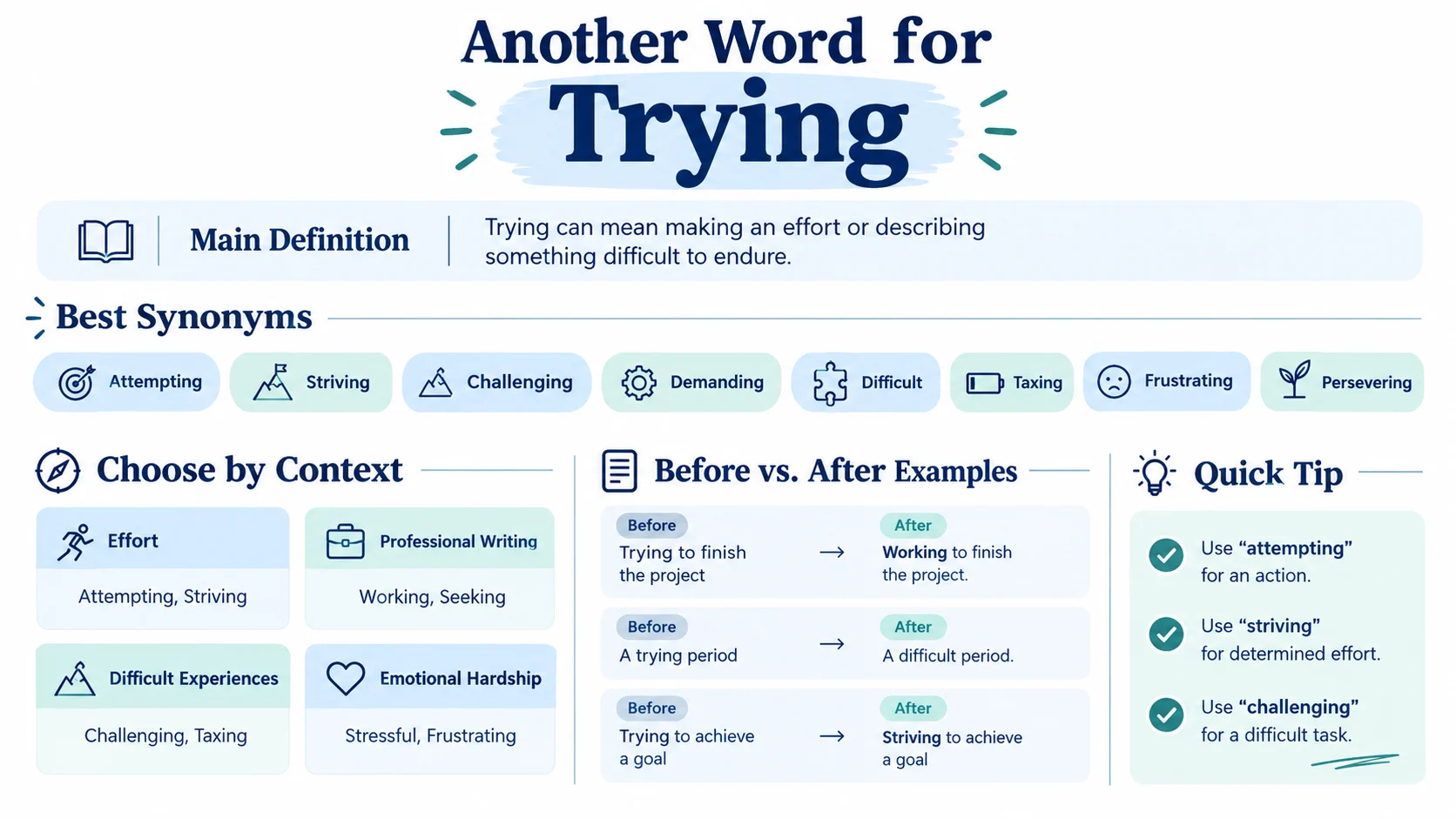
Another word for trying depends on its meaning in a sentence. When trying means making an effort, use attempting, striving, or working. When it means difficult or challenging, use demanding, difficult, or challenging. When it describes a test of patience, taxing or stressful may fit best.
What Does Trying Mean?
Definition
The word trying has several meanings in American English. It can describe making an effort to do something, experiencing difficulty, or testing someone’s patience.
As a form of the verb try, it means attempting to achieve a goal or complete an action. As an adjective, it describes something difficult to endure, manage, or deal with.
For example:
- Making an effort: She is trying to improve her writing.
- Experiencing difficulty: The team is going through a trying period.
- Testing patience: His constant interruptions were trying.
The correct synonym depends on which meaning you intend. Words such as attempting and striving relate to effort, while difficult and taxing describe hardship.
Common Uses
Trying appears in several everyday and professional situations:
- Personal goals: Trying to learn a new skill.
- Workplace tasks: Trying to solve a technical problem.
- Academic work: Trying to understand a complicated theory.
- Emotional experiences: Going through a trying time.
- Relationships: Dealing with a trying situation or behavior.
Understanding these differences helps you choose a replacement that preserves the original meaning.
Best Synonyms for Trying
The following table covers the most useful alternatives for the different meanings of trying.
| Synonym | Meaning | Best Used When | Example |
|---|---|---|---|
| Attempting | Making an effort to do something | Describing an action | She is attempting to solve the problem. |
| Striving | Working hard toward a goal | Emphasizing determination | He is striving for excellence. |
| Endeavoring | Making a serious effort | Formal writing | The team is endeavoring to improve performance. |
| Working | Putting effort into a task | Everyday and professional contexts | She is working to improve her skills. |
| Seeking | Trying to find or achieve something | Goals and opportunities | They are seeking a better solution. |
| Pursuing | Actively working toward a goal | Career or academic ambitions | He is pursuing a degree. |
| Challenging | Requiring effort or skill | Difficult tasks | The assignment was challenging. |
| Difficult | Not easy to manage or complete | General hardship | It was a difficult week. |
| Demanding | Requiring considerable effort | Workloads and responsibilities | The project was demanding. |
| Taxing | Requiring significant mental or physical energy | Exhaustion and pressure | The long shift was taxing. |
| Stressful | Causing worry or tension | Emotional situations | The process was stressful. |
| Frustrating | Causing annoyance or discouragement | Obstacles and setbacks | The repeated errors were frustrating. |
| Arduous | Requiring sustained effort | Formal descriptions of hard work | The team completed an arduous task. |
| Trying hard | Making a strong effort | Conversational emphasis | She is trying hard to succeed. |
| Testing | Putting patience or resilience under pressure | Difficult experiences | It was a testing period for the family. |
Synonyms for Trying by Context
Formal Writing
Formal writing benefits from precise words that communicate effort or difficulty without changing the intended meaning.
If trying means making an effort, consider:
- Endeavoring: Making a serious attempt to accomplish something.
- Striving: Working persistently toward a goal.
- Attempting: Undertaking an action with a particular objective.
- Pursuing: Actively working toward a goal or outcome.
Example:
Original: The researchers are trying to identify the cause of the problem.
Revised: The researchers are attempting to identify the cause of the problem.
More formal alternative: The researchers are endeavoring to identify the cause of the problem.
If trying describes hardship, alternatives such as arduous, demanding, and taxing may be more accurate.
Example: The organization experienced a trying period.
Revised: The organization experienced a challenging period.
Professional Writing
In business communication, choose alternatives that describe the action or challenge clearly.
Useful alternatives: Attempting, working, seeking, challenging, demanding, and difficult.
Business example
Original: We are trying to improve customer satisfaction.
Revised: We are working to improve customer satisfaction.
Alternative: We are seeking ways to improve customer satisfaction.
The first revision emphasizes ongoing effort. The second emphasizes looking for solutions.
For workplace reports, avoid replacing trying with striving unless the sentence needs a stronger sense of commitment or determination.
Academic Writing
Academic writing often requires specific verbs that explain what researchers or students are doing.
Useful alternatives: Investigating, examining, attempting, exploring, and evaluating.
Example:
Original: The study is trying to determine whether the treatment is effective.
Revised: The study is examining whether the treatment is effective.
Another option: The researchers are attempting to determine whether the treatment is effective.
The best choice depends on the research activity. Examining describes analysis, investigating suggests a systematic inquiry, and attempting emphasizes an effort to reach an outcome.
When trying means difficult, use challenging, demanding, or arduous instead.
Example: The students faced a trying research process.
Revised: The students faced a demanding research process.
Daily Conversation
In everyday American English, simple words often sound more natural than formal alternatives.
| Instead of Trying | Use | Example |
|---|---|---|
| Trying to fix it | Attempting to fix it | I’m attempting to fix the laptop. |
| A trying day | A difficult day | I had a difficult day at work. |
| Trying to learn | Working to learn | I’m working to learn Spanish. |
| A trying situation | A stressful situation | It was a stressful situation. |
| Trying to succeed | Striving to succeed | She’s striving to succeed. |
| Trying experience | Challenging experience | It was a challenging experience. |
In casual conversation, working on, attempting, and difficult are useful choices because they are familiar and easy to understand.
Professional Alternatives for Trying
The best professional replacement depends on whether you are describing effort, an ongoing task, or a difficult experience.
1. Attempting
Meaning: Making an effort to do something.
Best used for: Tasks, projects, problem-solving, and planned actions.
Tone: Neutral and professional.
Difficulty: Easy.
Usage frequency: Very common.
Best for: Email writing, essay writing, business writing, and professional reports.
- Business example: We are attempting to resolve the issue before the deadline.
- Academic example: The researchers are attempting to replicate the results.
- Daily conversation example: I’m attempting to bake a cake from scratch.
2. Striving
Meaning: Making a determined effort to achieve something.
Best used for: Goals, improvement, achievement, and personal development.
Tone: Positive and determined.
Difficulty: Medium.
Usage frequency: Common.
Best for: Resumes, professional profiles, essays, and business writing.
- Business example: Our department is striving to improve service quality.
- Academic example: The student is striving for academic excellence.
- Daily conversation example: I’m striving to become more confident.
On a resume, striving can sound vague unless you connect it to a specific goal or accomplishment. Strong action verbs such as improved, developed, and achieved are often more persuasive.
3. Challenging
Meaning: Requiring effort, skill, or determination.
Best used for: Projects, assignments, situations, and experiences that are not easy.
Tone: Neutral, sometimes positive.
Difficulty: Easy.
Usage frequency: Very common.
Best for: Business writing, academic writing, marketing copy, and everyday communication.
- Business example: The team managed a challenging product launch.
- Academic example: The course introduced challenging research questions.
- Daily conversation example: Learning to drive was challenging.
4. Demanding
Meaning: Requiring considerable time, effort, skill, or attention.
Best used for: Workloads, responsibilities, jobs, and complex tasks.
Tone: Professional and descriptive.
Difficulty: Medium.
Usage frequency: Common.
Best for: Resume writing, business reports, academic writing, and professional emails.
- Business example: Managing the transition was a demanding responsibility.
- Academic example: The program includes a demanding research schedule.
- Daily conversation example: My new job is demanding.
5. Taxing
Meaning: Requiring substantial mental or physical energy.
Best used for: Exhausting work, stressful processes, and prolonged challenges.
Tone: Formal and descriptive.
Difficulty: Medium.
Usage frequency: Less common.
Best for: Essays, workplace reports, and detailed descriptions of difficult experiences.
- Business example: The restructuring process was mentally taxing for employees.
- Academic example: The extended assessment period proved taxing for participants.
- Daily conversation example: Looking after everyone all weekend was taxing.
Simple Alternatives for Trying
If you want a clear, natural replacement, start with these options.
Trying to: Use working to, attempting to, or looking to, depending on the action.
Example: I’m trying to finish the report.
Simpler alternative: I’m working to finish the report.
Trying hard: Use making an effort or working hard.
Example: She is trying hard to improve.
Simpler alternative: She is working hard to improve.
A trying time: Use a difficult time or a challenging period.
Example: The family went through a trying time.
Simpler alternative: The family went through a difficult time.
Trying behavior: Use annoying, frustrating, or irritating if the behavior tests someone’s patience.
Example: His trying behavior upset the group.
Simpler alternative: His frustrating behavior upset the group.
Stronger Alternatives for Trying
Some synonyms communicate more intensity than the original word.
- Struggling: Emphasizes difficulty in making progress.
- Laboring: Highlights strenuous or sustained effort.
- Battling: Suggests actively fighting against an obstacle.
- Persevering: Emphasizes continuing despite difficulties.
- Arduous: Describes something that requires sustained effort.
- Exhausting: Highlights the energy something consumes.
- Agonizing: Describes an intensely painful or distressing experience.
Examples:
- Trying to finish the assignment → Struggling to finish the assignment.
- Trying to overcome obstacles → Battling obstacles.
- A trying journey → An arduous journey.
- A trying workday → An exhausting workday.
These replacements are not interchangeable in every situation. Persevering emphasizes persistence, while struggling suggests difficulty. Exhausting focuses on the effect something has on a person.
Difference Between Similar Synonyms
Several words related to trying have overlapping meanings, but their differences matter.
| Word | Key Difference | Example |
|---|---|---|
| Attempting | Making an effort to do something | She is attempting to repair the device. |
| Striving | Making a determined effort toward a goal | She is striving for excellence. |
| Struggling | Having difficulty making progress | She is struggling with the assignment. |
| Challenging | Requiring effort or skill | The assignment is challenging. |
| Demanding | Requiring substantial time or energy | The assignment is demanding. |
| Frustrating | Causing annoyance or discouragement | The assignment is frustrating. |
| Persevering | Continuing despite difficulties | She is persevering through setbacks. |
Trying vs. Attempting
Both words can describe making an effort. However, attempting is often more precise when the sentence refers to a specific action.
For example, “I am trying to contact the client” and “I am attempting to contact the client” express similar meanings. The second can sound slightly more formal.
Trying vs. Struggling
Trying indicates effort but does not necessarily mean the person is having difficulty. Struggling explicitly suggests that the task is difficult or progress is limited.
- Trying: He is trying to understand the lesson.
- Struggling: He is struggling to understand the lesson.
Trying vs. Challenging
Trying can describe either an effort or a difficult experience. Challenging is an adjective that describes something requiring effort or skill.
- Trying: She is trying to complete the project.
- Challenging: The project is challenging.
Opposite Words for Trying
Because trying has multiple meanings, its antonyms depend on the context.
| Meaning of Trying | Possible Opposite | Example |
|---|---|---|
| Making an effort | Giving up | She kept trying instead of giving up. |
| Difficult to endure | Easy | It was an easy week, not a trying one. |
| Stressful | Relaxing | The experience was relaxing rather than stressful. |
| Challenging | Simple | The task was simple to complete. |
| Testing patience | Pleasing | Her calm behavior was pleasing. |
| Attempting | Abandoning | They abandoned the attempt. |
There is no single opposite that fits every use of trying. Choose an antonym based on whether you mean effort, difficulty, or emotional strain.
FAQs
1. What is the best synonym for trying?
Attempting is a strong synonym when trying means making an effort. When trying describes hardship, difficult or challenging is usually more appropriate.
2. What is a formal word for trying?
Endeavoring and attempting are formal alternatives for making an effort. For a difficult experience, consider arduous, taxing, or demanding.
3. What is a professional alternative for trying?
Use working to, attempting to, or seeking to when describing an action. Use challenging or demanding to describe a difficult task or situation.
4. What is another word for trying hard?
Useful alternatives include working hard, striving, making an effort, and persevering. Choose persevering when the emphasis is on continuing despite obstacles.
5. What is another word for a trying time?
A difficult time, challenging period, stressful period, and taxing experience are useful alternatives. The best choice depends on the severity and type of hardship.
6. Is trying the same as attempting?
They have similar meanings when used as verbs. Attempting can sound more formal and often emphasizes a specific action or objective.
7. What is a stronger word than trying?
Struggling, battling, and persevering can communicate more intense effort. For difficult experiences, arduous or exhausting may be more descriptive.
8. What is another word for trying in an essay?
Use attempting, examining, investigating, or exploring when describing an academic activity. Use challenging or demanding when describing a difficult task.
9. What is another word for trying to improve?
Consider working to improve, striving to improve, seeking to improve, or making an effort to improve. Each emphasizes a slightly different aspect of the process.
10. What is the opposite of trying?
If trying means making an effort, giving up may express the opposite. If it means difficult or stressful, easy or relaxing may be appropriate.
Conclusion
The best synonym for trying depends on what you want to express. Choose attempting for a specific action, striving for determined effort, challenging for something that requires skill, and demanding for something that requires considerable time or energy. When describing emotional hardship, stressful, taxing, or frustrating may be more accurate.
For clear American English, focus on the meaning of the entire sentence rather than replacing a word without considering its context.