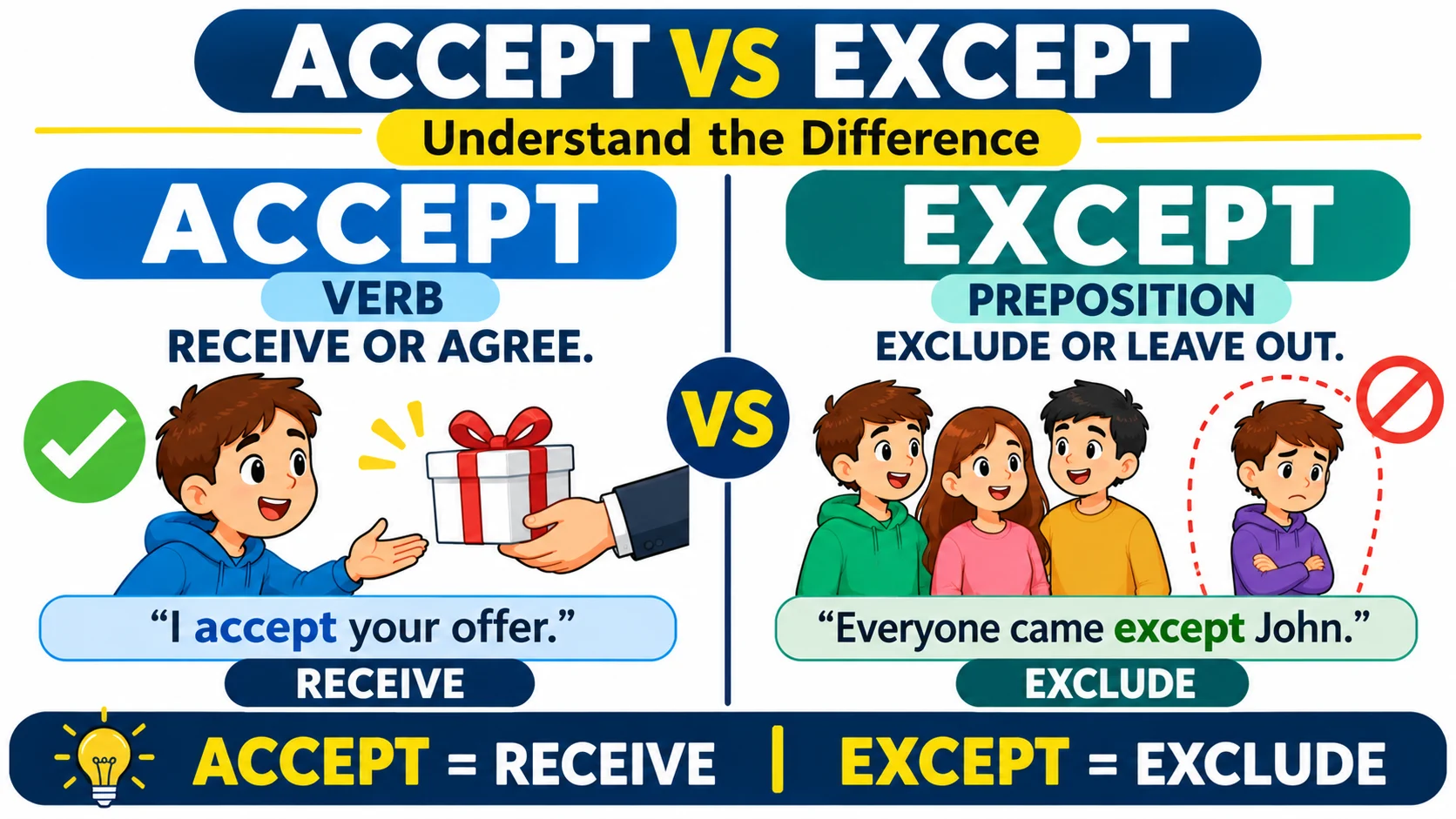
Accept and except are two commonly confused English words, but they have very different meanings. Accept is a verb that means to receive, agree to, or approve something, while except is usually a preposition that means excluding or leaving something out.
English has many words that sound alike but have different meanings. Accept and except are two common examples. They look similar, sound almost the same, and often confuse students, writers, and even people who speak English every day.
The difference between accept vs except is simple once you understand what each word means. Accept means to receive something, agree to an offer, or say yes to an idea. Except means to leave something or someone out of a group. Although these words have similar sounds, you cannot use them in place of each other.
For example, you can accept a job offer, accept an apology, or accept an invitation. However, you can say that everyone came to the party except John. In the first set of examples, you are receiving or agreeing to something. In the second example, you are excluding one person.
Learning the correct use of accept and except can improve your spelling, grammar, emails, essays, and everyday communication. This guide explains their meanings, differences, examples, common mistakes, and practical ways to remember which word to use.
Quick Answer: Accept vs Except
The main difference between accept and except is their meaning and grammatical use.
| Word | Part of Speech | Meaning | Example |
|---|---|---|---|
| Accept | Verb | To receive, agree to, or approve something | I accept your invitation. |
| Except | Preposition | Excluding or not including someone or something | Everyone attended except Sarah. |
| Except | Conjunction | Used to introduce an exception | I would go, except I am busy. |
| Except | Verb | To exclude or leave something out | The rule excepts certain cases. |
Easy way to remember:
- Accept = Receive or agree.
- Except = Exclude or leave out.
For example:
- I accept your offer. (I agree to it.)
- I invited everyone except Tom. (Tom is not included.)
Definition and Explanation of Accept
Accept is a verb that means to receive something willingly, agree to an offer, approve an idea, or recognize something as true.
It describes an action or decision. When you accept something, you show that you are willing to receive it, agree with it, or allow it.
Accept is commonly used in everyday conversations, professional communication, education, business, and formal writing.
What Does Accept Mean?
Accept can have several meanings depending on the situation.
To receive something:
When you take something that another person gives you, you accept it.
Examples:
- She accepted the gift from her friend.
- I accepted the package at the front desk.
- He accepted the award with pride.
- They accepted our invitation.
To agree to something:
Accept can also mean saying yes to an offer, request, or proposal.
Examples:
- I accepted the job offer.
- She accepted his invitation to dinner.
- The company accepted our proposal.
- He accepted the terms of the agreement.
To recognize something as true:
Sometimes, accept means understanding or admitting that something is real.
Examples:
- You must accept the truth.
- She finally accepted her mistake.
- It is hard to accept the news.
- He accepted that he needed help.
To approve or allow something:
Accept can also describe approval or willingness to consider something.
Examples:
- The school accepts online applications.
- This store accepts credit cards.
- The teacher accepted my late assignment.
- The website accepts different file formats.
Grammatical Forms of Accept
Accept is a regular verb. Its different forms are easy to learn.
| Form | Word | Example |
|---|---|---|
| Base form | Accept | I accept your offer. |
| Third-person singular | Accepts | She accepts the challenge. |
| Past tense | Accepted | He accepted the invitation. |
| Past participle | Accepted | They have accepted the terms. |
| Present participle | Accepting | She is accepting applications. |
The word acceptance is a noun that describes the act or state of accepting something.
Examples:
- Her acceptance of the offer surprised everyone.
- The acceptance of new students begins in June.
- Self-acceptance can improve confidence.
The adjective acceptable means suitable or good enough.
Example:
– Your answer is acceptable.
The adjective accepted means recognized, approved, or generally regarded as valid.
Example:
– This is an accepted method of solving the problem.
Common Expressions with Accept
Accept appears in many everyday English expressions.
| Expression | Meaning | Example |
|---|---|---|
| Accept an offer | Agree to an offer | She accepted the offer. |
| Accept responsibility | Admit responsibility | He accepted responsibility for the mistake. |
| Accept an apology | Agree to forgive someone | I accept your apology. |
| Accept the truth | Recognize reality | We must accept the truth. |
| Accept defeat | Admit that you have lost | The team accepted defeat. |
| Accept a challenge | Agree to try something difficult | She accepted the challenge. |
| Accept an invitation | Agree to attend an event | I accepted the invitation. |
| Accept payment | Receive money | The store accepts cash. |
| Accept change | Become comfortable with change | We must learn to accept change. |
| Accept differences | Respect differences | Good communities accept differences. |
Definition and Explanation of Except
Except is most commonly a preposition that means excluding, leaving out, or not including someone or something.
It identifies a person, thing, or situation that is not part of a larger group.
Unlike accept, which describes receiving or agreeing, except describes exclusion.
What Does Except Mean?
Except is used in several ways.
To exclude someone or something:
This is the most common use of except.
Examples:
- Everyone passed the test except Daniel.
- I like all fruits except bananas.
- The office is open every day except Sunday.
- All students attended the meeting except two.
In these sentences, except identifies the person or thing that is not included.
To introduce an exception:
Except can also introduce a clause that explains why something is different from what was expected.
Examples:
- I would visit you, except I have no free time.
- Everything went well, except that we arrived late.
- I would buy this phone, except it is too expensive.
To mean something other than:
Except can sometimes appear in expressions that identify the only thing different from a general statement.
Examples:
- There is nothing left except hope.
- Nobody knows the answer except Maria.
- I have no choice except to wait.
Grammatical Forms of Except
Except is mainly a preposition and conjunction. It can also function as a verb, although this use is less common.
| Part of Speech | Meaning | Example |
|---|---|---|
| Preposition | Excluding someone or something | Everyone came except Ali. |
| Conjunction | Introducing an exception | I would help, except I am busy. |
| Verb | To exclude or make an exception | The rule excepts certain groups. |
The verb except is more common in formal or legal writing than in everyday conversation.
Common Expressions with Except
Here are some common phrases that use except.
| Expression | Meaning | Example |
|---|---|---|
| Except for | Excluding something | Except for the rain, the day was perfect. |
| Everyone except | All people but one or more | Everyone except Jack agreed. |
| Nothing except | Only one thing | She wanted nothing except peace. |
| No one except | Nobody other than | No one except my brother knew. |
| All except | Everyone or everything but a few | All except two students passed. |
| Anything except | Anything but a particular thing | I will eat anything except fish. |
| Other than | Apart from or excluding | No one other than Sam called. |
| Except when | Excluding a particular time or situation | I walk every day except when it rains. |
Accept vs Except: Key Differences
The easiest way to understand accept vs except is to compare their meanings, grammatical roles, and sentence structures.
Accept is about receiving or agreeing. Except is about excluding or leaving something out.
Accept vs Except Comparison Table
| Feature | Accept | Except |
|---|---|---|
| Main meaning | Receive or agree | Exclude or leave out |
| Common part of speech | Verb | Preposition |
| Other grammatical use | Verb | Conjunction and verb |
| Describes | An action or decision | An exception |
| Common situation | Offers, gifts, invitations | Groups, lists, rules |
| Example | I accept your gift. | Everyone came except John. |
| Opposite idea | Reject or refuse | Include |
| Pronunciation | ak-SEPT | ik-SEPT |
Difference in Sentence Meaning
A small spelling change can completely change the meaning of a sentence.
Consider these examples:
Sentence 1: I accept everyone.
This means that I welcome or approve of everyone.
Sentence 2: Everyone came except me.
This means that everyone came, but I did not.
Another example:
Sentence 1: She accepted the invitation.
She agreed to attend an event.
Sentence 2: Everyone accepted the invitation except her.
Everyone agreed to attend, but she did not.
The words perform different jobs, even though their pronunciation is similar.
Accept vs Except: Quick Grammar Comparison
| Sentence | Correct Word | Reason |
|---|---|---|
| I ___ your apology. | Accept | You receive or agree to it. |
| Everyone passed ___ Jack. | Except | Jack is excluded. |
| They ___ credit cards. | Accept | They receive payment. |
| We invited everyone ___ Sarah. | Except | Sarah is not included. |
| She ___ the challenge. | Accept | She agrees to try. |
| All shops are closed ___ one. | Except | One shop is excluded. |
Accept vs Except Pronunciation
One reason people confuse accept and except is that their pronunciation is very similar.
Both words contain two syllables and end with the same sound.
However, their first vowel sounds are different.
| Word | Pronunciation | Sound |
|---|---|---|
| Accept | /əkˈsept/ | Uhk-SEPT |
| Except | /ɪkˈsept/ | Ik-SEPT |
The main stress falls on the second syllable in both words.
The difference is in the first vowel sound.
- Accept begins with a relaxed schwa sound, like the beginning of about.
- Except begins with a short i sound, like the vowel in sit.
How to Practice the Pronunciation
Try saying these words slowly:
- Accept
- Except
- Accept an offer
- Except for Sunday
Then practice these sentences:
- I accept your answer.
- Everyone agreed except David.
- We accept all major cards.
- All days are available except Monday.
Listening to the words in complete sentences can help you recognize the difference more easily.
Advantages and Disadvantages of Using Accept and Except
Accept and except are not competing words with advantages or disadvantages in the same way as two products or methods. Each word serves a different grammatical purpose.
However, understanding their benefits and limitations can help you choose the correct word.
Advantages of Using Accept Correctly
Using accept correctly helps you communicate agreement, approval, and willingness.
Its advantages include:
- Clear communication: It shows that you agree to something or receive something.
- Professional writing: It makes business emails and formal responses easier to understand.
- Better grammar: It improves sentence structure and word choice.
- Positive expression: It helps communicate agreement and understanding.
- Clear decisions: It makes your response to invitations, offers, and requests clear.
Example:
Incorrect: I except your job offer.
Correct: I accept your job offer.
Limitations of Accept
Accept cannot be used when you want to exclude someone or something.
For example:
Incorrect: Everyone attended accept John.
Correct: Everyone attended except John.
Using accept in the wrong situation changes the meaning and makes the sentence incorrect.
Advantages of Using Except Correctly
Using except correctly helps you explain exclusions and identify exceptions.
Its advantages include:
- Clear lists: It helps identify items that are not included.
- Accurate instructions: It makes rules and conditions easier to understand.
- Better explanations: It allows you to describe unusual situations.
- Professional communication: It helps clarify exceptions in policies and agreements.
- Precise meaning: It prevents confusion about who or what is included.
Example:
The store is open every day except Sunday.
This sentence clearly explains the store’s schedule.
Limitations of Except
Except cannot normally replace accept when you want to describe receiving or agreeing to something.
Incorrect: I except your invitation.
Correct: I accept your invitation.
The word except is also less suitable when you simply want to say yes to an offer or request.
Real-World Examples of Accept vs Except
The best way to understand accept vs except is to see how people use these words in everyday situations.
Both words appear in schools, offices, shops, personal conversations, and online communication.
Accept vs Except in Everyday Conversations
People use accept when agreeing to something or receiving an offer.
Examples:
- I accept your invitation to dinner.
- She accepted my apology.
- He accepted the gift happily.
- We accept your decision.
- My parents accepted my choice.
People use except when excluding someone or something.
Examples:
- Everyone is coming except Emma.
- I eat all vegetables except spinach.
- The family visits every weekend except this one.
- Nobody knows except my sister.
- All my friends agreed except Peter.
Accept vs Except in Business and Professional Writing
These words are especially important in workplace communication.
A small spelling mistake can change the meaning of a business email.
Examples of accept:
- We accept applications from qualified candidates.
- The company accepted our business proposal.
- Please accept our sincere apologies.
- The manager accepted the revised report.
- Our payment system accepts major credit cards.
Examples of except:
- All employees must attend except those on approved leave.
- The office operates Monday through Friday except on public holidays.
- All departments approved the plan except marketing.
- Every application was reviewed except incomplete submissions.
- The offer applies to all products except discounted items.
Accept vs Except in School and Academic Writing
Students frequently use these words in essays, assignments, and examinations.
Examples of accept:
- The professor accepted my research paper.
- Students must accept the academic rules.
- The school accepts applications until August.
- She accepted the scholarship.
Examples of except:
- All students passed except three.
- Every subject was easy except mathematics.
- The library is open daily except public holidays.
- All sources were included except one.
Accept vs Except in Technology
Accept and except are also common in technology-related communication.
Examples of accept:
- This application accepts PDF files.
- The website accepts new registrations.
- The software accepts several image formats.
- The payment gateway accepts digital payments.
Examples of except:
- The system supports all browsers except Internet Explorer.
- All files were uploaded except the largest one.
- The application works on every device except older models.
- All users can access the platform except restricted accounts.
Accept vs Except in Travel and Hospitality
Hotels, airlines, and travel companies also use both words.
Examples of accept:
- The hotel accepts online reservations.
- The airline accepted my booking request.
- The restaurant accepts card payments.
- She accepted the invitation to travel.
Examples of except:
- All flights are available except the morning flight.
- The hotel serves breakfast every day except Monday.
- Everyone joined the tour except two passengers.
- All rooms are available except the presidential suite.
Accept vs Except in Different English-Speaking Regions
Accept and except have the same basic meanings in American, British, Canadian, and Australian English.
There is no major regional difference in their spelling or standard usage.
However, pronunciation and accent can make the words sound slightly different.
American English
In American English:
- Accept means to receive or agree.
- Except means excluding or leaving out.
Examples:
- I accept your offer.
- Everyone attended except Mike.
Both words are widely used in schools, workplaces, and everyday conversations.
British English
British English follows the same grammatical rules.
Examples:
- She accepted the invitation.
- Everyone passed except James.
Differences in accent may affect the way the first vowel sounds, but the meanings remain unchanged.
Canadian English
Canadian English also uses accept and except in the same way.
Examples:
- We accept online payments.
- All stores are open except one.
Australian English
Australian English follows the same standard usage.
Examples:
- He accepted the job.
- Everyone joined except Sarah.
Global English Usage
English learners around the world should follow the same basic rule.
Whether you are writing in Pakistan, India, the United States, the United Kingdom, Canada, or Australia:
- Use accept for receiving or agreeing.
- Use except for excluding or making an exception.
The spelling does not change based on the country.
Accept vs Except: Common Mistakes and Corrections
Many spelling and grammar mistakes happen because accept and except sound alike.
Writers sometimes choose a word based on pronunciation rather than meaning.
Here are common errors and their corrections.
Using Except Instead of Accept
Incorrect: I except your apology.
Correct: I accept your apology.
Explanation: You are agreeing to receive the apology, so accept is the correct word.
Using Accept Instead of Except
Incorrect: Everyone came accept John.
Correct: Everyone came except John.
Explanation: John is excluded from the group.
Confusing Accept with Acceptance
Incorrect: Her accept was unexpected.
Correct: Her acceptance was unexpected.
Explanation: Acceptance is the noun form of accept.
Confusing Except with Expect
Accept and except are not the only words that cause confusion. Expect is another similar-looking word.
- Accept = Receive or agree.
- Except = Excluding.
- Expect = Think something will happen or believe something is likely.
Examples:
- I accept your invitation.
- Everyone came except Ali.
- I expect him to arrive soon.
Confusing Except with Excerpt
Excerpt means a short passage taken from a longer piece of writing.
Examples:
- The teacher shared an excerpt from the book.
- I read an excerpt from the novel.
Remember:
- Except = Excluding.
- Excerpt = A short part of a text.
Writing Accept When You Mean Except in Lists
Incorrect: All students passed accept two.
Correct: All students passed except two.
Explanation: Two students are not included in the group that passed.
Writing Except When You Mean Accept in Business Emails
Incorrect: We except your proposal.
Correct: We accept your proposal.
Explanation: The company agrees to the proposal.
Using the Wrong Word in Negative Sentences
Incorrect: I do not except your decision.
Correct: I do not accept your decision.
Explanation: The sentence expresses disagreement, so accept is needed.
However, the following sentence is also correct:
Everyone agreed except me.
Here, except identifies the person who did not agree.
How to Remember the Difference Between Accept and Except
If you regularly confuse these words, a simple memory trick can help.
The Receive or Exclude Rule
Remember these two words:
Accept = Agree or receive.
Except = Exclude or leave out.
Whenever you write a sentence, ask yourself whether you are receiving something or excluding something.
If you are receiving, use accept.
If you are excluding, use except.
Use the Gift Test
Imagine that a friend gives you a birthday gift.
You can say:
I accept your gift.
You cannot say:
I except your gift.
This is because you are receiving something, not excluding it.
Use the Group Test
Imagine that ten students are attending a class.
Nine students arrive, but one is absent.
You can say:
Everyone arrived except Ahmed.
You cannot say:
Everyone arrived accept Ahmed.
This is because Ahmed is excluded from the group.
Use the Replace Test
Another useful technique is to replace the word with a simpler expression.
If you can replace it with receive or agree to, use accept.
If you can replace it with excluding or leaving out, use except.
Examples:
– I ___ the invitation.
I receive or agree to the invitation. Use accept.
– Everyone attended ___ John.
Everyone attended, excluding John. Use except.
This technique works in most everyday situations.
Accept vs Except: Related Words and Comparisons
Understanding related words can help you avoid other common English mistakes.
Accept and except are part of a larger group of words that look or sound similar.
Accept vs Expect
Expect is a verb that means to believe something will happen or to think something is likely.
| Accept | Expect |
|---|---|
| Receive or agree | Believe something will happen |
| I accept the offer. | I expect an offer. |
| She accepted the invitation. | She expects an invitation. |
| He accepted the result. | He expects a result. |
Example:
I accept your invitation because I expect the event to be enjoyable.
Both words are correct because they have different meanings.
Accept vs Excerpt
Excerpt is a noun that means a short section taken from a longer text, speech, book, or article.
| Accept | Excerpt |
|---|---|
| Verb | Noun |
| Receive or agree | A short part of a text |
| I accept the offer. | I read an excerpt. |
Example:
The teacher accepted my assignment, which included an excerpt from a famous novel.
Except vs Exclude
Except and exclude have similar meanings, but their grammatical roles are different.
Except is commonly a preposition.
Exclude is a verb.
| Except | Exclude |
|---|---|
| Excluding someone or something | To leave someone or something out |
| Everyone came except John. | The organizer excluded John. |
| All days except Sunday | They exclude Sunday from the schedule. |
Accept vs Reject
Accept and reject are opposites in many situations.
Accept means to agree to or receive something.
Reject means to refuse or decline something.
| Accept | Reject |
|---|---|
| Agree to an offer | Refuse an offer |
| Accept an invitation | Reject an invitation |
| Accept an application | Reject an application |
| Accept responsibility | Reject responsibility |
Example:
The company accepted one proposal and rejected another.
Except vs Include
Except and include express different ideas.
Except identifies something that is left out.
Include means to make someone or something part of a group.
| Except | Include |
|---|---|
| Leave out | Add or make part of |
| Everyone except Ali | Include Ali in the group |
| All items except one | Include all items |
Example:
The package includes everything except the charger.
Accept vs Agree
Accept and agree are related but not always interchangeable.
Accept usually means to receive, approve, or take an offer.
Agree means to share the same opinion or give consent.
Examples:
- I accept your job offer.
- I agree with your opinion.
- She accepted the invitation.
- She agreed with the decision.
You can agree with an idea without accepting an offer.
Exercises: Accept vs Except
Practice is one of the best ways to learn the correct use of accept and except.
The following exercises cover basic, intermediate, and advanced sentence structures.
Choose the correct word in each sentence.
Exercise 1: Fill in the Blanks
Choose accept or except.
- I will ______ your invitation to dinner.
- Everyone passed the examination ______ David.
- The company does not ______ cash payments.
- All students attended the class ______ two.
- She decided to ______ the job offer.
- The store is open every day ______ Sunday.
- Please ______ my sincere apology.
- Nobody knew the secret ______ my brother.
- We ______ applications from international students.
- Everyone agreed ______ Sarah.
Exercise 2: Choose the Correct Sentence
Select the grammatically correct sentence.
1.
A. I except your offer.
B. I accept your offer.
2.
A. Everyone came accept John.
B. Everyone came except John.
3.
A. The school accepts new students.
B. The school excepts new students.
4.
A. All shops are closed except one.
B. All shops are closed accept one.
5.
A. She accepted the invitation.
B. She excepted the invitation.
Exercise 3: Correct the Mistakes
Rewrite the following sentences using the correct word.
- I except your apology.
- Everyone was invited accept Tom.
- The company excepts online payments.
- All students passed accept three.
- Please except my invitation.
- We accept everyone except Sarah.
- The store excepts credit cards.
- Nobody attended accept my sister.
Exercise 4: Advanced Sentence Practice
Choose the correct word based on the meaning of each sentence.
- The committee decided to ______ the revised proposal.
- All applications were approved ______ those submitted after the deadline.
- I would ______ the offer, but I need more time.
- No one was allowed inside ______ authorized staff.
- The organization does not ______ incomplete documents.
- The restaurant serves all meals ______ breakfast.
- She learned to ______ the changes in her life.
- Every department agreed ______ the finance department.
Answers and Explanations
Exercise 1 Answers
| No. | Correct Answer | Explanation |
|---|---|---|
| 1 | Accept | Agree to an invitation. |
| 2 | Except | David is excluded. |
| 3 | Accept | Receive cash payments. |
| 4 | Except | Two students are excluded. |
| 5 | Accept | Agree to a job offer. |
| 6 | Except | Sunday is excluded. |
| 7 | Accept | Receive an apology. |
| 8 | Except | Only the brother knows. |
| 9 | Accept | Receive applications. |
| 10 | Except | Sarah did not agree. |
Exercise 2 Answers
- B. I accept your offer.
- B. Everyone came except John.
- A. The school accepts new students.
- A. All shops are closed except one.
- A. She accepted the invitation.
Exercise 3 Answers
- I accept your apology.
- Everyone was invited except Tom.
- The company accepts online payments.
- All students passed except three.
- Please accept my invitation.
- We accept everyone except Sarah. (Already correct.)
- The store accepts credit cards.
- Nobody attended except my sister.
Exercise 4 Answers
| No. | Correct Answer | Explanation |
|---|---|---|
| 1 | Accept | Agree to the proposal. |
| 2 | Except | Exclude late applications. |
| 3 | Accept | Agree to the offer. |
| 4 | Except | Exclude unauthorized people. |
| 5 | Accept | Receive documents. |
| 6 | Except | Breakfast is excluded. |
| 7 | Accept | Recognize or become comfortable with changes. |
| 8 | Except | The finance department did not agree. |
FAQs About Accept vs Except
What is the main difference between accept and except?
Accept means to receive, agree to, or approve something. Except means excluding or leaving someone or something out of a group.
Example: I accept your offer. Everyone came except John.
When should I use accept instead of except?
Use accept when you receive something, agree to an offer, or approve an idea.
Example: She decided to accept the job.
Use except when you want to exclude someone or something.
Example: Everyone attended except Sarah.
Is accept a verb or a noun?
Accept is a verb. It describes an action, such as receiving or agreeing to something. Its noun form is acceptance.
Example: I accept your decision. Her acceptance was unexpected.
Is except a preposition or conjunction?
Except is most commonly a preposition. It can also function as a conjunction when it introduces an exception.
Examples:
- Everyone passed except Jack.
- I would help, except I am busy.
Are accept and except pronounced the same?
No. Their pronunciation is very similar, but the first vowel sound is different.
Accept begins with a schwa sound, while except begins with a short i sound. Both words have stress on the second syllable.
Can accept and except be used in the same sentence?
Yes. Both words can appear in one sentence because they have different meanings.
Example:
I accept everyone’s opinion except John’s.
Here, accept means to receive or respect, while except means excluding.
What is the opposite of accept?
The most common opposite of accept is reject or refuse.
Example:
- Accept the invitation.
- Reject the invitation.
The best opposite depends on the context.
What is the opposite of except?
The opposite of except is usually include.
Except means leaving someone or something out, while include means making someone or something part of a group.
Example:
- Everyone came except Ali.
- Include Ali in the invitation list.
What is the difference between accept, except, and expect?
These three words have different meanings.
- Accept means to receive or agree.
- Except means excluding.
- Expect means to think something will happen.
Examples:
- I accept your offer.
- Everyone came except John.
- I expect him to arrive soon.
Is it accept or except an apology?
The correct phrase is accept an apology.
Example:
I accept your apology.
It means that you receive the apology and are willing to forgive or move forward.
Is it accept or except an offer?
The correct phrase is accept an offer.
Example:
She decided to accept the job offer.
Accept is correct because she agrees to receive or take the offer.
Is it everyone accept or everyone except?
The correct expression is everyone except when you want to identify someone who is not included.
Example:
Everyone attended except Maria.
Accept would be incorrect in this sentence.
How do I remember accept vs except easily?
Use this simple memory trick:
- Accept = Agree or receive.
- Except = Exclude or leave out.
Think of accepting a gift and excluding someone from a group. This simple comparison can help you choose the right word.
Which word is correct: accept or except for?
Both can be correct, depending on the sentence.
Use accept when receiving or agreeing to something.
Example: I accept your invitation.
Use except for when identifying something that is not included or that differs from the rest.
Example: Except for the weather, everything was perfect.
Conclusion: Accept vs Except
Understanding the difference between accept vs except is important for clear and correct English communication. Although these words look and sound similar, their meanings are completely different.
Accept is a verb that means to receive, agree to, or approve something. You accept an invitation, accept an offer, accept an apology, or accept responsibility.
Except usually means excluding or leaving someone or something out. You use it when identifying an exception in a group, list, rule, or situation.
The easiest way to remember the difference is to connect accept with receiving and agreeing, while connecting except with excluding. For example, you accept a gift, but everyone receives a gift except one person.
When writing emails, school assignments, business documents, or everyday messages, always check the meaning of the sentence before choosing either word. A simple review can prevent spelling mistakes and improve your writing.
Practice using both words in short sentences. With regular use, you will find it much easier to choose the correct word without hesitation.