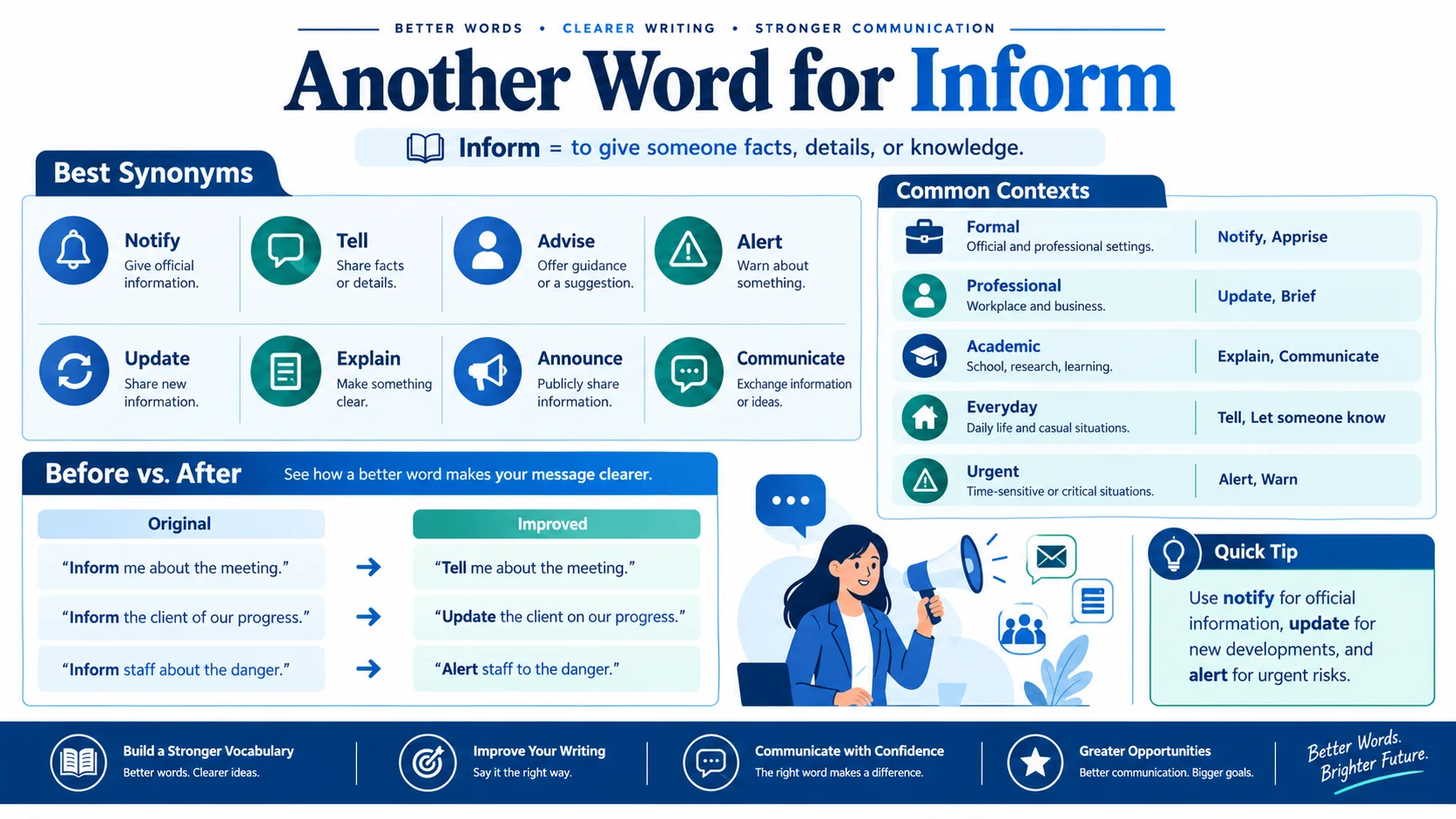
Another word for inform is notify, which means to give someone information about something. Other useful synonyms include tell, advise, alert, update, explain, announce, and communicate. The best choice depends on your purpose. Use notify for official messages, alert for urgent information, and update when sharing new developments.
What Does Inform Mean?
Definition
Inform is a verb that means to give someone facts, details, or knowledge about a particular subject, event, decision, or situation. It can also mean to make someone aware of something they did not previously know.
For example, “Please inform the manager about the schedule change” means to make the manager aware of the change.
Inform is common in professional emails, academic writing, workplace communication, news reports, and formal announcements. Although it is clear and professional, alternatives such as tell, notify, and update may sound more natural in specific situations.
Common Uses
The word inform is used in several contexts:
- Sharing news: Inform someone about an upcoming event.
- Professional communication: Inform employees about a policy change.
- Education: Inform students about examination requirements.
- Business: Inform clients about changes to a service.
- Safety: Inform the public about potential risks.
- Decision-making: Inform someone of the available options.
Inform can also appear in the phrase inform someone that something happened or inform someone of something. For example, “She informed us that the meeting had been postponed.”
Best Synonyms for Inform
The most suitable synonym depends on whether you are sharing routine information, providing advice, giving a warning, or making an official announcement.
| Synonym | Meaning | Best Used When | Example |
|---|---|---|---|
| Notify | Give official notice | Formal messages and policies | Please notify the team about the change. |
| Tell | Share information directly | Everyday conversation | Tell me what happened. |
| Advise | Give information or guidance | Professional recommendations | We advise customers of the updated policy. |
| Alert | Warn someone about something important | Urgent or safety-related information | Alert the staff to the potential risk. |
| Update | Provide the latest information | Ongoing projects or developments | Update the client on our progress. |
| Explain | Make something clear | Instructions or complex topics | Explain the new procedure to the team. |
| Announce | Make information publicly known | News, events, and decisions | The company announced its new policy. |
| Communicate | Share information or ideas | Business and general communication | Communicate the changes to all employees. |
| Advise of | Formally tell someone about something | Official correspondence | Please advise us of any changes. |
| Apprise | Inform someone about a situation | Formal professional writing | Apprise the director of the latest developments. |
| Brief | Give essential information | Meetings and professional settings | Brief the manager before the presentation. |
| Notify officially | Formally make someone aware | Administrative situations | The department notified applicants officially. |
Important distinction: These words are related, but they are not interchangeable in every sentence. Alert suggests urgency, advise can involve guidance, explain emphasizes clarity, and announce often means making information public.
Synonyms for Inform by Context
Formal Writing
Formal writing often requires language that sounds precise, respectful, and appropriate for official communication.
Useful alternatives include notify, apprise, advise, and communicate.
Examples:
- Original: Please inform the department of your decision.
- Alternative: Please notify the department of your decision.
- More formal alternative: Please apprise the department of your decision.
Notify is the safest general choice for official notices. Apprise is more formal and less common, so it may sound unnecessarily complicated in routine communication.
Professional Writing
In business emails, reports, and workplace messages, the best alternative depends on the action you want the recipient to take.
Examples:
- Instead of “I am writing to inform you of the delay,” write “I am writing to notify you of the delay.”
- Instead of “Please inform me about the project’s progress,” write “Please update me on the project’s progress.”
- Instead of “We informed the staff about the new procedure,” write “We briefed the staff on the new procedure.”
The word update works especially well when the recipient already knows about the project and needs the latest information.
Academic Writing
Academic writing uses inform when presenting findings, explaining methods, or describing how evidence contributes to understanding.
Useful alternatives include explain, report, communicate, and indicate. The correct choice depends on the sentence’s meaning.
Examples:
Original: The findings inform our understanding of student performance.
Alternative: The findings improve our understanding of student performance.
Original: The researchers informed participants about the study.
Alternative: The researchers explained the study to participants.
Be careful with indicate and demonstrate. These words describe what evidence suggests or establishes, not simply the act of telling someone information.
Daily Conversation
In everyday American English, simple verbs often sound more natural than formal alternatives.
| Instead of Inform | Use | Example |
|---|---|---|
| Inform me | Tell me | Tell me when you arrive. |
| Inform her | Let her know | Let her know about the change. |
| Inform us | Update us | Update us when you hear anything. |
| Inform everyone | Tell everyone | Tell everyone about the plan. |
| Inform him immediately | Let him know right away | Let him know right away. |
The phrase let someone know is especially useful in casual conversation, text messages, and friendly emails.
Professional Alternatives for Inform
The following alternatives are useful when writing emails, reports, business proposals, and professional documents.
1. Notify
Meaning: To officially tell someone about something.
Best used for: Policies, deadlines, decisions, changes, and formal notices.
Tone: Professional and direct.
Difficulty: Easy.
Usage frequency: Very common.
Best for: Resume writing, email writing, business writing, and professional reports.
- Business example: Please notify all clients about the revised delivery schedule.
- Academic example: The university will notify applicants of admission decisions.
- Daily conversation example: Let me know when you get home.
Notify is particularly suitable when someone needs to receive formal or important information.
2. Advise
Meaning: To give information, guidance, or a recommendation. In formal communication, it can also mean to inform someone.
Best used for: Customer communication, instructions, recommendations, and official correspondence.
Tone: Professional.
Difficulty: Medium.
Usage frequency: Common.
Best for: Email writing, business writing, and professional communication.
- Business example: Please advise the client of the revised terms.
- Academic example: The supervisor advised students of the submission deadline.
- Daily conversation example: I told my friend about the change.
Note that advise can mean either to inform or to recommend a course of action. Use it carefully when that distinction matters.
3. Update
Meaning: To provide the latest information about a situation or activity.
Best used for: Progress reports, project updates, changing schedules, and ongoing work.
Tone: Neutral and professional.
Difficulty: Easy.
Usage frequency: Very common.
Best for: Email writing, business writing, resumes, and project communication.
- Business example: I will update the client on our progress by Friday.
- Academic example: The research team updated participants about the study’s progress.
- Daily conversation example: I’ll update you when I know more.
Update is often better than inform when the recipient already has some background knowledge.
4. Brief
Meaning: To give someone a concise summary of important information.
Best used for: Meetings, presentations, management decisions, and project preparation.
Tone: Professional and purposeful.
Difficulty: Medium.
Usage frequency: Common.
Best for: Business writing, professional communication, and resumes.
- Business example: The project manager briefed the team before the client meeting.
- Academic example: The professor briefed students on the research requirements.
- Daily conversation example: Give me a quick summary before we leave.
Unlike inform, brief usually emphasizes a focused overview rather than simply sharing a fact.
Simple Alternatives for Inform
If your writing feels too formal, replace inform with a more familiar expression.
Tell: Best for direct communication.
Example: Please inform me about the meeting.
Simpler: Please tell me about the meeting.
Let someone know: Best for friendly or conversational communication.
Example: Inform me when you arrive.
Simpler: Let me know when you arrive.
Share: Best for giving someone details, news, or information.
Example: She informed us of her plans.
Simpler: She shared her plans with us.
Explain: Best when the recipient needs to understand something.
Example: Inform the students about the procedure.
Clearer when detail is needed: Explain the procedure to the students.
Mention: Best for referring to something briefly.
Example: He informed me of a small issue.
Alternative: He mentioned a small issue to me.
Remember that mention suggests a brief reference, not necessarily a complete explanation.
Stronger Alternatives for Inform
Some situations require a more specific verb than inform.
- Alert: Use when the information involves danger, urgency, or a significant risk. Example: Alert the staff to the security concern.
- Announce: Use when sharing news with a group or the public. Example: The company announced its expansion plans.
- Disclose: Use when revealing information that was previously private, confidential, or unknown. Example: The organization disclosed the financial details.
- Notify: Use for official communication. Example: Notify applicants of the final decision.
- Brief: Use when giving someone essential background information. Example: Brief the director before the presentation.
- Clarify: Use when correcting confusion or making a point easier to understand. Example: Clarify the revised requirements for the team.
These alternatives add precision rather than simply making the sentence sound stronger. For example, disclose can imply that information was previously withheld, while announce often suggests a formal or public statement.
Difference Between Similar Synonyms
Understanding the differences between related verbs helps you select the most accurate replacement.
| Word | Main Difference | Example |
|---|---|---|
| Inform | General act of giving information | Inform the manager about the delay. |
| Notify | Provide official notice | Notify the manager of the deadline. |
| Advise | Inform or offer guidance | Advise the manager of the risks. |
| Alert | Draw attention to a risk or urgent issue | Alert the manager to the security problem. |
| Update | Provide new information | Update the manager on progress. |
| Explain | Make information understandable | Explain the cause of the delay. |
| Announce | Make information publicly known | Announce the new deadline. |
| Disclose | Reveal information, often confidential | Disclose the relevant financial details. |
| Brief | Provide a concise overview | Brief the manager before the meeting. |
Inform vs. Notify
Inform is broad and can describe almost any act of sharing information. Notify more often suggests an official notice or communication about a specific matter.
Inform vs. Advise
Inform means to give information. Advise can mean to give information in formal usage, but it also commonly means to recommend what someone should do.
Inform vs. Explain
Inform makes someone aware of a fact. Explain helps someone understand the fact, its meaning, or how something works.
Inform vs. Educate
Educate means to develop someone’s knowledge or understanding, often through teaching. It usually involves more than a single message.
Opposite Words for Inform
The opposite of inform depends on the intended meaning. If inform means sharing knowledge, an opposite may involve withholding or concealing information.
| Antonym | Meaning | Example |
|---|---|---|
| Conceal | Keep information hidden | They concealed the relevant details. |
| Withhold | Refuse to provide information | The company withheld the results. |
| Mislead | Give someone a false impression | The statement misled the audience. |
| Deceive | Cause someone to believe something untrue | He deceived the team about the outcome. |
| Obscure | Make information difficult to understand | The wording obscured the main point. |
| Disinform | Deliberately provide false or misleading information | The campaign attempted to disinform voters. |
These words are not exact opposites in every context. Conceal and withhold are closest when inform means revealing information, while mislead and deceive involve creating false beliefs.
FAQs
1. What is the best synonym for inform?
Notify is a strong choice for formal communication. Tell works in everyday conversation, while update is ideal for sharing new developments.
2. What is a formal synonym for inform?
Notify, apprise, and advise are formal alternatives. Choose notify for official notices and apprise when a more formal tone is appropriate.
3. What is a professional alternative for inform?
Notify, update, brief, and communicate are useful professional alternatives. The best option depends on whether you are sharing a notice, progress, or a summary.
4. What word can replace inform in an email?
Use notify for official information, update for progress, and let you know for a friendly or conversational message.
5. What is another word for inform someone about something?
You can say notify someone about something, tell someone about something, update someone on something, or make someone aware of something.
6. Is notify stronger than inform?
Not necessarily. Notify generally emphasizes giving notice, often formally. Inform is broader and can be used in both formal and general communication.
7. What is a synonym for inform in academic writing?
Depending on context, use explain, report, communicate, or notify. If you mean that evidence contributes to knowledge, shape or influence may be more accurate.
8. What is another word for inform someone immediately?
Use alert when the information is urgent or safety-related. Use notify immediately for formal instructions, or tell them right away in everyday conversation.
9. What is the difference between inform and disclose?
Inform means to give someone information generally. Disclose means to reveal information, especially details that were private, confidential, or previously unknown.
10. What is the opposite of inform?
Common opposites include conceal, withhold, and hide. If the intended meaning involves giving false information, mislead or disinform may be more appropriate.
Conclusion
The best word to replace inform depends on what you want to communicate and who will receive the message. Choose notify for official notices, tell for everyday conversation, update for new developments, alert for urgent concerns, and explain when someone needs clarity.
In professional and academic writing, precise word choice makes communication easier to understand. Instead of choosing a complicated synonym simply to sound formal, select the verb that accurately describes the action.