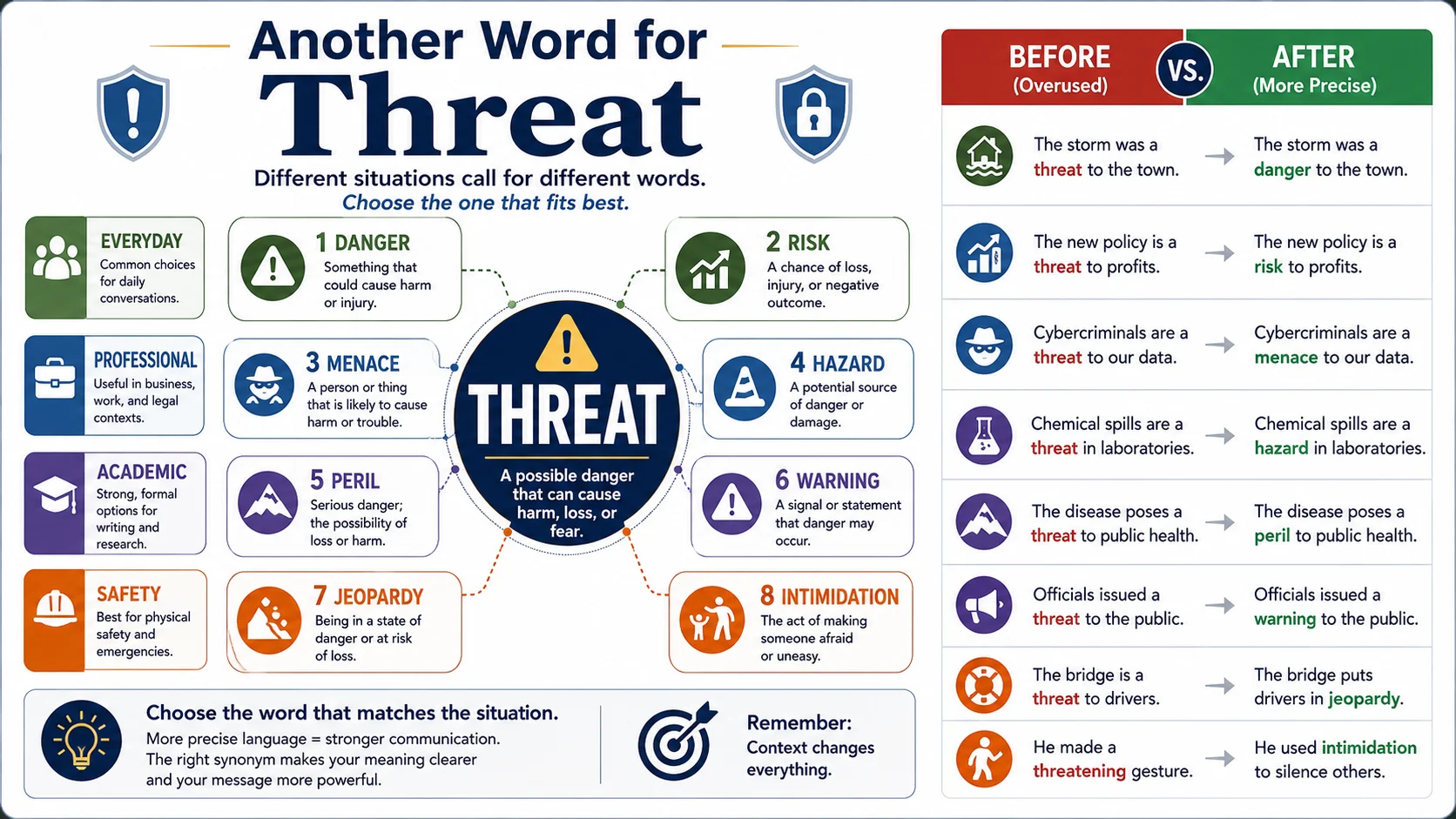
If you need another word for threat, the best choice depends on what you mean. Common alternatives include danger, risk, menace, warning, intimidation, hazard, peril, and jeopardy. For professional or academic writing, risk, hazard, or potential danger often work well, while menace and peril create a stronger sense of danger.
What Does Threat Mean?
Definition
A threat is something or someone that may cause harm, danger, damage, loss, or trouble. The word can describe a physical danger, a possible problem, an expression of intended harm, or something that puts a person, organization, or situation at risk.
For example:
The storm posed a serious threat to coastal communities.
Threat can also describe an intentional statement or action meant to frighten someone:
The company received a threat after the controversial decision.
The meaning changes slightly depending on context, so choosing the right synonym matters.
Common Uses
The word threat commonly appears in several situations:
- Physical danger: a threat to someone’s safety
- Security: a cybersecurity threat
- Business: a threat to a company’s growth
- Environment: a threat to endangered species
- Health: a threat to public health
- Personal conflict: a threat of violence
- Potential problems: a threat to financial stability
- Intimidation: making a threat against someone
Because these meanings are different, danger, risk, menace, and warning are not always interchangeable.
Best Synonyms for Threat
| Synonym | Meaning | Best Used When | Example |
|---|---|---|---|
| Danger | Possibility of harm | General physical or serious harm | The damaged bridge is a danger to drivers. |
| Risk | Possibility of loss or harm | Business, health, finance, and decisions | Cyberattacks pose a major risk to businesses. |
| Menace | Person or thing causing serious trouble | Strong or dramatic situations | The invasive species is a menace to local wildlife. |
| Hazard | Something that can cause harm | Safety, workplaces, and environments | Wet floors are a safety hazard. |
| Peril | Serious and immediate danger | Formal or dramatic writing | The hikers were in great peril. |
| Warning | Notice of possible danger | Alerts and advance notice | The storm warning was issued early. |
| Intimidation | Action intended to frighten | Personal, legal, or social situations | The witness reported intimidation. |
| Jeopardy | Exposure to danger or loss | Formal writing | The mistake placed the project in jeopardy. |
Danger
Meaning: A situation or condition that could cause harm.
Best used for: General descriptions of physical or serious danger.
Tone: Neutral and direct.
Difficulty: Easy
Usage frequency: Very Common
Best for: Email Writing, Essay Writing, Daily Conversation, Business Writing
Business Example:
The outdated software creates a danger to the company’s data security.
Academic Example:
Climate change presents a growing danger to vulnerable ecosystems.
Daily Conversation:
That broken step is a danger, so be careful.
Risk
Meaning: The possibility that something harmful or undesirable may happen.
Best used for: Business, finance, health, technology, and decision-making.
Tone: Professional and neutral.
Difficulty: Easy
Usage frequency: Very Common
Best for: Resume, Email Writing, Essay Writing, Marketing Copy, Business Writing
Business Example:
The new policy could reduce the risk of financial losses.
Academic Example:
Researchers examined the risk of infection among different populations.
Daily Conversation:
Driving in this weather is a big risk.
Menace
Meaning: A person, object, or situation that creates serious trouble or danger.
Best used for: Strong descriptions where you want more emotional force.
Tone: Strong, negative, sometimes dramatic.
Difficulty: Medium
Usage frequency: Common
Best for: Essay Writing, Marketing Copy, Creative Writing
Business Example:
Counterfeit products have become a serious menace to the brand.
Academic Example:
The invasive species represents a growing menace to native plants.
Daily Conversation:
That dog can be a real menace when it gets loose.
Hazard
Meaning: Something that can cause injury, damage, or harm.
Best used for: Workplace safety, construction, health, transportation, and environmental contexts.
Tone: Professional and practical.
Difficulty: Easy
Usage frequency: Common
Best for: Email Writing, Essay Writing, Business Writing
Business Example:
Employees must report any workplace hazard immediately.
Academic Example:
Air pollution is a significant environmental hazard.
Daily Conversation:
Ice on the sidewalk is a serious hazard.
Peril
Meaning: Serious or extreme danger.
Best used for: Formal, literary, historical, or dramatic writing.
Tone: Formal and dramatic.
Difficulty: Advanced
Usage frequency: Less Common
Best for: Essay Writing, Academic Writing, Creative Writing
Business Example:
The company faced financial peril after years of declining sales.
Academic Example:
The study examines the perils associated with rapid urban expansion.
Daily Conversation:
The climber was in serious peril.
Warning
Meaning: A statement or signal that alerts someone to possible danger or trouble.
Best used for: Situations where threat refers to an alert rather than the danger itself.
Tone: Neutral.
Difficulty: Easy
Usage frequency: Very Common
Best for: Email Writing, Business Writing, Daily Conversation
Business Example:
The security alert served as a warning about a possible data breach.
Academic Example:
The findings provide a warning about the long-term effects of pollution.
Daily Conversation:
That dark sky is a warning that rain is coming.
Synonyms by Context
Formal Writing
For formal writing, consider:
- Danger
- Peril
- Jeopardy
- Menace
- Hazard
- Risk
Threat is usually the safest general choice, while peril and jeopardy sound more formal.
Example:
Original: The economy faces a threat from rising inflation.
Alternative: The economy faces a risk from rising inflation.
Professional Writing
In business and workplace communication, risk, hazard, security concern, and potential danger are often more precise than threat.
Instead of:
Cyberattacks are a threat to our company.
You could write:
Cyberattacks represent a significant security risk to our company.
This version sounds more specific and professional.
Academic Writing
Academic writing benefits from precise terminology. Depending on the subject, use:
- Risk
- Hazard
- Danger
- Menace
- Jeopardy
- Potential harm
For example:
Rising temperatures pose a threat to marine ecosystems.
Could become:
Rising temperatures pose a significant risk to marine ecosystems.
Use risk when discussing probability or potential outcomes. Use hazard when referring to something capable of causing harm.
Daily Conversation
In everyday American English, the most natural alternatives are:
- Danger
- Risk
- Warning
- Problem
- Menace
For example:
“That road is a threat to drivers.”
sounds less natural than:
“That road is dangerous.”
Or:
“That road is a serious hazard.”
Professional Alternatives for Threat
If you are writing an email, report, presentation, resume, or business document, these alternatives can make your language more precise:
Risk is best when something could negatively affect an outcome.
Hazard is best when something has the potential to cause physical or environmental harm.
Security risk is useful for cybersecurity, data protection, and organizational safety.
Potential danger works when you want a clear but neutral expression.
Vulnerability is appropriate when discussing a weakness that could be exploited.
Challenge can replace threat when the situation is difficult but not necessarily dangerous.
Example:
“The company faces a threat from new competitors.”
Professional alternatives include:
“The company faces increased competition from new market entrants.”
or:
“The company faces a significant business risk from new competitors.”
Simple Alternatives for Threat
For plain, easy-to-understand American English, use:
- Danger
- Risk
- Warning
- Problem
- Harm
- Trouble
- Fear
- Concern
The best simple replacement is usually danger.
For example:
The virus is a threat to public health.
Simple version:
The virus is a danger to public health.
However, risk may be more accurate when you are talking about the possibility of harm rather than an existing danger.
Stronger Alternatives for Threat
When you want a stronger or more dramatic word, consider:
- Menace
- Peril
- Jeopardy
- Intimidation
- Imminent danger
- Grave danger
The strength of these words varies.
Danger is broad and neutral.
Risk emphasizes possibility.
Hazard emphasizes a source of harm.
Menace emphasizes something actively troublesome or dangerous.
Peril suggests serious danger.
Jeopardy emphasizes exposure to loss or danger.
For example:
The soldiers were in danger.
Stronger:
The soldiers were in grave peril.
Difference Between Similar Synonyms
Threat vs. Danger
A threat can be an indication, possibility, person, or force that may cause harm. Danger usually refers more directly to the harmful situation itself.
The hacker poses a threat.
The compromised system is in danger.
Threat vs. Risk
A risk is the possibility of a negative outcome. A threat can be a source or indication of potential harm.
Cybercrime is a threat to businesses.
Data loss is a risk of poor cybersecurity.
Threat vs. Hazard
A hazard is specifically something that can cause harm. It is common in safety-related contexts.
Chemicals can be a workplace hazard.
Threat vs. Menace
Menace is stronger and more negative than the general word threat. It often suggests an ongoing source of trouble.
The aggressive policy was seen as a threat.
The criminal organization was considered a menace.
Threat vs. Warning
A warning alerts someone to possible danger. It is not necessarily the danger itself.
The storm is a threat.
The weather alert is a warning.
Opposite Words
The best antonym for threat depends on the intended meaning. Possible opposites include:
- Safety
- Security
- Protection
- Peace
- Reassurance
- Assurance
- Benefit
- Opportunity
For example:
The new system reduced the threat of cyberattacks.
Possible opposite concept:
The new system improved security and protection.
If threat means an intimidating statement, an opposite might be reassurance or promise of safety.
FAQs
What is another word for threat?
Common alternatives for threat include danger, risk, menace, hazard, peril, warning, intimidation, and jeopardy. The best synonym depends on context. Risk works well for potential negative outcomes, while danger is the most straightforward general alternative.
What is a formal synonym for threat?
Formal synonyms include peril, jeopardy, menace, hazard, and risk. Peril is especially formal and suggests serious danger, while jeopardy emphasizes being exposed to loss or harm.
What is a professional alternative for threat?
Risk is usually the best professional alternative to threat. In specialized contexts, security risk, business risk, hazard, vulnerability, or potential danger may be more precise.
What word can replace threat?
Depending on the sentence, you can replace threat with danger, risk, hazard, menace, warning, peril, jeopardy, or intimidation. Choose the word based on whether you mean potential harm, a source of danger, an alert, or an attempt to frighten someone.
What is a stronger word for threat?
Menace, peril, and grave danger can express a stronger sense of threat. Peril suggests serious danger, while menace suggests an active or persistent source of trouble.
What is a simple word for threat?
Danger is the simplest general alternative. Risk is also easy to understand and works especially well when discussing something that might cause harm or loss.
Is risk the same as threat?
Not exactly. A risk is the possibility of a harmful outcome, while a threat can refer to a person, situation, force, or indication that could cause harm. The two words overlap but are not always interchangeable.
Is hazard a synonym for threat?
Yes, in some contexts. Hazard is particularly useful when the threat comes from something capable of causing physical, environmental, or workplace harm. It is more specific than the general word threat.
What is another word for a verbal threat?
Depending on the situation, alternatives include intimidation, warning, menace, threat of harm, or coercion. Intimidation is especially appropriate when the purpose is to frighten or pressure someone.
What is the opposite of threat?
Common opposites or contrasting concepts include safety, security, protection, peace, reassurance, and assurance. The best choice depends on whether threat refers to danger, intimidation, or potential loss.
Conclusion
The best alternative for threat depends on the exact meaning and tone you need. Danger is the easiest general synonym, while risk is especially useful in professional, business, financial, and academic writing. Hazard works well for safety-related situations, menace adds stronger negative force, and peril suits formal or dramatic writing.
When choosing a replacement, do not simply select the strongest word. Choose the word that accurately communicates the type of danger, possibility, warning, or intimidation you mean.