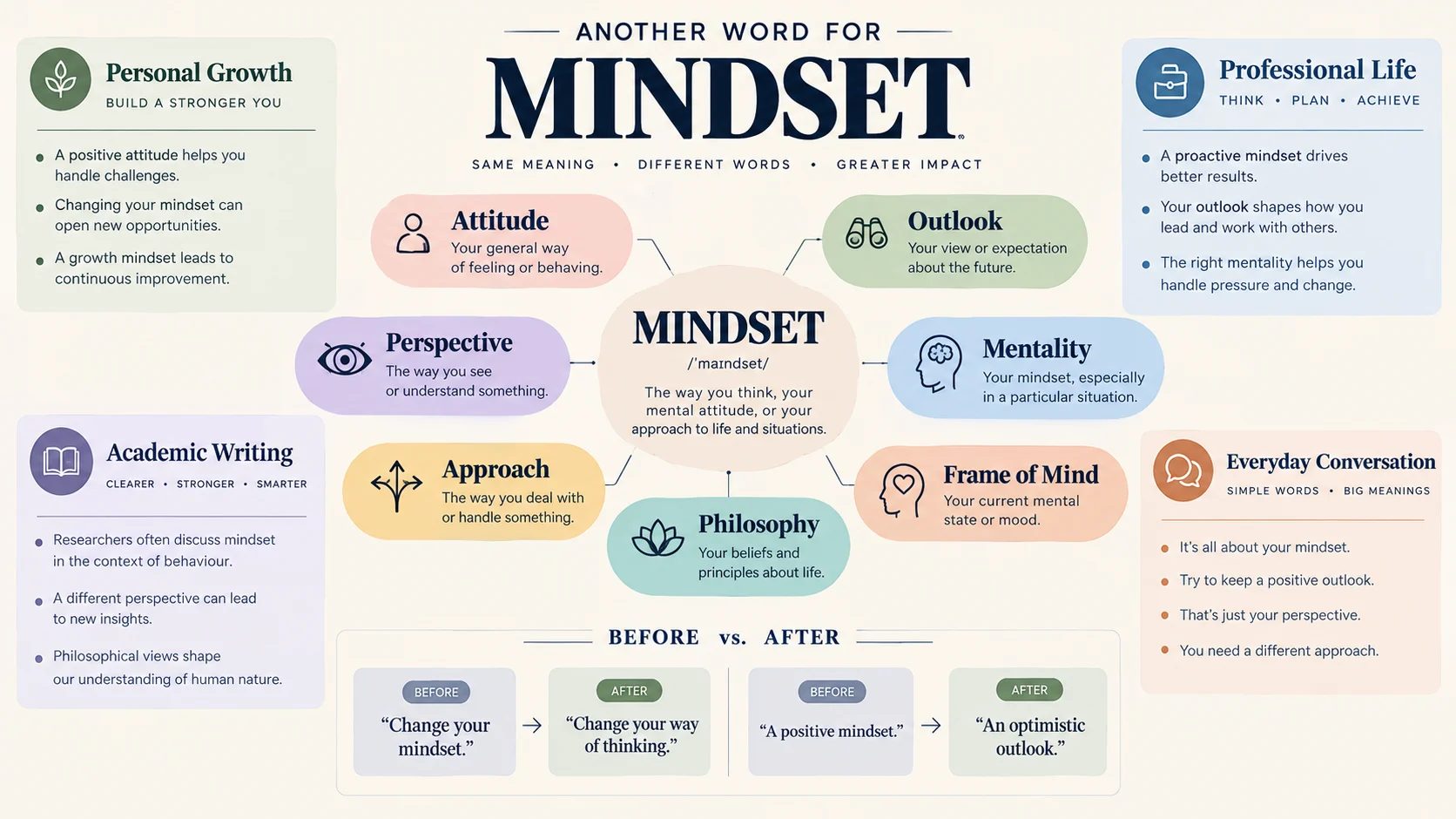
Another word for mindset depends on the context. Common synonyms include attitude, outlook, perspective, mentality, way of thinking, approach, and frame of mind. Use attitude to describe how someone feels about something, perspective for how they see a situation, and mentality for their characteristic way of thinking. The best alternative depends on the idea you want to express.
What Does Mindset Mean?
Definition
The word mindset is a noun that describes a person’s established way of thinking, interpreting experiences, and responding to situations. It can reflect beliefs, attitudes, assumptions, and expectations that influence decisions and behavior.
For example:
- A positive mindset can help someone approach challenges with confidence.
- Her professional mindset encourages continuous learning.
- A growth mindset emphasizes developing abilities through effort and learning.
- His cautious mindset influences how he evaluates financial risks.
Mindset is broader than a single thought or feeling. It often refers to a recurring pattern of thinking that shapes how someone understands the world.
Common Uses
The word mindset commonly appears in these contexts:
- Personal growth: Beliefs about learning, improvement, and overcoming challenges.
- Work and leadership: Attitudes toward responsibility, teamwork, and problem-solving.
- Education: Beliefs about learning, ability, and academic progress.
- Emotional well-being: General ways of interpreting experiences and responding to difficulties.
- Business and strategy: Approaches to innovation, risk, competition, and decision-making.
- Everyday conversation: A person’s general outlook, attitude, or way of thinking.
Because these meanings overlap, choosing the right synonym depends on whether you mean someone’s attitude, beliefs, perspective, or overall approach.
Best Synonyms for Mindset
| Synonym | Meaning | Best Used When | Example |
|---|---|---|---|
| Attitude | A person’s feelings or position toward something | Behavior, work, and relationships | She has a positive attitude toward learning. |
| Outlook | A general way of viewing life or the future | Personal growth and expectations | His optimistic outlook helped him stay motivated. |
| Perspective | A particular way of understanding something | Different viewpoints and interpretations | Try to see the problem from another perspective. |
| Mentality | A characteristic way of thinking | Group behavior or established thinking patterns | The team adopted a problem-solving mentality. |
| Approach | A way of handling a task or situation | Work, strategy, and problem-solving | We need a more practical approach. |
| Frame of mind | A person’s current mental or emotional state | Feelings, readiness, and concentration | She was in the right frame of mind for the interview. |
| Way of thinking | How someone processes ideas and situations | Simple explanations and everyday writing | His way of thinking changed after the experience. |
| Belief system | A set of ideas a person accepts as true | Values, philosophy, and decision-making | Her belief system influences her choices. |
| Philosophy | A set of guiding principles or beliefs | Life, leadership, and personal values | His leadership philosophy emphasizes fairness. |
| Outlook on life | A person’s general view of life | Personal development and emotional perspective | She has a hopeful outlook on life. |
| Disposition | A person’s usual temperament or tendency | Personality and habitual responses | He has a calm disposition. |
| Mental attitude | A person’s attitude toward a situation | Motivation and performance | A constructive mental attitude can support progress. |
| Orientation | A general direction of thought or priorities | Professional, political, or academic contexts | The program has a practical orientation. |
| Paradigm | A framework or model for understanding something | Academic, scientific, and organizational writing | The discovery changed the prevailing paradigm. |
| Conviction | A firmly held belief | Principles and strong opinions | She acted with the conviction that change was necessary. |
Synonyms by Context
Formal Writing
In formal writing, perspective, mentality, philosophy, orientation, and paradigm can replace mindset when their meanings fit.
Perspective is appropriate when discussing how someone interprets a situation.
Example: The study examined how cultural perspectives influence decision-making.
Philosophy works when describing a set of guiding principles.
Example: The organization’s management philosophy emphasizes transparency and accountability.
Paradigm is more specialized. It refers to a framework or model through which something is understood, rather than simply a person’s attitude.
Example: The findings challenged the traditional paradigm of economic development.
For formal writing, choose the word that describes the exact idea instead of replacing mindset automatically.
Professional Writing
For business communication, useful alternatives include approach, attitude, outlook, mentality, and philosophy.
Approach is especially useful when discussing how a person or team handles a task.
Business example: The company adopted a customer-focused approach to product development.
Mentality can describe a recurring pattern of thought within a team or organization.
Business example: A collaborative mentality encouraged employees to share ideas.
Philosophy works when referring to broader organizational principles.
Business example: Our leadership philosophy prioritizes accountability and employee development.
On a resume, specific wording such as strategic approach, collaborative attitude, or growth-oriented outlook often communicates more than the general phrase positive mindset.
Academic Writing
Academic writing often benefits from perspective, belief system, orientation, paradigm, and way of thinking.
Perspective describes a particular interpretation or viewpoint.
Academic example: The research explores students’ perspectives on online education.
Orientation describes a general direction of interest, thought, or emphasis.
Academic example: The course has a strong practical orientation.
Paradigm refers to an established framework of ideas or assumptions.
Academic example: The evidence prompted researchers to reconsider the existing paradigm.
Use paradigm only when discussing a genuine framework or model. It is not a direct replacement for every use of mindset.
Daily Conversation
In everyday English, attitude, outlook, way of thinking, and frame of mind sound natural.
Examples:
- Instead of “You need to change your mindset,” say “You need to change your way of thinking.”
- Instead of “She has a positive mindset,” say “She has a positive attitude.”
- Instead of “I’m not in the right mindset,” say “I’m not in the right frame of mind.”
- Instead of “He has a different mindset,” say “He sees things differently.”
These alternatives make your meaning easier to understand and help your writing sound conversational.
Professional Alternatives for Mindset
When writing a resume, business email, academic paper, or professional profile, select a synonym that reflects the quality or behavior you want to describe.
Approach
Meaning: A method or way of handling a task or problem.
Best Used For: Leadership, strategy, problem-solving, and project management.
Tone: Neutral to professional
Difficulty: Easy
Usage Frequency: Very Common
Best For: Resume, Email Writing, Marketing Copy, Business Writing
- Business example: Developed a practical approach to improving customer satisfaction.
- Academic example: The researchers used a systematic approach to data collection.
- Daily conversation example: I like your approach to solving problems.
Perspective
Meaning: A way of viewing or understanding a situation.
Best Used For: Analysis, communication, research, and decision-making.
Tone: Neutral to formal
Difficulty: Medium
Usage Frequency: Very Common
Best For: Essay Writing, Academic Writing, Business Writing
- Business example: Brought a fresh perspective to the product development team.
- Academic example: The paper examines the issue from a historical perspective.
- Daily conversation example: That gives me a different perspective.
Attitude
Meaning: A person’s feelings, opinions, or position toward something.
Best Used For: Teamwork, motivation, relationships, and personal behavior.
Tone: Neutral
Difficulty: Easy
Usage Frequency: Very Common
Best For: Resume, Email Writing, Marketing Copy, Business Writing
- Business example: Demonstrated a positive attitude toward team collaboration.
- Academic example: The survey measured students’ attitudes toward science.
- Daily conversation example: I appreciate your positive attitude.
Philosophy
Meaning: A set of principles or beliefs that guide decisions and actions.
Best Used For: Leadership, education, business values, and personal principles.
Tone: Formal
Difficulty: Medium
Usage Frequency: Common
Best For: Resume, Essay Writing, Academic Writing, Business Writing
- Business example: Established a leadership philosophy based on trust and accountability.
- Academic example: The essay explores the philosopher’s approach to ethics.
- Daily conversation example: My philosophy is to keep learning from mistakes.
Simple Alternatives for Mindset
If you want an easy, natural replacement, consider these options:
- Attitude: How you feel about something.
- Outlook: How you view life or the future.
- Perspective: How you understand a situation.
- Approach: How you handle a task.
- Beliefs: Ideas you accept as true.
- Way of thinking: How you process ideas.
- Frame of mind: How you feel or think at a particular moment.
- Mentality: Your characteristic pattern of thinking.
For example, “A growth mindset helps students learn” could become “A willingness to learn and improve helps students grow.”
Stronger Alternatives for Mindset
Sometimes a more precise word makes your writing more effective.
Mentality emphasizes a characteristic pattern of thought, especially one shared by a group or associated with repeated behavior.
Philosophy highlights guiding principles and values that influence decisions.
Conviction emphasizes a strong belief held with confidence.
Paradigm describes an established framework for understanding an issue.
Orientation highlights a general direction of thought, interest, or priorities.
Worldview describes the broader set of beliefs and assumptions through which someone interprets the world.
For example, “The company needs a new mindset” could become “The company needs a more innovative approach” if the real goal is to change how it solves problems.
Difference Between Similar Synonyms
Mindset vs. Attitude: A mindset is a broader pattern of thinking and assumptions. An attitude is a person’s feelings or position toward a particular subject.
Mindset vs. Perspective: A mindset may shape how someone thinks across many situations. A perspective is a particular viewpoint or interpretation.
Mindset vs. Mentality: These words overlap considerably. Mentality often emphasizes a characteristic pattern of thinking, while mindset commonly highlights beliefs that influence behavior and responses to challenges.
Mindset vs. Outlook: An outlook often describes how someone views life or the future. A mindset can include deeper assumptions about learning, ability, and change.
Mindset vs. Philosophy: A philosophy is a set of guiding principles or beliefs. A mindset is a broader way of thinking that may or may not involve clearly defined principles.
Mindset vs. Frame of Mind: A mindset can describe a relatively established pattern of thought. A frame of mind often refers to someone’s current mental or emotional state.
Mindset vs. Worldview: A worldview is a broad framework of beliefs about life and reality. A mindset can be narrower, such as a growth mindset at work or school.
Opposite Words
The word mindset does not have one universal antonym. Its opposite depends on the particular meaning.
| Meaning of Mindset | Possible Opposite | Example |
|---|---|---|
| Openness to new ideas | Closed-mindedness | Closed-mindedness can limit learning. |
| Positive outlook | Pessimism | Pessimism made the future seem uncertain. |
| Willingness to adapt | Rigidity | Rigidity made it difficult to change the plan. |
| Growth-oriented thinking | Fixed thinking | Fixed thinking can discourage experimentation. |
| Open perspective | Narrow-mindedness | Narrow-mindedness prevented meaningful discussion. |
These are contextual contrasts rather than exact antonyms in every sentence.
FAQs
What is another word for mindset?
Common synonyms include attitude, outlook, perspective, mentality, approach, philosophy, and frame of mind. The best choice depends on whether you mean someone’s beliefs, viewpoint, behavior, or current emotional state.
What is a formal synonym for mindset?
Formal alternatives include perspective, mentality, orientation, philosophy, and paradigm. Use paradigm when discussing an established framework of ideas, not simply a person’s attitude.
What is a professional alternative for mindset?
Approach, attitude, philosophy, and mentality are useful in professional writing. For resumes, phrases such as strategic approach, collaborative attitude, and growth-oriented outlook can be more specific.
What word can replace mindset in an essay?
Consider perspective, outlook, mentality, belief system, or worldview. Choose the term that matches the argument and the depth of thinking you want to describe.
What is another word for a positive mindset?
Possible alternatives include positive attitude, optimistic outlook, constructive approach, and growth-oriented mentality. Each phrase emphasizes a slightly different quality.
What is another word for a growth mindset?
You could use learning-oriented attitude, willingness to improve, openness to feedback, or commitment to continuous learning. These phrases explain the behavior associated with a growth mindset rather than merely renaming it.
What is another word for mindset in business?
Useful alternatives include business philosophy, strategic approach, organizational mentality, and leadership outlook. The right choice depends on whether you mean company values, decision-making, or team behavior.
Is mentality the same as mindset?
The words are closely related. Both describe ways of thinking, but mentality often emphasizes a characteristic pattern of thought, while mindset frequently refers to beliefs that shape how people respond to situations.
What is the opposite of mindset?
There is no single opposite. Depending on the context, possible contrasts include closed-mindedness, rigidity, pessimism, and narrow-mindedness.
What is another word for a negative mindset?
Possible alternatives include pessimistic outlook, negative attitude, defeatist mentality, and closed-minded perspective. Choose the phrase that accurately describes the person’s thinking without making an unsupported judgment about their character.
Conclusion
The best another word for mindset depends on what you want to express. Choose attitude for feelings toward something, perspective for a viewpoint, outlook for a general view of life, approach for handling a task, and philosophy for guiding principles.
For professional and academic writing, more specific alternatives such as strategic approach, learning-oriented attitude, or established paradigm can make your meaning clearer. The strongest word choice is the one that communicates the exact idea, tone, and context of your sentence.