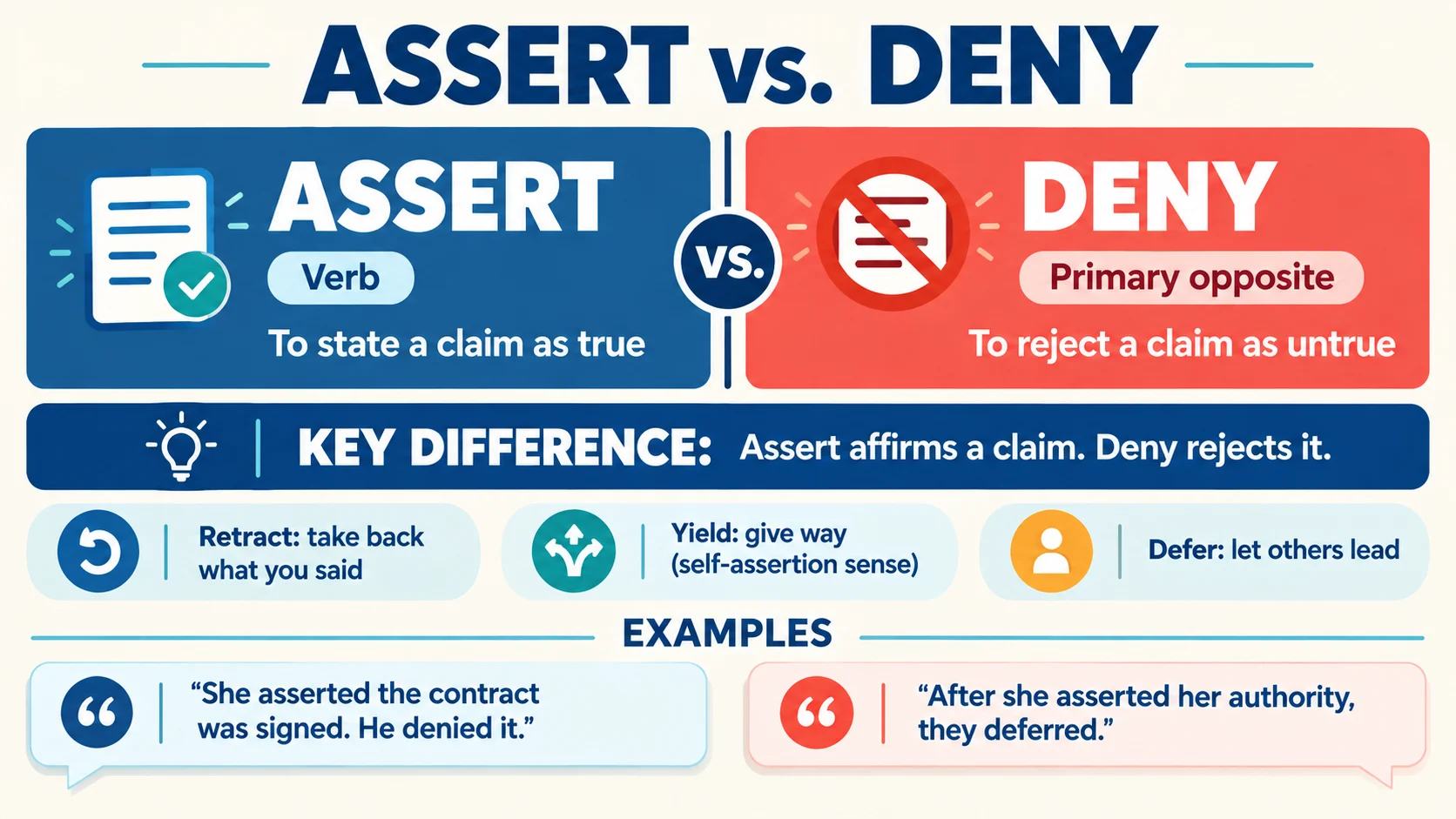
The opposite of assert is deny when assert means to state something firmly as true. Assert also means to act with confidence, and in that sense yield or defer works as a contextual opposite. Retract is the best choice when someone takes back a claim they made earlier.
Part of speech: verb
Primary opposite: deny
Definition: Assert most often means to declare that something is true, usually with confidence and without offering proof.
When assert means to state a claim as fact, deny is the strongest direct opposite. One person asserts a claim, and another denies it. Both words act on the same statement, one affirming it and one rejecting it.
No single word opposes every sense of assert, though. The verb also means to make your rights, authority, or opinions known, as in “assert yourself.” For that meaning, yield and defer fit better. Context decides which opposite is correct.
Direct and Strong Antonyms
Deny is the only direct antonym here. The other words are strong opposites, but each one is contextual and works in a narrower situation.
| Antonym | Tone or Nuance | Example Sentence |
|---|---|---|
| Deny (direct) | Neutral. Rejects a claim as untrue. | The manager asserted that the report was late, but the analyst denied it. |
| Retract (contextual) | Formal. Takes back something already said. | The newspaper retracted its claim after the source corrected the record. |
| Recant (contextual) | Formal and weighty. Gives up a belief, often under pressure. | He recanted his testimony before the trial ended. |
| Disavow (contextual) | Strong and distancing. Rejects responsibility or association. | The senator disavowed the remarks made by his former aide. |
Notice the pattern. Deny works against a claim someone is making now. Retract, recant, and disavow usually work against something already said.
Contextual and Subtle Opposites
The best opposite changes with the meaning of assert. Every pairing below is contextual, so none replaces deny in every sentence.
| Context | Best Opposite | Why It Fits |
|---|---|---|
| Stating a fact or claim | Deny | It rejects the statement that assert affirms. |
| Taking back an earlier claim | Retract | It reverses a prior assertion. |
| Giving up a belief in public | Recant | It signals a formal renunciation. |
| Insisting on authority or rights | Yield | It means giving way instead of pressing a position. |
| Speaking up in a disagreement | Defer | It lets someone else’s view take priority. |
| Standing your ground | Back down | It is casual and common in everyday speech. |
Here are the two main senses in real sentences.
Claim sense: “She asserted that the contract was signed on Friday, and he denied it.”
Authority sense: “After the team lead asserted her authority, two engineers deferred to her plan.”
In the second example, yield or back down could also work. Yield is neutral, defer is polite, and back down suggests losing a standoff.
The authority sense is also gradable. A person can assert themselves a little or a lot, so the opposite can be mild (hold back) or complete (submit).
Words That Seem Opposite But Are Not
Refute
Many writers treat refute as a synonym for deny, then assume it opposes assert. It is not an exact antonym. To refute a claim is to prove it wrong with evidence, while to deny a claim is simply to say it is false.
Example: “The CEO denied the allegation, but the audit later refuted it.”
Refute involves proof, and assert does not require any.
Suggest
Suggest can look like a quiet opposite, but it is a weaker version of the same act. Someone who suggests an idea still puts it forward, just with less force.
Example: “The memo suggested a delay, but the director asserted that the launch must stay on schedule.”
That is a contrast in strength, not an opposition in meaning. It is a related contrast, not an antonym.
Subtle Tone Differences
Deny is the everyday default. It works in a text message and in a legal filing.
Retract is more formal and appears often in journalism and academic corrections. “We retract our earlier statement” sounds careful and official. “We take it back” sounds personal.
Disavow adds distance. “The company disavowed the post” implies more than simple disagreement. Recant carries the most weight, since it usually involves a serious belief or sworn statement.
In casual speech, back down and give in are natural. In workplace writing, defer is more polite. “I’ll defer to your judgment on the budget” sounds respectful, while “I’ll back down on the budget” sounds like surrender.
Frequently Asked Questions
What is the direct antonym of assert?
Deny is the most direct antonym when assert means to declare something true. The two verbs act on the same claim in opposite ways. Other opposites, such as retract and yield, apply only in more specific situations.
What is the opposite of assert in the sense of assert yourself?
When assert means to stand up for your rights or opinions, the opposite is yield, defer, or back down. Each one means letting another person’s wishes or position take priority over your own.
Can I use deny and retract interchangeably?
No. Deny rejects a claim as false. Retract takes back something you already said. Use deny when disputing someone’s statement, and use retract when correcting your own earlier statement.
Practical Word Choice
1. Identify the intended meaning. Ask whether assert means “state as true” or “stand up for yourself.” The first points to deny, retract, or recant. The second points to yield, defer, or back down.
2. Match the context, tone, strength, and formality. Use retract in formal corrections, deny in everyday disagreement, and defer when you want to sound polite. Choose disavow only to create distance, and recant only for serious reversals.
Final Thoughts
Assert has two main jobs. It can mean stating something as true, and it can mean pressing your own position. Deny is the strongest direct opposite for the first job, while yield and defer cover the second.
That is why context matters so much with this word. A single antonym cannot cover every sense, and the wrong choice can shift a sentence from polite to defeated or from neutral to accusatory.
When in doubt, read your sentence aloud and ask what the speaker is actually doing. Are they rejecting a claim, taking one back, or giving way? What is a sentence of your own where assert and its opposite made the difference?