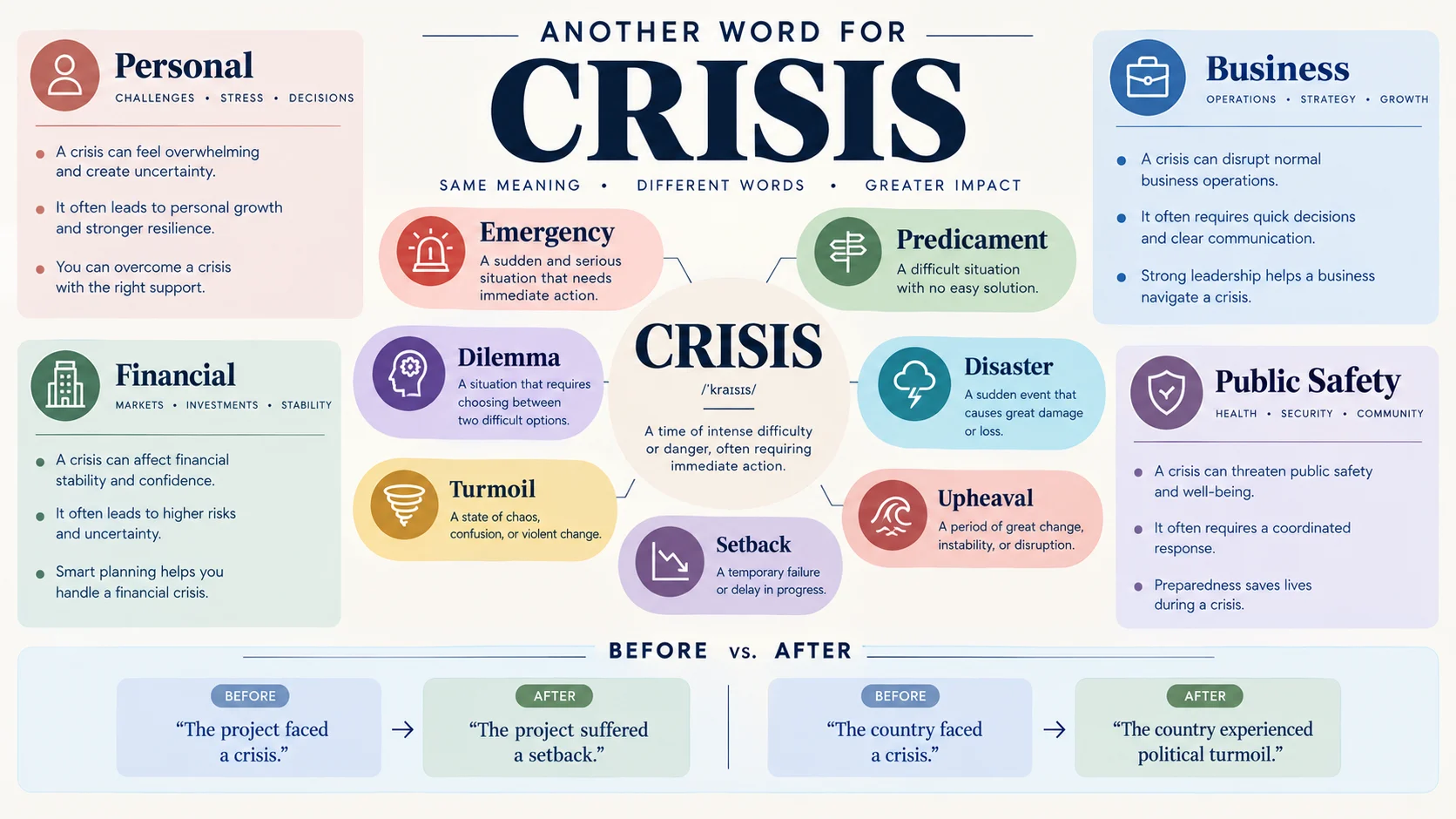
Another word for crisis depends on the situation. Common synonyms include emergency, predicament, dilemma, catastrophe, disaster, turmoil, turning point, and setback. Use emergency for an urgent situation, predicament for a difficult position, catastrophe for a devastating event, and turmoil for widespread disorder. The best alternative depends on the seriousness and nature of the problem.
What Does Crisis Mean?
Definition
The word crisis is a noun that describes a time of intense difficulty, danger, uncertainty, or disruption. It often refers to a situation that requires immediate attention, important decisions, or significant changes.
For example:
- The hospital prepared for a public health crisis.
- The company faced a financial crisis after losing its biggest client.
- Their disagreement developed into a relationship crisis.
- The economic downturn created a national crisis.
A crisis can affect an individual, family, organization, community, or entire country. Depending on the context, it may involve an emergency, a serious setback, a period of instability, or a critical turning point.
Common Uses
The word crisis appears in several situations:
- Personal crisis: A difficult period involving relationships, health, emotions, or major life changes.
- Financial crisis: A serious problem involving debt, income, banking, or economic stability.
- Business crisis: An event that threatens a company’s operations, reputation, or survival.
- Political crisis: A period of serious conflict or instability in government.
- Public health crisis: A widespread health emergency that requires urgent action.
- Environmental crisis: A serious environmental threat affecting ecosystems or communities.
These situations are not identical. A dilemma involves a difficult choice, while a disaster involves serious damage or harm. Selecting a more specific synonym helps communicate exactly what happened.
Best Synonyms for Crisis
| Synonym | Meaning | Best Used When | Example |
|---|---|---|---|
| Emergency | A serious situation requiring immediate action | Health, safety, or urgent problems | The hospital declared an emergency. |
| Predicament | A difficult or unpleasant situation | Personal or professional problems | She found herself in a difficult predicament. |
| Dilemma | A situation involving a difficult choice | Conflicting options or responsibilities | He faced a dilemma about accepting the offer. |
| Catastrophe | An event causing extreme damage or suffering | Devastating events | The flood became a regional catastrophe. |
| Disaster | An event causing serious harm or failure | Natural events, projects, or major setbacks | The failed launch was a business disaster. |
| Turmoil | A state of confusion, disorder, or instability | Political, social, or emotional unrest | The country experienced political turmoil. |
| Setback | An obstacle that delays progress | Projects, careers, and plans | The funding loss was a major setback. |
| Trouble | A problem or difficult situation | Everyday conversation | The company is facing financial trouble. |
| Plight | A difficult or unfortunate condition | Personal hardship or social issues | The report highlighted the plight of displaced families. |
| Calamity | An event causing serious distress or damage | Formal descriptions of severe events | The storm was a devastating calamity. |
| Distress | Severe anxiety, suffering, or difficulty | Emotional, financial, or physical hardship | The family experienced financial distress. |
| Upheaval | A major disruption or sudden change | Politics, society, or organizations | The industry underwent a period of upheaval. |
| Breakdown | A failure of a system, relationship, or process | Communication, machinery, or institutions | The negotiations ended in a breakdown. |
| Impasse | A situation where progress becomes impossible | Negotiations and disagreements | The two sides reached an impasse. |
| Turning point | A moment when a situation begins to change significantly | Major decisions or life events | The resignation became a turning point for the company. |
Synonyms by Context
Formal Writing
For formal writing, useful alternatives include predicament, catastrophe, upheaval, impasse, and calamity.
Predicament describes a difficult situation that is hard to escape.
Example: The organization faced a serious predicament after losing its primary funding source.
Upheaval emphasizes widespread disruption or significant change.
Example: The policy change caused considerable upheaval across the education system.
Impasse is particularly useful when a crisis results from a disagreement that prevents further progress.
Example: Negotiations reached an impasse after both parties rejected the proposed terms.
These terms add precision to formal writing because they identify the nature of the difficulty rather than simply labeling it a crisis.
Professional Writing
In business communication, setback, emergency, breakdown, financial distress, and upheaval are useful alternatives.
Setback works well for a problem that delays progress without necessarily threatening the entire organization.
Business example: The supply shortage created a temporary setback for the production team.
Breakdown describes the failure of a process, relationship, or system.
Business example: A communication breakdown delayed the product launch.
Financial distress is appropriate when an organization experiences serious financial difficulty.
Business example: The company introduced cost controls to address its financial distress.
For a resume or professional report, specific wording is generally stronger than using crisis repeatedly.
Academic Writing
Academic writing benefits from terms such as dilemma, disruption, instability, emergency, and turning point.
Dilemma is appropriate when a person or institution must choose between difficult alternatives.
Academic example: The research explores the ethical dilemma faced by healthcare professionals.
Disruption describes an interruption to normal activity.
Academic example: The study examines the effects of educational disruption on student achievement.
Instability describes a condition in which a system or situation lacks consistency or security.
Academic example: Economic instability affected household spending patterns.
Daily Conversation
In everyday English, problem, trouble, emergency, difficult situation, and setback are often more natural than formal alternatives.
Examples:
- Instead of “I’m going through a personal crisis,” say “I’m going through a really difficult time.”
- Instead of “The project is in crisis,” say “The project is in serious trouble.”
- Instead of “We experienced a crisis during the trip,” say “We had an emergency during the trip.”
- Instead of “The delay caused a crisis,” say “The delay caused a major problem.”
Choose the alternative that matches the seriousness of the situation. Calling a minor inconvenience a catastrophe may exaggerate what happened.
Professional Alternatives for Crisis
When writing a business report, resume, email, or academic paper, choose a synonym that communicates the specific challenge.
Setback
Meaning: An event or problem that delays progress or makes success more difficult.
Best Used For: Projects, careers, business goals, and research.
Tone: Neutral and professional
Difficulty: Easy
Usage Frequency: Very Common
Best For: Resume, Email Writing, Essay Writing, Business Writing
- Business example: Overcame a production setback by reorganizing the delivery schedule.
- Academic example: The lack of available data created a setback for the research project.
- Daily conversation example: Missing the deadline was a setback, but we can recover.
Predicament
Meaning: A difficult, unpleasant, or challenging situation.
Best Used For: Complicated personal, financial, and professional problems.
Tone: Formal to neutral
Difficulty: Medium
Usage Frequency: Common
Best For: Essay Writing, Academic Writing, Business Writing
- Business example: The company faced a predicament after its main supplier withdrew.
- Academic example: The case study examines the ethical predicament faced by the researcher.
- Daily conversation example: I’m in a predicament and need some advice.
Emergency
Meaning: A serious and often unexpected situation requiring immediate action.
Best Used For: Safety, healthcare, urgent business disruptions, and disasters.
Tone: Direct and urgent
Difficulty: Easy
Usage Frequency: Very Common
Best For: Email Writing, Business Writing, Marketing Copy when appropriate
- Business example: The operations team activated its emergency response plan.
- Academic example: The report evaluates the institution’s response to the public health emergency.
- Daily conversation example: Call for help if there’s an emergency.
Upheaval
Meaning: A major disturbance or dramatic change in an established situation.
Best Used For: Political, social, economic, and organizational changes.
Tone: Formal
Difficulty: Medium
Usage Frequency: Common
Best For: Essay Writing, Academic Writing, Business Writing
- Business example: The merger caused significant upheaval within the organization.
- Academic example: The research examines social upheaval during the industrial transition.
- Daily conversation example: Moving to another city caused a lot of upheaval in my life.
Simple Alternatives for Crisis
If you want a clear and easy replacement, consider these words:
- Problem: A situation that needs to be solved.
- Trouble: A difficult or worrying situation.
- Emergency: An urgent situation requiring immediate action.
- Setback: Something that delays progress.
- Difficulty: A challenging condition or task.
- Disaster: A situation involving serious damage or failure.
- Turning point: A moment when circumstances begin to change.
- Difficult time: A period of personal hardship or stress.
For example, “The business faced a crisis” could become “The business faced a serious problem.” If the business is still functioning but has experienced a delay, “The business faced a setback” may be more accurate.
Stronger Alternatives for Crisis
Sometimes a more specific word creates a stronger sentence.
Catastrophe emphasizes an extremely destructive or damaging event.
Example: The earthquake was a catastrophe for the affected communities.
Disaster describes a serious failure or harmful event. It can also be used informally to describe something that went very badly.
Example: Poor planning turned the event into a disaster.
Emergency emphasizes urgency and the need for immediate action.
Example: Officials declared an emergency after the storm damaged critical infrastructure.
Turmoil highlights confusion, unrest, or instability.
Example: The leadership dispute plunged the organization into turmoil.
Breaking point describes a moment when pressure becomes too much to tolerate.
Example: Months of uncertainty pushed the team to its breaking point.
Use these stronger alternatives only when the situation justifies their intensity.
Difference Between Similar Synonyms
Crisis vs. Emergency: A crisis is a serious situation that may develop over time or require major decisions. An emergency usually demands immediate action to address urgent danger or harm.
Crisis vs. Disaster: A crisis is a period of serious difficulty or instability. A disaster is an event or outcome that causes substantial damage, suffering, or failure.
Crisis vs. Dilemma: A crisis is a serious difficult situation, while a dilemma specifically involves choosing between difficult alternatives.
Crisis vs. Predicament: Both describe difficult situations. A predicament often refers to a particular problem that is hard to escape, while a crisis can affect a much larger system or situation.
Crisis vs. Setback: A setback delays progress or creates an obstacle. A crisis is generally more serious and may threaten stability or require substantial intervention.
Crisis vs. Turmoil: A crisis refers to a serious problem or critical period. Turmoil emphasizes the disorder, confusion, or instability surrounding a situation.
Crisis vs. Turning Point: A crisis is a difficult or dangerous situation. A turning point is a moment when circumstances change significantly, and that change may be positive or negative.
Opposite Words
The opposite of crisis depends on the context because the word can describe an emergency, instability, or a period of serious difficulty.
| Meaning of Crisis | Possible Opposite | Example |
|---|---|---|
| Emergency or danger | Safety | The community returned to safety. |
| Disorder or turmoil | Stability | The organization regained stability. |
| Serious difficulty | Ease | The process continued with ease. |
| Uncertainty | Certainty | The agreement provided greater certainty. |
| Conflict or tension | Harmony | The two groups restored harmony. |
| A period of instability | Calm | The market returned to calm. |
These are contextual opposites rather than exact antonyms in every sentence.
FAQs
What is another word for crisis?
Common synonyms include emergency, predicament, dilemma, disaster, catastrophe, turmoil, setback, and upheaval. The best choice depends on the type and severity of the situation.
What is a formal synonym for crisis?
Formal alternatives include predicament, upheaval, calamity, impasse, and instability. Use impasse for a deadlock and upheaval for major disruption.
What is a professional alternative for crisis?
In business writing, consider setback, operational disruption, financial distress, emergency, or breakdown. Select the term that accurately describes the problem.
What is another word for a personal crisis?
Possible alternatives include personal emergency, difficult period, emotional turmoil, personal hardship, and challenging situation. The best option depends on the circumstances.
What is another word for a financial crisis?
Common alternatives include financial emergency, economic turmoil, financial distress, and economic downturn. These expressions have different meanings, so choose one that fits the specific situation.
What is another word for a crisis situation?
You can use emergency, critical situation, serious predicament, difficult situation, or urgent problem.
What is another word for crisis in academic writing?
Useful alternatives include disruption, instability, dilemma, upheaval, and emergency. Academic writing should favor the term that most accurately describes the event or condition.
Is crisis the same as emergency?
Not exactly. An emergency generally requires immediate action. A crisis can involve urgent danger, but it can also describe a prolonged period of instability or serious difficulty.
What is the opposite of crisis?
Depending on context, possible opposites include stability, calm, safety, harmony, and normalcy. No single antonym fits every meaning of crisis.
What is a stronger word than crisis?
Catastrophe and disaster can convey greater severity when an event causes extensive damage or failure. Turmoil is stronger when emphasizing widespread disorder rather than destruction.
Conclusion
The best another word for crisis depends on the type of difficulty you want to describe. Use emergency for urgent situations, predicament for a difficult position, dilemma for a difficult choice, setback for delayed progress, and turmoil for widespread disorder.
For professional and academic writing, specific alternatives such as financial distress, operational disruption, and economic instability often communicate more than the general word crisis. Choose a synonym that reflects the seriousness, cause, and consequences of the situation.