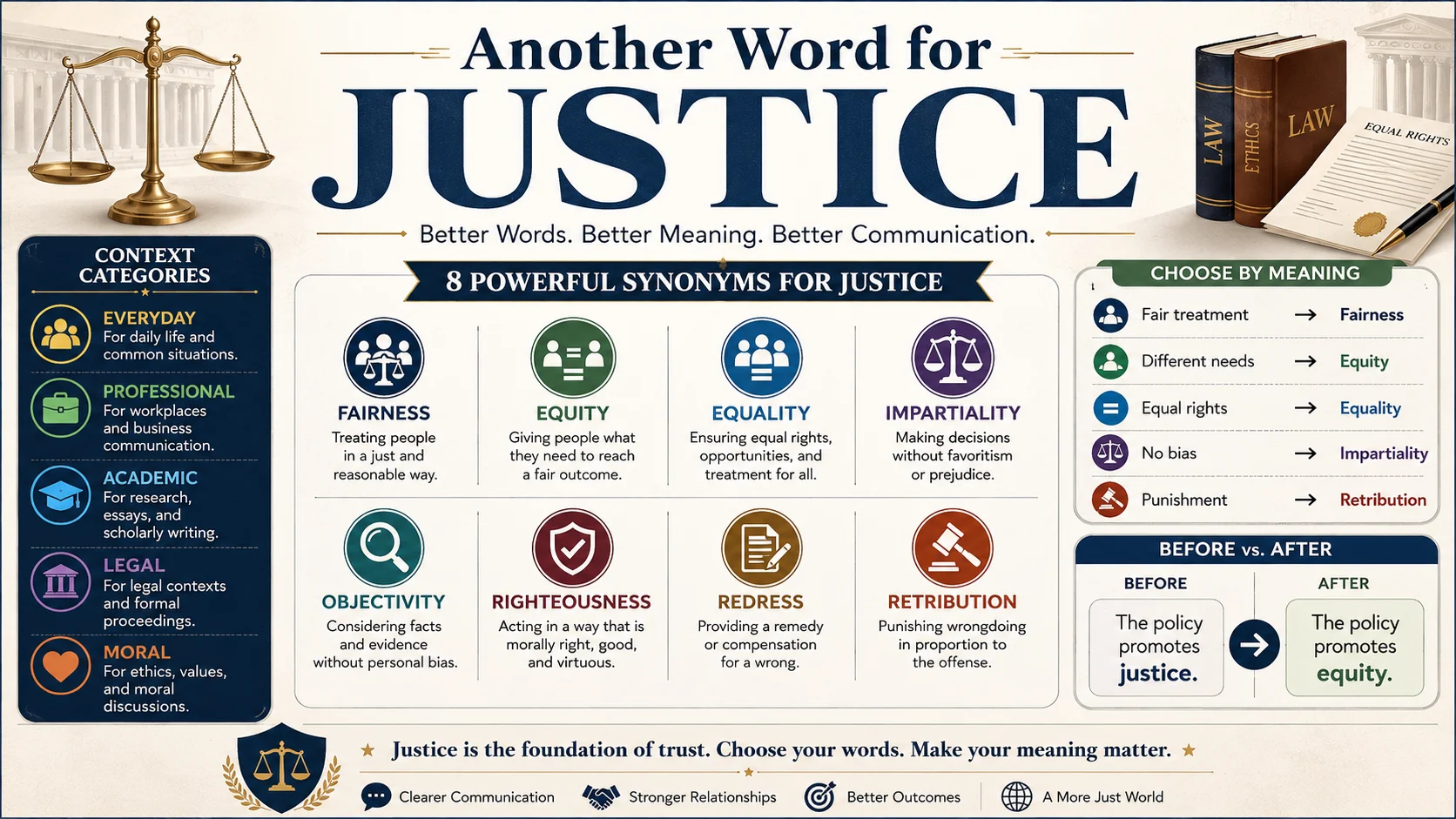
Another word for justice is fairness, especially when you mean treating people equally and reasonably. Depending on the context, useful alternatives include equity, fairness, impartiality, righteousness, lawfulness, equality, and retribution. The best synonym depends on whether you are discussing legal decisions, moral behavior, equal treatment, or punishment.
What Does Justice Mean?
Definition
Justice is the principle of treating people fairly and making decisions according to what is right, lawful, or deserved. It can refer to fair treatment between individuals, the proper application of laws, or a moral sense of right and wrong.
For example:
- The court was expected to deliver justice.
- Everyone deserves justice and equal treatment.
- The organization fought for social justice.
- The punishment was intended to bring justice to the victim.
The word can have several meanings, so replacing it with a synonym requires attention to context.
Common Uses
The most common uses of justice include:
- Legal justice: Fair application of laws and legal procedures.
- Social justice: Fair treatment and equal rights within society.
- Moral justice: What is considered right or morally deserved.
- Distributive justice: Fair distribution of resources, opportunities, or benefits.
- Retributive justice: Punishment or consequences for wrongdoing.
- Personal justice: A person’s sense that something is fair or deserved.
Because these meanings differ, fairness may work in one sentence while retribution or equity may be more precise in another.
Best Synonyms for Justice
| Synonym | Meaning | Best Used When | Example |
|---|---|---|---|
| Fairness | Treating people reasonably and equally | General situations | Everyone deserves fairness. |
| Equity | Fair treatment based on individual circumstances | Social or professional contexts | The policy promotes equity in education. |
| Impartiality | Lack of bias or favoritism | Legal and professional writing | The judge demonstrated impartiality. |
| Equality | Equal treatment, rights, or opportunities | Social and political contexts | The movement demanded equality. |
| Righteousness | Moral correctness or virtue | Ethical or religious contexts | He believed righteousness required honesty. |
| Lawfulness | Acting according to the law | Legal contexts | The decision was based on lawfulness. |
| Integrity | Strong adherence to ethical principles | Professional and moral contexts | She handled the case with integrity. |
| Objectivity | Making judgments without personal bias | Academic and professional contexts | The review required objectivity. |
| Rectitude | Moral correctness or uprightness | Formal writing | His actions reflected moral rectitude. |
| Impartial treatment | Fair treatment without favoritism | Formal communication | The policy guarantees impartial treatment. |
| Desert | What someone deserves because of actions or qualities | Moral or philosophical contexts | The award reflected his desert. |
| Retribution | Punishment for wrongdoing | Criminal or dramatic contexts | The story focused on retribution. |
| Vindication | Proof that someone was right or wrongly accused | Personal or legal contexts | The evidence finally brought vindication. |
| Redress | Correction of a wrong or grievance | Legal and formal writing | The victim sought redress. |
| Due process | Fair legal procedures | Legal contexts | Every defendant deserves due process. |
Fairness
Meaning: Treatment that is reasonable, unbiased, and free from favoritism.
Best used for: Everyday conversation, professional communication, and general writing.
Tone: Neutral and accessible
Difficulty: Easy
Usage Frequency: Very Common
Business example: The manager emphasized fairness when evaluating employees.
Academic example: Fairness is an important principle in ethical decision-making.
Daily conversation: I just want a little fairness in this situation.
Equity
Meaning: Fairness that considers different needs, circumstances, or starting points.
Best used for: Education, workplace policies, healthcare, economics, and social issues.
Tone: Professional and analytical
Difficulty: Medium
Usage Frequency: Common
Business example: The company introduced new policies to improve pay equity.
Academic example: Researchers examined equity in access to higher education.
Daily conversation: The program is designed to create more equity for families with limited resources.
Impartiality
Meaning: The quality of making decisions without favoritism or personal bias.
Best used for: Law, journalism, management, investigations, and formal writing.
Tone: Formal
Difficulty: Advanced
Usage Frequency: Common
Business example: The hiring committee maintained impartiality throughout the selection process.
Academic example: The study emphasized impartiality when evaluating the evidence.
Daily conversation: We need someone who can handle the disagreement with impartiality.
Equality
Meaning: The condition of having the same rights, status, opportunities, or treatment.
Best used for: Social issues, law, education, civil rights, and public policy.
Tone: Neutral to formal
Difficulty: Easy
Usage Frequency: Very Common
Business example: The company promotes equality in hiring and promotion.
Academic example: The paper explores the relationship between equality and opportunity.
Daily conversation: Everyone should have equality at work.
Retribution
Meaning: Punishment or a negative consequence imposed because of wrongdoing.
Best used for: Criminal justice, literature, storytelling, and discussions of punishment.
Tone: Strong and formal
Difficulty: Medium
Usage Frequency: Common
Business example: The term is generally inappropriate for routine workplace discipline because it emphasizes punishment rather than correction.
Academic example: The researcher compared retribution with rehabilitation as approaches to criminal punishment.
Daily conversation: He wanted retribution after being betrayed.
Synonyms by Context
Formal Writing
For formal writing, consider:
- Impartiality
- Equity
- Rectitude
- Lawfulness
- Fairness
- Due process
- Redress
Example:
Instead of writing, “The committee wanted justice,” you could write, “The committee sought impartiality and due process.”
The replacement becomes more precise because it explains what kind of justice is intended.
Professional Writing
In business and workplace communication, these alternatives are usually more natural:
- Fairness
- Equity
- Equality
- Impartiality
- Objectivity
- Integrity
Example:
“The company is committed to fairness and equity in employee evaluations.”
Academic Writing
Academic writing often benefits from precise terms such as:
- Equity
- Equality
- Impartiality
- Objectivity
- Rectitude
- Fairness
For example, “The research examines equity in healthcare access” is more specific than simply saying “The research examines justice.”
Daily Conversation
For everyday speech, the simplest choices are:
- Fairness
- Equality
- Right treatment
- Fair treatment
- What is right
Example:
“I just want fair treatment.”
This sounds more natural in conversation than “I just want impartiality.”
Professional Alternatives for Justice
When writing a resume, email, report, or workplace document, choose a synonym based on the specific meaning.
For fair treatment: fairness, equity, equality
For unbiased decisions: impartiality, objectivity
For ethical behavior: integrity, rectitude
For legal fairness: due process, lawfulness
For correcting a wrong: redress, remedy
For proving someone was treated wrongly: vindication
For example, a resume might say:
“Promoted equity and fairness across team policies.”
This is generally clearer than saying:
“Promoted justice across team policies.”
Simple Alternatives for Justice
If your audience prefers plain English, use:
- Fairness
- Equality
- Fair treatment
- Equal treatment
- What is right
- Rightful treatment
- A fair outcome
Justice can sound formal or abstract. Fairness is often the easiest replacement when you want a sentence that feels direct and conversational.
Stronger Alternatives for Justice
Some alternatives carry a more specific or intense meaning:
- Retribution: emphasizes punishment.
- Vindication: emphasizes proving that someone was right.
- Redress: emphasizes correcting a wrong.
- Righteousness: emphasizes moral correctness.
- Rectitude: emphasizes strong moral principles.
- Retributive justice: emphasizes deserved punishment.
These words should not be treated as interchangeable in every sentence.
For example:
Justice: The family wanted justice.
Retribution: The family wanted retribution.
The second sentence suggests that punishment was important.
Justice: She finally received justice.
Vindication: She finally received vindication.
The second sentence suggests that her innocence, correctness, or reputation was finally confirmed.
Difference Between Similar Synonyms
Justice vs. Fairness
Justice often refers to a broader principle of what is right, lawful, or deserved.
Fairness usually focuses on reasonable and equal treatment.
The court sought justice.
The manager tried to ensure fairness.
Justice vs. Equity
Equity focuses on fair outcomes while recognizing differences in people’s circumstances.
Equity in education may involve providing additional support to students who face greater barriers.
Justice vs. Equality
Equality means providing equal rights, status, opportunities, or treatment.
Justice is broader and can include questions about what people deserve and whether laws or decisions are morally or legally right.
Justice vs. Impartiality
Impartiality specifically means avoiding bias or favoritism.
A judge can demonstrate impartiality while making a decision intended to achieve justice.
Justice vs. Retribution
These words have very different meanings.
Justice can involve fairness, law, rights, and appropriate treatment.
Retribution specifically emphasizes punishment for wrongdoing.
Justice vs. Redress
Redress means correcting or compensating for a wrong.
Someone may seek justice by asking for redress.
Opposite Words
Depending on the intended meaning, opposites of justice can include:
- Injustice
- Unfairness
- Inequality
- Bias
- Partiality
- Discrimination
- Oppression
- Wrongdoing
- Lawlessness
The most direct opposite is usually injustice, meaning an unfair or unjust situation or action.
For example:
The organization worked to address injustice in the community.
FAQs
What is another word for justice?
The most common alternative is fairness. Other choices include equity, equality, impartiality, righteousness, lawfulness, objectivity, redress, and retribution. The right synonym depends on whether you mean fair treatment, equal rights, moral correctness, legal fairness, or punishment.
What is a formal synonym for justice?
Impartiality, equity, rectitude, lawfulness, and redress can work as formal alternatives, depending on the context. For legal writing, due process may be more precise when discussing fair legal procedures.
What is a professional alternative for justice?
Fairness, equity, impartiality, objectivity, and integrity are useful professional alternatives. Choose the word that describes the specific principle you want to communicate.
What word can replace justice in an essay?
For an essay, useful alternatives include fairness, equity, equality, impartiality, righteousness, and retribution. Avoid replacing justice automatically. First identify which meaning the sentence requires.
What is another word for social justice?
Depending on the sentence, alternatives include social equity, equality, equal rights, fairness, and social equality. These terms have related but distinct meanings.
What is another word for justice in law?
Legal alternatives include due process, fairness, lawfulness, redress, and impartiality. Retribution is more specific because it refers to punishment for wrongdoing.
What is a synonym for justice in the workplace?
Fairness, equity, equality, impartiality, and objectivity are useful choices. For example, “pay equity” is more precise than simply saying “pay justice.”
What is the opposite of justice?
The most direct opposite is injustice. Other related opposites include unfairness, bias, inequality, partiality, discrimination, and oppression.
Is fairness the same as justice?
Not exactly. The words overlap, but justice is broader and can involve laws, rights, morality, and deserved consequences. Fairness usually emphasizes reasonable and unbiased treatment.
Is equity the same as justice?
No. Equity is one concept associated with justice, but it has a more specific focus on fair treatment or outcomes while considering differences in circumstances.
Conclusion
The best answer to “What is another word for justice?” is usually fairness, but the most accurate synonym depends on your context. Use equity for fair treatment that considers different circumstances, impartiality for unbiased decisions, equality for equal rights or treatment, redress for correcting a wrong, and retribution when the focus is punishment.
Choosing the right synonym makes your writing more precise. Instead of searching for a word that simply sounds similar to justice, identify the exact idea you want to communicate and choose the alternative that expresses that meaning naturally.