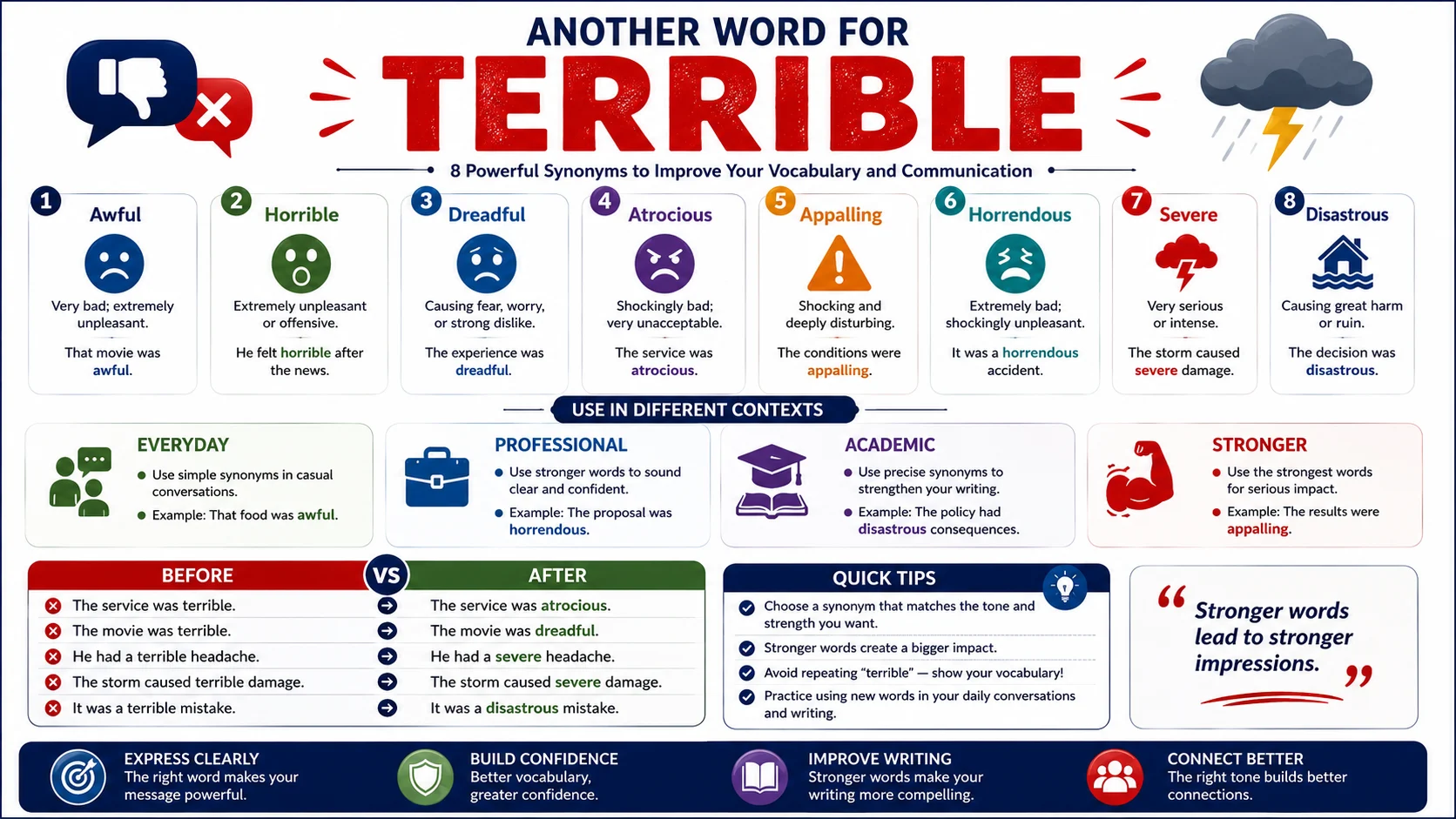
If you need another word for terrible, good alternatives include awful, horrible, dreadful, dreadful, atrocious, appalling, unpleasant, severe, disastrous, and horrendous. The best choice depends on what you mean. For everyday speech, “awful” or “horrible” works naturally. For formal writing, “severe,” “atrocious,” or “disastrous” may be more precise.
What Does Terrible Mean?
Definition
Terrible usually describes something extremely bad, unpleasant, serious, frightening, or poor in quality. Its meaning changes with context.
For example:
- “The weather was terrible.” means the weather was very unpleasant.
- “She had a terrible headache.” means the headache was severe.
- “That was a terrible mistake.” means the mistake was very serious.
- “The movie was terrible.” means the movie was extremely poor or disappointing.
- “He felt terrible after hearing the news.” means he felt very bad emotionally or physically.
Because terrible has several meanings, its best synonym depends on the exact situation.
Common Uses
You can use terrible to describe:
- Poor quality: “The service was terrible.”
- Severe conditions: “He suffered a terrible injury.”
- Negative experiences: “We had a terrible day.”
- Strong emotions: “She felt terrible about the argument.”
- Serious consequences: “The accident caused terrible damage.”
- Frightening situations: “They heard a terrible noise.”
Best Synonyms for Terrible
| Synonym | Meaning | Best Used When | Example |
|---|---|---|---|
| Awful | Extremely bad or unpleasant | Everyday conversation | The food tasted awful. |
| Horrible | Very bad, unpleasant, or distressing | General situations | We had a horrible experience. |
| Dreadful | Extremely bad or unpleasant | Formal or expressive writing | The weather was dreadful. |
| Atrocious | Extremely bad or unacceptable | Quality, behavior, conditions | The service was atrocious. |
| Appalling | Shockingly bad or disturbing | Serious situations | The living conditions were appalling. |
| Horrendous | Extremely severe, shocking, or unpleasant | Serious events | The accident caused horrendous injuries. |
| Disastrous | Causing major damage or failure | Plans, decisions, outcomes | The project had disastrous results. |
| Unpleasant | Not enjoyable or comfortable | Mild negative situations | It was an unpleasant conversation. |
| Severe | Very serious or intense | Problems, symptoms, conditions | The storm caused severe damage. |
| Lousy | Very bad or poor quality | Informal conversation | We had lousy service. |
Synonyms by Context
Formal Writing
In formal writing, avoid repeating terrible when a more precise word communicates the situation.
Useful alternatives include:
Severe: Best for serious conditions, problems, or effects.
The region experienced severe flooding.
Atrocious: Appropriate when describing extremely poor quality, conduct, or conditions.
The report documented atrocious working conditions.
Appalling: Useful when something is shocking, unacceptable, or deeply disturbing.
The investigation revealed appalling safety violations.
Disastrous: Best when something produces serious failure, loss, or damage.
The policy had disastrous economic consequences.
Professional Writing
Professional communication usually benefits from precise language rather than emotionally strong words.
Instead of:
The company’s terrible performance caused concern.
You could write:
The company’s poor performance caused concern.
Or:
The company experienced significant operational difficulties.
Useful professional alternatives include poor, inadequate, unacceptable, severe, problematic, disappointing, and disastrous, depending on the context.
Academic Writing
Academic writing should distinguish between something that is simply poor and something that is severe or harmful.
Examples:
- Terrible conditions → severe conditions
- Terrible results → poor results
- Terrible consequences → serious consequences
- Terrible effects → adverse effects
- Terrible failure → significant failure
For example:
The study found that extreme temperatures had adverse effects on crop production.
“Adverse” is often more precise than “terrible” in academic contexts.
Daily Conversation
Everyday English gives you many natural alternatives.
Common choices include:
- Awful
- Horrible
- Bad
- Dreadful
- Lousy
- Unpleasant
Examples:
“That movie was awful.”
“I had a horrible day.”
“The traffic was terrible.”
“The hotel was lousy.”
These alternatives sound more natural than formal words such as “atrocious” in casual conversation.
Professional Alternatives for Terrible
When writing an email, report, resume, proposal, or business document, consider the specific problem you want to describe.
Poor
Use poor when something performs below an expected standard.
The company reported poor sales results.
Inadequate
Use inadequate when something does not meet a necessary requirement.
The existing system provided inadequate security.
Unacceptable
Use unacceptable when something fails an established standard or expectation.
The delay created an unacceptable risk.
Severe
Use severe for serious problems or conditions.
The organization experienced severe financial difficulties.
Disastrous
Use disastrous when an action, decision, or event produces extremely damaging results.
The strategy proved disastrous for the business.
Simple Alternatives for Terrible
If you want an easy replacement, these words are usually the most accessible:
- Bad
- Awful
- Horrible
- Poor
- Unpleasant
- Very bad
Examples:
The weather was terrible.
The weather was awful.
The customer service was terrible.
The customer service was poor.
It was a terrible experience.
It was a horrible experience.
For most everyday situations, awful and horrible are the closest natural replacements.
Stronger Alternatives for Terrible
Sometimes you need a word that communicates a much greater degree of seriousness.
Atrocious
“Atrocious” suggests something is exceptionally bad or unacceptable.
The restaurant received complaints about its atrocious service.
Appalling
“Appalling” emphasizes shock, disgust, or serious concern.
The investigation uncovered appalling safety conditions.
Horrendous
“Horrendous” emphasizes extreme severity or distress.
The disaster resulted in horrendous losses.
Disastrous
“Disastrous” focuses on extremely damaging results.
The decision had disastrous consequences.
Abysmal
“Abysmal” often describes extremely poor quality or performance.
The team’s performance was abysmal.
Difference Between Similar Synonyms
Not every synonym for terrible means exactly the same thing.
Terrible vs. awful:
These are close in everyday English. “Awful” often sounds slightly more conversational.
Terrible vs. horrible:
“Horrible” can emphasize something that causes distress, fear, or strong dislike.
Terrible vs. dreadful:
“Dreadful” can sound more formal, literary, or expressive.
Terrible vs. atrocious:
“Atrocious” is stronger and often suggests that something is exceptionally bad or unacceptable.
Terrible vs. appalling:
“Appalling” often implies that something is shocking or deeply disturbing.
Terrible vs. severe:
“Severe” describes intensity or seriousness rather than simply being bad.
Terrible vs. disastrous:
“Disastrous” focuses on damaging consequences or failure.
Choosing the right synonym means matching the word to the meaning, not simply choosing the strongest-sounding option.
Synonym Analysis
Awful
Meaning: Extremely bad or unpleasant.
Best Used For: Everyday conversation, reviews, experiences, and general descriptions.
Tone: Informal to neutral.
Difficulty: Easy.
Usage Frequency: Very Common.
Best for: Resume: Sometimes | Email: Yes | Essay: Yes | Marketing: Yes | Business: Sometimes
- Business Example: The customer described the service as awful.
- Academic Example: The participants reported an awful experience with the process.
- Daily Conversation: That coffee tastes awful.
Horrible
Meaning: Extremely unpleasant, bad, or distressing.
Best Used For: Experiences, events, feelings, situations, and general conversation.
Tone: Neutral to informal.
Difficulty: Easy.
Usage Frequency: Very Common.
Best for: Resume: Rarely | Email: Yes | Essay: Yes | Marketing: Sometimes | Business: Sometimes
- Business Example: Customers reported a horrible experience during the outage.
- Academic Example: The event created horrible conditions for affected communities.
- Daily Conversation: I had a horrible morning.
Atrocious
Meaning: Extremely bad, unacceptable, or of very poor quality.
Best Used For: Serious criticism of quality, behavior, or conditions.
Tone: Strong and formal.
Difficulty: Advanced.
Usage Frequency: Less Common.
Best for: Resume: Rarely | Email: Yes | Essay: Yes | Marketing: Sometimes | Business: Yes
- Business Example: The audit identified atrocious record-keeping practices.
- Academic Example: Researchers documented atrocious conditions in the facility.
- Daily Conversation: The service at that restaurant was atrocious.
Severe
Meaning: Very serious, intense, or extreme.
Best Used For: Problems, damage, conditions, symptoms, and consequences.
Tone: Formal and neutral.
Difficulty: Easy to Medium.
Usage Frequency: Very Common.
Best for: Resume: Yes | Email: Yes | Essay: Yes | Marketing: Yes | Business: Yes
- Business Example: The company faced severe supply-chain disruptions.
- Academic Example: Severe environmental conditions affected the results.
- Daily Conversation: The storm caused severe damage.
What Is a Formal Synonym for Terrible?
Depending on the context, severe, atrocious, appalling, disastrous, or dreadful can work as formal alternatives. For academic or professional writing, however, a precise word such as severe, poor, inadequate, or adverse is often better than a highly emotional synonym.
What Is a Professional Alternative for Terrible?
Professional alternatives include poor, inadequate, unacceptable, severe, problematic, disappointing, and disastrous. The correct choice depends on whether you are describing quality, performance, risk, conditions, or results.
What Word Can Replace Terrible?
The closest general replacements are awful, horrible, dreadful, and very bad. For more specific situations, use severe for serious conditions, atrocious for exceptionally poor quality, appalling for something shocking, and disastrous for damaging outcomes.
Opposite Words
Common opposites of terrible include:
- Excellent
- Wonderful
- Great
- Amazing
- Pleasant
- Good
- Outstanding
- Fantastic
- Exceptional
The best opposite depends on the original meaning. For example, the opposite of “terrible service” might be excellent service, while the opposite of “terrible conditions” could be pleasant conditions.
FAQs
What is the closest synonym for terrible?
The closest everyday synonyms are awful and horrible. Both can replace “terrible” in many casual sentences without changing the basic meaning.
What is a stronger word than terrible?
Words such as atrocious, appalling, horrendous, and abysmal can express a stronger degree of negativity, depending on the context.
What is a polite word for terrible?
Unpleasant, poor, disappointing, or unsatisfactory can sound more measured than “terrible.”
What is a formal word for terrible?
Possible formal alternatives include severe, atrocious, appalling, disastrous, and dreadful. The most appropriate choice depends on the sentence.
What is another word for a terrible experience?
You could say horrible experience, awful experience, unpleasant experience, or distressing experience.
What is another word for terrible conditions?
Depending on the meaning, use severe conditions, harsh conditions, difficult conditions, unacceptable conditions, or appalling conditions.
What is another word for terrible quality?
Poor, inferior, substandard, atrocious, or abysmal may work depending on how strongly you want to describe the quality.
Is awful the same as terrible?
“Awful” and “terrible” are very close in many situations, especially in everyday English. However, “terrible” can also mean severe or serious, while “awful” more often emphasizes something extremely unpleasant or bad.
Is horrible stronger than terrible?
Not necessarily. Both can express a very high degree of negativity. The difference usually comes from context and personal wording preference rather than a fixed level of intensity.
What is the best synonym for terrible in an essay?
There is no single best synonym. Severe, poor, adverse, significant, unacceptable, or disastrous may be more appropriate depending on what you are describing. Academic writing generally benefits from precise wording instead of simply using a stronger synonym.
Conclusion
The best alternative to terrible depends on what you are trying to communicate. Awful and horrible are natural choices for everyday English. Poor and inadequate work well in professional writing. Severe is useful for serious conditions, while atrocious and appalling express exceptionally bad or disturbing situations. Disastrous is especially useful when describing damaging results.
Rather than replacing “terrible” automatically, identify the exact meaning first. A precise synonym will make your sentence clearer, more natural, and more effective.