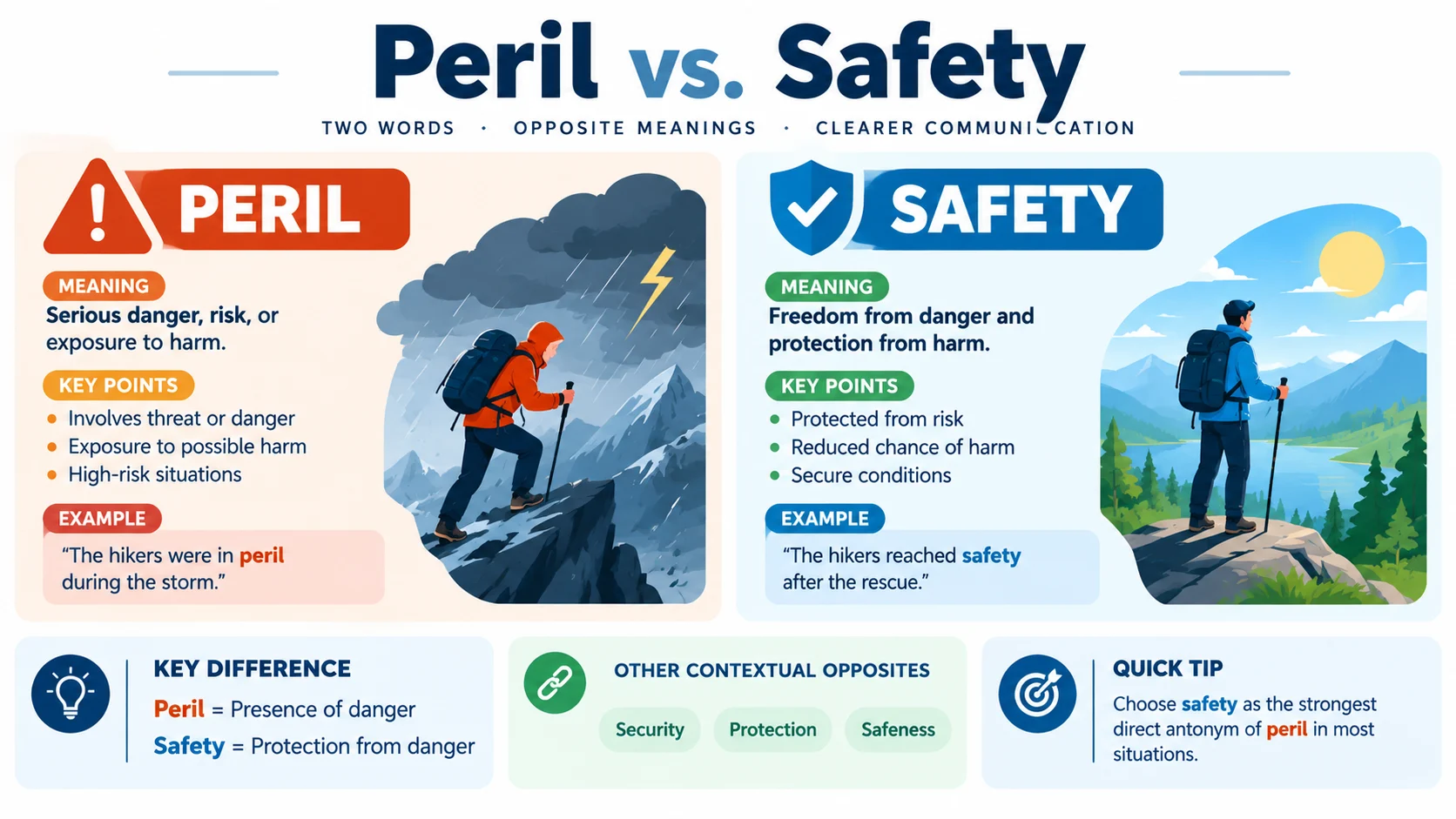
The strongest opposite of peril is safety. Peril refers to serious danger, risk, or the possibility of harm, while safety means being protected from danger or injury. Depending on the context, words such as security, protection, and safeness can also function as useful opposites.
Part of Speech: Noun
Primary Opposite: Safety
Definition of Peril: A state of serious danger, risk, or exposure to harm.
When peril means a dangerous situation or the likelihood of harm, safety is the strongest direct opposite. The two words represent contrasting conditions. Peril involves threat and risk, while safety involves protection and freedom from harm.
For example:
- The hikers were in peril during the storm.
- The hikers reached safety after the rescue team arrived.
In most American English contexts, safety is the clearest and most widely understood antonym.
Direct and Strong Antonyms
| Antonym | Tone or Nuance | Example Sentence |
|---|---|---|
| Safety | Direct opposite of danger or risk | The workers followed procedures to ensure safety on the job site. |
| Security | Emphasizes protection from threats | Strong security reduced the risk of unauthorized access. |
| Protection | Focuses on being shielded from harm | The shelter provided protection during the hurricane. |
| Safeness | Formal or less common form of safety | Parents appreciated the safeness of the neighborhood. |
| Well-being | Highlights freedom from harm and distress | The policy was designed to improve public well-being. |
Among these choices, safety remains the most precise and broadly applicable antonym. The others often work best in specific contexts.
For instance, a cybersecurity professional might discuss security, while a health expert might focus on well-being. Both contrast with peril, but neither replaces safety in every situation.
Contextual and Subtle Opposites
The best opposite of peril can change depending on what type of danger is being discussed.
Peril as Physical Danger
When peril refers to immediate physical risk, safety is usually the strongest opposite.
| Context | Best Opposite | Why It Fits |
|---|---|---|
| Natural disasters | Safety | Indicates freedom from harm |
| Workplace hazards | Safety | Contrasts directly with risk |
| Emergency situations | Safety | Represents successful protection |
Example:
“The family escaped the wildfire and reached safety before nightfall.”
Peril as Exposure to Threats
Sometimes peril refers to vulnerability rather than immediate danger.
| Context | Best Opposite | Why It Fits |
|---|---|---|
| Crime prevention | Security | Focuses on protection from threats |
| Data privacy | Security | Emphasizes safeguards and defense |
| National defense | Security | Highlights protection against risks |
Example:
“Improved network security reduced the company’s exposure to cyber threats.”
Peril as a General Risk
In broader discussions, protection may function as a contextual opposite.
Example:
“Strong insurance coverage provided protection against unexpected financial losses.”
Here, protection counters the potential harm represented by peril, even though the words are not exact semantic opposites in every context.
Words That Seem Opposite But Are Not
Common Grammatical or Semantic Confusions
Comfort
People sometimes assume comfort is the opposite of peril because dangerous situations are often uncomfortable.
However, comfort refers to physical or emotional ease, not the absence of danger.
Example:
- The hotel room was comfortable.
- The hotel was located in an area prone to flooding.
A person can experience comfort while still facing peril.
Peace
Peace is another commonly confused word.
Peace refers to calmness, harmony, or the absence of conflict. While peaceful situations are often safe, peace does not automatically eliminate danger.
Example:
- The town seemed peaceful.
- The aging bridge still posed a serious risk.
Because peace and safety overlap in some situations, people sometimes treat them as interchangeable. They are not exact antonyms of peril.
Subtle Tone Differences
Choosing the right opposite affects tone and precision.
Safety is direct and practical.
Example:
“Our top priority is passenger safety.”
Security sounds more formal and often relates to protection systems.
Example:
“The company invested heavily in security.”
Protection emphasizes active defense.
Example:
“The equipment offers protection from hazardous chemicals.”
Using the wrong term can slightly shift the meaning of a sentence. A writer discussing workplace accidents will usually choose safety, while a writer discussing cyber threats may prefer security.
Frequently Asked Questions
What is the direct antonym of peril?
The most direct antonym of peril is safety. Peril means serious danger or risk, while safety means freedom from danger and protection from harm. In most situations, safety provides the clearest and most accurate opposite.
Is security the opposite of peril?
Security can function as a contextual opposite of peril, especially when discussing protection from threats, crime, or cyber risks. However, safety is generally considered the broader and more direct antonym because it applies across more situations.
Which antonym should I use in writing?
Choose the word that matches your context. Use safety for general danger and risk, security for protection from threats, and protection when emphasizing defensive measures. The best choice depends on your intended meaning and audience.
Practical Word Choice
1. Identify the Intended Meaning
Determine whether peril refers to physical danger, vulnerability, or general risk before selecting an opposite.
2. Match Context, Tone, Strength, and Formality
Use safety for broad everyday situations, security for threat-related contexts, and protection when emphasizing defense against harm.
Final Thoughts
The strongest antonym of peril is usually safety because it directly expresses freedom from danger and risk. In everyday American English, this pairing is clear, natural, and widely understood.
Context still matters. Security and protection can serve as effective opposites when discussing specific types of threats or safeguards. Choosing the most precise word helps readers understand exactly what kind of contrast you intend.
When selecting an antonym, focus on the type of danger being described and the level of precision your writing requires. What sentence would you use to contrast peril and safety in your own writing?