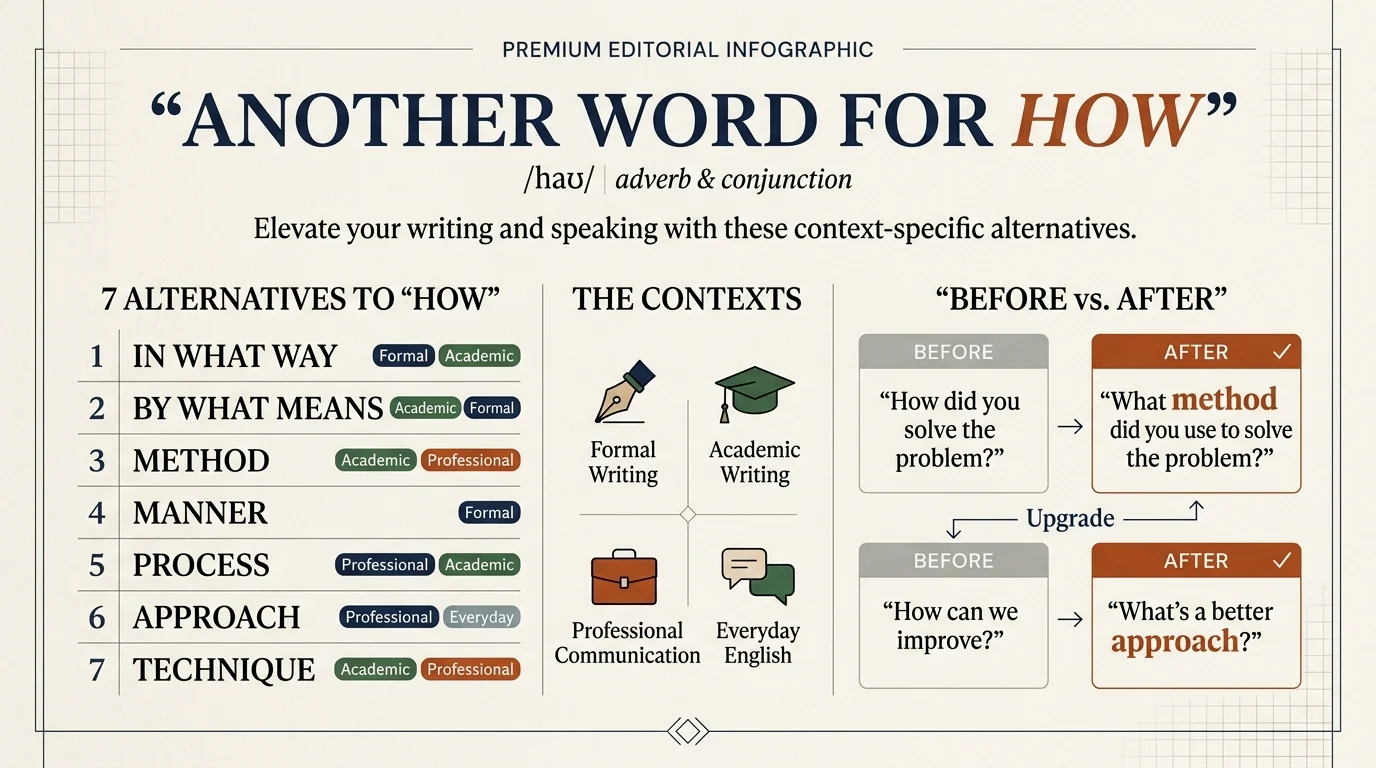
Another word for how depends on the sentence because how is primarily an adverb used to ask about a method, condition, manner, or degree. Useful alternatives include in what way, by what means, the way, manner, method, process, and approach. For formal writing, phrases such as in what manner or by what means may fit. For everyday English, the way is often more natural.
What Does How Mean?
Definition
How is an interrogative and sometimes relative adverb in American English. It asks about the way something happens, the method used to do something, a person’s condition, or the degree to which something is true.
Examples include:
- How does this machine work?
- How are you feeling today?
- How did you solve the problem?
- How difficult is the assignment?
The word can also introduce an indirect question or describe the manner in which something happens.
For example, “I understand how the system works” explains that the speaker understands the process.
Because how performs several grammatical functions, there is no single synonym that works in every sentence. The best replacement depends on the meaning, sentence structure, and tone.
Common Uses
The word how commonly appears in five contexts:
- Method: How something is done or accomplished.
- Manner: The way an action is performed.
- Condition: How someone feels or how something is functioning.
- Degree: How much, how often, or how difficult something is.
- Process: How something develops, operates, or changes.
For example, how in “How did you complete the task?” asks about the method. In “How tired are you?” it asks about degree. These meanings require different alternatives.
Best Synonyms for How
The following alternatives are useful when you want to replace how or express the same idea in different words.
| Synonym or Alternative | Meaning | Best Used When | Example |
|---|---|---|---|
| In what way | By what method or manner | Formal questions and explanations | In what way did the policy improve results? |
| By what means | Using which method or resources | Formal, technical, or academic writing | By what means was the data collected? |
| In what manner | In what way something happens | Formal writing | In what manner should the equipment be handled? |
| The way | The manner or method in which something happens | Everyday writing and conversation | I like the way you explained the concept. |
| Manner | The way an action is performed | Formal descriptions | She completed the task in a professional manner. |
| Method | A particular procedure for doing something | Research, education, and work | Which method did you use to solve the problem? |
| Process | A series of steps or actions | Procedures and explanations | The process explains how the product is made. |
| Approach | A way of dealing with a task or problem | Business and problem-solving | We discussed a new approach to training. |
| Technique | A specific way of performing an activity | Skills and practical tasks | This technique makes the task easier. |
| Procedure | An established series of steps | Technical and professional writing | Follow the procedure carefully. |
| Mechanism | The way something operates or produces an effect | Science and technology | Researchers examined the mechanism behind the reaction. |
| Means | A method or resource used to achieve something | Formal writing | The team found a means of reducing costs. |
| Way | A method or manner | General conversation | Is there a better way to do this? |
| Degree | The extent or level of something | Questions about intensity or amount | The degree of difficulty surprised everyone. |
| Extent | The amount or level to which something occurs | Formal and academic writing | The study measured the extent of the problem. |
Important: These alternatives do not all replace how grammatically. For example, “How did you do it?” can become “In what way did you do it?” However, replacing how directly with method requires restructuring the sentence: “What method did you use?”
Synonyms by Context
Formal Writing
In formal writing, in what manner, in what way, by what means, and through which method can help express questions more precisely.
Original: How was the issue resolved?
Alternative: By what means was the issue resolved?
The alternative sounds more formal and emphasizes the method used.
Another example:
Original: How should the procedure be completed?
Alternative: In what manner should the procedure be completed?
Although these expressions are grammatically correct, they can sound unnecessarily formal in simple sentences. Use them when the context calls for a formal tone, not merely to make writing sound sophisticated.
Professional Writing
In professional communication, approach, method, process, technique, and procedure are often more useful than a direct replacement for how.
Approach works when discussing a strategy or way of handling a problem.
Business example: The team evaluated a new approach to customer support.
Process is appropriate when explaining a sequence of actions.
Business example: The report describes the process used to approve new suppliers.
Method is useful when comparing ways to complete a task.
Business example: Which method produces the most reliable results?
In emails and business reports, changing the sentence structure often produces a clearer result than replacing how with a synonym.
Academic Writing
Academic writing benefits from precise terms such as method, procedure, mechanism, manner, and extent.
Method describes how research or analysis is conducted.
Academic example: The researchers used a quantitative method to analyze the results.
Procedure describes the specific steps followed in an experiment or study.
Academic example: The procedure was repeated under controlled conditions.
Mechanism explains how a process operates or produces an outcome.
Academic example: The study investigated the mechanism responsible for the observed change.
Extent is useful when the original question asks how much or how far something occurs.
Academic example: The researchers measured the extent of the effect.
These words are not interchangeable. Select the term that reflects the exact research question.
Daily Conversation
In everyday English, the way, way, method, and approach are usually more natural than formal expressions such as in what manner.
Examples:
- Original: How did you make this?
- Alternative: What method did you use to make this?
- Original: I like how you organize your notes.
- Alternative: I like the way you organize your notes.
- Original: How can we fix this?
- Alternative: What’s the best way to fix this?
- Original: How does this work?
- Alternative: What’s the process behind this?
The best conversational alternative is usually the one that keeps the sentence simple and natural.
Professional Alternatives for How
When writing a resume, report, email, or academic paper, choose a noun or phrase that identifies the exact aspect you want to describe.
Method
Meaning: A particular way of doing something.
Best Used For: Research, problem-solving, procedures, and professional tasks.
Tone: Neutral to professional
Difficulty: Easy
Usage Frequency: Very Common
Best For: Resume, Email Writing, Essay Writing, Business Writing
- Business example: Developed a method for tracking project performance.
- Academic example: The study used a method designed to reduce measurement errors.
- Daily conversation example: What method did you use to learn the language?
Approach
Meaning: A way of dealing with a situation, problem, or task.
Best Used For: Strategy, planning, management, and decision-making.
Tone: Professional
Difficulty: Easy
Usage Frequency: Very Common
Best For: Resume, Email Writing, Marketing Copy, Business Writing
- Business example: Introduced a new approach to customer retention.
- Academic example: The researchers adopted a different approach to data analysis.
- Daily conversation example: I like your approach to solving problems.
Process
Meaning: A series of steps or actions that produce a result.
Best Used For: Workflows, explanations, research, and technical documentation.
Tone: Neutral to professional
Difficulty: Easy
Usage Frequency: Very Common
Best For: Resume, Essay Writing, Academic Writing, Business Writing
- Business example: Improved the process for handling customer requests.
- Academic example: The paper explains the process of cellular division.
- Daily conversation example: Can you explain the process to me?
Technique
Meaning: A particular skill or method used to perform an activity.
Best Used For: Training, practical skills, research, and specialized tasks.
Tone: Neutral to professional
Difficulty: Medium
Usage Frequency: Common
Best For: Resume, Essay Writing, Academic Writing, Business Writing
- Business example: Applied a new technique to improve quality control.
- Academic example: The researchers used an advanced imaging technique.
- Daily conversation example: That’s an interesting technique for remembering names.
Simple Alternatives for How
If you want an easy replacement, consider these options:
- The way: “I like how you work” becomes “I like the way you work.”
- Method: “How did you solve it?” becomes “What method did you use?”
- Process: “How is it made?” becomes “What is the process for making it?”
- Approach: “How will you handle this?” becomes “What’s your approach to this?”
- Way: “How can we improve?” becomes “What’s a better way to improve?”
- Degree: “How serious is it?” becomes “What is the degree of seriousness?” This is more formal and often less natural in conversation.
Not every replacement will sound equally natural. In many sentences, keeping how is the clearest choice.
Stronger Alternatives for How
Sometimes the best improvement is to replace a vague question with a more precise one.
By what means emphasizes the resources or method used to achieve something.
Example: By what means was the information verified?
Through which process emphasizes a sequence of steps.
Example: Through which process were the applications evaluated?
Using what method makes the procedure explicit.
Example: Using what method did the researchers calculate the result?
To what extent asks about the degree or scale of something rather than the method.
Example: To what extent did the new policy improve performance?
In what way asks about the manner or aspect in which something occurs.
Example: In what way does the proposal address the problem?
These expressions are useful in formal questions, but the most precise wording depends on what information you need.
Difference Between Similar Synonyms
How vs. Method: How asks about a way something happens or is done. Method is a noun naming a particular way of doing it. “How did you solve it?” and “What method did you use?” ask similar questions with different structures.
How vs. Manner: Manner describes the way an action is performed. It is often more formal than how and usually requires sentence restructuring.
How vs. Approach: Approach emphasizes a strategy or general way of dealing with a situation. It does not necessarily describe every step in a process.
How vs. Process: Process refers to a sequence of steps or events. It is useful when the question concerns how something develops or operates.
How vs. Technique: Technique usually refers to a specific skill or practical method, while how has a broader range of meanings.
How vs. To what extent: To what extent asks about degree, influence, or scope. It does not ask about the method used.
How vs. Why: How asks about the way something happens; why asks for the reason. For example, “How did the system fail?” asks about the mechanism, while “Why did the system fail?” asks about the cause.
Opposite Words
The word how does not have a direct antonym because it is a question word that asks about method, manner, condition, or degree.
Instead, related question words ask for different types of information:
| Question Word | Purpose | Example |
|---|---|---|
| Why | Asks for a reason | Why did the system fail? |
| When | Asks about time | When did the system fail? |
| Where | Asks about location | Where did the system fail? |
| Who | Asks about a person | Who reported the failure? |
| What | Asks about a thing, fact, or identity | What caused the failure? |
These are alternatives for asking different questions, not antonyms of how.
FAQs
What is another word for how?
Useful alternatives include in what way, by what means, in what manner, the way, method, process, and approach. The best choice depends on whether you are asking about a method, manner, or degree.
What is a formal synonym for how?
Formal alternatives include in what manner, in what way, by what means, and through which method. These phrases are useful in academic, technical, and professional questions.
What is a professional alternative for how?
In professional writing, method, approach, process, and procedure may communicate the intended meaning more precisely. You may need to restructure the sentence instead of replacing how directly.
What word can replace how in an essay?
Depending on the sentence, you can use method, manner, process, approach, or extent. For example, “How does the policy affect students?” could become “To what extent does the policy affect students?” if you are asking about the level of its impact.
What is another word for how in academic writing?
Academic alternatives include by what means, in what way, method, procedure, mechanism, and extent. Select the term based on whether you mean a method, a sequence of steps, or a degree of influence.
What is another way to say how to?
Common alternatives include ways to, methods for, steps to, instructions for, and a guide to.
For example, “How to improve writing” could become “Ways to Improve Writing” or “A Guide to Improving Writing.”
Is method a synonym for how?
Not exactly. How is an adverb that asks about manner or method, while method is a noun that names a way of doing something. They can express similar ideas when the sentence is rewritten.
What is another word for how much?
Depending on context, use what amount, to what extent, or how great a quantity. For countable items, “how many” is usually more appropriate.
What is another word for how often?
How frequently is a direct alternative. In formal writing, you can also use frequency when referring to the number of times something occurs within a period.
What is the difference between how and in what way?
Both can ask about the manner or method of an action. In what way generally sounds more formal, while how is shorter and more natural in everyday conversation.
Conclusion
The best another word for how depends on the information you want to express. Use in what way for a formal question, by what means to emphasize a method, method to identify a specific procedure, approach for a strategy, and process for a sequence of steps. Use to what extent when asking about degree or impact.
Because how serves several grammatical purposes, a natural sentence often requires restructuring rather than a direct word replacement. Choose the expression that communicates your question clearly and fits the audience.