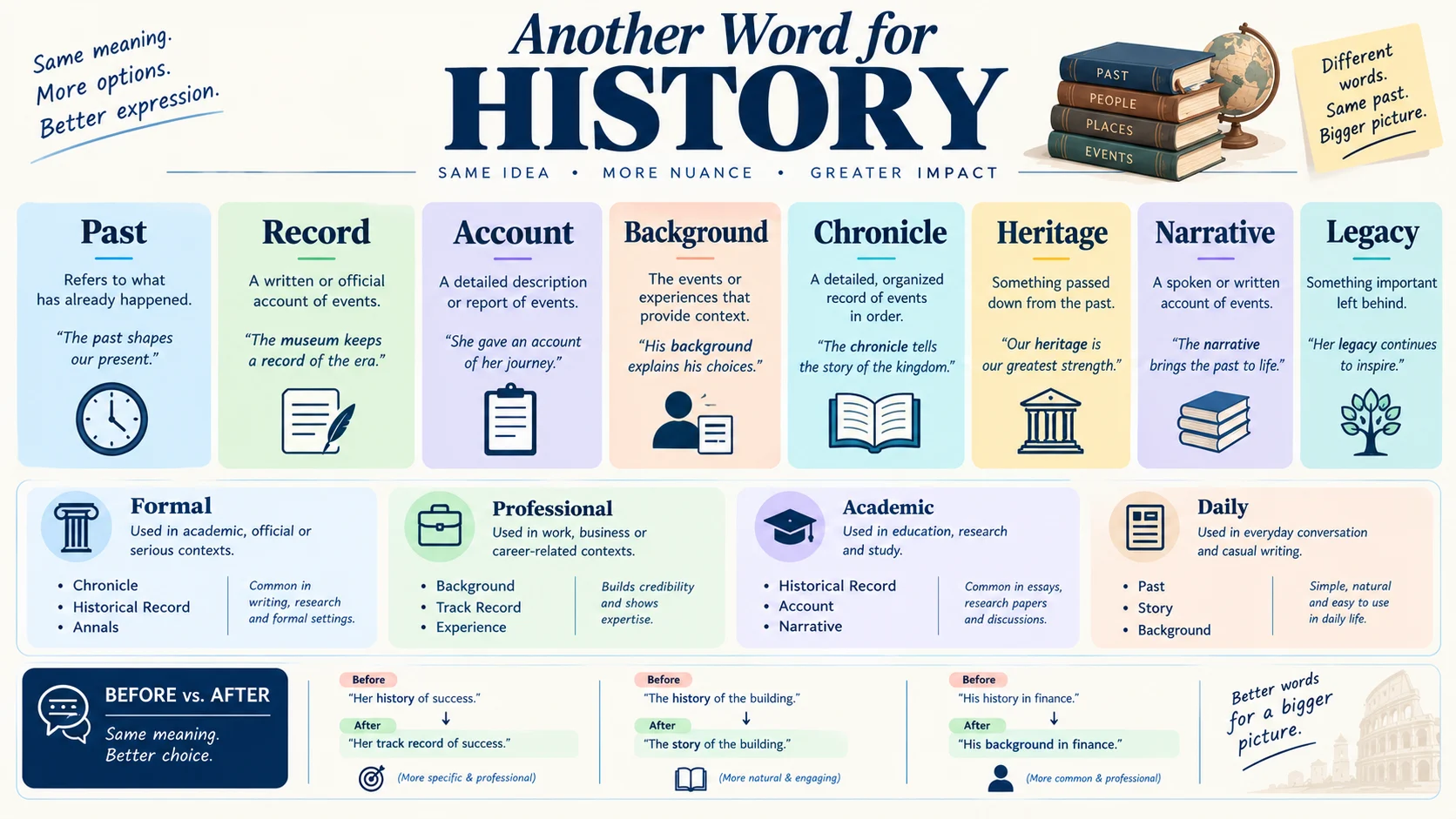
Another word for history depends on the context. Common alternatives include past, record, account, background, chronicle, heritage, narrative, and annals. Use past for events that happened before now, record for documented facts, background for context, and heritage for traditions or cultural history.
What Does History Mean?
Definition
History refers to events, people, places, ideas, and developments from the past, especially when they are studied, recorded, or remembered. The word can describe the entire story of past events or a specific record of what happened.
For example:
- She enjoys studying American history.
- The company has a long history of innovation.
- The doctor reviewed the patient’s medical history.
- The building has a fascinating history.
Because history has several meanings, the best synonym depends on what you are trying to say.
Common Uses
The word history commonly appears in four situations:
Past events:
Use words such as past or historical record when referring to things that happened before the present.
A documented account:
Use record, account, chronicle, or annals when referring to information preserved about past events.
Personal or organizational background:
Use background, track record, or experience when discussing someone’s previous activities or achievements.
Cultural traditions and inheritance:
Use heritage, legacy, or tradition when discussing customs, values, or influences passed down through generations.
Best Synonyms for History
| Synonym | Meaning | Best Used When | Example |
|---|---|---|---|
| Past | Time or events that happened before now | Referring broadly to earlier events | We should learn from the past. |
| Record | Documented information about events or activities | Facts, documentation, or official information | The company has a strong safety record. |
| Account | A description of events | Retelling or explaining what happened | She gave an account of the meeting. |
| Background | Previous circumstances or information that provides context | Personal, professional, or organizational context | He has a background in engineering. |
| Chronicle | A detailed record of events in chronological order | Historical or formal writing | The book chronicles the city’s development. |
| Heritage | Cultural traditions, history, and values inherited from the past | Culture, family, or national identity | The museum celebrates local heritage. |
| Narrative | A structured story or interpretation of events | Stories, historical interpretations, or analysis | The documentary presents a different historical narrative. |
| Annals | Historical records, usually arranged by years or periods | Formal historical writing | The event entered the annals of local history. |
| Legacy | Something handed down from the past | Influence, achievements, or lasting impact | Her legacy continues to inspire students. |
| Experience | Knowledge or skills gained through previous events | Personal or professional history | He has years of experience in finance. |
Synonyms by Context
Formal Writing
In formal writing, record, chronicle, account, annals, and historical record can replace history when the context involves documented events.
Example:
Original:
The history of the organization is well documented.
Alternative:
The historical record of the organization is well documented.
Chronicle works particularly well when describing events over a period of time:
The book chronicles the development of modern medicine.
Professional Writing
In business and workplace writing, background, experience, record, track record, and legacy are often more natural than history.
Instead of:
She has a strong history of successful leadership.
You could write:
She has a strong track record of successful leadership.
For professional profiles, background and experience are especially useful:
He has a background in financial analysis.
She brings ten years of experience in project management.
Academic Writing
Academic writing often uses historical record, account, narrative, chronicle, past, and heritage, depending on the subject.
For example:
Researchers examined the historical record to understand the conflict.
Or:
The study explores competing narratives about the event.
Historical record is useful when referring to documented evidence, while narrative can describe the way historical events are presented or interpreted.
Daily Conversation
In everyday American English, past, background, story, experience, and record tend to sound more natural than formal terms such as annals or chronicle.
For example:
Instead of:
Tell me the history of your relationship.
You might say:
Tell me about your past together.
Instead of:
What is the history behind this building?
You could say:
What’s the story behind this building?
Professional Alternatives for History
The best professional replacement depends on the specific meaning.
Track Record
Meaning: A record of someone’s previous performance or achievements.
Best used for: Business, employment, leadership, performance, and results.
Tone: Professional
Difficulty: Easy
Usage Frequency: Very Common
Resume: Excellent
Email Writing: Excellent
Essay Writing: Good
Marketing Copy: Excellent
Business Writing: Excellent
Business example:
The company has a proven track record of delivering projects on time.
Academic example:
The researcher has a strong track record of publishing peer-reviewed studies.
Daily example:
She has a good track record of keeping her promises.
Background
Meaning: Previous experience, education, circumstances, or information about a person or organization.
Best used for: Professional profiles and personal context.
Tone: Neutral and professional
Difficulty: Easy
Usage Frequency: Very Common
Example:
His background in software development prepared him for the role.
Experience
Meaning: Knowledge or ability gained through previous activities or events.
Best used for: Careers, skills, personal development, and professional qualifications.
Example:
She has extensive experience working with international clients.
Simple Alternatives for History
If you want an easy word that most readers immediately understand, consider:
- Past
- Story
- Background
- Record
- Experience
Past is usually the simplest replacement.
Original:
We cannot change history.
Simple alternative:
We cannot change the past.
Story works when history means a series of events that can be told or explained.
Original:
The history of the old house is fascinating.
Alternative:
The story of the old house is fascinating.
Stronger Alternatives for History
Some alternatives provide a more precise or sophisticated meaning.
Chronicle emphasizes a detailed record of events.
Historical record emphasizes documented evidence.
Heritage emphasizes cultural or inherited history.
Legacy emphasizes lasting influence.
Annals has a formal, literary tone and usually refers to recorded historical events.
Narrative emphasizes how events are organized, described, or interpreted.
Choosing a stronger synonym does not always mean choosing a more complicated word. The goal is to select the word that expresses the exact meaning you intend.
Difference Between Similar Synonyms
History vs. Past
History can mean the study or record of past events. Past simply refers to a time before the present.
She studies American history.
We learned from the past.
History vs. Record
A record is documented information about something that happened. History is broader and can include events, interpretation, memory, and study.
The company’s history spans 50 years.
The company has an impressive safety record.
History vs. Background
Background provides information that helps explain a person, situation, organization, or event. It does not necessarily refer to distant historical events.
Tell me about the history of the city.
Tell me about your professional background.
History vs. Heritage
Heritage usually refers to cultural, family, national, or traditional elements inherited from the past.
The museum teaches local history.
The festival celebrates local heritage.
History vs. Legacy
Legacy focuses on what someone or something leaves behind and how it continues to affect the future.
The history of the university spans more than a century.
The founder’s legacy continues to shape the university.
History vs. Chronicle
A chronicle is a detailed account of events, often presented in chronological order. It is more specific and formal than history.
The book provides a history of the region.
The book chronicles the region’s development over 200 years.
Opposite Words
History does not have one exact opposite in every context. Depending on the meaning, possible contrasting concepts include:
- Future
- Present
- Now
- Forecast
- Prospect
- Prediction
When history means the past, future is the clearest contrast:
History tells us what happened; the future concerns what has yet to happen.
When history means a documented account, the contrast may instead involve something unrecorded, unknown, or undocumented.
FAQs
What is another word for history?
Common alternatives for history include past, record, account, background, chronicle, heritage, narrative, and legacy. The best choice depends on whether you mean past events, documented information, personal background, or cultural heritage.
What is a formal synonym for history?
Chronicle, historical record, account, and annals can serve as formal alternatives to history. The appropriate choice depends on the sentence and the type of historical information being discussed.
What is a professional alternative for history?
In professional writing, background, experience, track record, record, and legacy can replace history in specific contexts. For example, “a strong track record” is often more precise than “a strong history” when discussing performance.
What word can replace history on a resume?
Depending on the sentence, useful alternatives include experience, background, track record, achievements, and record. “Experience” is particularly common when describing previous employment or skills.
What is another word for the history of something?
Depending on context, you can use background, story, development, evolution, record, chronicle, or origins. For example, “the history of the company” could become “the company’s background” or “the company’s development.”
What is another word for personal history?
Background, experience, past, personal record, or life story can work depending on the context. In professional writing, “background” or “experience” usually sounds more natural.
What is another word for family history?
Ancestry, genealogy, heritage, lineage, or family background may work depending on the intended meaning. “Genealogy” specifically focuses on family relationships and descent.
What is another word for medical history?
In medical contexts, medical record or patient history can sometimes replace medical history. The exact term depends on whether you mean the patient’s documented records or information about previous health events.
What is another word for company history?
Useful alternatives include company background, corporate history, organizational history, heritage, and company story. “Company background” is often appropriate for business profiles.
What is another word for historical account?
Chronicle, record, narrative, description, or history can work depending on the context. “Chronicle” emphasizes a detailed record, while “narrative” emphasizes how events are presented.
Conclusion
The best synonym for history depends on what you mean. Past is the simplest choice for events that happened before now. Record works for documented information, background describes previous circumstances, track record fits professional performance, and heritage refers to cultural or inherited history. For detailed historical writing, chronicle and historical record provide greater precision.
Instead of replacing history automatically, identify the specific idea behind the word first. A precise synonym makes your writing clearer, more natural, and more effective.