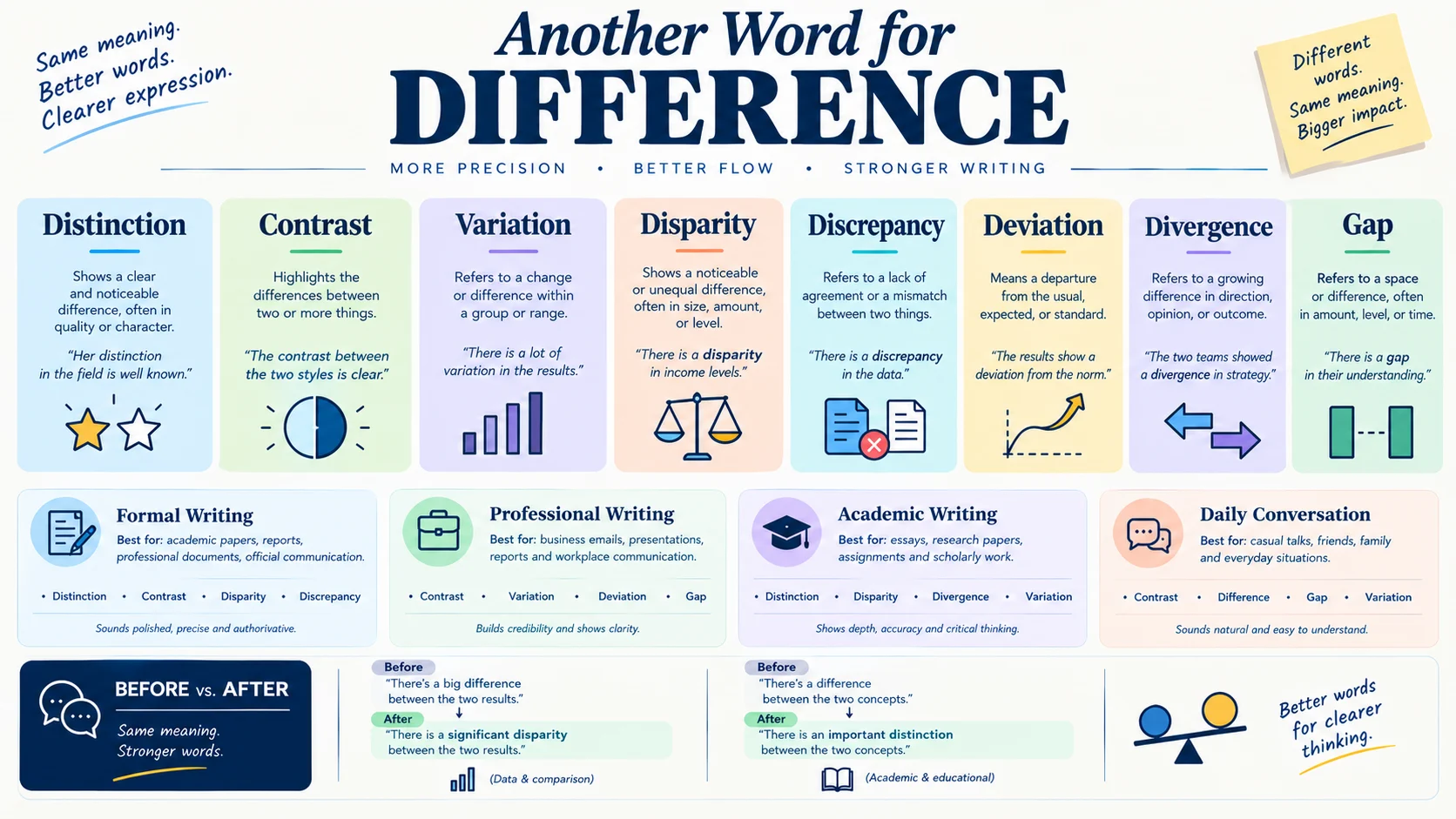
If you need another word for difference, the best choice depends on what you mean. Common alternatives include distinction, contrast, variation, disparity, deviation, discrepancy, change, gap, divergence, and distinction. For everyday writing, “change” or “distinction” may work well, while “disparity,” “discrepancy,” or “divergence” can be more precise in professional and academic contexts.
What Does Difference Mean?
Definition
Difference means a way in which two or more people, things, ideas, situations, or qualities are not the same.
It can describe a noticeable contrast, a variation in characteristics, a disagreement between people, or the amount by which two things differ.
For example:
- There is a difference between the two products.
- We noticed a significant difference in test results.
- The two teams had a difference of opinion.
- A small price difference can affect the final decision.
Because “difference” has several meanings, its best synonym changes according to context.
Common Uses
“Difference” commonly appears when discussing:
- Differences between people or objects
- Differences in quality or performance
- Differences in opinions
- Differences in prices or numbers
- Cultural differences
- Differences in research findings
- Differences between two versions
- Differences in appearance, behavior, or results
Best Synonyms for Difference
| Synonym | Meaning | Best Used When | Example |
|---|---|---|---|
| Distinction | A clear difference between things | You want to emphasize separate qualities | There is an important distinction between the two concepts. |
| Contrast | A noticeable difference | Two things are being directly compared | The contrast between the designs is obvious. |
| Variation | A difference or change within a group or range | Discussing forms, amounts, or results | There is considerable variation in test scores. |
| Disparity | A significant inequality or difference | Discussing unequal outcomes or conditions | The report found a disparity in income levels. |
| Discrepancy | A difference between information that should agree | Records, numbers, reports, or data | We found a discrepancy in the financial records. |
| Divergence | A movement or development away from something else | Ideas, opinions, trends, or paths | The researchers observed a divergence in their findings. |
| Deviation | A departure from an expected standard | Statistics, measurements, rules, or norms | The result showed a slight deviation from the average. |
| Gap | A noticeable space or difference | Skills, knowledge, performance, or resources | There is a significant gap between the two groups. |
| Change | A movement from one state or condition to another | General or everyday situations | The change in prices was unexpected. |
| Distinction | A meaningful separation between related things | Formal or precise comparisons | The distinction between the terms is important. |
Distinction
Meaning: A clear or meaningful difference between two or more things.
Best used for: Formal, professional, and academic comparisons.
Tone: Formal and precise
Difficulty: Medium
Usage Frequency: Common
Best for: Resume writing, email writing, essays, marketing copy, and business writing.
Business example: The report makes a clear distinction between short-term and long-term goals.
Academic example: Researchers must recognize the distinction between correlation and causation.
Daily example: There is a big distinction between being busy and being productive.
Contrast
Meaning: A noticeable difference between two things placed side by side or compared.
Best used for: Writing that directly compares people, objects, ideas, colors, styles, or results.
Tone: Neutral to formal
Difficulty: Easy
Usage Frequency: Very Common
Business example: The contrast between the two marketing strategies is clear.
Academic example: The study highlights a strong contrast between urban and rural communities.
Daily example: The contrast between the two outfits is easy to see.
Variation
Meaning: A difference or change within a particular group, range, or set.
Best used for: Data, results, products, behavior, measurements, and natural differences.
Tone: Neutral and analytical
Difficulty: Medium
Usage Frequency: Common
Business example: Seasonal variation affects our monthly sales figures.
Academic example: The researchers found significant variation among participants.
Daily example: There is some variation in the prices at different stores.
Disparity
Meaning: A substantial difference, especially an unequal difference between people, groups, or outcomes.
Best used for: Income, access, opportunities, performance, resources, and social or economic comparisons.
Tone: Formal
Difficulty: Advanced
Usage Frequency: Common
Business example: The company identified a disparity in compensation across departments.
Academic example: The research examines disparities in educational access.
Daily example: There is a noticeable disparity between the two neighborhoods.
Discrepancy
Meaning: A difference between two pieces of information, numbers, records, or accounts that should normally match.
Best used for: Reports, invoices, data, documents, statistics, and records.
Tone: Professional and formal
Difficulty: Medium
Usage Frequency: Common
Business example: The accountant noticed a discrepancy between the invoice and payment record.
Academic example: The researcher investigated a discrepancy between the two data sets.
Daily example: There is a discrepancy between what you told me and what actually happened.
Synonyms by Context
Formal Writing
For formal writing, choose words that explain the exact type of difference.
Good choices include:
- Distinction
- Disparity
- Discrepancy
- Divergence
- Deviation
- Contrast
Example:
Instead of:
There is a big difference between the two approaches.
You could write:
There is a significant distinction between the two approaches.
For unequal outcomes:
The study identified a substantial disparity between the groups.
For conflicting records:
The audit revealed a discrepancy in the reported figures.
Professional Writing
Professional alternatives depend on the subject.
Use discrepancy for records and data, variation for performance or results, gap for skills or capabilities, and distinction for strategic or conceptual comparisons.
Example:
The analysis revealed a significant gap between customer expectations and actual service performance.
Academic Writing
Academic writing often benefits from precise terms such as distinction, variation, disparity, divergence, and deviation.
For example:
The researchers observed a significant variation in participant responses.
Instead of:
The study found a difference in the results.
A more specific sentence could be:
The study found a significant disparity in outcomes between the two groups.
The important point is that academic synonyms should describe the exact relationship rather than simply replace the word “difference.”
Daily Conversation
For casual speech, simpler alternatives usually sound more natural:
- Change
- Contrast
- Gap
- Variation
- Separation
Examples:
What’s the difference?
Could become:
What’s the change?
Or:
How are they different?
In everyday conversation, “difference” itself is often the most natural choice.
Professional Alternatives for Difference
When writing a resume, report, business email, or workplace document, consider:
- Distinction
- Discrepancy
- Variation
- Gap
- Disparity
- Deviation
- Divergence
- Contrast
Choose the word according to meaning rather than formality alone.
For example, “discrepancy” sounds professional because it describes a specific type of difference between expected or matching information. It should not replace “difference” when you simply mean that two products look different.
Simple Alternatives for Difference
If you want an easy, natural replacement, use:
- Change
- Contrast
- Gap
- Variation
- Distinction
Examples:
Difference in price → price gap
Difference in appearance → contrast
Difference in condition → change
Difference between ideas → distinction
Difference among results → variation
These alternatives are generally easier for broad audiences to understand.
Stronger Alternatives for Difference
When “difference” feels too general, a more precise word can make your writing stronger.
Disparity suggests a meaningful inequality.
There is a significant disparity in household income.
Discrepancy suggests conflicting or inconsistent information.
The auditor discovered a discrepancy in the records.
Deviation suggests movement away from a standard or expected value.
The measurement showed a slight deviation from the target.
Divergence suggests that ideas, paths, opinions, or trends are moving apart.
The two companies showed a divergence in their long-term strategies.
These words are stronger because they communicate the specific nature of the difference.
Difference Between Similar Synonyms
Not every synonym for “difference” means exactly the same thing.
Difference vs. distinction:
A difference is general. A distinction emphasizes a clear or meaningful separation.
Difference vs. contrast:
A contrast usually involves directly comparing two things and emphasizing how they differ.
Difference vs. variation:
Variation describes differences within a group, range, or set.
Difference vs. disparity:
Disparity usually implies a significant or unequal difference.
Difference vs. discrepancy:
Discrepancy usually refers to conflicting information, numbers, records, or accounts.
Difference vs. deviation:
Deviation means moving away from an expected standard, average, or norm.
Difference vs. divergence:
Divergence suggests that things are becoming increasingly separate in direction, opinion, development, or results.
Choosing the precise term can make a sentence clearer and more informative.
Opposite Words
Common opposites of difference include:
- Similarity
- Sameness
- Agreement
- Uniformity
- Equality
- Resemblance
- Consistency
The correct opposite depends on the meaning.
For example:
The two products have several similarities.
When discussing opinions:
The team reached an agreement.
When discussing equal treatment or amounts:
The two groups showed equality in the measured outcome.
FAQs
What is another word for difference?
Common alternatives for “difference” include distinction, contrast, variation, disparity, discrepancy, deviation, divergence, gap, and change. The best synonym depends on whether you mean a general contrast, an unequal outcome, conflicting information, or a change from one state to another.
What is a formal synonym for difference?
Formal synonyms include distinction, disparity, discrepancy, divergence, and deviation. “Distinction” works well for conceptual differences, while “discrepancy” is appropriate for conflicting records or data.
What is a professional word for difference?
Professional alternatives include distinction, discrepancy, variation, gap, disparity, and divergence. The best choice depends on the business context and the specific type of difference being described.
What word can replace difference in an essay?
Useful academic alternatives include distinction, contrast, variation, disparity, divergence, and deviation. Select the word that accurately describes the relationship between the ideas, groups, or results.
What is another word for a big difference?
Depending on the context, you can use major distinction, significant disparity, substantial gap, marked contrast, or considerable variation.
What is another word for a small difference?
Possible alternatives include slight variation, minor distinction, small discrepancy, subtle contrast, or minor deviation.
What is another word for difference in opinion?
Common alternatives include disagreement, divergence of opinion, and conflicting views.
What is another word for difference in numbers?
Depending on the situation, use discrepancy, variation, gap, difference in value, or deviation.
What is another word for difference in appearance?
Good choices include contrast, distinction, variation, or change in appearance.
Is “distinction” always a synonym for “difference”?
No. “Distinction” is a type of difference that emphasizes a clear or meaningful separation between things. It does not fit every situation where “difference” is used.
Conclusion
The best alternative for difference depends on what kind of difference you mean. Use distinction for a clear conceptual separation, contrast for direct comparison, variation for differences within a group, disparity for significant inequality, discrepancy for conflicting information, deviation for departure from a standard, and divergence when ideas or trends move apart.
For everyday writing, difference, change, contrast, and variation are usually natural choices. For professional and academic writing, a more precise synonym can make your meaning clearer and your writing more authoritative.