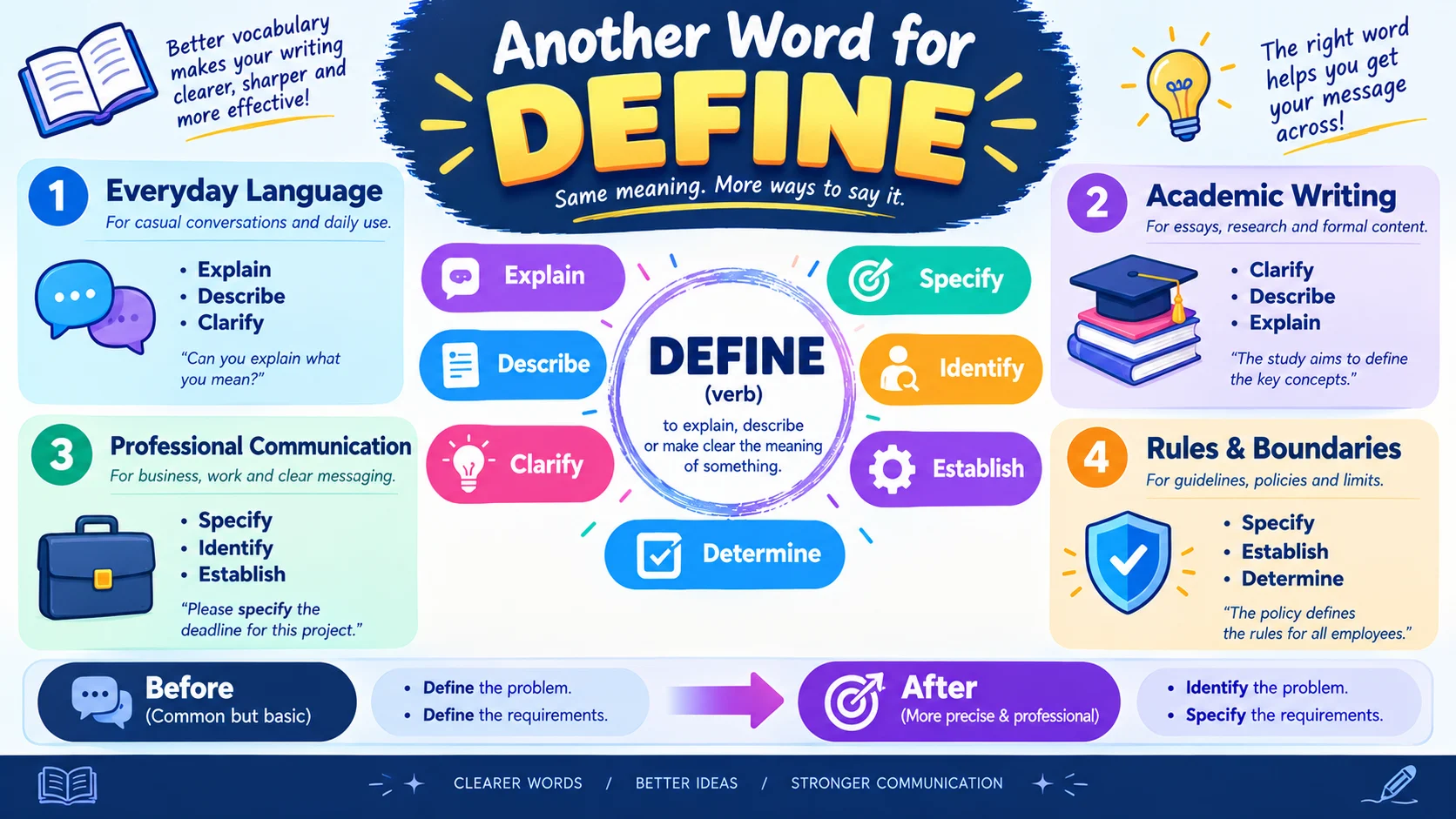
Another word for define depends on the context. Common synonyms include explain, describe, clarify, specify, identify, establish, outline, and determine. Use explain to make an idea understandable, clarify to remove confusion, specify to provide exact details, and determine to establish something through investigation. The best alternative depends on what you want to communicate.
What Does Define Mean?
Definition
The word define is a verb that means to explain the meaning of a word, describe the essential qualities of something, or establish the limits and characteristics of an idea, situation, or object.
For example:
- The dictionary helps define unfamiliar words.
- The report defines the project’s main objectives.
- Researchers must define the scope of their study.
- Her experiences helped define her character.
The word has several related meanings. It can refer to explaining a term, describing something precisely, identifying boundaries, or establishing the characteristics of a situation.
Common Uses
The word define commonly appears in these contexts:
- Vocabulary and language: Explain what a word or phrase means.
- Academic writing: Establish the meaning, scope, or terms of a study.
- Professional communication: Clarify goals, roles, responsibilities, or expectations.
- Personal identity: Describe the qualities or experiences that shape someone.
- Rules and boundaries: Establish limits or conditions.
- Problem-solving: Identify or describe an issue precisely.
Because these uses differ, a synonym that works for a dictionary definition may not fit a business strategy or scientific study.
Best Synonyms for Define
| Synonym | Meaning | Best Used When | Example |
|---|---|---|---|
| Explain | Make something understandable | Teaching or clarifying an idea | Please explain the concept. |
| Describe | Tell what something is like | Presenting characteristics or details | Describe the main features of the system. |
| Clarify | Make something clearer | Removing confusion or ambiguity | Clarify the project’s requirements. |
| Specify | State something precisely | Providing exact details or conditions | Specify the required file format. |
| Identify | Recognize or establish what something is | Naming a problem, person, or factor | Identify the main cause of the issue. |
| Establish | Set up or firmly determine something | Defining rules, standards, or principles | Establish clear performance standards. |
| Outline | Present the main points | Summarizing goals, plans, or ideas | Outline the research objectives. |
| Determine | Establish something through reasoning or investigation | Finding a result or deciding a condition | Determine the cause of the failure. |
| Characterize | Describe distinctive qualities | Academic or analytical writing | Characterize the behavior of the system. |
| Interpret | Explain the meaning of something | Analyzing information or evidence | Interpret the results carefully. |
| Delimit | Set boundaries or limits | Research scope and technical discussions | Delimit the scope of the investigation. |
| Formulate | Express or develop something systematically | Creating definitions, policies, or plans | Formulate a clear working definition. |
| Classify | Arrange into categories | Research, science, and organization | Classify the samples by size. |
| Distinguish | Show how something differs | Comparing ideas or concepts | Distinguish facts from opinions. |
| Mean | Convey a particular idea or definition | Everyday language and direct explanations | What does this term mean? |
Synonyms by Context
Formal Writing
In formal writing, specify, establish, characterize, delimit, and formulate can replace define when their meanings match.
Specify is useful when exact information is required.
Example: The guidelines specify the conditions for participation.
Establish works when setting standards, principles, or boundaries.
Example: The committee established clear criteria for evaluating applications.
Characterize describes the distinctive qualities of a person, system, or situation.
Example: The researchers characterized the material according to its physical properties.
For formal writing, select the word that expresses the intended action instead of choosing a synonym simply because it sounds sophisticated.
Professional Writing
In business communication, useful alternatives include clarify, establish, specify, outline, and identify.
Clarify works when expectations or instructions are confusing.
Business example: The manager clarified each team member’s responsibilities.
Outline is appropriate when presenting the main elements of a plan.
Business example: The proposal outlines the company’s growth strategy.
Establish works when setting standards or creating a shared understanding.
Business example: The department established measurable performance goals.
These verbs make professional writing more precise by identifying exactly what action is taking place.
Academic Writing
Academic writing often requires characterize, specify, identify, delimit, and formulate.
Characterize describes the essential qualities of a subject.
Academic example: The study characterizes the relationship between sleep quality and academic performance.
Delimit means to establish the boundaries of a topic or investigation.
Academic example: The researchers delimited the study to adults within a specific age range.
Formulate is useful when developing a precise definition or conceptual framework.
Academic example: The research team formulated an operational definition of student engagement.
In academic writing, define remains appropriate when introducing a technical term. For example, “This study defines academic achievement as the final course grade” is clear and direct.
Daily Conversation
In everyday English, explain, describe, clarify, mean, and show are usually natural alternatives.
Examples:
- Instead of “Define the problem,” say “Explain the problem.”
- Instead of “Can you define that term?” say “What does that term mean?”
- Instead of “Define your expectations,” say “Tell me exactly what you expect.”
- Instead of “The experience defined her character,” say “The experience helped shape her character.”
The simplest alternative is often the best choice for everyday conversations.
Professional Alternatives for Define
When writing a resume, email, report, or academic paper, choose a verb that accurately describes your contribution.
Establish
Meaning: Set up or determine something firmly.
Best Used For: Standards, goals, policies, procedures, and criteria.
Tone: Professional and formal
Difficulty: Medium
Usage Frequency: Very Common
Best For: Resume, Email Writing, Business Writing, Academic Writing
- Business example: Established clear guidelines for project delivery.
- Academic example: The research established criteria for selecting participants.
- Daily conversation example: We established some basic rules.
Clarify
Meaning: Make an idea, statement, or requirement easier to understand.
Best Used For: Instructions, expectations, responsibilities, and communication.
Tone: Neutral and professional
Difficulty: Easy
Usage Frequency: Very Common
Best For: Resume, Email Writing, Business Writing
- Business example: Clarified project requirements to reduce misunderstandings.
- Academic example: The author clarified the distinction between the two theories.
- Daily conversation example: Can you clarify what you meant?
Specify
Meaning: State exact details or identify something precisely.
Best Used For: Requirements, conditions, technical details, and formal instructions.
Tone: Formal and precise
Difficulty: Medium
Usage Frequency: Common
Best For: Email Writing, Essay Writing, Business Writing
- Business example: Specified project deadlines and delivery requirements.
- Academic example: The study specified the variables used in the analysis.
- Daily conversation example: Please specify which item you need.
Identify
Meaning: Recognize, name, or establish what something is.
Best Used For: Problems, causes, needs, opportunities, and research findings.
Tone: Neutral to professional
Difficulty: Easy
Usage Frequency: Very Common
Best For: Resume, Essay Writing, Marketing Copy, Business Writing
- Business example: Identified opportunities to improve customer satisfaction.
- Academic example: The researchers identified the primary factors affecting the results.
- Daily conversation example: Can you identify the person in this picture?
Simple Alternatives for Define
If you want a straightforward replacement, consider these words:
- Explain: Make an idea understandable.
- Describe: Tell someone what something is like.
- Mean: Express the meaning of a word or statement.
- Clarify: Remove confusion.
- Name: State what something is called.
- Show: Make a quality or fact clear.
- Identify: Recognize or establish what something is.
- Set: Establish a rule, limit, or standard.
For example, “Define your goals” could become “Set your goals” when the intended meaning is to establish objectives. “Define the term” could become “Explain the term” when the goal is to help readers understand it.
Stronger Alternatives for Define
Some situations call for a more specific or technical verb.
Characterize emphasizes the distinctive features of a subject. Use it in analytical and academic writing.
Delimit emphasizes setting clear boundaries around a topic, study, or problem.
Specify emphasizes precision and exact details.
Establish emphasizes setting a standard, principle, or condition firmly.
Formulate emphasizes developing an idea or expressing it in a systematic way.
Determine emphasizes reaching a conclusion through investigation, analysis, or decision-making.
For example, “The researchers defined the study’s scope” could become “The researchers delimited the study’s scope” when the focus is specifically on setting boundaries.
However, stronger words are not always better. Use them only when their meanings fit the sentence.
Difference Between Similar Synonyms
Define vs. Explain: Define states the meaning or essential nature of something. Explain provides additional information about how or why it works.
Define vs. Describe: Define establishes what something means or what its essential characteristics are. Describe provides details about its appearance, qualities, or behavior.
Define vs. Clarify: Define establishes meaning, while clarify makes something easier to understand or removes uncertainty.
Define vs. Specify: Specify provides precise details or requirements. Define may establish the broader meaning, scope, or characteristics of a subject.
Define vs. Identify: Identify recognizes or names something. Define explains its meaning or establishes its boundaries.
Define vs. Determine: Determine means finding or deciding something, often through investigation. Define explains meaning or establishes what something includes.
Define vs. Establish: Establish means setting up or confirming something. Define focuses on meaning, characteristics, or boundaries.
Opposite Words
The word define has no single opposite that works in every context. Its antonyms depend on the intended meaning.
| Meaning of Define | Possible Opposite | Example |
|---|---|---|
| Explain meaning | Obscure | The wording obscured the meaning. |
| Make clear | Confuse | The instructions confused the reader. |
| Set boundaries | Blur | The policy blurred the distinction between roles. |
| Identify precisely | Misidentify | The report misidentified the cause. |
| Establish a rule | Abandon | The organization abandoned its original standards. |
| State explicitly | Imply | The speaker implied the answer rather than stating it directly. |
These are contextual opposites rather than exact antonyms for every use of define.
FAQs
What is another word for define?
Common alternatives include explain, describe, clarify, specify, identify, establish, outline, and determine. The best choice depends on whether you are explaining meaning, describing characteristics, or setting boundaries.
What is a formal synonym for define?
Formal alternatives include characterize, specify, delimit, formulate, and establish. Use delimit for boundaries and characterize for distinctive qualities.
What is a professional alternative for define?
In business writing, clarify, establish, specify, outline, and identify are useful choices. For example, “Clarify project requirements” is appropriate when making expectations easier to understand.
What word can replace define in academic writing?
Useful alternatives include characterize, specify, identify, formulate, and delimit. However, define is often the clearest choice when introducing a term or concept.
What is another word for define a problem?
You can use identify, describe, clarify, analyze, or formulate, depending on your goal. Identify names the problem, while describe explains its characteristics.
What is another word for define goals?
Common alternatives include establish goals, set objectives, specify targets, and outline priorities. Use the phrase that best reflects whether you are creating, describing, or detailing the goals.
What is another word for clearly define?
Possible alternatives include specify precisely, explain clearly, establish explicitly, and delineate. Delineate is especially useful when describing boundaries or distinctions.
Is describe the same as define?
No. Describe provides details about what something is like, while define establishes its meaning, essential characteristics, or boundaries.
What is the opposite of define?
Depending on the context, possible opposites include obscure, confuse, blur, and misidentify. For example, obscure is a suitable contrast when defining something means making its meaning clear.
What is another word for defining a person’s character?
Useful alternatives include shaping, influencing, forming, and characterizing. For example, “Her experiences helped shape her character” sounds natural when discussing personal development.
Conclusion
The best another word for define depends on what you want to express. Use explain to make an idea understandable, describe to present its characteristics, clarify to remove confusion, specify to provide exact details, and establish to set standards or boundaries.
For academic writing, characterize and delimit can provide greater precision. In professional communication, clarify, identify, and outline often sound natural and direct.
The goal is to choose a word that communicates your intended meaning accurately rather than replacing define with a synonym that only sounds more formal.