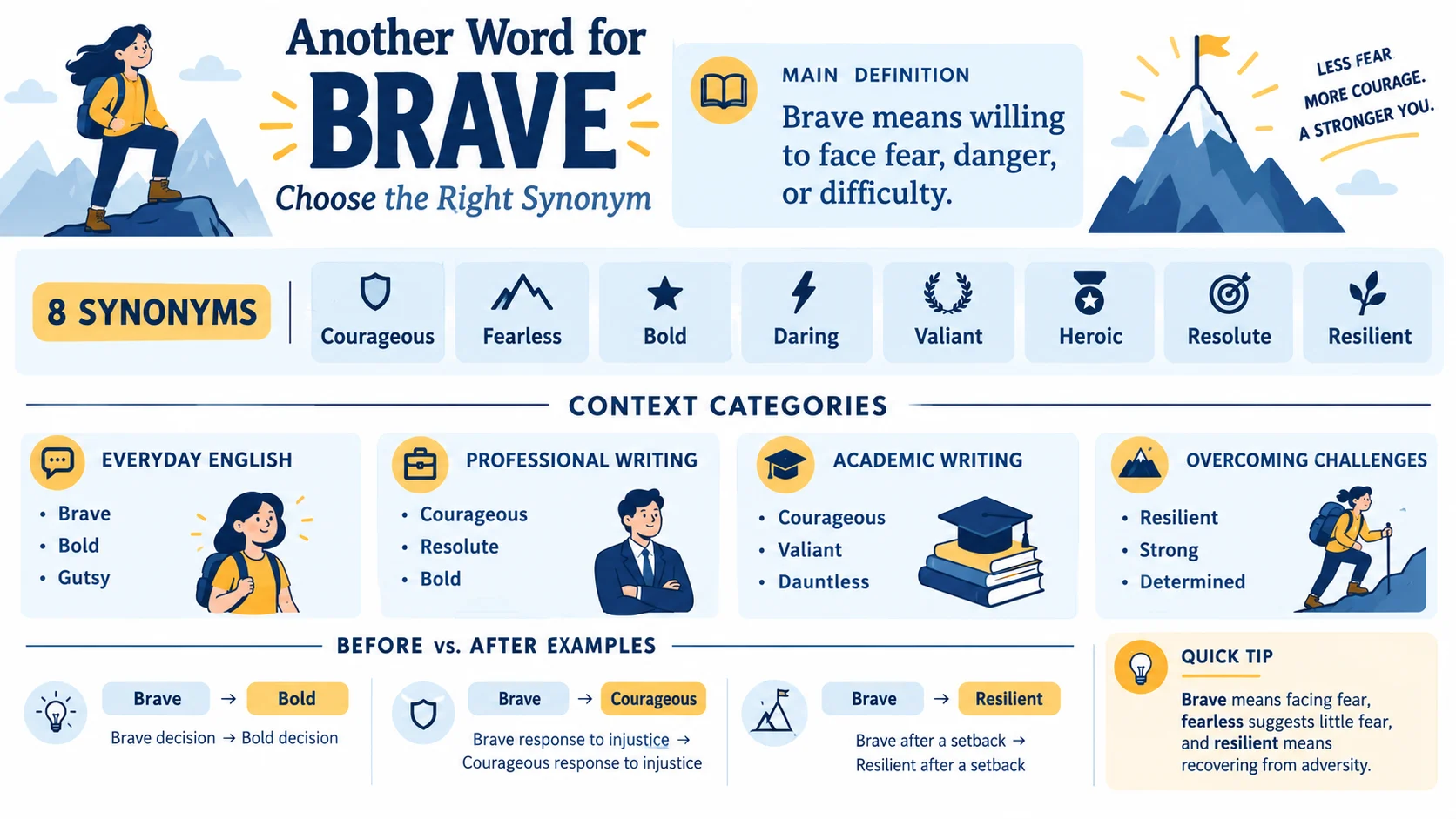
Another word for brave is courageous, meaning willing to face danger, difficulty, or fear. Other synonyms include fearless, bold, daring, valiant, heroic, and gutsy. The best choice depends on context. Use courageous for general writing, valiant for heroic actions, bold for confident decisions, and resilient for overcoming adversity.
What Does Brave Mean?
Definition
Brave is an adjective that describes someone who faces danger, fear, pain, uncertainty, or difficulty with courage. A brave person may feel afraid but chooses to act despite that fear.
Bravery does not always mean taking physical risks. Speaking up against unfair treatment, admitting a mistake, defending someone, or starting over after failure can also demonstrate bravery.
For example, “She was brave enough to report the misconduct” describes someone who acted despite the possibility of negative consequences.
Common Uses
The word brave appears in several contexts:
- Physical courage: A firefighter enters a burning building to rescue someone.
- Emotional courage: A person discusses a painful experience openly.
- Moral courage: An employee challenges an unethical decision.
- Social courage: A student stands up for a classmate who is being bullied.
- Personal growth: Someone leaves an unhealthy situation and starts again.
Choosing the right synonym depends on the type of courage you want to emphasize. Fearless suggests little or no fear, while courageous emphasizes facing fear. Bold highlights confidence, and resilient focuses on recovering from hardship.
Best Synonyms for Brave
The following words offer different shades of meaning, from quiet determination to extraordinary heroism.
| Synonym | Meaning | Best Used When | Example |
|---|---|---|---|
| Courageous | Willing to face fear or difficulty | General writing | She made a courageous decision. |
| Fearless | Showing little or no fear | Risk-taking or confidence | The fearless climber reached the summit. |
| Bold | Confident and willing to take risks | Decisions and actions | He made a bold career move. |
| Daring | Willing to attempt something risky | Adventures and ambitious actions | Their daring plan succeeded. |
| Valiant | Showing great courage, especially during struggle | Heroic or formal descriptions | The valiant soldiers protected the village. |
| Heroic | Showing exceptional courage or selflessness | Extraordinary acts | Her heroic actions saved a life. |
| Gutsy | Showing determination despite risk or difficulty | Informal conversation | That was a gutsy move. |
| Audacious | Bold and willing to take significant risks | Ambitious or unconventional actions | The company proposed an audacious strategy. |
| Intrepid | Fearless and determined when facing danger | Exploration and adventure | The intrepid explorer crossed the desert. |
| Doughty | Brave, persistent, and determined | Literary or historical writing | The doughty defender held her ground. |
| Dauntless | Not easily discouraged or intimidated | Inspirational writing | His dauntless spirit inspired the team. |
| Plucky | Showing courage in a difficult situation | Informal or encouraging descriptions | The plucky child tried again. |
| Strong-hearted | Emotionally courageous and determined | Personal encouragement | She remained strong-hearted through hardship. |
| Resolute | Firmly determined despite challenges | Leadership and professional writing | The resolute manager addressed the crisis. |
| Resilient | Able to recover from adversity | Personal growth and professional settings | The resilient student overcame setbacks. |
Not every synonym is interchangeable. A resilient person recovers from difficulty, while a fearless person appears unafraid. A resolute person stays committed to a decision, even when others disagree.
Synonyms for Brave by Context
Formal Writing
For essays, reports, speeches, and formal descriptions, choose words that communicate courage precisely.
- Courageous: The most versatile formal alternative.
- Valiant: Suitable for heroic struggles or acts of protection.
- Dauntless: Emphasizes determination in the face of intimidation.
- Resolute: Highlights firmness and determination.
- Intrepid: Works well for dangerous journeys or challenging pursuits.
Example:
Original: The brave leader confronted the crisis.
Revised: The courageous leader confronted the crisis.
More specific: The resolute leader remained committed to the plan despite mounting pressure.
Use resolute when the focus is determination rather than fear itself.
Professional Writing
In business communication, bravery often means speaking honestly, accepting responsibility, taking calculated risks, or leading through uncertainty.
Useful alternatives include courageous, bold, confident, resolute, and decisive.
Business example
Original: She made a brave decision to restructure the department.
Revised: She made a bold decision to restructure the department.
Another option: She demonstrated the courage to challenge an ineffective process.
For resumes, describe the actual behavior instead of simply calling yourself brave. For example, “Raised concerns about compliance risks and proposed corrective actions” demonstrates professional courage with specific evidence.
Academic Writing
Academic writing benefits from words that describe the nature of courage without exaggeration.
Useful alternatives include courageous, resolute, fearless, and morally courageous.
Academic example
Original: The brave activists challenged discriminatory policies.
Revised: The courageous activists challenged discriminatory policies.
More specific: The activists demonstrated moral courage by challenging discriminatory policies despite public opposition.
The final version is especially useful in research about social movements, ethics, leadership, and human behavior.
Daily Conversation
In everyday American English, simple and conversational words often sound more natural.
| Instead of Brave | Try | Example |
|---|---|---|
| Brave | Courageous | You were courageous to speak up. |
| Brave | Bold | That was a bold choice. |
| Brave | Gutsy | That was a gutsy move. |
| Brave | Fearless | She’s fearless when trying new things. |
| Brave | Strong | You’re strong for getting through this. |
| Brave | Daring | That was a daring adventure. |
For emotional situations, courageous and strong often sound supportive. Gutsy feels casual and energetic, while fearless can suggest an adventurous personality.
Professional Alternatives for Brave
These alternatives are especially useful in resumes, performance reviews, leadership profiles, and business writing.
Courageous
Meaning: Willing to face fear, danger, or difficulty.
Best used for: Ethical decisions, difficult conversations, and leadership.
Tone: Professional and positive.
Difficulty: Easy.
Usage frequency: Very common.
Best for: Resume writing, email writing, essays, business writing, and marketing copy.
- Business example: She took courageous action to address the compliance issue.
- Academic example: The study examines courageous resistance to social injustice.
- Daily conversation example: It was courageous of you to ask for help.
Bold
Meaning: Confident and willing to take risks or challenge expectations.
Best used for: Innovation, strategy, entrepreneurship, and decisive action.
Tone: Confident and assertive.
Difficulty: Easy.
Usage frequency: Very common.
Best for: Resumes, marketing copy, business writing, and professional emails.
- Business example: Led a bold initiative to improve customer retention.
- Academic example: The researcher proposed a bold interpretation of the findings.
- Daily conversation example: That’s a bold move, but it might work.
Resolute
Meaning: Firmly determined and unwilling to abandon a decision or purpose.
Best used for: Leadership, long-term goals, and difficult professional situations.
Tone: Formal and authoritative.
Difficulty: Medium.
Usage frequency: Common.
Best for: Executive resumes, academic essays, business reports, and leadership profiles.
- Business example: The resolute team continued its recovery plan despite setbacks.
- Academic example: The movement remained resolute in its opposition to the policy.
- Daily conversation example: She stayed resolute and finished what she started.
Resilient
Meaning: Able to recover, adapt, or continue after hardship.
Best used for: Overcoming setbacks, adapting to change, and personal development.
Tone: Positive and encouraging.
Difficulty: Easy.
Usage frequency: Very common.
Best for: Resumes, professional biographies, academic writing, and business communication.
- Business example: Built a resilient team capable of adapting to changing priorities.
- Academic example: The research explores resilient communities following natural disasters.
- Daily conversation example: He’s resilient and always finds a way forward.
Remember that resilient is not a direct synonym in every situation. It describes recovery and adaptation more than the act of confronting fear.
Simple Alternatives for Brave
If you want easy words that readers understand immediately, consider these options:
Strong: Useful when someone handles a difficult experience with determination.
Example: She stayed strong during a challenging period.
Fearless: Best when someone seems unafraid of danger or uncertainty.
Example: He is fearless when trying something new.
Bold: Appropriate for confident choices or actions that involve risk.
Example: She made a bold decision to change careers.
Gutsy: An informal alternative that expresses admiration for someone’s nerve or determination.
Example: That was a gutsy thing to say.
Confident: Useful when the intended meaning is self-assurance rather than courage in the face of danger.
Example: He confidently presented his proposal.
Stronger Alternatives for Brave
When describing exceptional courage, select a word that matches the scale and nature of the action.
- Heroic: Best for extraordinary actions that protect or help others.
- Valiant: Emphasizes courageous effort during a serious struggle.
- Dauntless: Highlights persistence despite intimidation or difficulty.
- Intrepid: Suitable for facing dangerous or unfamiliar situations.
- Audacious: Describes unusually bold, ambitious, or risky actions.
- Fearless: Emphasizes an apparent lack of fear.
Examples:
- The heroic nurse helped evacuate patients during the emergency.
- The valiant team continued fighting despite overwhelming obstacles.
- Her dauntless determination kept the project moving.
- The intrepid journalist investigated the dangerous assignment.
- The startup made an audacious attempt to transform the industry.
Use stronger words carefully. Calling an ordinary decision heroic can exaggerate its importance, while audacious can imply that an action is excessively bold or even reckless.
Difference Between Similar Synonyms
Understanding the distinctions between similar words helps you select the most accurate replacement.
| Word | Main Difference | Example |
|---|---|---|
| Brave | General willingness to face fear or danger | She was brave enough to speak up. |
| Courageous | Emphasizes acting despite fear or difficulty | He made a courageous choice. |
| Fearless | Suggests little or no fear | The fearless athlete accepted the challenge. |
| Bold | Emphasizes confidence and risk-taking | They introduced a bold proposal. |
| Daring | Focuses on adventurous or risky action | The daring rescue made headlines. |
| Valiant | Suggests noble or heroic courage | The valiant defenders held their position. |
| Resilient | Focuses on recovering from hardship | She remained resilient after the setback. |
| Confident | Emphasizes belief in one’s abilities | He was confident during the presentation. |
| Audacious | Highlights unusually bold or unconventional behavior | The company made an audacious investment. |
Brave vs. Courageous
These words are close in meaning. Brave is shorter and more conversational, while courageous often sounds more formal or emphatic.
Example: “That was a brave decision” and “That was a courageous decision” are both natural sentences.
Brave vs. Fearless
A brave person can experience fear and still act. A fearless person is described as showing little or no fear. In real life, bravery does not require the absence of fear.
Brave vs. Bold
Brave emphasizes facing fear or danger. Bold emphasizes confidence, assertiveness, or willingness to take risks. A bold marketing campaign may be unconventional without involving any personal danger.
Brave vs. Strong
Strong is broader than brave. It can refer to physical ability, emotional endurance, influence, or determination. Brave specifically emphasizes facing something frightening or difficult.
Opposite Words for Brave
The opposite of brave depends on the type of courage being described.
| Antonym | Meaning | Example |
|---|---|---|
| Cowardly | Showing an unwillingness to face danger or difficulty | His cowardly response disappointed the team. |
| Fearful | Experiencing or showing fear | She felt fearful before the interview. |
| Timid | Lacking confidence or being hesitant | The timid speaker avoided questions. |
| Afraid | Feeling fear | He was afraid to speak publicly. |
| Fainthearted | Lacking courage or determination | The fainthearted candidate withdrew. |
| Spineless | Lacking the courage to stand up for oneself or one’s beliefs | The criticism targeted his spineless response. |
These words differ in tone. Afraid describes a feeling and does not necessarily imply weakness. Cowardly and spineless are strongly negative judgments, so use them carefully.
FAQs
1. What is the best synonym for brave?
Courageous is the best general synonym for brave. Depending on context, bold, fearless, valiant, and heroic may communicate more specific kinds of courage.
2. What is a formal word for brave?
Valiant, intrepid, dauntless, and courageous are suitable formal alternatives. Choose resolute when you want to emphasize determination rather than courage alone.
3. What is a professional alternative for brave?
Courageous, bold, and resolute work well in professional writing. For resumes, describe a specific action that demonstrates courage instead of relying on a general adjective.
4. What is another word for brave in an essay?
Use courageous, valiant, fearless, or resolute, depending on the argument. Moral courage is especially useful when discussing ethical decisions or standing against injustice.
5. What is a more powerful word for brave?
Heroic, valiant, dauntless, and intrepid can express exceptional courage. The strongest choice depends on whether the situation involves sacrifice, danger, persistence, or adventure.
6. What is a casual word for brave?
Gutsy is a popular informal alternative. Bold and fearless also work in casual conversation.
7. What is another word for brave in a positive way?
Courageous, inspiring, fearless, strong, and heroic can express admiration. Use inspiring when someone’s courage motivates other people.
8. Can resilient replace brave?
Sometimes, but the words are not interchangeable in every sentence. Brave emphasizes facing fear, while resilient emphasizes recovering or adapting after hardship.
9. What is the opposite of brave?
Common opposites include cowardly, timid, fearful, and fainthearted. Afraid is not always a true opposite because brave people can feel afraid and still act courageously.
10. What is another word for brave enough to speak up?
Courageous, assertive, and bold may fit. Use courageous when speaking involves personal risk, assertive when expressing a position confidently, and bold when the action challenges expectations.
Conclusion
The best alternative to brave depends on the situation. Choose courageous for general use, bold for confident decisions, fearless for apparent fearlessness, valiant for heroic struggles, and resilient for overcoming setbacks.
For professional writing, specific descriptions are often more persuasive than broad claims. Instead of simply calling someone brave, explain what they did, what challenge they faced, and why their actions demonstrated courage.