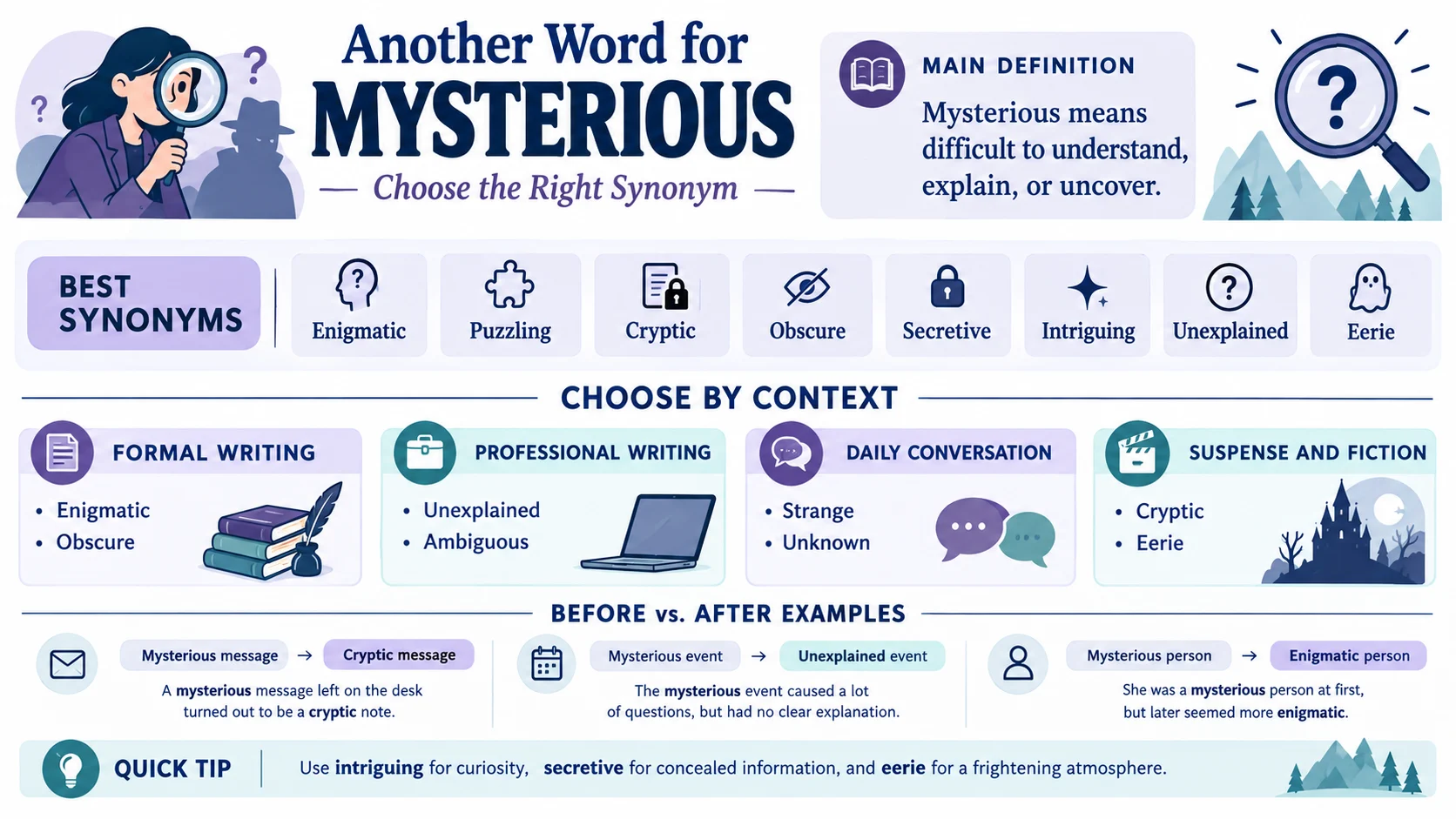
Another word for mysterious is enigmatic, which describes someone or something that is difficult to understand or explain. Other useful synonyms include puzzling, cryptic, obscure, secretive, intriguing, and inexplicable. The best choice depends on context: use enigmatic for something hard to interpret, secretive for hidden intentions, and intriguing for something that sparks curiosity.
What Does Mysterious Mean?
Definition
Mysterious is an adjective that describes a person, place, event, object, or situation that is difficult to understand, explain, identify, or uncover. It often suggests that important information is hidden or that something unusual remains unexplained.
For example, “A mysterious message appeared on her desk” suggests that the message’s origin or meaning is unknown.
The word can create different impressions depending on context. A mysterious person may seem secretive, while a mysterious event may be unexplained. A mysterious place may feel eerie, fascinating, or unfamiliar.
Common Uses
Mysterious commonly describes:
- People: Someone whose personality, intentions, or past are difficult to understand.
- Events: Occurrences with no obvious explanation.
- Places: Locations that feel unfamiliar, hidden, or full of secrets.
- Messages: Statements or clues with unclear meanings.
- Stories: Plots involving secrets, suspense, or unanswered questions.
- Feelings: Experiences that are difficult to explain or interpret.
Understanding the intended meaning helps you select a synonym that fits your sentence rather than simply replacing one adjective with another.
Best Synonyms for Mysterious
The following words are useful alternatives, but they emphasize different aspects of mystery.
| Synonym | Meaning | Best Used When | Example |
|---|---|---|---|
| Enigmatic | Difficult to interpret or understand | Describing people, expressions, or behavior | She gave him an enigmatic smile. |
| Puzzling | Confusing or difficult to explain | Describing problems or events | The results were puzzling. |
| Cryptic | Mysteriously unclear or indirect | Describing messages, clues, or remarks | He left a cryptic note. |
| Obscure | Unclear, hidden, or not widely known | Describing facts, meanings, or details | The reference was obscure. |
| Secretive | Inclined to conceal information | Describing people or organizations | The manager was secretive about the plan. |
| Intriguing | Interesting in a way that sparks curiosity | Describing ideas, people, or discoveries | The proposal was intriguing. |
| Unexplained | Not yet accounted for or understood | Describing events or phenomena | Investigators examined the unexplained incident. |
| Inexplicable | Impossible or very difficult to explain | Describing unusual experiences or behavior | An inexplicable noise came from upstairs. |
| Perplexing | Causing confusion or uncertainty | Describing complicated situations | The decision was perplexing. |
| Baffling | Extremely confusing | Describing problems or behavior | The sudden change was baffling. |
| Uncanny | Strangely unusual or unsettling | Describing experiences or similarities | She noticed an uncanny resemblance. |
| Eerie | Strange and frightening | Describing places, sounds, or atmospheres | An eerie silence filled the room. |
| Elusive | Difficult to find, catch, or understand | Describing answers, goals, or people | The truth remained elusive. |
| Hidden | Kept out of sight or not revealed | Describing information or objects | They discovered a hidden passage. |
| Ambiguous | Having more than one possible meaning | Describing statements or instructions | His response was ambiguous. |
| Bewildering | Causing considerable confusion | Describing complicated experiences | The unfamiliar system was bewildering. |
Synonyms for Mysterious by Context
Formal Writing
Formal writing benefits from precise alternatives that describe why something seems mysterious.
Consider these options:
- Enigmatic: Best for a person, statement, or expression that is difficult to interpret.
- Obscure: Best for information, meanings, or concepts that are unclear or little known.
- Inexplicable: Best for events or behavior that resist explanation.
- Unexplained: Best for situations that have not yet been accounted for.
Example:
Original: The mysterious circumstances surrounding the incident raised concerns.
Revised: The unexplained circumstances surrounding the incident raised concerns.
The revised sentence is more precise if investigators have not established what happened.
Professional Writing
In business communication, mysterious can sound vague or overly dramatic. Choose an alternative that identifies the actual problem.
Useful replacements include unclear, unexplained, ambiguous, and unresolved.
Business example
Original: The mysterious decline in sales concerned the management team.
Revised: The unexplained decline in sales concerned the management team.
Another option: The unclear reasons for the decline in sales concerned the management team.
The first revision emphasizes that the cause is unknown. The second emphasizes a lack of clarity about the reasons.
Academic Writing
Academic writing requires careful distinctions between uncertainty, complexity, and lack of evidence.
Useful alternatives include unexplained, obscure, ambiguous, and enigmatic.
Academic example
Original: Researchers investigated a mysterious pattern in the data.
Revised: Researchers investigated an unexplained pattern in the data.
If the pattern has multiple possible interpretations, ambiguous may be more appropriate. If researchers cannot identify its cause, unexplained is clearer.
Avoid using inexplicable when the phenomenon may simply need further investigation. It can imply that an explanation is impossible rather than currently unavailable.
Daily Conversation
Everyday English usually sounds more natural with simple, familiar words.
| Instead of Mysterious | Try | Example |
|---|---|---|
| Mysterious person | Hard to read | He is difficult to read. |
| Mysterious sound | Strange sound | I heard a strange sound outside. |
| Mysterious behavior | Unusual behavior | Her unusual behavior surprised us. |
| Mysterious message | Cryptic message | I received a cryptic message. |
| Mysterious place | Strange place | We found a strange place in the woods. |
| Mysterious reason | Unknown reason | The event was canceled for an unknown reason. |
For casual conversation, strange, weird, unknown, and hard to explain are often more direct than mysterious.
Professional Alternatives for Mysterious
Three particularly useful alternatives are enigmatic, obscure, and intriguing. Each communicates a different idea.
1. Enigmatic
Meaning: Difficult to understand, interpret, or explain.
Best used for: People, expressions, behavior, and statements.
Tone: Sophisticated and thoughtful.
Difficulty: Advanced.
Usage frequency: Common in formal and literary writing.
Best for: Essay writing, marketing copy, professional descriptions, and creative writing.
- Business example: The founder maintained an enigmatic public image.
- Academic example: The author’s enigmatic statement has attracted several interpretations.
- Daily conversation example: He gave me an enigmatic smile and walked away.
2. Obscure
Meaning: Unclear, hidden, difficult to understand, or not widely known.
Best used for: Details, concepts, references, and information.
Tone: Neutral to formal.
Difficulty: Medium.
Usage frequency: Very common.
Best for: Resumes, academic writing, business writing, and essays.
- Business example: The report contained obscure references that required clarification.
- Academic example: The researcher examined an obscure historical document.
- Daily conversation example: The meaning of that phrase is obscure to me.
For resumes and business documents, unclear may be preferable when you simply mean that something needs clarification.
3. Intriguing
Meaning: Interesting or unusual in a way that creates curiosity.
Best used for: Ideas, discoveries, people, stories, and possibilities.
Tone: Positive and engaging.
Difficulty: Medium.
Usage frequency: Very common.
Best for: Marketing copy, business writing, email writing, and essays.
- Business example: The proposal presents an intriguing opportunity for expansion.
- Academic example: The study revealed an intriguing relationship between the variables.
- Daily conversation example: That sounds intriguing. Tell me more.
Unlike enigmatic, intriguing emphasizes interest rather than difficulty of interpretation.
Simple Alternatives for Mysterious
If you want an easy-to-understand replacement, consider these words:
Strange: Something unusual or unexpected.
Example: A strange light appeared in the sky.
Unknown: Something that has not been identified or discovered.
Example: The source of the sound remains unknown.
Unclear: Something that is difficult to understand.
Example: The instructions were unclear.
Secret: Something concealed from others.
Example: They discovered a secret room.
Unusual: Something that differs from what is normal or expected.
Example: She noticed an unusual pattern.
These alternatives work well in everyday conversation, school assignments, emails, and online content.
Stronger Alternatives for Mysterious
Some words add a more specific emotional or descriptive effect.
- Cryptic: Suggests deliberately or unusually unclear communication.
- Baffling: Emphasizes how difficult something is to understand.
- Uncanny: Suggests something strangely familiar, unnatural, or unsettling.
- Eerie: Adds a frightening or ghostly atmosphere.
- Inexplicable: Emphasizes that something cannot readily be explained.
- Enigmatic: Creates a sense of depth, uncertainty, or hidden meaning.
Examples:
- The detective received a cryptic warning.
- The machine’s behavior was baffling.
- An uncanny resemblance connected the two strangers.
- An eerie sound echoed through the abandoned building.
- The witness described an inexplicable experience.
Choose eerie when you want a frightening mood, intriguing for a positive sense of curiosity, and baffling when confusion is the main point.
Difference Between Similar Synonyms
Mysterious vs. Enigmatic
Both describe something difficult to understand. Mysterious is broader and works for people, events, places, and objects. Enigmatic often emphasizes an elusive meaning or personality.
Example: A mysterious disappearance versus an enigmatic expression.
Mysterious vs. Secretive
Mysterious describes something that is difficult to understand or explain. Secretive describes a tendency to conceal information.
Example: A mysterious event may have no known explanation, while a secretive employee deliberately withholds details.
Mysterious vs. Cryptic
Cryptic is particularly useful for messages, statements, symbols, and clues that are difficult to interpret.
Example: A mysterious visitor versus a cryptic message from that visitor.
Mysterious vs. Intriguing
Mysterious emphasizes uncertainty or hidden information. Intriguing emphasizes the curiosity something creates.
Example: A mysterious document contains unknown details, while an intriguing document makes readers want to learn more.
Mysterious vs. Uncanny
Uncanny suggests something unusually strange or unsettling, sometimes because it resembles something familiar in an unexpected way.
Example: A mysterious noise is unexplained; an uncanny noise might sound strangely familiar or unnatural.
Opposite Words for Mysterious
The best antonym depends on which aspect of mystery you want to contrast.
| Antonym | Meaning | Example |
|---|---|---|
| Clear | Easy to understand | Her explanation was clear. |
| Obvious | Easily recognized or understood | The answer was obvious. |
| Understandable | Possible to comprehend | His reaction was understandable. |
| Familiar | Known through experience | The place felt familiar. |
| Transparent | Open and easy to examine | The company maintained transparent policies. |
| Revealed | Made known or visible | The investigation revealed the truth. |
| Explained | Made understandable | The scientist explained the unusual result. |
Clear and obvious are often the best direct contrasts. Transparent is especially useful when describing communication, intentions, or organizational practices.
FAQs
1. What is another word for mysterious?
Common synonyms include enigmatic, puzzling, cryptic, obscure, intriguing, secretive, and unexplained. The best choice depends on the sentence.
2. What is a formal synonym for mysterious?
Enigmatic, obscure, and inexplicable are useful formal alternatives. Use enigmatic for difficult-to-interpret behavior and inexplicable for events that resist explanation.
3. What is a professional alternative for mysterious?
Unexplained, unclear, ambiguous, and unresolved often work better in professional writing because they identify the specific uncertainty.
4. What word describes a mysterious person?
Enigmatic describes someone whose personality or intentions are difficult to understand. Secretive is more appropriate when the person deliberately hides information.
5. What is a positive word for mysterious?
Intriguing is a strong positive alternative because it suggests interest and curiosity. Fascinating also works when something captures attention.
6. What is a scary synonym for mysterious?
Eerie is an excellent choice for something strange and frightening. Uncanny works when something feels unusually familiar or unsettling.
7. What is a synonym for mysterious in literature?
Enigmatic, cryptic, obscure, and uncanny are useful literary alternatives. Choose based on whether the mystery involves hidden meaning, unclear clues, or an unsettling atmosphere.
8. Is mysterious the same as unknown?
No. Unknown means that something is not known or identified. Mysterious often suggests that something is unknown in a way that invites curiosity or speculation.
9. What is the opposite of mysterious?
Common antonyms include clear, obvious, understandable, and transparent. The right choice depends on whether you mean clear information, familiar surroundings, or open behavior.
10. How can I avoid repeating mysterious in an essay?
Use alternatives that match the intended meaning. Replace it with enigmatic for difficult-to-interpret behavior, unexplained for events without known causes, or intriguing when emphasizing curiosity. You can also restructure the sentence to describe the specific unknown detail.
Conclusion
The best synonym for mysterious depends on what makes something mysterious. Choose enigmatic for a person or expression that is difficult to interpret, cryptic for unclear messages, unexplained for events without known causes, and intriguing for something that sparks curiosity. For frightening situations, eerie and uncanny provide a stronger atmosphere.
Good word choice depends on meaning, tone, and context. Instead of selecting the most complicated synonym, choose the word that communicates your idea clearly and naturally.