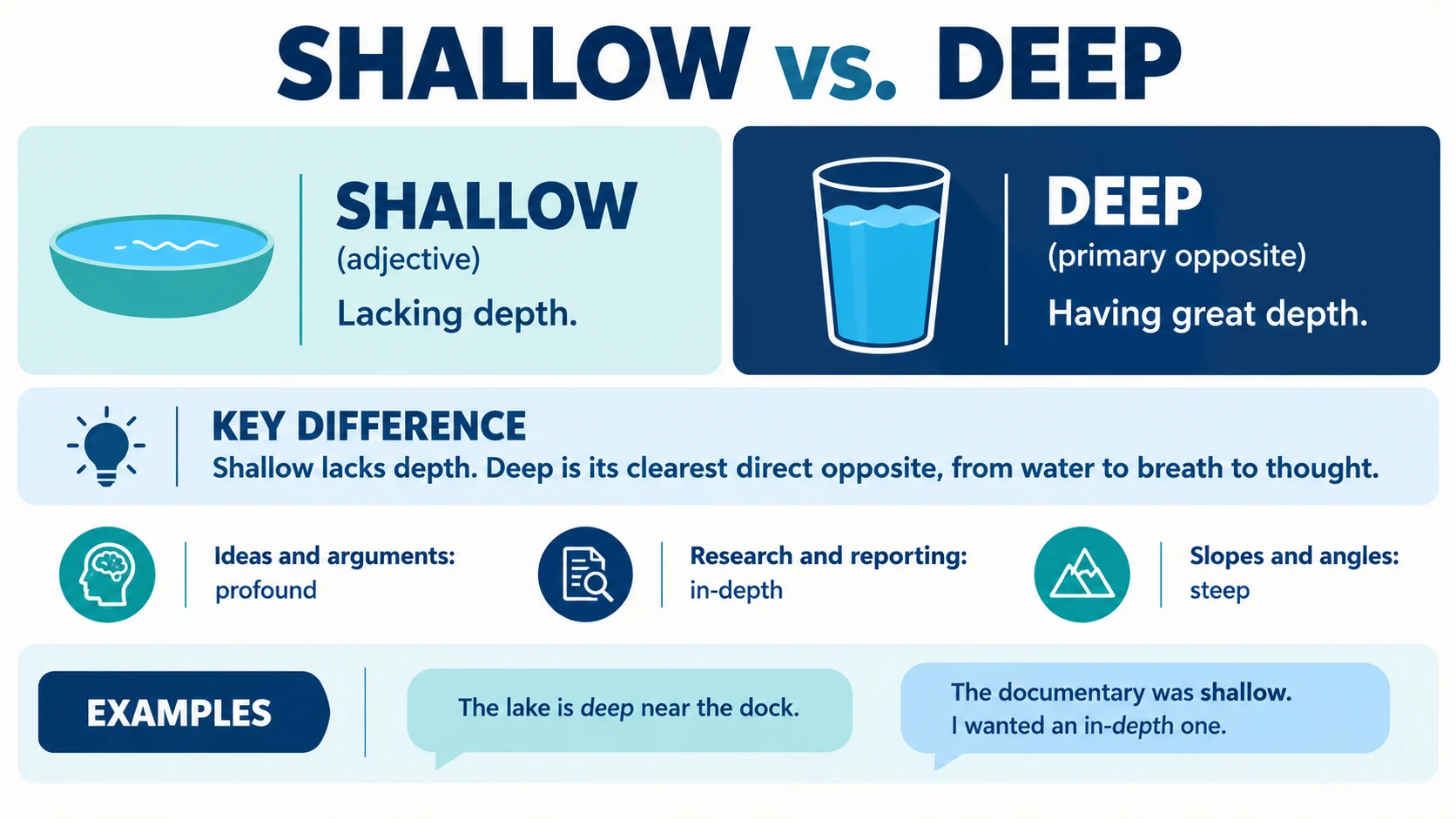
The opposite of shallow is deep. As an adjective, shallow means lacking depth, whether in water, thought, or feeling. Deep is the clearest direct antonym across these uses. For ideas and character, profound is a stronger choice, and for slopes or angles, steep is the natural contrast.
Part of speech: Adjective. Shallow also appears as a plural noun (“the shallows”), but most people searching for its opposite mean the adjective.
Primary opposite: deep
Shallow describes something with little depth. The depth can be physical, as in a shallow pool, or figurative, as in a shallow argument or a shallow person. When shallow means “not far from top to bottom,” deep is the strongest direct opposite. Deep also carries over to breathing, thought, and feeling, which is why the pairing feels so natural in everyday speech.
No single word covers every sense perfectly. In figurative uses, the best opposite shifts with what is being described. The sections below sort those choices by meaning.
Direct and Strong Antonyms
Two words earn a place here. Both are gradable opposites, meaning they sit on a scale rather than forming an either-or pair.
| Antonym | Tone or Nuance | Example Sentence |
|---|---|---|
| Deep | Neutral and versatile. Works for water, breath, thought, and emotion. | The lake is deep near the dock, so the kids should wear life jackets. |
| Profound | More formal and intellectual. Suggests weighty insight. | Her essay offered a profound look at how grief reshapes a family. |
Deep is the safer default. Profound works best in writing or speech where you want to signal real intellectual or emotional weight.
Contextual and Subtle Opposites
Shallow has several senses, so its best opposite changes with each one. The words below are contextual opposites, not universal ones.
| Context | Best Opposite | Why It Fits |
|---|---|---|
| Water or containers | Deep | It is the plain physical opposite. |
| Breathing | Deep | A shallow breath is quick and small. A deep breath fills the lungs. |
| Ideas and arguments | Profound | It describes insight that goes beneath the surface. |
| Research or reporting | In-depth | It describes thorough, detailed coverage. |
| A person’s character | Thoughtful | It suggests someone who reflects before speaking. |
| Conversations or relationships | Meaningful | It points to substance rather than small talk. |
| Slopes and angles | Steep | A shallow angle is gentle. A steep angle is sharp. |
A few examples show the differences in action:
- “The documentary gave only a shallow account of the strike, so I wanted an in-depth one.”
- “After years of small talk, they finally had a meaningful conversation.”
- “The trail climbs at a shallow angle at first, then turns steep near the ridge.”
Profound and in-depth are not interchangeable. Profound describes the quality of an idea or feeling. In-depth describes how much detailed work stands behind it. A report can be in-depth without being profound.
Words That Seem Opposite But Are Not
Narrow. Shallow and narrow both sound like measurements, so they get mixed up. Narrow measures width, so its opposite is wide or broad. A river can be narrow and deep, or wide and shallow. People often say someone has “broad but shallow” knowledge, which shows the two words describe different dimensions.
Simple. A shallow idea is not the same as a simple one. A simple idea can be profound, like a short piece of advice that changes how someone handles a problem. Shallow implies that something important is missing. Simple only implies that something is uncomplicated. For that reason, complex is not an antonym of shallow.
Subtle Tone Differences
When applied to people or ideas, shallow is usually a criticism. Its opposites tend to sound like praise, but their strength and formality vary.
- Deep is the everyday choice: “He has deep respect for his coach.”
- Profound is formal and heavier: “The book had a profound effect on her views.” Using it for something minor can sound inflated.
- Thoughtful is warm and personal. It describes care and reflection, not just intellectual depth: “That was a thoughtful reply to a hard question.”
- Meaningful fits relationships and exchanges: “We finally had a meaningful talk about money.”
Workplace writing shows the contrast well. A manager might say, “This feedback feels shallow,” and then ask for “specific, in-depth comments” instead. The antonym changes because the problem is a lack of detail, not a lack of wisdom.
Frequently Asked Questions
What is the direct opposite of shallow?
Deep is the direct opposite of shallow. Both describe depth on a scale, whether the subject is water, a bowl, a breath, or a thought. Profound is a more formal direct antonym when the depth is intellectual or emotional.
What is the opposite of shallow when describing a person?
Thoughtful or deep are the usual contextual opposites. Shallow suggests someone who focuses mostly on appearances or surface matters, while thoughtful suggests someone who reflects, listens, and considers what lies beneath the surface.
Is steep the opposite of shallow?
Only for angles and slopes. A shallow slope rises gently, and a steep slope rises sharply. In other senses, such as water or ideas, steep does not fit, so deep is the safer choice.
Practical Word Choice
- Identify the intended meaning first. Ask whether you mean physical depth, depth of thought, depth of feeling, or the angle of a slope. Deep suits the first three. Steep suits the last.
- Match the context, tone, strength, and formality. Use deep in casual speech, profound in formal writing, thoughtful for people, in-depth for research, and meaningful for conversations and relationships.
Final Thoughts
The core distinction is simple. Shallow means lacking depth, and deep is its clearest opposite. Everything else is a matter of which kind of depth you are describing.
Context matters because shallow stretches across water, breath, ideas, people, and angles. Each sense calls for a slightly different opposite, and the wrong choice can blur your point. Narrow and simple look like opposites but measure something else entirely.
Before you reach for a synonym of deep, name the problem you are describing. If the issue is missing insight, choose profound. If it is missing detail, choose in-depth. Which opposite of shallow do you use most often, and what sentence would you pair it with?