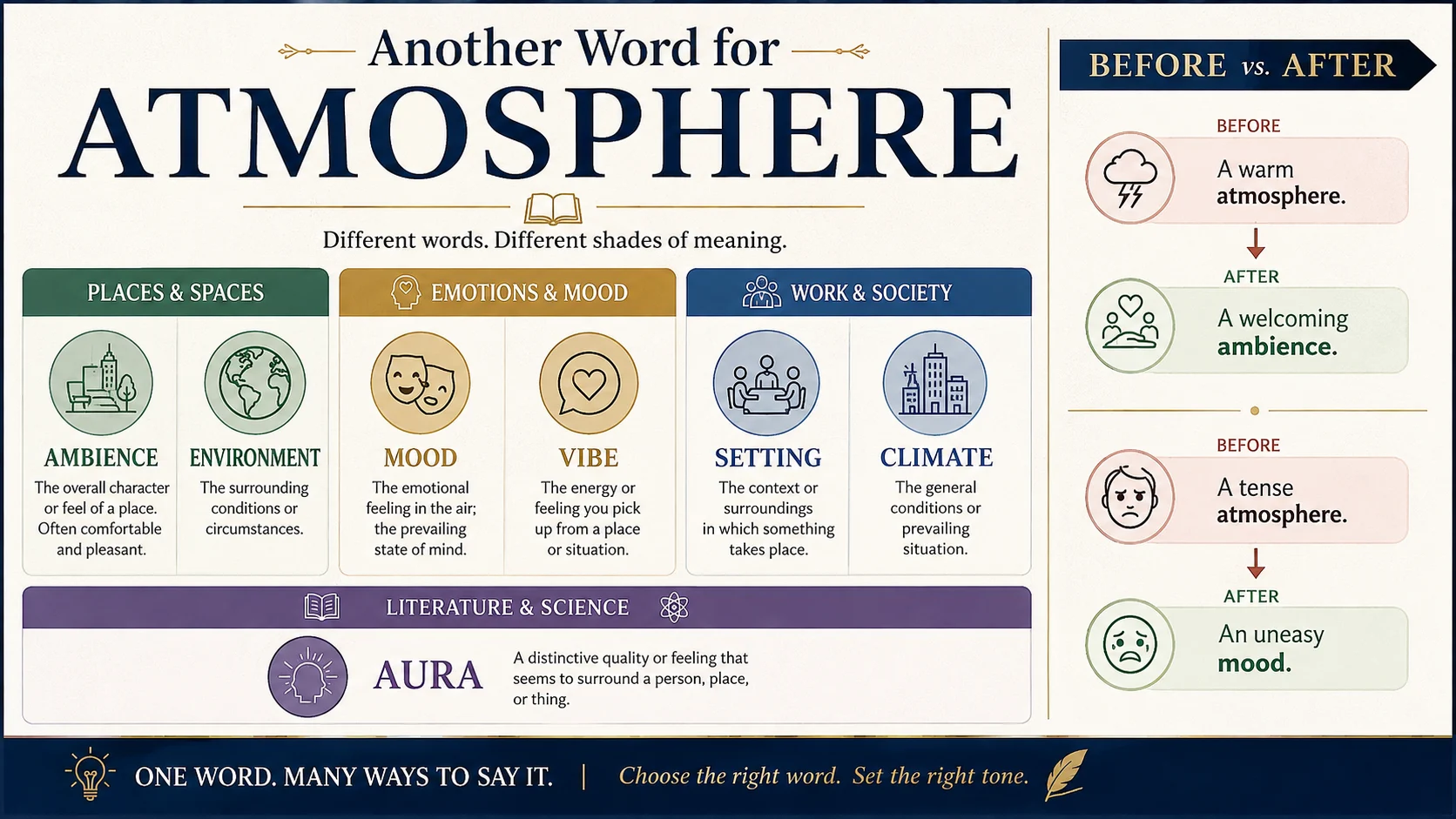
Another word for atmosphere depends on the context. Common synonyms include ambience, environment, mood, feeling, setting, surroundings, climate, and aura. Use ambience to describe the feeling of a place, environment for surrounding conditions, mood for an emotional tone, and setting for the place where events happen. The best alternative depends on what you want to describe.
What Does Atmosphere Mean?
Definition
The word atmosphere has several meanings in American English. It can describe the gases surrounding a planet, the emotional feeling of a place, or the general conditions surrounding a person, event, or situation.
For example:
- The restaurant has a warm atmosphere.
- Earth’s atmosphere protects life from harmful solar radiation.
- The meeting had a tense atmosphere.
- The city creates an atmosphere of creativity and opportunity.
Because the word covers both scientific and figurative meanings, its synonyms vary according to context. Ambience works well for a restaurant’s mood, but it cannot replace atmosphere in every scientific sentence.
Common Uses
Atmosphere commonly appears in four contexts:
- Mood and feeling: The emotional quality of a room, event, or interaction.
- Environment and surroundings: The conditions in which people live, work, or interact.
- Science: The layer of gases surrounding a planet or celestial body.
- Literature and entertainment: The emotional tone created through setting, language, imagery, and sound.
Identifying the intended meaning helps you select a synonym that communicates the right impression.
Best Synonyms for Atmosphere
| Synonym | Meaning | Best Used When | Example |
|---|---|---|---|
| Ambience | The overall feeling or character of a place | Restaurants, hotels, and interior design | The café has a relaxing ambience. |
| Environment | Surrounding conditions or circumstances | Workplaces, nature, and social settings | The office provides a supportive environment. |
| Mood | The emotional tone of a place, event, or piece of writing | Literature, conversations, and events | The music created a peaceful mood. |
| Feeling | The emotional impression something creates | Everyday conversation and personal experiences | The room had a welcoming feeling. |
| Setting | The place and circumstances in which something occurs | Stories, films, and events | The remote village provides a mysterious setting. |
| Surroundings | The area and things around someone or something | Travel, homes, and nature | The mountain surroundings were breathtaking. |
| Climate | General conditions or attitudes within a group or place | Politics, workplaces, and society | The company promotes a climate of trust. |
| Aura | A distinctive quality or impression associated with someone or something | Descriptive and creative writing | The old building had an aura of mystery. |
| Tone | The emotional or expressive character of communication | Writing, speeches, and conversations | The author’s tone creates a somber atmosphere. |
| Air | A noticeable quality or impression | Descriptive and literary writing | There was an air of excitement in the room. |
| Vibe | An informal impression or feeling | Casual conversation and social media | This place has a friendly vibe. |
| Character | The distinctive qualities of a place or thing | Architecture, neighborhoods, and design | The historic district has plenty of character. |
| Milieu | The social or cultural environment surrounding someone | Academic and formal writing | She grew up in an artistic milieu. |
| Backdrop | The setting or background against which something happens | Stories, photography, and events | The mountains provided a dramatic backdrop. |
| Conditions | The circumstances affecting a situation | Science, work, and daily life | The conditions encouraged cooperation. |
Synonyms by Context
Formal Writing
In formal writing, environment, climate, milieu, conditions, and ambience are useful alternatives when their meanings fit.
Environment describes surrounding conditions, whether physical, social, or professional.
Example: The institution fosters an inclusive learning environment.
Climate is particularly effective when discussing shared attitudes or relationships within a group.
Example: The organization is working to establish a climate of accountability.
Milieu refers to the social or cultural circumstances surrounding a person or group. It is more specialized than environment and is best used when that distinction matters.
Example: The writer’s work reflects the cultural milieu of the period.
Professional Writing
For business communication, consider environment, climate, ambience, and conditions.
Environment is a natural choice when describing workplace culture.
Business example: The company aims to create a collaborative work environment.
Climate emphasizes shared attitudes and relationships.
Business example: Open communication helped establish a climate of trust.
Ambience is particularly useful in hospitality, retail, and interior design.
Business example: The hotel uses lighting and music to create a relaxing ambience.
Academic Writing
Academic writing benefits from precise words such as environment, conditions, climate, setting, and milieu.
Use environment to discuss the circumstances in which research or behavior occurs.
Academic example: The study examined how the learning environment influenced student participation.
Use conditions when referring to specific factors affecting an experiment.
Academic example: Researchers maintained consistent atmospheric conditions during testing.
Use climate when examining collective attitudes or social dynamics.
Academic example: The researchers investigated the relationship between classroom climate and student engagement.
In scientific writing, retain atmosphere when referring to a planet’s gaseous envelope. Words such as environment may describe the broader surroundings but are not exact substitutes.
Daily Conversation
In everyday English, vibe, feeling, mood, surroundings, and ambience are often natural choices.
Examples:
- Instead of “The restaurant has a pleasant atmosphere,” say “The restaurant has a great vibe.”
- Instead of “The room had a tense atmosphere,” say “The room felt tense.”
- Instead of “I enjoyed the atmosphere,” say “I loved the feeling of the place.”
- Instead of “The atmosphere was relaxing,” say “The mood was relaxing.”
Vibe is casual and conversational, while ambience sounds more polished and descriptive.
Professional Alternatives for Atmosphere
When writing a resume, business email, report, or academic paper, choose a synonym that describes the exact quality you mean.
Environment
Meaning: The physical, social, or organizational conditions surrounding people or activities.
Best Used For: Workplace culture, education, research, and community settings.
Tone: Neutral to professional
Difficulty: Easy
Usage Frequency: Very Common
Best For: Resume, Email Writing, Essay Writing, Business Writing
- Business example: Helped create a productive environment for cross-functional teams.
- Academic example: The research examined the effects of the learning environment on student performance.
- Daily conversation example: I like the friendly environment at my new workplace.
Ambience
Meaning: The distinctive mood or character of a particular place.
Best Used For: Hospitality, retail, interior design, and descriptive writing.
Tone: Polished and descriptive
Difficulty: Medium
Usage Frequency: Common
Best For: Marketing Copy, Business Writing, Essay Writing
- Business example: The restaurant redesigned its interior to create a welcoming ambience.
- Academic example: The study explored how lighting influenced the perceived ambience of public spaces.
- Daily conversation example: The café has a cozy ambience.
Climate
Meaning: The general attitudes, relationships, or conditions within a group or organization.
Best Used For: Workplace culture, education, politics, and social research.
Tone: Professional
Difficulty: Medium
Usage Frequency: Very Common
Best For: Resume, Essay Writing, Academic Writing, Business Writing
- Business example: The manager encouraged a climate of transparency and accountability.
- Academic example: The researchers examined the school’s social climate.
- Daily conversation example: There’s a positive climate in our team.
Mood
Meaning: The emotional quality or feeling associated with a place, event, or creative work.
Best Used For: Literature, entertainment, events, and personal experiences.
Tone: Neutral
Difficulty: Easy
Usage Frequency: Very Common
Best For: Essay Writing, Marketing Copy, Email Writing
- Business example: The campaign’s visuals established an optimistic mood.
- Academic example: The author uses imagery to create a threatening mood.
- Daily conversation example: The music put me in a good mood.
Simple Alternatives for Atmosphere
If you want a straightforward replacement, consider these words:
- Mood: The emotional feeling of a place or situation.
- Feeling: The impression something creates.
- Vibe: The overall impression in casual conversation.
- Environment: The surrounding conditions.
- Setting: The place where an event happens.
- Air: A noticeable quality or impression.
- Surroundings: The area around someone or something.
For example, “The room had a strange atmosphere” could become “The room had a strange feeling” or “The room had a strange vibe.”
Stronger Alternatives for Atmosphere
Sometimes a more specific word makes your writing more vivid.
Ambience highlights the distinctive character of a physical place, especially a restaurant, hotel, or interior.
Aura suggests a distinctive impression that surrounds a person, place, or object.
Climate emphasizes the prevailing attitudes within a group or institution.
Tension describes an atmosphere filled with unease, conflict, or anticipation.
Mystique emphasizes an intriguing or mysterious quality.
Milieu describes the cultural or social context surrounding a person or group.
For example, “The room had an unusual atmosphere” could become “The room was filled with tension” if the intended meaning is anxiety or conflict. A precise description is often more effective than a general synonym.
Difference Between Similar Synonyms
Atmosphere vs. Ambience: Atmosphere has scientific and figurative meanings. Ambience usually describes the character or feeling of a physical place.
Atmosphere vs. Environment: Environment emphasizes surrounding conditions. Atmosphere often emphasizes the impression or mood those conditions create.
Atmosphere vs. Mood: Mood refers specifically to an emotional state or tone. Atmosphere can include mood along with other features of a setting.
Atmosphere vs. Setting: Setting identifies where and when something happens. Atmosphere describes the feeling or quality associated with that setting.
Atmosphere vs. Climate: Climate can mean long-term weather patterns or the prevailing attitudes within a group. Atmosphere is broader when describing a particular situation or place.
Atmosphere vs. Vibe: Vibe is an informal word for the impression a person or place creates. Atmosphere is more suitable for formal and scientific writing.
Atmosphere vs. Aura: Aura suggests a distinctive or almost mysterious quality, while atmosphere can describe a general mood or surrounding conditions.
Opposite Words
The opposite of atmosphere depends on the meaning of the word in a sentence. There is no single universal antonym.
| Intended Meaning | Possible Opposite | Example |
|---|---|---|
| Welcoming atmosphere | Hostile environment | The hostile environment discouraged visitors. |
| Calm atmosphere | Tense atmosphere | The tense atmosphere made everyone uncomfortable. |
| Friendly mood | Unfriendly mood | The unfriendly mood affected the meeting. |
| Supportive climate | Toxic climate | Employees struggled in a toxic workplace climate. |
| Pleasant ambience | Unpleasant ambience | The harsh lighting created an unpleasant ambience. |
These expressions contrast with particular types of atmosphere rather than serving as exact antonyms in every context.
FAQs
What is another word for atmosphere?
Common synonyms include ambience, environment, mood, feeling, setting, surroundings, climate, and aura. The best choice depends on whether you mean a place’s mood, its surrounding conditions, or the gases around a planet.
What is a formal synonym for atmosphere?
Environment, climate, milieu, conditions, and ambience can work in formal writing. Choose milieu for a social or cultural context and climate for prevailing attitudes within a group.
What is a professional alternative for atmosphere?
Environment is useful for workplace culture, climate for organizational attitudes, and ambience for the character of a physical space. Select the term that matches the subject.
What is another word for a positive atmosphere?
Possible alternatives include welcoming environment, pleasant ambience, positive mood, friendly vibe, and supportive climate.
What is another word for a negative atmosphere?
Depending on the situation, use tense mood, hostile environment, uneasy feeling, oppressive ambience, or toxic climate.
What is another word for atmosphere in literature?
Common alternatives include mood, tone, setting, ambience, and feeling. Mood is especially useful when discussing the emotional effect a literary work creates.
What is another word for workplace atmosphere?
Useful alternatives include work environment, workplace culture, organizational climate, and office ambience. Workplace culture is broader because it includes shared values and behaviors.
Is ambience the same as atmosphere?
The words overlap when describing the feeling of a place. However, ambience usually refers to the character of a physical space, while atmosphere also covers scientific and broader figurative meanings.
What is another word for Earth’s atmosphere?
In scientific contexts, related terms include gaseous envelope and, in some contexts, air. These expressions are not identical in every use, so Earth’s atmosphere remains the clearest standard term.
What is the opposite of atmosphere?
There is no single direct antonym. Depending on the intended meaning, contrasts might include hostility, tension, unpleasantness, or a lack of ambience.
Conclusion
The best another word for atmosphere depends on what you want to describe. Choose ambience for the feeling of a physical place, environment for surrounding conditions, mood for emotional tone, climate for shared attitudes, and setting for the place where events occur.
For creative writing, words such as aura and vibe can add personality. For academic or professional writing, more precise terms such as environment, conditions, and organizational climate help communicate your meaning clearly.
The strongest synonym is not always the closest dictionary match. It is the word that accurately expresses the context, tone, and impression you want readers to understand.