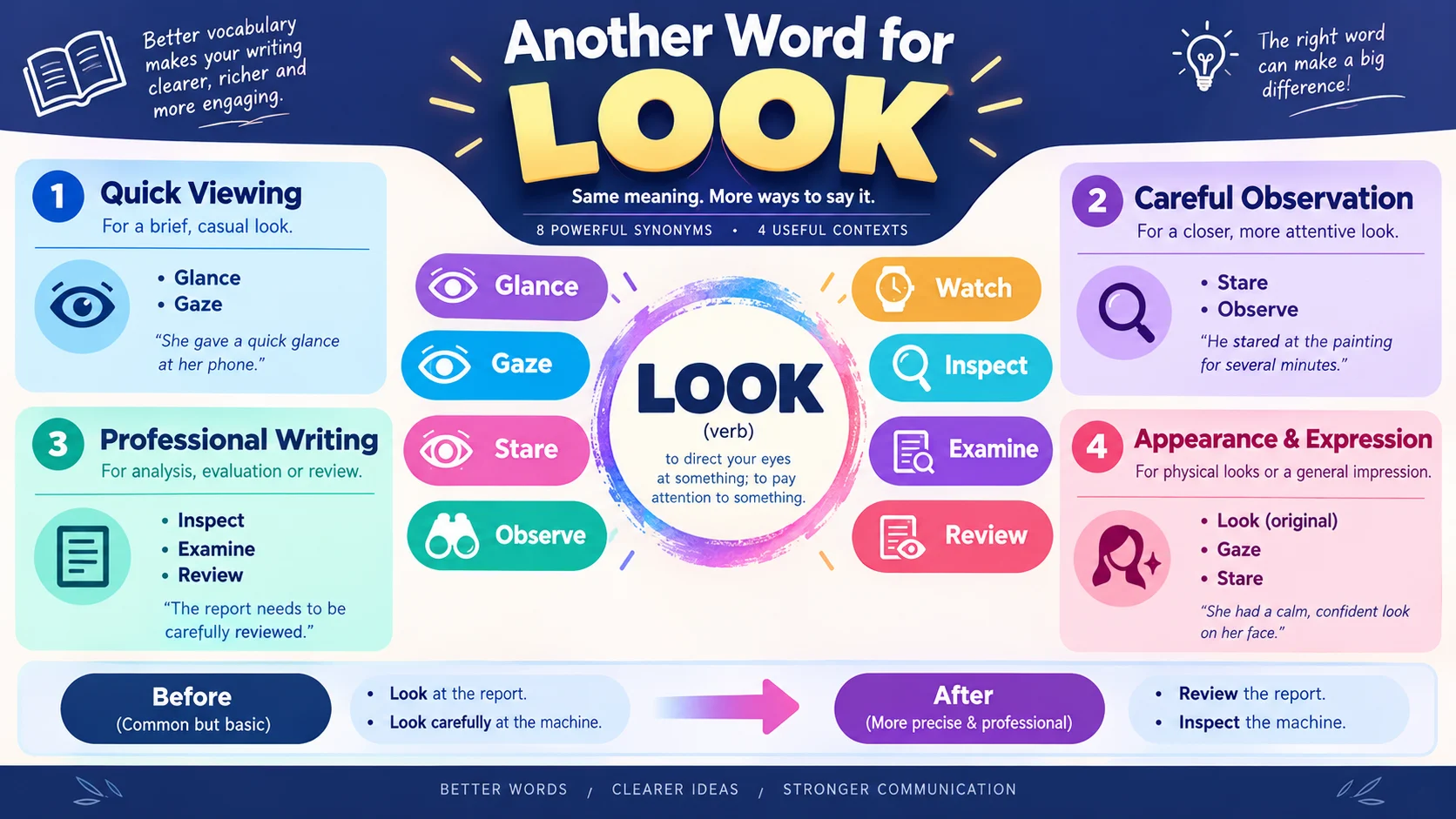
Another word for look depends on the context. Common synonyms include glance, gaze, stare, observe, watch, view, inspect, appear, and examine. Use glance for a quick look, gaze for a long or thoughtful look, inspect for a careful check, and appear when describing how someone or something seems. The best alternative depends on the intended meaning.
What Does Look Mean?
Definition
The word look can function as both a verb and a noun in American English. As a verb, it can mean directing your eyes toward something, examining an object, appearing a certain way, or searching for something. As a noun, it can describe an act of seeing, a facial expression, or someone’s appearance or style.
For example:
- Please look at the instructions before starting.
- She took a quick look at her phone.
- The manager will inspect the equipment.
- You look tired today.
- They are looking for a new apartment.
Because look has several meanings, its synonyms are not always interchangeable. The right replacement depends on whether you mean seeing, examining, appearing, searching, or describing someone’s style.
Common Uses
The word look appears in several everyday situations:
- Seeing something: Directing your eyes toward a person or object.
- Observing: Paying attention to an event, action, or situation.
- Examining: Checking something carefully for problems or details.
- Appearing: Describing how a person or object seems.
- Searching: Trying to find a person, item, or opportunity.
- Appearance or style: Describing someone’s clothing, expression, or overall presentation.
Identifying the intended meaning helps you choose a more precise and natural alternative.
Best Synonyms for Look
| Synonym | Meaning | Best Used When | Example |
|---|---|---|---|
| Glance | Look briefly | Checking something quickly | She glanced at the clock. |
| Gaze | Look steadily, often with interest | Admiration or thoughtful attention | He gazed at the stars. |
| Stare | Look fixedly for a long time | Strong attention or surprise | They stared at the unusual painting. |
| Observe | Watch carefully and notice details | Research, behavior, or events | Researchers observed the participants. |
| Watch | Look at something over time | Movement, activities, or events | We watched the sunset. |
| View | Look at or consider something | Images, presentations, or formal contexts | Please view the attached report. |
| Inspect | Examine carefully | Quality checks, safety, or condition | The technician inspected the machine. |
| Examine | Study something closely | Detailed analysis or investigation | The doctor examined the results. |
| Survey | Look over or assess broadly | Areas, situations, or groups | She surveyed the room. |
| Peer | Look closely or with difficulty | Seeing in darkness or from a distance | He peered through the window. |
| Peek | Take a quick or secret look | Curiosity or brief checking | She peeked inside the box. |
| Glare | Look angrily | Disapproval or irritation | He glared at the noisy visitor. |
| Spot | Notice or identify something | Finding a person or object | I spotted my friend in the crowd. |
| Notice | Become aware of something | Recognizing details or changes | She noticed a small mistake. |
| Appear | Seem or give a particular impression | Describing how something seems | The task appears difficult. |
| Search | Try to find something | Looking for a person or item | They searched for the missing keys. |
Synonyms by Context
Formal Writing
In formal writing, observe, examine, inspect, view, and survey can replace look, depending on the sentence.
Observe is appropriate when watching behavior, events, or changes carefully.
Example: The researchers observed changes in participants’ responses.
Examine emphasizes detailed attention or analysis.
Example: The committee examined the evidence before reaching a decision.
Inspect is more suitable when checking an object, facility, or process for quality, safety, or defects.
Example: The engineer inspected the structure for damage.
These verbs make formal writing more specific than repeatedly using look.
Professional Writing
In business communication, useful alternatives include review, inspect, examine, assess, and view.
Review works well when reading or evaluating a document, plan, or proposal.
Business example: Please review the proposal before the meeting.
Assess emphasizes judging the quality, value, or condition of something.
Business example: The management team assessed the project’s risks.
Inspect is useful for physical checks and quality control.
Business example: The supervisor inspected the equipment before approving its use.
For resumes, precise action verbs such as reviewed, assessed, and inspected can communicate your responsibilities more clearly than looked at.
Academic Writing
Academic writing often benefits from observe, examine, analyze, investigate, and survey.
Observe describes watching behavior or recording events.
Academic example: Researchers observed how students responded to the new teaching method.
Examine works when studying a topic, argument, or set of findings.
Academic example: The paper examines the relationship between sleep and memory.
Investigate emphasizes systematically exploring a question or problem.
Academic example: The study investigates the effects of air pollution on plant growth.
Analyze is particularly useful when the work involves interpreting evidence rather than simply looking at it.
Academic example: The researchers analyzed the collected data.
Daily Conversation
In everyday English, glance, peek, watch, check, and see are often natural alternatives.
Examples:
- Instead of “Look at this picture,” say “Check out this picture.”
- Instead of “I looked at my phone,” say “I glanced at my phone.”
- Instead of “Look at the children playing,” say “Watch the children play.”
- Instead of “I looked inside the bag,” say “I peeked inside the bag.”
These alternatives are conversational and easy to understand, but each expresses a slightly different action.
Professional Alternatives for Look
When writing a resume, email, report, or academic paper, choose a verb that accurately describes what you did.
Review
Meaning: Examine something to understand, evaluate, or verify it.
Best Used For: Reports, proposals, documents, plans, and performance assessments.
Tone: Professional
Difficulty: Easy
Usage Frequency: Very Common
Best For: Resume, Email Writing, Business Writing, Academic Writing
- Business example: Reviewed quarterly reports to identify performance trends.
- Academic example: The researcher reviewed previous studies on the subject.
- Daily conversation example: I’ll review the details tonight.
Assess
Meaning: Evaluate the quality, condition, importance, or value of something.
Best Used For: Risks, performance, needs, and project outcomes.
Tone: Formal and professional
Difficulty: Medium
Usage Frequency: Common
Best For: Resume, Essay Writing, Business Writing
- Business example: Assessed operational risks before launching the project.
- Academic example: The study assessed students’ reading comprehension.
- Daily conversation example: We need to assess the situation first.
Inspect
Meaning: Examine something closely to check its condition or identify problems.
Best Used For: Equipment, facilities, products, and quality control.
Tone: Professional
Difficulty: Easy
Usage Frequency: Common
Best For: Resume, Email Writing, Business Writing
- Business example: Inspected incoming products to ensure quality standards were met.
- Academic example: Students inspected the samples for visible changes.
- Daily conversation example: I’ll inspect the package before accepting it.
Observe
Meaning: Watch carefully to notice or understand what happens.
Best Used For: Research, behavior, processes, and changes.
Tone: Neutral to formal
Difficulty: Easy
Usage Frequency: Very Common
Best For: Essay Writing, Academic Writing, Business Writing
- Business example: Observed customer behavior to identify service improvements.
- Academic example: Researchers observed the participants during the experiment.
- Daily conversation example: I observed something unusual in the parking lot.
Simple Alternatives for Look
If you want a clear, everyday replacement, consider these options:
- See: Become aware of something visually.
- Watch: Pay attention to something over time.
- Check: Look to confirm information or condition.
- Glance: Look quickly.
- Peek: Take a brief or discreet look.
- Notice: Become aware of a detail.
- View: Look at an image, document, or scene.
- Find: Locate something you are searching for.
For example, “I looked at the schedule” could become “I checked the schedule.” The revised sentence makes the purpose of looking clearer.
Stronger Alternatives for Look
A more specific verb can make a sentence more expressive or precise.
Scrutinize means to examine something very closely, often to find errors or weaknesses.
Example: The editor scrutinized the report for inconsistencies.
Investigate means to examine a question, event, or problem systematically.
Example: The team investigated the cause of the system failure.
Analyze means to study information or evidence in detail to understand its meaning.
Example: The company analyzed customer feedback.
Survey means to look over or assess something broadly.
Example: She surveyed the audience before beginning her presentation.
Peer means to look closely, often because something is difficult to see.
Example: He peered through the fog.
Gaze emphasizes a steady look, often expressing admiration, thought, or wonder.
Example: They gazed at the ocean in silence.
These words add precision, but they should only replace look when their meanings fit the context.
Difference Between Similar Synonyms
Look vs. See: Look usually involves directing your eyes intentionally. See means becoming visually aware of something, whether intentionally or not.
Look vs. Watch: Watch suggests sustained attention, especially when something moves or changes. Look may describe a brief action.
Look vs. Glance: A glance is a quick look. It is not suitable when you mean prolonged attention.
Look vs. Gaze: A gaze is generally steady and may suggest interest, admiration, or thoughtfulness. A neutral look does not necessarily convey emotion.
Look vs. Stare: A stare is intense or prolonged and may seem rude, surprised, or confrontational. A look is more neutral.
Look vs. Observe: Observe suggests careful attention and often implies noticing details. Look is broader and more casual.
Look vs. Examine: Examine means inspecting something closely to understand it or evaluate its condition. It is more deliberate than simply looking.
Look vs. Appear: Look can describe someone’s appearance, as in “You look happy.” Appear can often replace it with a slightly more formal tone: “You appear happy.”
Opposite Words
The opposite of look depends on its meaning in context.
| Meaning of Look | Possible Opposite | Example |
|---|---|---|
| Direct your eyes toward something | Look away | She looked away from the screen. |
| Watch carefully | Ignore | He ignored the warning signs. |
| Examine something | Overlook | The reviewer overlooked a small error. |
| Search for something | Stop searching | They stopped searching after sunset. |
| Pay attention | Disregard | She disregarded the instructions. |
These are contextual opposites rather than exact antonyms for every use of look.
FAQs
What is another word for look?
Common synonyms include glance, gaze, stare, observe, watch, view, inspect, and examine. The best alternative depends on whether you mean seeing, watching, checking, or appearing a certain way.
What is a formal synonym for look?
Formal alternatives include observe, examine, inspect, survey, and scrutinize. Use examine for detailed study and observe for careful watching.
What is a professional alternative for look?
In professional writing, use review, assess, inspect, analyze, or evaluate, depending on the task. For example, “reviewed the proposal” is more precise than “looked at the proposal.”
What is another word for look at?
Possible alternatives include view, examine, observe, inspect, watch, and consider. Use consider when looking at something means thinking about it rather than seeing it.
What is another word for a quick look?
Glance, peek, glimpse, and brief look are useful alternatives. A glance is a quick act of looking, while a glimpse is often a brief or incomplete view of something.
What is another word for look carefully?
Use examine, inspect, scrutinize, study, or observe closely. Scrutinize is particularly strong when searching for errors or small details.
What is another word for look in academic writing?
Useful alternatives include examine, observe, investigate, analyze, and assess. Choose analyze when interpreting data and investigate when exploring a research question.
What is another word for look good?
Depending on the context, alternatives include appear attractive, look appealing, seem polished, and present well. For professional settings, “present well” may be appropriate.
Is gaze the same as look?
Not exactly. Gaze usually describes looking steadily for a period of time, often with interest or admiration. Look is a broader term that can describe any act of directing your eyes.
What is the opposite of look?
Depending on the sentence, possible opposites include look away, ignore, overlook, and disregard. The best choice depends on whether look means seeing, examining, or paying attention.
Conclusion
The best another word for look depends on the action you want to describe. Use glance for a quick look, gaze for a steady look, watch for sustained attention, inspect for checking something carefully, and examine for detailed study. In professional writing, review, assess, and analyze can communicate your work more precisely.
Instead of replacing look with the first synonym you find, consider the purpose, tone, and context of the sentence. A precise verb makes your writing clearer, more natural, and easier to understand.