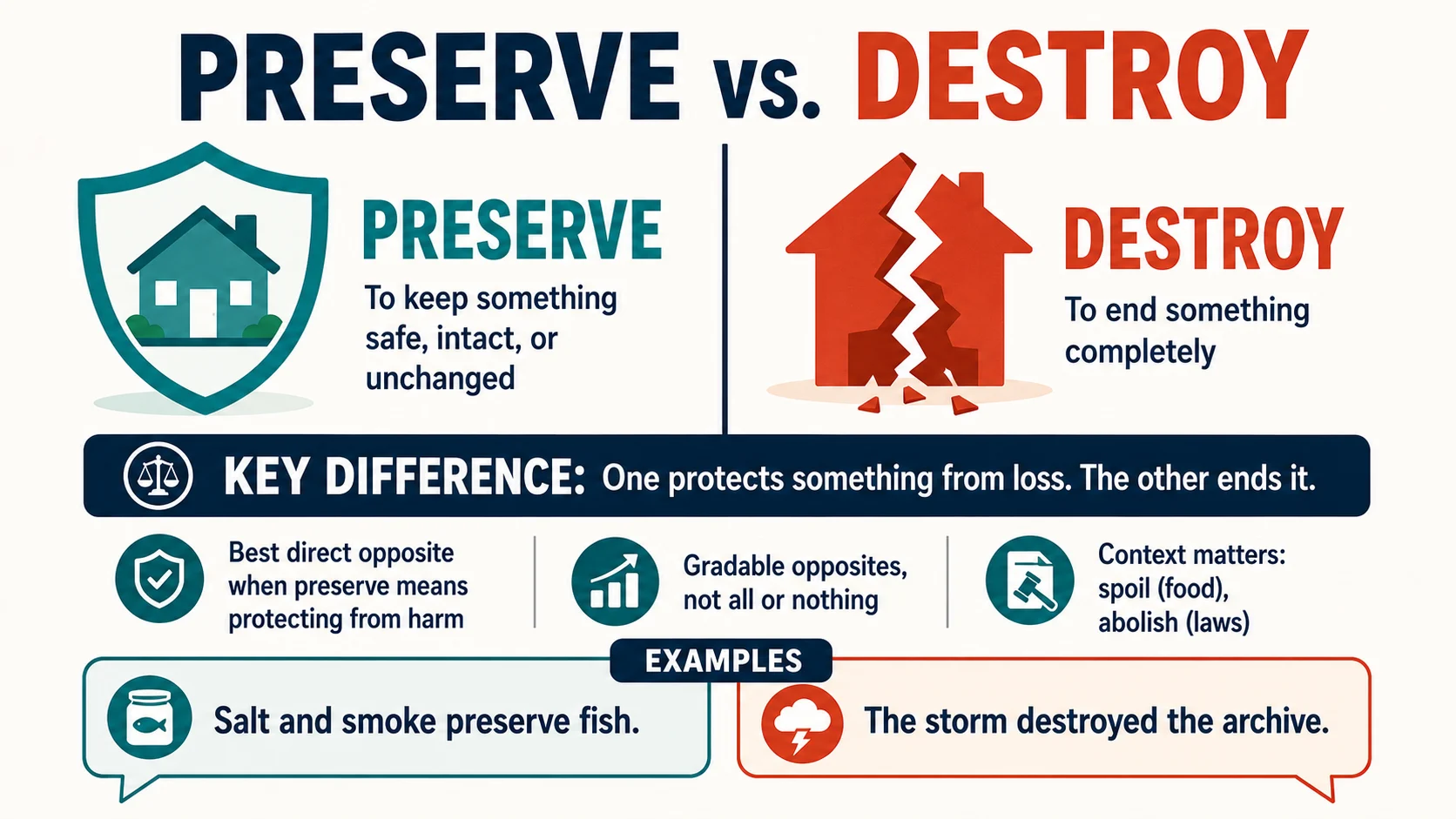
The opposite of preserve is destroy. To preserve means to protect something from harm, decay, or loss so it stays intact. When the meaning is keeping something safe, destroy is the strongest direct opposite. In other contexts, abolish, spoil, or squander may fit better, depending on what is being preserved.
Part of speech: Verb. (Preserve also works as a noun, as in “peach preserves” or “a nature preserve,” but the noun senses have no true antonym.)
Primary opposite: destroy
As a verb, preserve means to keep something safe, intact, or unchanged. When it means protecting something from harm or loss, destroy is the strongest direct opposite. One word keeps a thing alive and whole, and the other ends it.
No single antonym covers every sense of preserve, though. The best opposite depends on what is being preserved: a building, a food, a law, or a reputation. The sections below sort the options by meaning.
Direct and Strong Antonyms
These words work as true opposites when preserve means protecting something from harm.
| Antonym | Tone or Nuance | Example Sentence |
|---|---|---|
| Destroy | Strongest and most general; suggests complete loss | A single flood destroyed the photographs the family had kept safe for decades. |
| Ruin | Neutral to casual; damage that wrecks value or quality | Hot water can ruin an antique quilt that gentle washing would have protected. |
| Demolish | Deliberate and physical; mostly used for structures | The council voted to demolish the old depot rather than preserve it. |
Preserve and destroy are not strict complements. Plenty of middle ground exists between them, such as damaging, altering, or neglecting something. That makes this a gradable opposition rather than an all-or-nothing pair.
Contextual and Subtle Opposites
Preserve is polysemous, so the best opposite changes with the object. The options below are contextual, meaning they work as opposites only in the stated sense.
| Context | Best Opposite | Why It Fits |
|---|---|---|
| Historic sites and objects | demolish, destroy | They end what preserving protects. |
| Food | spoil | Preserved food resists rot, so spoiled food is the failed result. |
| Laws, rights, and traditions | abolish | Abolishing removes what preserving keeps in force. |
| Energy and supplies | squander, waste | Preserving saves a limited resource, while squandering burns through it. |
| Dignity or calm | lose, forfeit | Preserving holds onto a quality, while forfeiting gives it up. |
Here is how those pairings sound in practice. Salt and smoke preserve fish, but a warm afternoon will spoil it. Senators who want to preserve the program face colleagues who want to abolish it. A marathon runner who preserves energy early finishes strong, while one who squanders it fades by mile twenty. In a tense meeting, she preserved her composure, but her colleague lost his within minutes.
Words That Seem Opposite But Are Not
Neglect. Neglect means failing to give proper care or attention. It describes a lack of action, while preserve describes active protection. Neglect may lead to decay, but it does not guarantee it, and it names a cause rather than the opposite outcome. “The landlord neglected the roof for years” says nothing about whether the building was destroyed.
Restore. Restore means bringing something back to an earlier condition after damage. It often follows preserving or fixing, so it sits beside preserve instead of against it. A museum can preserve a painting for a century and restore it after a leak.
Subtle Tone Differences
Choosing among the opposites changes how a sentence feels.
Destroy sounds neutral and formal enough for news or academic writing: “The storm destroyed the archive.” Ruin is more personal and emotional: “Don’t ruin the old recipe cards by laminating them.” Demolish sounds technical and intentional, which fits construction and planning. Abolish carries legal weight and belongs in policy discussions, as in “Voters chose to abolish the fee.”
Strength matters, too. Spoil is milder and more everyday than destroy, so it rarely implies total loss.
Frequently Asked Questions
What is the direct antonym of preserve?
Destroy is the closest direct antonym when preserve means protecting something from harm or loss. No single word covers every sense, so demolish, abolish, or spoil may fit better depending on whether you mean buildings, laws, or food.
What is the opposite of preserve when talking about food?
Spoil is the best contextual opposite. Preserved food is treated with salt, heat, cold, or acid to resist rot, while food that spoils turns unsafe or unpleasant to eat if left too long.
Is neglect the opposite of preserve in a sentence?
Not exactly. Neglect means failing to care for something, while preserve means actively protecting it. Use neglect to describe missing effort, and use destroy or ruin when you mean the damaging outcome.
Practical Word Choice
- Identify the intended meaning. Ask what is being preserved: a structure, food, a rule, a resource, or a personal quality. That answer points to demolish, spoil, abolish, squander, or lose.
- Match context, tone, strength, and formality. Use destroy in formal writing, ruin in conversation, and abolish for laws. Choose a milder word when the damage is only partial.
Final Thoughts
Preserve means to keep something safe and whole, and destroy is the clearest direct opposite when that protection fails or is deliberately removed. Beyond that sense, English offers no single perfect antonym, which is why spoil, abolish, and squander each win in their own territory.
Context drives the choice because preserve attaches to very different objects. What you are guarding, whether a food, a law, or your calm, decides which opposite sounds natural to a reader.
A useful habit is to say the sentence aloud with your chosen opposite and listen for a mismatch. If the word feels too strong or too weak, try a milder or more specific option. What is your own example of preserve and its opposite in a sentence?