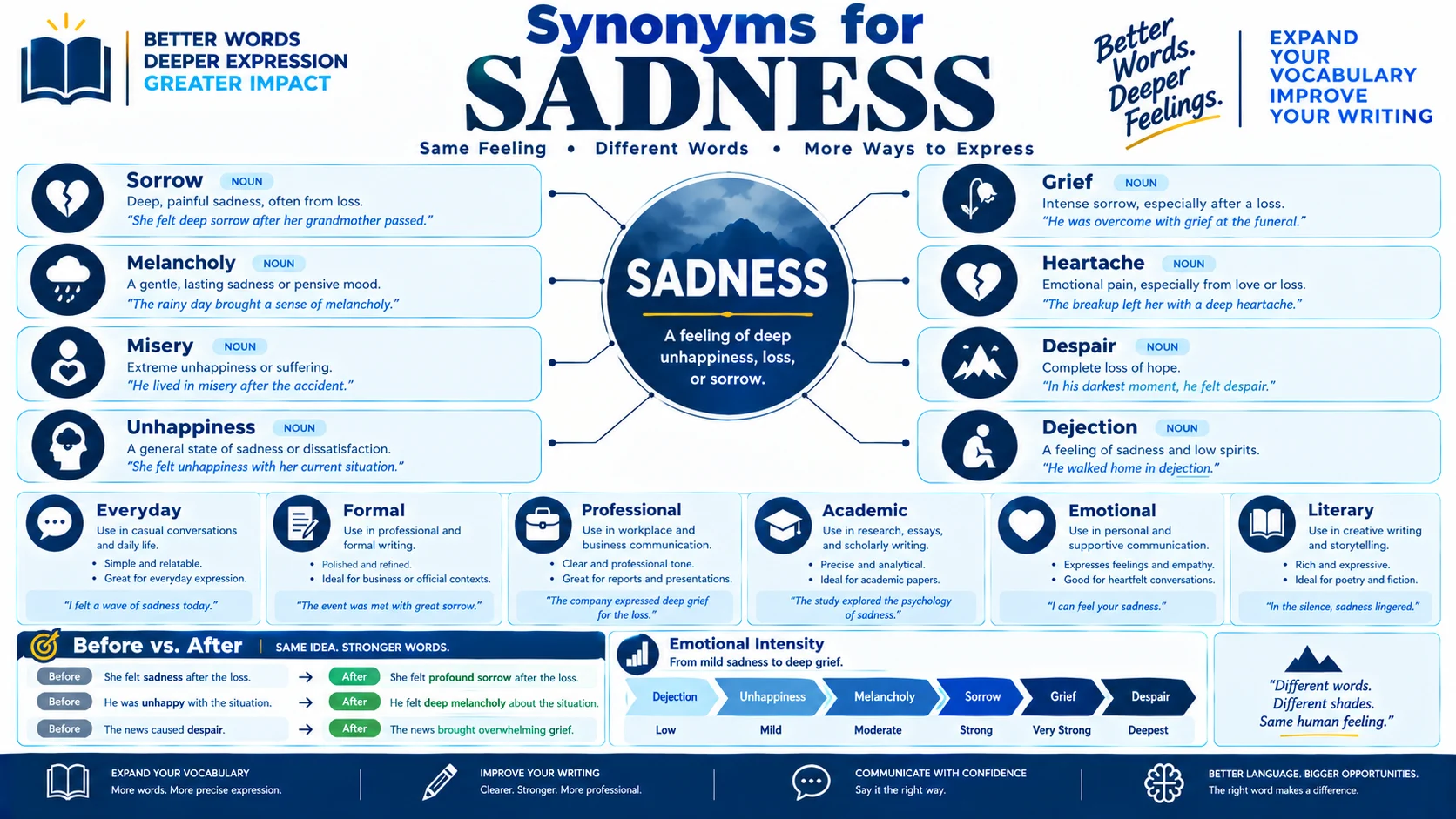
Another word for sadness is sorrow. Other synonyms include grief, melancholy, heartache, misery, despair, unhappiness, and dejection. The best choice depends on context: grief relates to loss, melancholy suggests quiet sadness, and despair describes intense sadness with hopelessness.
What Does Sadness Mean?
Definition
Sadness is a feeling of unhappiness, emotional pain, disappointment, or low spirits. It can describe a temporary emotional reaction, a deeper sense of sorrow, or the pain caused by loss.
The best synonym depends on the situation. For example, sorrow can sound more serious than sadness, while melancholy often describes a quiet or reflective feeling. Grief is strongly associated with loss, especially the death of someone close.
Common Uses
The word sadness works in everyday conversation, academic writing, professional communication, literature, and emotional descriptions.
Examples:
- She felt a deep sadness after saying goodbye.
- The novel explores themes of sadness and loneliness.
- His message expressed genuine sadness about the decision.
- The song captures a sense of sadness and longing.
If you need a more precise word, choosing a synonym based on the intensity and cause of the emotion usually produces stronger writing.
Best Synonyms for Sadness
| Synonym | Meaning | Best Used When | Example |
|---|---|---|---|
| Sorrow | Deep sadness or emotional pain | Serious emotional situations | She felt great sorrow after the loss. |
| Grief | Intense sadness caused by loss | Bereavement or major loss | He struggled with grief after his father’s death. |
| Melancholy | Quiet, thoughtful sadness | Reflective or literary writing | A feeling of melancholy filled the room. |
| Heartache | Emotional pain, especially from relationships or loss | Personal or romantic situations | She experienced heartache after the breakup. |
| Misery | Extreme unhappiness or suffering | Very intense negative emotion | He was overwhelmed by misery. |
| Despair | Loss of hope combined with deep sadness | Severe emotional distress or hopelessness | The situation left her in despair. |
| Unhappiness | A general lack of happiness | Neutral everyday writing | His unhappiness was easy to notice. |
| Gloom | A dark, low, or depressing mood | Mood, atmosphere, or outlook | The rainy weather added to the gloom. |
| Dejection | A feeling of low spirits or discouragement | Disappointment or failure | She felt dejection after receiving the rejection letter. |
| Sorrowfulness | The state of being sorrowful | Formal or literary contexts | His expression showed sorrowfulness. |
Sorrow
Meaning: Deep sadness, often caused by loss, disappointment, or suffering.
Best used for: Serious emotional situations, literature, personal writing, and formal descriptions.
Tone: Emotional and somewhat formal.
Difficulty: Easy
Usage frequency: Common
Best for: Essays, literary writing, personal stories, and formal communication.
Examples:
- Business: The company expressed sorrow following the employee’s passing.
- Academic: The poem explores sorrow as a response to human loss.
- Daily conversation: She was filled with sorrow after hearing the news.
Grief
Meaning: Deep sadness associated particularly with the loss of a person, relationship, or something important.
Best used for: Death, bereavement, major personal loss, and emotional recovery.
Tone: Serious and emotional.
Difficulty: Easy
Usage frequency: Very Common
Best for: Academic writing, personal writing, healthcare-related communication, and serious conversations.
Examples:
- Business: The organization offered support to employees experiencing grief.
- Academic: The study examines how people respond to grief after bereavement.
- Daily conversation: She is still dealing with grief after losing her grandmother.
Melancholy
Meaning: A gentle, reflective, or lingering feeling of sadness.
Best used for: Literature, music, art, memories, and thoughtful descriptions.
Tone: Literary, reflective, and sometimes poetic.
Difficulty: Medium
Usage frequency: Common
Best for: Essays, creative writing, reviews, and descriptive content.
Examples:
- Business: The campaign uses a melancholy tone to reflect the brand’s nostalgic theme.
- Academic: The novel presents melancholy as a recurring emotional state.
- Daily conversation: That old song always makes me feel a little melancholy.
Heartache
Meaning: Emotional pain or distress, especially after romantic disappointment, separation, or loss.
Best used for: Relationships and deeply personal experiences.
Tone: Emotional and conversational.
Difficulty: Easy
Usage frequency: Common
Best for: Personal stories, social media, creative writing, and informal communication.
Examples:
- Business: The advertisement focuses on the heartache of saying goodbye.
- Academic: The character’s heartache becomes central to the narrative.
- Daily conversation: The breakup caused a lot of heartache.
Despair
Meaning: A state of extreme sadness in which a person feels that there is little or no hope.
Best used for: Situations involving hopelessness rather than ordinary sadness.
Tone: Strong and serious.
Difficulty: Medium
Usage frequency: Common
Best for: Essays, literature, serious reporting, and dramatic writing.
Examples:
- Business: The prolonged setback created a sense of despair among the team.
- Academic: The character’s despair reflects the novel’s central conflict.
- Daily conversation: After months without progress, he began to feel despair.
Synonyms by Context
Formal Writing
For formal writing, consider:
- Sorrow
- Grief
- Despondency
- Dejection
- Distress
- Despair
These words can provide more precision than simply repeating sadness.
For example:
The character experiences profound sorrow following the loss.
This sounds more specific and formal than:
The character experiences profound sadness following the loss.
Professional Writing
In workplace communication, avoid overly dramatic alternatives unless the situation genuinely calls for them.
Useful choices include:
- Disappointment
- Concern
- Regret
- Distress
- Unhappiness
For example:
We regret to inform you that the project has been delayed.
In this context, regret is often more appropriate than sadness because it communicates an unfavorable situation professionally.
Academic Writing
Academic writing benefits from precise emotional vocabulary.
Useful alternatives include:
- Sorrow
- Grief
- Melancholy
- Emotional distress
- Despondency
- Despair
The right choice depends on what caused the emotion and how intense it is.
Daily Conversation
For everyday speech, simpler alternatives usually sound more natural:
- Feeling down
- Unhappy
- Upset
- Heartbroken
- Downhearted
- Low
- Miserable
For example:
I’m feeling a little down today.
This sounds more natural in casual conversation than:
I’m experiencing melancholy today.
Professional Alternatives for Sadness
When writing an email, report, workplace announcement, or business document, choose words that describe the situation without exaggerating the emotion.
Disappointment works well when an expected result did not happen.
The team expressed disappointment with the final outcome.
Regret works when communicating that something unfortunate happened or a decision has negative consequences.
We regret the inconvenience caused by the delay.
Concern can replace sadness when the emotional response involves worry about a situation.
Employees expressed concern about the changes.
Distress is stronger and indicates significant emotional difficulty.
The incident caused considerable distress among affected customers.
Simple Alternatives for Sadness
If you want an easy, natural replacement for sadness, try:
- Unhappiness
- Sorrow
- Upset
- Feeling down
- Heartache
- Low spirits
- Gloom
- Misery
The simplest choice is often unhappiness because it closely matches the general meaning of sadness.
For casual conversation, feeling down is especially natural:
I’ve been feeling down lately.
Stronger Alternatives for Sadness
Not every synonym means exactly the same thing. Some describe a much stronger emotional state.
Sorrow suggests deep sadness.
Grief usually connects sadness with loss.
Heartache emphasizes emotional pain.
Misery suggests severe unhappiness or suffering.
Despair adds a sense of hopelessness.
Agony describes extreme emotional or physical suffering and is considerably stronger than sadness.
For this reason, replacing sadness with a stronger word should depend on the actual situation.
Difference Between Similar Synonyms
Sadness vs. Sorrow
Sadness is the broad, everyday term. Sorrow generally suggests deeper emotional pain.
She felt sadness after the argument.
She felt profound sorrow after losing her friend.
Sadness vs. Grief
Grief is usually connected to significant loss, particularly the death of someone.
He felt sadness after the cancellation.
She experienced grief after her husband’s death.
Sadness vs. Melancholy
Melancholy often describes a quieter, reflective type of sadness. It can even have a nostalgic or artistic quality.
The memory brought a sense of melancholy.
Sadness vs. Depression
These words should not automatically be treated as synonyms. Sadness is a normal emotion that can be temporary. Depression can refer to a clinical mental health condition and should not be used simply as a stronger synonym for feeling sad.
Sadness vs. Despair
Despair is more intense because it includes a loss of hope.
Sadness can follow disappointment, while despair suggests that a person sees little reason to hope.
Opposite Words
Common opposites of sadness include:
- Happiness
- Joy
- Delight
- Cheerfulness
- Contentment
- Pleasure
- Optimism
- Elation
The best opposite depends on the context. For example, joy suggests strong happiness, while contentment describes a peaceful sense of satisfaction.
FAQs
What is another word for sadness?
Common alternatives for sadness include sorrow, grief, melancholy, unhappiness, heartache, misery, dejection, gloom, and despair. The best choice depends on the cause and intensity of the emotion.
What is a formal synonym for sadness?
Sorrow, grief, dejection, despondency, and distress can work as formal alternatives, depending on the context. Sorrow is one of the most broadly useful choices.
What is a professional alternative for sadness?
In professional writing, disappointment, regret, concern, or distress may be more appropriate than sadness. The best word depends on whether the situation involves an unfavorable outcome, concern, or emotional difficulty.
What word can replace sadness in an essay?
Good choices include sorrow, melancholy, grief, emotional distress, dejection, and despair. Choose the word that accurately reflects the specific emotion being discussed.
What is a stronger word for sadness?
Sorrow, misery, despair, grief, and heartache can express stronger or more specific forms of sadness. Despair is particularly strong because it suggests a loss of hope.
What is a softer word for sadness?
Melancholy, low spirits, gloom, or feeling down can describe milder forms of sadness. Melancholy is especially useful for quiet or reflective sadness.
What is another word for deep sadness?
Sorrow, grief, despair, misery, and heartache can describe deep sadness. The appropriate term depends on whether the sadness comes from loss, disappointment, emotional pain, or hopelessness.
Is melancholy the same as sadness?
Not exactly. Melancholy is a type of sadness that is often quiet, reflective, or lingering. It can carry a nostalgic or literary feeling that the general word sadness does not necessarily have.
Is grief a synonym for sadness?
Grief is related to sadness but is more specific. It generally refers to the emotional response to a significant loss, particularly the death of someone.
What is the opposite of sadness?
Common opposites include happiness, joy, delight, cheerfulness, contentment, and pleasure. The most appropriate opposite depends on the intended meaning.
Conclusion
The best synonym for sadness depends on the emotion you want to describe. Sorrow works well for deep sadness, grief for loss, melancholy for quiet reflection, heartache for emotional pain, and despair for sadness combined with hopelessness.
For everyday writing, sadness and unhappiness are usually clear and natural. For professional or academic writing, a more precise word can make the sentence stronger without changing its meaning. Always choose the synonym that matches the cause, intensity, tone, and context of the emotion.