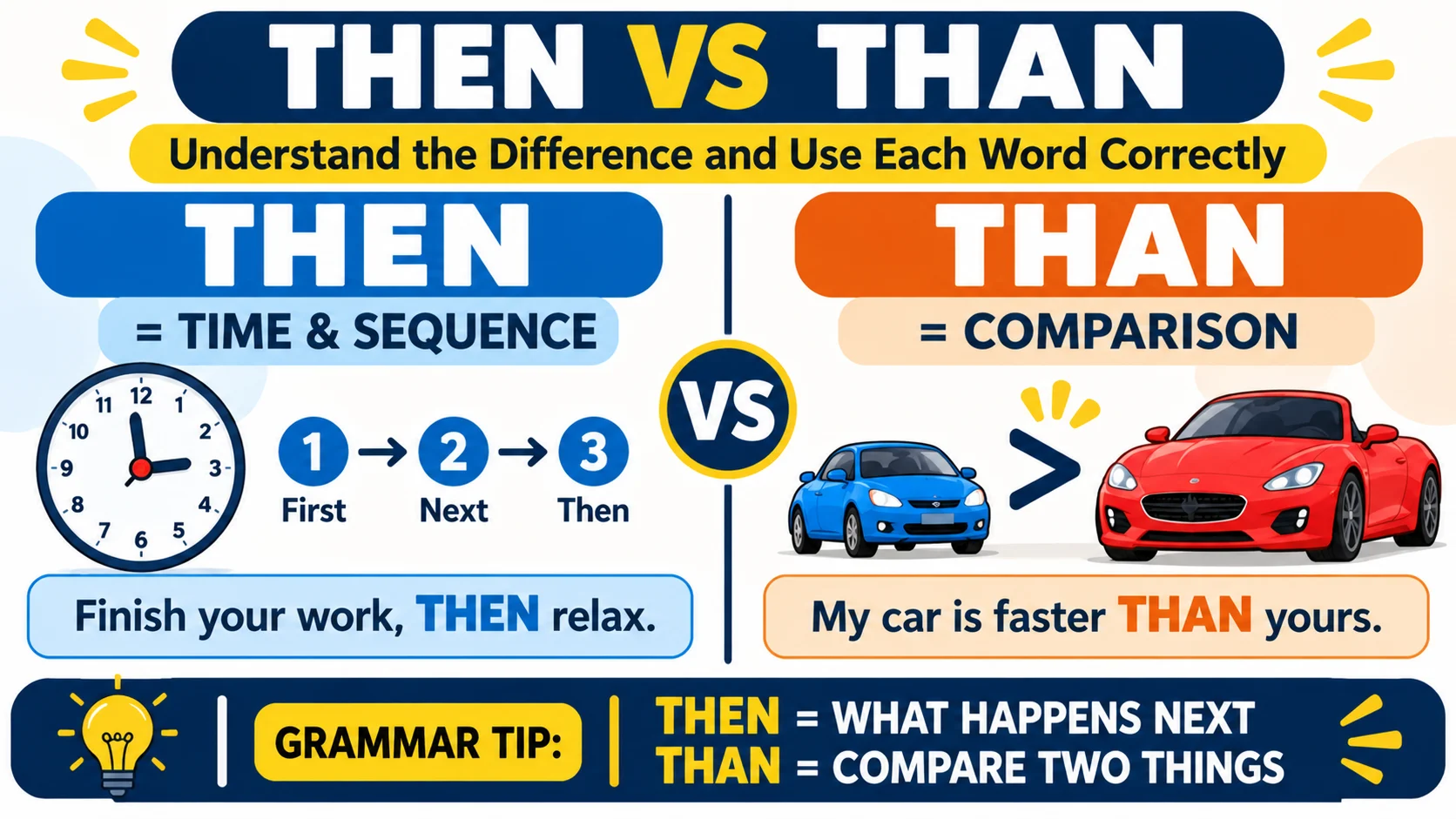
Then and than are two commonly confused English words, but they have different meanings. Use then to talk about time, order, or what happens next. Use than to compare two people, things, actions, or ideas.
Then vs than is one of the most common grammar mistakes in English. These two words look almost the same and sound similar in everyday speech. However, they have very different meanings and uses. Mixing them up can change the meaning of a sentence and make your writing less clear.
For example, consider these two sentences:
- I finished my homework, then I watched TV.
- My brother is taller than me.
The first sentence uses then because it describes what happened next. The second uses than because it compares two people.
This difference may seem small, but it matters in school assignments, professional emails, social media posts, business writing, and everyday conversations. Even fluent English speakers sometimes make this mistake when typing quickly.
The good news is that learning the difference between then and than is easy. You only need to understand what each word does in a sentence. In this guide, you will learn their meanings, grammar rules, sentence patterns, common mistakes, and practical examples. You will also find exercises to test your understanding and improve your English writing skills.
Quick Answer: Then vs Than
The main difference between then and than is their purpose in a sentence.
| Word | Meaning | Main Use | Example |
|---|---|---|---|
| Then | At that time, next, or afterward | Time and sequence | Eat dinner, then go to bed. |
| Than | Used to compare things | Comparison | Sarah is older than John. |
Remember these simple rules:
- Use then when talking about what happened before, after, or at a particular time.
- Use than when comparing two or more things.
- Use then to show the next step in a process.
- Use than after comparative words such as better, bigger, smaller, faster, and more.
A simple memory trick is to associate then with time and than with comparison.
What Does Then Mean?
The word then is an adverb in most of its common uses. It tells us when something happens, what happens next, or what was true at a particular time.
It can describe the past, present, or future. Its meaning depends on the sentence.
For example:
- I was living in New York then.
- Finish your work, then take a break.
- If you are ready, then we can begin.
- She worked as a teacher back then.
In each example, then gives information about time, order, or a result.
Definition of Then
According to its common English usage, then means:
- At that time.
- After that.
- Next in a sequence.
- In that case.
- As a result of a condition.
Then helps readers understand the order of events and the relationship between different actions.
Then as an Adverb of Time
One of the most common uses of then is to describe when something happened.
It can refer to a specific time in the past or future.
Examples:
- I was a student then.
- We lived in Chicago back then.
- I will call you then.
- Things were different in those days.
- The office was much smaller then.
In these sentences, then refers to a particular time.
More examples in everyday English:
| Sentence | Meaning |
|---|---|
| I was younger then. | I was younger at that time. |
| We did not know each other then. | We did not know each other at that time. |
| Life was easier back then. | Life was easier in the past. |
| I will see you then. | I will see you at that agreed time. |
Then to Show Sequence or Order
Then can also show that one action happens after another.
It is useful when explaining instructions, telling stories, describing routines, or sharing events.
Examples:
- First, wash your hands. Then prepare the food.
- She finished her meeting, then went home.
- Open the application, then enter your password.
- I took a shower, then went to sleep.
- He checked the answers, then submitted the test.
Notice that each example describes an order of actions.
The first action happens before the second action.
This use of then is especially helpful in step-by-step instructions.
For example, when explaining how to make tea:
- Boil some water.
- Add the tea leaves.
- Then add milk and sugar.
- Let the tea cook for a few minutes.
- Pour it into a cup.
Here, then tells the reader which step comes next.
Then in Conditional Sentences
Then can also introduce a result or consequence.
It often appears in sentences that begin with if.
Examples:
- If you study regularly, then you will improve.
- If it rains, then we will stay home.
- If you need help, then call me.
- If the price is too high, then choose another product.
- If she agrees, then we can move forward.
In these sentences, then connects a condition with its expected result.
However, remember that then is not always necessary in conditional sentences.
Both sentences below are correct:
- If you work hard, you will succeed.
- If you work hard, then you will succeed.
The second version gives slightly more emphasis to the result.
Then as a Way to Introduce a Conclusion
Sometimes, then means “in that case” or “therefore.”
It helps connect an earlier statement with a logical conclusion.
Examples:
- You have finished your work. Then you can leave.
- Nobody answered the phone. Then we had to send an email.
- The store is closed. Then we should come back tomorrow.
This use is common in conversations and informal explanations.
Common Expressions with Then
Several English expressions use then. Learning these expressions can help you understand natural English.
| Expression | Meaning | Example |
|---|---|---|
| Back then | At a time in the past | Life was different back then. |
| Since then | From that time until now | I have improved since then. |
| Every now and then | Occasionally | We meet every now and then. |
| Just then | At that exact moment | Just then, the phone rang. |
| Until then | Up to that time | Stay here until then. |
| And then | After that | We ate dinner and then watched a movie. |
| Now and then | Sometimes | I visit my old school now and then. |
| By then | Before or at a particular future or past time | By then, the train had left. |
These expressions are useful in both spoken and written English.
What Does Than Mean?
The word than is mainly used as a conjunction or preposition in comparisons.
It helps show how one person, object, place, action, or idea differs from another.
For example:
- My car is faster than yours.
- This book is more interesting than that one.
- She is younger than her brother.
- Learning English is easier than I expected.
In each example, than introduces the second part of a comparison.
Definition of Than
Than means “in comparison with” or “compared with.”
It connects two things and shows a difference between them.
Examples:
- John is taller than Mike.
- This phone costs more than that phone.
- I prefer coffee than tea.
The last sentence is not standard English when expressing a preference. The correct sentence is:
– I prefer coffee to tea.
This example shows why understanding the grammar around than is important.
Than After Comparative Adjectives
One of the most common uses of than is after comparative adjectives.
A comparative adjective describes a difference between two people or things.
Common comparative adjectives include:
| Basic Adjective | Comparative Form | Example |
|---|---|---|
| Tall | Taller | Jack is taller than Tom. |
| Small | Smaller | My room is smaller than yours. |
| Fast | Faster | A train is faster than a bicycle. |
| Big | Bigger | This house is bigger than ours. |
| Strong | Stronger | Iron is stronger than wood. |
| Easy | Easier | This lesson is easier than the last one. |
| Happy | Happier | She looks happier than before. |
| Good | Better | Your answer is better than mine. |
| Bad | Worse | Today’s weather is worse than yesterday’s. |
| Far | Farther/Further | The airport is farther than I thought. |
More examples:
- My new laptop is lighter than my old one.
- Summer is hotter than spring in many places.
- This road is safer than the other road.
- Her explanation was clearer than mine.
- The blue dress is cheaper than the red dress.
The word than introduces the second item in each comparison.
Than After More and Less
Than commonly follows more and less when comparing quantities, qualities, or degrees.
Examples:
- She has more experience than I do.
- This project requires more time than the previous one.
- He spends less money than his brother.
- I have less free time than last year.
- The new system uses less energy than the old system.
These sentences compare amounts or degrees.
Comparison patterns:
- More + noun + than
- Less + noun + than
- More + adjective + than
- Less + adjective + than
Examples:
| Pattern | Example |
|---|---|
| More + noun + than | I have more books than you. |
| Less + noun + than | She has less patience than her teacher. |
| More + adjective + than | This task is more difficult than that one. |
| Less + adjective + than | The second option is less expensive than the first. |
Than in Comparisons of Actions
Than can also compare actions and behavior.
It often appears after verbs or phrases that express preference or difference.
Examples:
- I would rather walk than drive.
- She works harder than I do.
- He would prefer to read than watch television.
- They spend more time studying than playing games.
- I enjoy writing more than speaking.
Notice that than does not only compare people or objects. It can also compare activities.
Than in Numbers and Quantities
Than is frequently used when comparing numbers, amounts, ages, and measurements.
Examples:
- The building is more than 100 years old.
- More than 50 students attended the event.
- The package weighs less than five kilograms.
- She earns more than $3,000 a month.
- The journey takes less than two hours.
In these examples, than introduces a number or quantity.
Common Expressions with Than
Several common English expressions contain than.
| Expression | Meaning | Example |
|---|---|---|
| More than | Greater in amount or degree | More than 100 people attended. |
| Less than | A smaller amount | It costs less than $20. |
| Rather than | Instead of | I walked rather than taking a taxi. |
| Other than | Apart from or except | Nobody other than Sam knew. |
| Better than | Superior in quality | This option is better than the first. |
| Worse than | Inferior in quality | The result was worse than expected. |
| No more than | Only or at most | It took no more than ten minutes. |
| Sooner than | Before an expected time | She arrived sooner than expected. |
Then vs Than: Key Differences
The easiest way to understand then vs than is to look at their purpose.
Then tells readers about time, order, or a result. Than introduces a comparison.
Although these words look similar, they cannot usually replace each other.
Complete Comparison Table
| Feature | Then | Than |
|---|---|---|
| Main purpose | Shows time or sequence | Shows comparison |
| Meaning | At that time or afterward | Compared with |
| Common grammar role | Adverb | Conjunction or preposition |
| Used with time | Yes | No |
| Used with comparisons | No | Yes |
| Used with instructions | Yes | No |
| Used after comparative adjectives | No | Yes |
| Example | Finish your work, then rest. | This book is better than that one. |
Difference in Sentence Structure
The structure of a sentence can help you choose the correct word.
Then sentence patterns:
- Action + then + next action.
- First event + then + second event.
- If + condition, then + result.
Examples:
- I ate breakfast, then went to work.
- She studied, then took the exam.
- If you are tired, then take a rest.
Than sentence patterns:
- Comparative adjective + than + comparison.
- More + noun/adjective + than + comparison.
- Less + noun/adjective + than + comparison.
- Rather + action + than + action.
Examples:
- My sister is taller than me.
- This bag is more expensive than that one.
- He is less confident than his friend.
- I would rather sleep than work.
Then vs Than in One-Line Examples
Compare these sentences to see the difference clearly.
| With Then | With Than |
|---|---|
| I ate lunch, then went outside. | I am taller than my brother. |
| She was happy then. | She is happier than before. |
| Finish the task, then call me. | This task is easier than the last one. |
| We met in 2020 and became friends then. | I have more friends than he does. |
| First read the question, then answer it. | Reading is better than guessing. |
Important: If you are describing what happens next, choose then. If you are comparing two things, choose than.
How to Remember the Difference Between Then and Than
Many learners understand the definitions but still make mistakes when writing quickly.
A simple memory trick can help you choose the correct word without thinking too much.
Remember: Then = Time
Think of the letter E in then as a reminder of events.
Events happen in a particular order. Then helps show that order.
For example:
- First, I woke up.
- Then, I brushed my teeth.
- Then, I had breakfast.
You can also replace then with “next” or “after that” in many sentences.
Example:
- I finished my homework, then watched TV.
- I finished my homework, after that I watched TV.
The meaning remains almost the same.
Remember: Than = Comparison
Think of than whenever you compare two things.
For example:
- My house is bigger than yours.
- This test is harder than the last one.
- She is more careful than her brother.
You can often recognize than by looking for comparison words.
These include:
- Better
- Worse
- Taller
- Shorter
- Faster
- Slower
- More
- Less
- Older
- Younger
- Stronger
- Weaker
If a sentence contains one of these words and makes a comparison, than is often the correct choice.
The Replacement Test
Another useful trick is to replace the word with a simpler phrase.
For then, try:
- After that
- Next
- At that time
For than, try:
- Compared with
- In comparison with
Examples:
Sentence: I finished work, then went home.
Replacement:
I finished work, after that went home.
The sentence needs a small grammatical adjustment, but the meaning is clear. Then is correct.
Sentence: My phone is cheaper than yours.
Replacement:
My phone is cheaper compared with yours.
Than is correct.
This method is especially useful when you are unsure while writing an email, essay, or message.
Advantages and Disadvantages of Using Then and Than Correctly
Using then and than correctly improves the quality of your writing. These words help communicate time, order, and comparison.
However, using them incorrectly can create confusion.
Advantages of Using Then Correctly
Then helps readers understand the order of events.
Its main benefits include:
- Clear instructions: Readers know which step comes next.
- Better storytelling: Events are easier to follow.
- Logical writing: It connects actions and results.
- Time awareness: It explains when something happened.
- Smooth communication: It makes explanations easier to understand.
Example:
Incorrect:
Open the file than click Save.
Correct:
Open the file, then click Save.
The correct version clearly explains the order of actions.
Advantages of Using Than Correctly
Than makes comparisons clear and meaningful.
Its benefits include:
- Accurate comparisons: It shows differences between two things.
- Better descriptions: It helps explain qualities and quantities.
- Clear arguments: It makes comparisons easier to understand.
- Professional writing: It improves grammar in reports and presentations.
- Stronger communication: It helps readers understand preferences and differences.
Example:
Incorrect:
This product is better then the previous one.
Correct:
This product is better than the previous one.
Disadvantages of Confusing Then and Than
There are no disadvantages to using these words correctly. However, confusing them can cause several problems.
Common consequences include:
- Grammar mistakes in academic writing.
- Reduced clarity in professional communication.
- Confusing instructions.
- Incorrect comparisons.
- Poor proofreading quality.
- Negative impressions in formal documents.
For example:
“I am older then my sister.”
This sentence uses the wrong word. The intended meaning is a comparison, so than is required.
Correct:
“I am older than my sister.”
Small mistakes may not stop readers from understanding your message, but avoiding them makes your writing more polished.
Real-World Examples of Then vs Than
The best way to understand the difference between then and than is to see how people use these words in everyday situations.
Let’s explore common examples from daily conversations, education, work, technology, and storytelling.
Then vs Than in Daily Conversation
People use both words frequently when talking with friends and family.
Examples using then:
- I will call you, then we can discuss the plan.
- Let’s finish dinner, then watch a movie.
- I was very shy back then.
- We can meet at 6 PM and leave then.
- Take your medicine, then get some rest.
Examples using than:
- My brother is taller than me.
- This restaurant is better than the other one.
- I prefer tea more than coffee.
- Your new phone is faster than mine.
- She is younger than her cousin.
These examples show how both words fit naturally into everyday communication.
Then vs Than in Academic Writing
Students often use then and than in essays, assignments, examinations, and research papers.
Using the correct word helps make academic writing clear.
Examples using then:
- The researcher collected the data, then analyzed the results.
- First, the participants completed the survey. Then, the findings were recorded.
- The experiment was repeated, then the results were compared.
- The students completed the first task, then moved to the next section.
Examples using than:
- The experimental group performed better than the control group.
- The results were more accurate than expected.
- Online learning may be less expensive than traditional education.
- The second method required more time than the first method.
In academic writing, then is useful for explaining research procedures and sequences. Than is useful for comparing findings, methods, and results.
Then vs Than in Professional Emails
Professional emails should be clear and grammatically correct.
A wrong word can make an instruction or comparison confusing.
Examples using then:
- Please review the attached document, then send your feedback.
- We will discuss the proposal and then finalize the budget.
- Complete the registration form, then submit it to the HR department.
- I will contact the client, then share the response with you.
Examples using than:
- The revised proposal is more detailed than the original version.
- This solution is more cost-effective than the previous option.
- The new process is faster than the existing one.
- We received fewer applications than expected.
Correct word choice makes professional communication easier to understand.
Then vs Than in Social Media Posts
Social media users often type quickly. This can lead to mistakes, especially when both words sound similar.
Examples using then:
- Work hard now, then enjoy the results.
- I was a different person back then.
- First coffee, then everything else.
- Take a deep breath, then keep going.
Examples using than:
- Better late than never.
- Nothing is more important than family.
- I would rather be happy than popular.
- Actions speak louder than words.
These short expressions are common in captions, comments, and everyday online communication.
Then vs Than in Technology and Instructions
Technology instructions often use then because they explain a sequence of steps.
Than is used when comparing devices, systems, or performance.
Examples using then:
- Open the settings menu, then select Privacy.
- Enter your username, then create a password.
- Download the software, then install it.
- Restart your computer, then check the connection.
Examples using than:
- This computer is faster than the older model.
- An SSD is usually faster than a traditional hard drive.
- The new application uses less memory than the previous version.
- This processor is more powerful than the entry-level model.
Understanding the difference is useful when writing tutorials, technical reports, and user guides.
Regional and Global Usage of Then vs Than
Then and than are standard English words used in American, British, Canadian, Australian, and other major English varieties.
Their basic meanings and grammatical functions do not change across these regions.
However, pronunciation and speaking habits can vary.
American English
In American English, then and than are often pronounced with slightly different vowel sounds.
- Then: commonly pronounced with a vowel similar to the one in “pen.”
- Than: commonly pronounced with a vowel similar to the one in “cat.”
The difference may be subtle in fast conversation.
Examples:
- I will call you then.
- This book is better than that one.
American English writing follows the same basic grammar rules for both words.
British English
British English also uses then for time and sequence and than for comparisons.
The pronunciation can vary across British accents.
For example:
- We met back then.
- This option is cheaper than the other one.
The spelling and basic grammatical rules remain the same.
Canadian English
Canadian English follows the same standard rules.
Examples:
- We can finish the meeting, then go for lunch.
- This winter is colder than last winter.
There is no separate Canadian spelling rule that changes the difference between then and than.
Australian English
Australian English also uses both words in the same way.
Examples:
- Finish your work, then take a break.
- This beach is quieter than the other one.
The main difference between English-speaking regions is often pronunciation, not meaning or spelling.
Why Do People Confuse Them Around the World?
People confuse then and than because:
- Their spellings differ by only one letter.
- Their pronunciation can sound similar.
- Both words appear frequently in everyday writing.
- People sometimes type without proofreading.
- Autocorrect may not identify a correctly spelled but incorrectly used word.
- English learners may not understand comparative sentence structures.
The confusion is not limited to one country or region. It occurs among both native and non-native English speakers.
Common Mistakes When Using Then vs Than
Even though the difference is simple, people often make the same mistakes.
Understanding these errors can help you avoid them.
Using Then Instead of Than in Comparisons
This is one of the most common mistakes.
Incorrect:
- My sister is smarter then me.
- This car is faster then that one.
- Your idea is better then mine.
Correct:
- My sister is smarter than me.
- This car is faster than that one.
- Your idea is better than mine.
Why?
Each sentence compares two people, objects, or ideas. Therefore, than is required.
Using Than Instead of Then for Sequence
This mistake often happens in instructions.
Incorrect:
- First, wash the vegetables, than cut them.
- Finish your homework, than go outside.
- Open the website, than click Login.
Correct:
- First, wash the vegetables, then cut them.
- Finish your homework, then go outside.
- Open the website, then click Login.
Why?
Each sentence describes an action followed by another action. Then is used to show the sequence.
Confusing Then and Than in Conditional Sentences
Incorrect:
- If you are hungry, than eat something.
- If she calls, than tell me.
- If it rains, than stay inside.
Correct:
- If you are hungry, then eat something.
- If she calls, then tell me.
- If it rains, then stay inside.
Why?
These sentences describe a condition and its result. Then is the appropriate word.
Using Then After Comparative Adjectives
Incorrect:
- This lesson is easier then the previous lesson.
- He is stronger then his brother.
- My new job is better then my old job.
Correct:
- This lesson is easier than the previous lesson.
- He is stronger than his brother.
- My new job is better than my old job.
Remember that comparative adjectives usually need than when introducing the second item.
Using Than When Talking About the Past
Incorrect:
- I was a student than.
- Life was different than.
- We lived there back than.
Correct:
- I was a student then.
- Life was different then.
- We lived there back then.
Why?
These sentences refer to a time in the past. They do not compare anything.
Using the Wrong Word in Common Expressions
Some expressions have fixed forms.
| Incorrect | Correct |
|---|---|
| Better then ever | Better than ever |
| More then 100 people | More than 100 people |
| Back than | Back then |
| Other then | Other than |
| Every now and than | Every now and then |
| Rather then | Rather than |
| Since than | Since then |
Learning common expressions can reduce mistakes in everyday writing.
Is Then or Than Ever Correct?
The correct expression is than ever.
It is used to compare something with any previous time or situation.
Examples:
- I am happier than ever.
- She is working harder than ever.
- Technology is changing faster than ever.
- This year has been busier than ever.
The word than introduces a comparison between the present situation and earlier situations.
Incorrect:
– I am happier then ever.
Correct:
– I am happier than ever.
Is It Better Then or Better Than?
The correct expression is better than when comparing two things.
Better is the comparative form of good.
Examples:
- This phone is better than my old phone.
- Your performance is better than mine.
- Exercise is better than sitting all day.
- This solution is better than the previous one.
However, then can be correct when describing a sequence after a complete statement.
Example:
– This option is better. Then we can choose it.
Here, better describes the option, while then introduces the next action.
Is It More Then or More Than?
The correct expression is more than.
It indicates an amount or degree that exceeds a particular number or comparison point.
Examples:
- I have more than 20 books.
- The project costs more than $500.
- She is more than capable of completing the task.
- More than 100 people attended the event.
Incorrect:
– The project costs more then $500.
Correct:
– The project costs more than $500.
Is It Back Then or Back Than?
The correct expression is back then.
It refers to a time in the past.
Examples:
- I was very young back then.
- We did not have smartphones back then.
- Things were much simpler back then.
- I remember those days back then.
Than is incorrect because the expression does not introduce a comparison.
Is It Rather Then or Rather Than?
The correct expression is rather than.
It means instead of or in preference to something else.
Examples:
- I would rather read than watch television.
- She chose to walk rather than drive.
- We should focus on quality rather than quantity.
- He decided to stay home rather than attend the event.
The expression compares two choices or actions.
Then vs Than in Advanced Grammar
For advanced learners, understanding the grammatical roles of these words can make their writing more accurate.
Grammatical Role of Then
Then functions mainly as an adverb.
It modifies a verb or connects ideas by showing time, sequence, or a result.
Examples:
- We arrived then.
- She finished her degree and then started working.
- If the results are correct, then the theory is supported.
In these sentences, then gives additional information about time or logical sequence.
Grammatical Role of Than
Than functions as a conjunction or preposition in comparative constructions.
Its grammatical role depends on how it connects the comparison.
Examples:
- She is taller than her brother.
- He works harder than I do.
- The task took longer than expected.
In modern English, than can introduce a noun phrase or a clause.
Than with Pronouns
One area that often confuses advanced learners is choosing the correct pronoun after than.
Consider:
- She is taller than I am.
- She is taller than me.
Both are accepted in standard English, but they have slightly different grammatical structures.
She is taller than I am.
Here, than introduces a clause with the subject pronoun I and the verb am.
The sentence means:
She is taller than I am tall.
She is taller than me.
Here, than introduces the object pronoun me.
This form is natural and widely used in everyday English.
Other examples:
- He is older than I am.
- He is older than me.
- They work harder than we do.
- They work harder than us.
In formal writing, the full clause can make the intended meaning clearer. In casual writing and conversation, object pronouns are common.
Than with Elliptical Clauses
An elliptical clause is a sentence structure in which some words are left out because the meaning is already understood.
For example:
- She is smarter than I expected.
- This task is harder than it looks.
- He arrived earlier than we thought.
The complete meanings are:
- She is smarter than I expected her to be.
- This task is harder than it looks to be.
- He arrived earlier than we thought he would arrive.
Writers often use shorter comparative structures because they sound more natural.
Than in Parallel Comparisons
When comparing two actions or ideas, it is important to keep the sentence structure balanced.
Examples:
Incorrect:
– I prefer reading than to watch television.
Better:
- I prefer reading to watching television.
- I would rather read than watch television.
Both corrected sentences use parallel structures.
Another example:
Incorrect:
– She enjoys cooking more than to eat outside.
Correct:
– She enjoys cooking more than eating outside.
Parallel structures improve clarity and make comparisons easier to understand.
Related Concepts and Comparisons
Understanding then vs than becomes easier when you also know other English words that look or sound similar.
Then vs Than vs That
These three words have different grammatical purposes.
| Word | Main Meaning | Example |
|---|---|---|
| Then | Time or sequence | Finish your work, then rest. |
| Than | Comparison | She is taller than me. |
| That | Refers to a person, thing, or idea | That is my favorite book. |
Examples:
- I was younger then.
- This dress is better than that one.
- That car belongs to my uncle.
That can also introduce a clause.
Example:
– I think that she is right.
Then vs When
Then and when are both related to time, but they are not interchangeable.
Then refers to a particular time or the next event.
When asks about or introduces the time something happens.
Examples:
- I was living there then.
- When did you arrive?
- Call me when you reach home.
- Finish your lunch, then go outside.
Then vs Next
Both words can describe sequence.
However, next is often used to identify the following item or step, while then can also refer to time or consequences.
Examples:
- First, open the file. Next, select the folder.
- First, open the file. Then, select the folder.
- I lived in Boston then.
The final example cannot naturally use next because it refers to a past time, not a following step.
Than vs As
Both can appear in comparisons, but their sentence patterns are different.
Than is used in comparative structures.
- My car is faster than yours.
- She is more confident than before.
As is used in equal comparisons.
- My car is as fast as yours.
- She is as confident as her sister.
Compare:
| Than | As |
|---|---|
| Taller than | As tall as |
| Faster than | As fast as |
| More expensive than | As expensive as |
| Better than | As good as |
Then vs Afterward
Both words can indicate that something happens later.
Examples:
- We ate dinner, then watched a movie.
- We ate dinner and afterward watched a movie.
Then is shorter and more flexible. Afterward clearly refers to something happening later.
Than vs From
Than is used in comparisons, while from often identifies an origin or starting point.
Examples:
- This phone is cheaper than mine.
- I received a letter from my friend.
- She is different from her sister.
Do not use than simply because two things are being discussed. Choose the word that matches the relationship.
Exercises: Practice Then vs Than
The best way to remember the difference between then and than is to practice using them.
The following exercises include beginner, intermediate, and advanced questions.
Try to answer each question before checking the answer key.
Exercise One: Fill in the Blanks
Choose either then or than to complete each sentence.
- My sister is older _____ me.
- I finished my homework, _____ I went outside.
- This movie is better _____ the last one.
- We lived in that house back _____.
- First, open the book, _____ read the instructions.
- She is more intelligent _____ her classmates.
- If you are tired, _____ take a break.
- This bag is cheaper _____ that one.
- I was very shy _____.
- He runs faster _____ his brother.
- I will finish my work, _____ call you.
- More _____ 200 people attended the event.
- She would rather study _____ play games.
- Life was simpler _____.
- This road is longer _____ the other one.
Exercise Two: Correct the Mistakes
Each sentence contains an incorrect use of then or than. Rewrite it correctly.
- My new phone is better then my old phone.
- I ate breakfast than went to school.
- She is taller then her sister.
- We were very happy back than.
- This question is easier then the previous one.
- Finish your work than go home.
- He has more then 10 books.
- I would rather sleep then work.
- If you agree, than we can start.
- This car is faster then mine.
Exercise Three: Choose the Correct Sentence
Select the grammatically correct option.
Question 1
A. She is smarter then me.
B. She is smarter than me.
Question 2
A. I finished dinner, then watched television.
B. I finished dinner, than watched television.
Question 3
A. This is more expensive than that.
B. This is more expensive then that.
Question 4
A. We were children back than.
B. We were children back then.
Question 5
A. First, open the app, then sign in.
B. First, open the app, than sign in.
Question 6
A. He is younger than his brother.
B. He is younger then his brother.
Question 7
A. I have more than enough time.
B. I have more then enough time.
Question 8
A. If you need help, then call me.
B. If you need help, than call me.
Exercise Four: Advanced Sentence Practice
Choose the correct word and consider why it fits the sentence.
- The research findings were more reliable _____ the earlier results.
- The participants completed the survey and _____ reviewed their answers.
- The new method requires less effort _____ the traditional method.
- She was more confident _____ she had been before.
- The system checks the information, _____ generates a report.
- The total cost was higher _____ we originally expected.
- If the application is approved, _____ the next stage will begin.
- The company received fewer complaints _____ last year.
Answer Key
Answers to Exercise One
| Question | Answer | Explanation |
|---|---|---|
| 1 | Than | Compares two people. |
| 2 | Then | Shows the next action. |
| 3 | Than | Compares two movies. |
| 4 | Then | Refers to the past. |
| 5 | Then | Shows the next step. |
| 6 | Than | Compares intelligence. |
| 7 | Then | Introduces a result. |
| 8 | Than | Compares prices. |
| 9 | Then | Refers to a past time. |
| 10 | Than | Compares speed. |
| 11 | Then | Shows the order of actions. |
| 12 | Than | Indicates a quantity greater than 200. |
| 13 | Than | Used in the expression rather than. |
| 14 | Then | Refers to the past. |
| 15 | Than | Compares two roads. |
Answers to Exercise Two
- My new phone is better than my old phone.
- I ate breakfast, then went to school.
- She is taller than her sister.
- We were very happy back then.
- This question is easier than the previous one.
- Finish your work, then go home.
- He has more than 10 books.
- I would rather sleep than work.
- If you agree, then we can start.
- This car is faster than mine.
Answers to Exercise Three
| Question | Correct Answer |
|---|---|
| 1 | B |
| 2 | A |
| 3 | A |
| 4 | B |
| 5 | A |
| 6 | A |
| 7 | A |
| 8 | A |
Answers to Exercise Four
- Than
- Then
- Than
- Than
- Then
- Than
- Then
- Than
How to Evaluate Your Results
Use the following guide to check your understanding.
| Correct Answers | Performance |
|---|---|
| 30–33 | Excellent understanding |
| 25–29 | Very good understanding |
| 19–24 | Good start, but review the rules |
| 13–18 | More practice is recommended |
| Below 13 | Review the definitions and examples |
The total includes all four exercises.
If you made mistakes, do not worry. Focus on the purpose of the word rather than its spelling.
Ask yourself:
- Am I talking about time or order? Use then.
- Am I comparing two things? Use than.
With regular practice, choosing the correct word will become natural.
FAQs About Then vs Than
What is the main difference between then and than?
Then refers to time, order, or what happens next. Than is used to compare two people, things, actions, or ideas. For example, “I ate dinner, then slept” and “She is taller than me.”
When should I use then instead of than?
Use then when describing time, sequence, or a result. For example, “Finish your assignment, then submit it.” You can often replace then with “after that” or “next.”
When should I use than instead of then?
Use than when comparing two things. It commonly follows comparative words such as better, bigger, smaller, faster, more, and less. For example, “This book is more interesting than that one.”
Is it better then or better than?
Better than is correct when comparing two things. For example, “This computer is better than my old computer.” Better is a comparative form, so than introduces the comparison.
Is it more then or more than?
More than is correct when describing an amount or degree that exceeds something. For example, “More than 100 students attended the event.” Then is incorrect in this expression.
Is it back then or back than?
Back then is the correct expression. It refers to a particular time in the past. For example, “People used different technology back then.”
Is it rather then or rather than?
Rather than is correct. It means instead of or in preference to another choice. For example, “I would rather walk than take a taxi.”
Can then and than be used in the same sentence?
Yes. Both words can appear in one sentence when the sentence needs to express time and comparison.
Example: “She chose the cheaper phone, then realized it was slower than her old one.”
Here, then shows sequence, while than introduces a comparison.
Why do people confuse then and than?
People confuse these words because their spellings are similar and their pronunciation can sound alike. Fast typing, autocorrect, and a lack of proofreading can also cause mistakes.
Are then and than pronounced the same way?
No. In many English accents, then has a vowel sound like the one in “pen,” while than has a vowel sound like the one in “cat.” However, the distinction may be less clear in some accents and fast speech.
Is then a conjunction or an adverb?
Then is primarily an adverb. It describes time, sequence, or a result. It can also connect ideas in conditional sentences, as in “If you agree, then we can begin.”
Can I start a sentence with then?
Yes. Then can begin a sentence when it introduces a next step, a result, or a point in time.
Example: “Then we decided to change our plans.”
Which is correct: older then me or older than me?
Older than me is correct. Older is a comparative adjective, and than introduces the person being compared.
How can I remember the difference between then and than?
Remember that then is connected with time and than is connected with comparison. Use the replacement test: if “after that” makes sense, choose then. If “compared with” makes sense, choose than.
Is it sooner then or sooner than?
Sooner than is correct when comparing the time something happens with an expected or previous time.
Example: “She arrived sooner than expected.”
Then can appear in a different sentence to show sequence, such as “She arrived, then called her friend.”
Conclusion
Understanding then vs than is a simple but important part of English grammar. Although these words look and sound similar, they serve different purposes. Then is used for time, order, sequence, and results. Than is used to make comparisons between people, objects, actions, and ideas.
The easiest way to remember the difference is to connect then with time and than with comparison. When describing what happens next, use then. When comparing something with another thing, use than.
For better writing, pay attention to comparative words such as better, faster, taller, more, and less. These words often require than. Also, look for time expressions and instructions that need then.
Practice the examples and exercises in this guide. Read your sentences again before submitting an assignment, publishing an article, or sending a professional email. A small grammar check can make a big difference in the clarity and quality of your writing.
With regular practice, you will learn to use then and than correctly and confidently in everyday English.