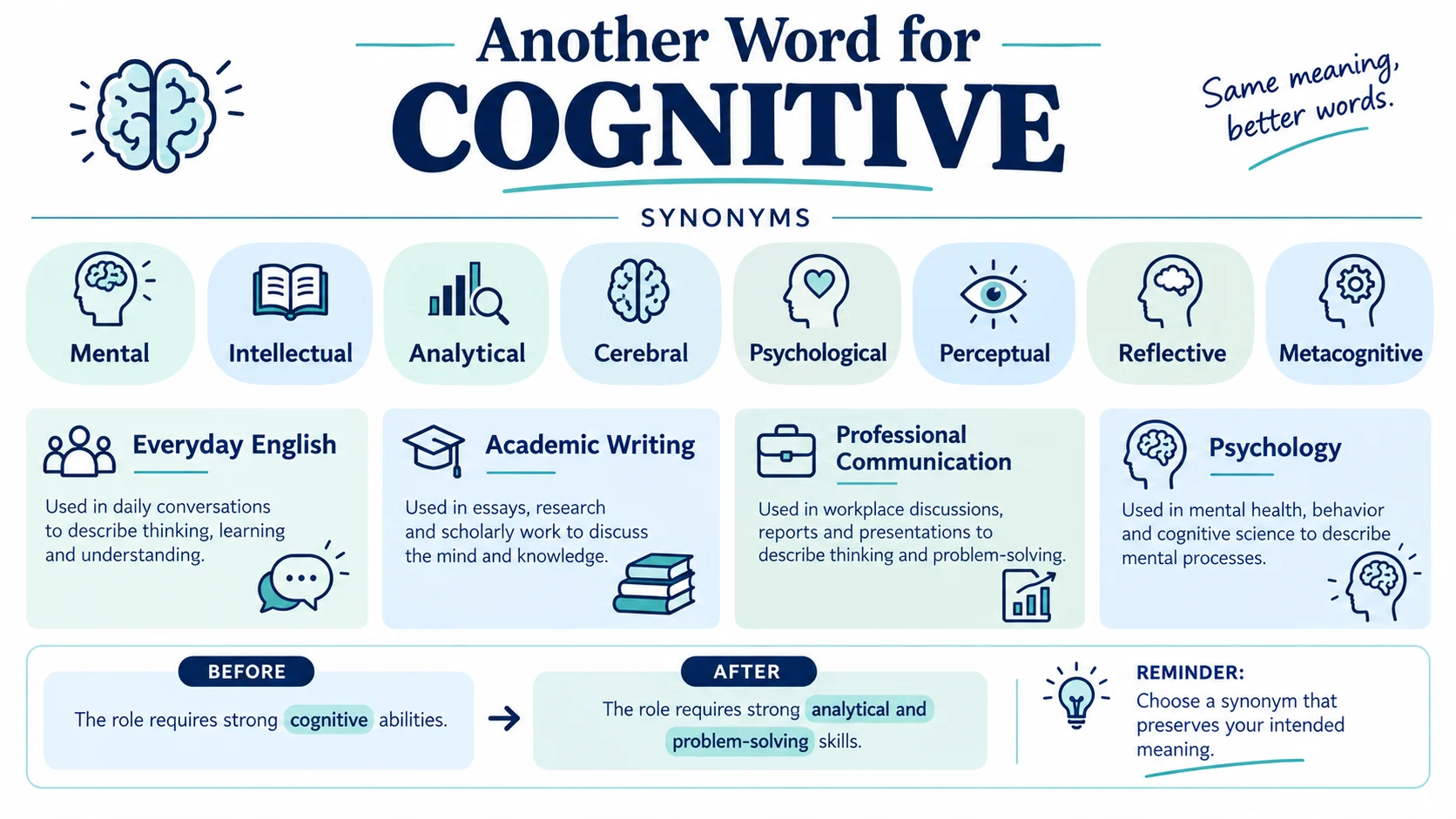
Another word for cognitive is mental, which describes anything related to thinking, understanding, learning, memory, and reasoning. Other useful synonyms include intellectual, cerebral, analytical, perceptual, and psychological. The best alternative depends on your context, whether you are writing an academic paper, describing professional skills, or having an everyday conversation.
What Does Cognitive Mean?
Definition
The word cognitive is an adjective that refers to the mental processes involved in acquiring knowledge, processing information, understanding ideas, remembering experiences, and making decisions.
In simple terms, cognitive describes how the mind works. It commonly appears in psychology, education, neuroscience, healthcare, and academic writing.
For example, cognitive development refers to how a person’s thinking and reasoning abilities change over time. Cognitive skills include attention, memory, problem-solving, and language comprehension.
Common Uses
The word cognitive is frequently used in these contexts:
- Psychology: Cognitive processes, cognitive behavior, and cognitive development.
- Education: Cognitive skills, learning abilities, and cognitive growth.
- Healthcare: Cognitive impairment, cognitive assessment, and cognitive function.
- Business: Cognitive abilities, decision-making, and analytical thinking.
- Everyday conversation: Mental effort, memory, concentration, and understanding.
Because cognitive has a specific meaning, not every synonym works in every sentence. Mental is a broad alternative, while intellectual emphasizes reasoning and knowledge.
Best Synonyms for Cognitive
The best synonym depends on which aspect of thinking you want to emphasize.
| Synonym | Meaning | Best Used When | Example |
|---|---|---|---|
| Mental | Related to the mind | General descriptions | Mental abilities improve with practice. |
| Intellectual | Related to reasoning and knowledge | Education and academic writing | Intellectual development continues throughout life. |
| Cerebral | Involving deep thought or the intellect | Advanced or formal writing | The course requires cerebral effort. |
| Analytical | Involving systematic examination | Problem-solving and business | Analytical skills support better decisions. |
| Psychological | Related to mental processes and behavior | Psychology and behavioral research | Psychological factors influence learning. |
| Perceptual | Related to interpreting sensory information | Vision, hearing, and perception | Perceptual skills help children recognize patterns. |
| Reasoning | Involving logical thought | Problem-solving contexts | Reasoning abilities develop with experience. |
| Intellectual | Involving understanding and abstract thought | Research and education | Intellectual challenges encourage learning. |
| Reflective | Involving careful thought | Personal development and education | Reflective thinking improves self-awareness. |
| Thought-related | Connected with thinking | Plain-language explanations | Thought-related activities strengthen concentration. |
Note: Intellectual appears twice conceptually in the table because it is particularly versatile; for a tighter synonym list, the second entry can be replaced with comprehension-based, which emphasizes understanding information.
Synonyms by Context
Formal Writing
In formal writing, choose a synonym that preserves the intended meaning rather than simply replacing cognitive with a more complicated word.
Good alternatives include:
- Mental: Suitable for general descriptions of thought and memory.
- Intellectual: Appropriate when discussing reasoning, knowledge, or learning.
- Cerebral: Useful when emphasizing complex or abstract thinking.
- Psychological: Best when the discussion concerns mental processes or behavior.
Example:
Original: The study examined cognitive development in children.
Alternative: The study examined intellectual development in children.
The alternative works when the study focuses on reasoning and knowledge. If it covers attention, perception, and memory more broadly, cognitive development may remain more accurate.
Professional Writing
In business and workplace communication, cognitive often describes skills required to evaluate information and solve problems.
Consider these alternatives:
- Analytical: Best for examining information and identifying patterns.
- Mental: Suitable for discussing concentration and mental workload.
- Problem-solving: Appropriate when emphasizing practical solutions.
- Decision-making: Useful when describing judgment and choices.
Business example:
Original: The role requires strong cognitive abilities.
Alternative: The role requires strong analytical and problem-solving skills.
The revised sentence is more specific and tells employers which abilities matter.
For a resume, use analytical thinking, critical thinking, or problem-solving skills when those terms accurately describe your experience.
Academic Writing
Academic writing requires particular care because cognitive is a technical term in several disciplines.
Useful alternatives include:
- Intellectual: For reasoning, knowledge, and abstract thinking.
- Psychological: For mental processes and behavior.
- Perceptual: For recognizing and interpreting sensory information.
- Reasoning-based: For logical inference and evaluation.
Academic example:
Original: Cognitive factors influenced student performance.
Alternative: Psychological factors influenced student performance.
This replacement is appropriate only if the factors concern psychological processes. If the study specifically examines attention, working memory, or executive function, the original term may be more precise.
Daily Conversation
In everyday English, simpler words can make your meaning easier to understand.
Try these alternatives:
- Mental
- Thinking-related
- Learning-related
- Related to memory
- Involving reasoning
Daily conversation example:
Original: The activity supports cognitive development.
Alternative: The activity helps develop thinking and learning skills.
This version sounds natural and communicates the idea without requiring specialized vocabulary.
Professional Alternatives for Cognitive
The most effective professional alternative depends on the skill or process you want to describe.
Analytical
Meaning: Involving the careful examination of information.
Best used for: Business decisions, data analysis, research, and problem-solving.
Tone: Professional and precise.
Difficulty: Medium.
Usage frequency: Very common.
Best for: Resumes, business writing, emails, and reports.
- Business example: The team used analytical methods to identify operational problems.
- Academic example: Analytical thinking helped researchers interpret the results.
- Daily conversation example: She has strong analytical skills.
Intellectual
Meaning: Related to reasoning, knowledge, and understanding.
Best used for: Learning, academic achievement, and complex ideas.
Tone: Formal and thoughtful.
Difficulty: Medium.
Usage frequency: Common.
Best for: Essays, professional profiles, and academic writing.
- Business example: The position offers intellectual challenges.
- Academic example: The program encourages intellectual development.
- Daily conversation example: He enjoys intellectual discussions.
Mental
Meaning: Related to the mind or its activities.
Best used for: General discussions of attention, memory, effort, and thought.
Tone: Neutral and accessible.
Difficulty: Easy.
Usage frequency: Very common.
Best for: Emails, everyday communication, educational materials, and general writing.
- Business example: The task requires sustained mental effort.
- Academic example: Mental processes influence how students learn.
- Daily conversation example: I need a mental break after studying.
Simple Alternatives for Cognitive
If your audience may not be familiar with technical vocabulary, use straightforward expressions.
| Simple Alternative | Example |
|---|---|
| Mental | Mental skills improve through practice. |
| Thinking-related | Thinking-related activities encourage problem-solving. |
| Learning-related | Learning-related abilities change as children grow. |
| Memory-based | Memory-based exercises can support recall. |
| Related to understanding | The lesson improves skills related to understanding. |
These alternatives are especially useful in educational content, introductory explanations, and general-audience articles.
However, some are descriptive phrases rather than exact synonyms. Choose the phrase that best matches the original sentence.
Stronger Alternatives for Cognitive
Sometimes you need a more specific term rather than a stronger-sounding word.
- Cerebral: Emphasizes deep, complex, or abstract thinking.
- Analytical: Highlights systematic examination and evaluation.
- Intellectual: Emphasizes knowledge, reasoning, and understanding.
- Metacognitive: Refers to thinking about and regulating one’s own thinking.
- Executive-function-related: Refers to processes such as planning, working memory, and inhibitory control.
Example:
Original: The course develops cognitive abilities.
More specific: The course develops executive functioning skills, including planning and self-regulation.
Use this version only if the course actually targets those skills. More specialized terminology is not automatically more accurate.
Difference Between Similar Synonyms
Although these words overlap, their meanings are not identical.
| Word | Key Difference | Example |
|---|---|---|
| Cognitive | Broadly covers mental processes involved in knowledge and thought | Cognitive assessment measures aspects of thinking and memory. |
| Mental | General term for the mind and its activities | Mental fatigue can affect concentration. |
| Intellectual | Emphasizes reasoning, knowledge, and understanding | Intellectual curiosity encourages exploration. |
| Cerebral | Suggests complex, abstract, or intensive thought | The novel presents a cerebral challenge. |
| Psychological | Relates to mental processes, emotions, and behavior | Psychological factors can affect motivation. |
| Analytical | Focuses on examining information systematically | Analytical reasoning helps solve problems. |
| Perceptual | Focuses on interpreting sensory information | Perceptual skills support object recognition. |
| Metacognitive | Focuses on awareness and regulation of one’s own thinking | Metacognitive strategies help students monitor their learning. |
The main distinction is scope. Cognitive is broad, while most alternatives highlight a particular mental process.
For example, analytical is a good replacement when discussing logical evaluation, but it may not fully describe memory or sensory perception.
Opposite Words for Cognitive
Cognitive does not have one perfect antonym because it describes a broad category of mental processes. However, several expressions can communicate contrasting ideas in specific contexts.
- Noncognitive: Not directly related to cognitive processes, often used when distinguishing cognitive skills from other abilities or characteristics.
- Physical: Relating to the body rather than mental processes.
- Motor: Relating to movement and the control of muscles.
- Automatic: Occurring without deliberate conscious thought in a particular context.
- Reflexive: Occurring as a reflex rather than through deliberate reasoning.
Example: A study might compare cognitive skills with motor skills, examining thinking abilities separately from movement abilities.
These are contextual contrasts rather than universal antonyms. For instance, physical and cognitive processes can interact, so they are not always opposites.
FAQs
1. What is another word for cognitive?
The most common alternative is mental. Other options include intellectual, analytical, cerebral, psychological, and perceptual, depending on the context.
2. What is a formal synonym for cognitive?
Intellectual, cerebral, and psychological can work in formal writing. Choose intellectual for reasoning and knowledge, cerebral for complex thought, and psychological for mental processes and behavior.
3. What is a professional alternative for cognitive?
Analytical is useful when describing problem-solving and evaluating information. For broader workplace descriptions, mental abilities or critical-thinking skills may be more appropriate.
4. What is a simple word for cognitive?
Mental is usually the simplest direct alternative. You can also use phrases such as thinking skills, learning abilities, or memory skills.
5. Is intellectual the same as cognitive?
No. Cognitive covers a broad range of mental processes, including attention, memory, perception, and reasoning. Intellectual more specifically emphasizes reasoning, knowledge, and understanding.
6. What is the difference between cognitive and psychological?
Cognitive focuses on processes such as thinking, remembering, learning, and attention. Psychological is broader and can include emotions, behavior, motivation, and mental processes.
7. What is another word for cognitive skills?
Depending on the context, you can use thinking skills, mental abilities, intellectual skills, reasoning abilities, or problem-solving skills.
8. What is another word for cognitive development?
Intellectual development can work when the focus is on reasoning and knowledge. Mental development is broader and more general, while learning development may fit specific educational contexts.
9. What is a synonym for cognitive ability on a resume?
Analytical thinking, critical thinking, reasoning ability, and problem-solving skills are useful alternatives. Select terms that accurately represent your actual skills and experience.
10. What is the opposite of cognitive?
There is no single universal opposite. Noncognitive is useful in technical contexts, while physical and motor describe different dimensions of functioning.
Conclusion
The best word to replace cognitive depends on the meaning you want to communicate. Mental is the most versatile everyday alternative, intellectual works well for reasoning and knowledge, and analytical is especially useful for problem-solving and professional writing. Psychological and perceptual are more specialized choices.
Before choosing a synonym, consider your audience, the subject, and the exact mental process being described. A precise word improves clarity and preserves the meaning of your sentence.