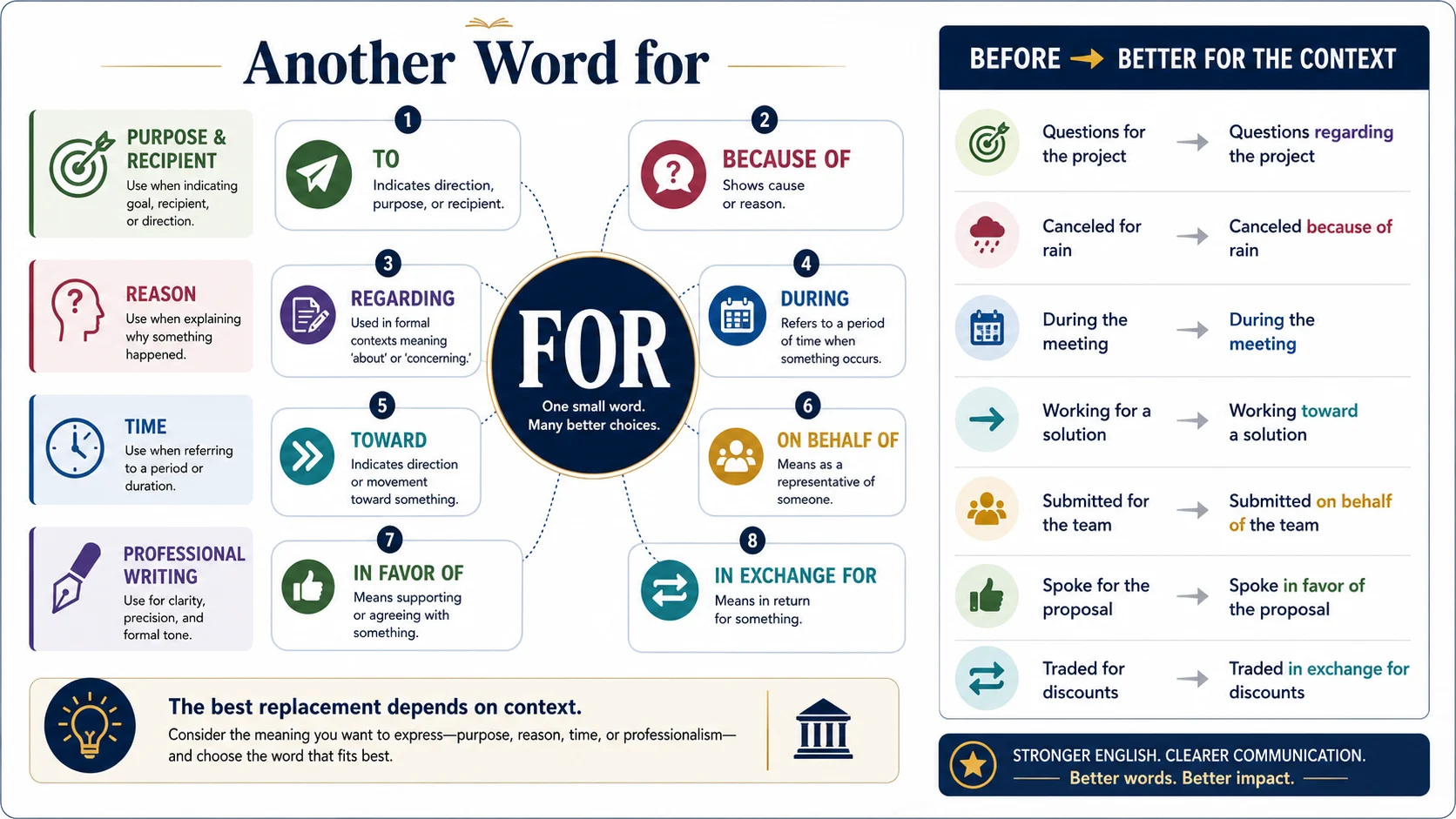
Another word for “for” depends on the context. Common alternatives include to, toward, regarding, concerning, because of, during, on behalf of, in favor of, and in exchange for. Since “for” has several meanings, the best replacement depends on whether it expresses purpose, reason, time, support, or another relationship.
What Does For Mean?
Definition
For is a common English preposition and conjunction with several meanings. It can express purpose, benefit, intended recipients, duration, reason, exchange, support, and connection. Because its meaning changes with context, there is no single word that can replace for in every sentence.
Depending on the sentence, possible alternatives include to, toward, on behalf of, because of, intended for, during, in favor of, regarding, concerning, in exchange for, and on account of.
Common Uses
The meaning of for depends on how it functions in a sentence.
- Purpose: “This tool is for editing photos.”
- Recipient: “This gift is for Sarah.”
- Benefit: “Exercise is good for you.”
- Duration: “I stayed there for three days.”
- Reason: “They were praised for their honesty.”
- Exchange: “I paid $20 for the book.”
- Support: “We voted for the proposal.”
- Destination or intended use: “The package is for the office.”
- Representation: “She spoke for the entire team.”
This range of meanings explains why choosing another word for for requires attention to the sentence, not just a thesaurus list.
Best Synonyms for For
The best alternative depends on what for means in the original sentence.
| Synonym or Alternative | Meaning | Best Used When | Example |
|---|---|---|---|
| to | Direction, recipient, or purpose | Indicating a destination or recipient | “I gave the report to my manager.” |
| toward | Direction or movement | Describing movement toward something | “She walked toward the entrance.” |
| on behalf of | Representing someone | Speaking or acting for another person | “He accepted the award on behalf of the team.” |
| because of | Reason or cause | Explaining why something happened | “The event was canceled because of rain.” |
| due to | Cause or reason | Formal explanations of causes | “The delay occurred due to severe weather.” |
| during | A period of time | Replacing “for” when referring to an event or period | “Several changes occurred during the meeting.” |
| in favor of | Support or approval | Expressing agreement or preference | “Most members voted in favor of the proposal.” |
| regarding | About or concerning | Formal business or academic writing | “I am contacting you regarding your application.” |
| concerning | About a subject | Formal communication | “We received questions concerning the policy.” |
| in exchange for | Trade or payment | Describing something received in return | “She received the equipment in exchange for her services.” |
| intended for | Designed or meant for | Explaining intended users or purposes | “This course is intended for beginners.” |
Not all of these words are interchangeable with for. They replace it only when they express the same underlying relationship.
Synonyms by Context
Formal Writing
In formal writing, the best replacement for for depends on its meaning.
For reason, consider because of, due to, or on account of.
- Original: “The project was delayed for technical reasons.”
- Alternative: “The project was delayed because of technical issues.”
For about, use regarding or concerning.
- Original: “We have several questions for the committee.”
- Alternative: “We have several questions regarding the committee’s decision.”
For representation, use on behalf of.
- Original: “She accepted the certificate for the organization.”
- Alternative: “She accepted the certificate on behalf of the organization.”
Professional Writing
Business communication often benefits from a more precise alternative when for sounds vague.
Regarding works well in emails and formal correspondence:
“I am writing regarding your recent application.”
On behalf of is useful when someone represents a company, department, or group:
“I am contacting you on behalf of the marketing department.”
Intended for works when describing a target audience:
“This training program is intended for new employees.”
In exchange for is useful in contracts, business agreements, and transactions:
“The company provided consulting services in exchange for technical support.”
Academic Writing
Academic writing should prioritize precision.
When expressing cause, because of, due to, or as a result of may be more informative than for.
- “The results changed because of variations in temperature.”
- “The decline was due to reduced participation.”
- “The change occurred as a result of increased demand.”
When introducing a topic, regarding, concerning, and with respect to can sometimes replace vague uses of for.
- “The study provides new evidence regarding consumer behavior.”
- “The researchers examined concerns concerning data reliability.”
However, replacing every instance of for with a longer phrase can make academic writing unnecessarily wordy. Often, for is already the clearest choice.
Daily Conversation
In everyday American English, short and natural alternatives are usually best.
To can replace for when talking about a recipient:
- “I bought this for you.”
- “I gave this to you.”
But these sentences do not always have exactly the same meaning, so context matters.
For duration, for is normally the natural choice:
- “I lived there for five years.”
Using a formal alternative such as during may change the meaning:
- “I lived there during five years” sounds unnatural.
In casual conversation, for is often better than its formal alternatives.
Professional Alternatives for For
When writing a resume, email, report, or business document, consider these alternatives when they match the intended meaning:
- Regarding for “about”
- Concerning for “about”
- On behalf of for “representing”
- Intended for for “designed for”
- In support of for “supporting”
- In favor of for “supporting a decision”
- Because of for “due to a reason”
- As a result of for explaining a consequence
- In exchange for for a transaction
- With respect to for a formal reference to a topic
Synonym Analysis
Regarding
Meaning: About a particular subject.
Best Used For: Business emails, formal correspondence, reports.
Tone: Professional and formal.
Difficulty: Easy.
Usage Frequency: Common.
Best For: Resume writing, email writing, essay writing, business writing, marketing copy.
On behalf of
Meaning: Representing another person or organization.
Best Used For: Professional communication and official statements.
Tone: Formal and professional.
Difficulty: Easy.
Usage Frequency: Common.
Best For: Email writing, business writing, professional communication.
Because of
Meaning: As a result of a particular cause.
Best Used For: Explaining reasons.
Tone: Neutral.
Difficulty: Easy.
Usage Frequency: Very Common.
Best For: Essay writing, email writing, daily conversation, business writing.
Simple Alternatives for For
If you want plain, easy-to-understand English, consider:
- to
- about
- because of
- during
- toward
- for the benefit of
- meant for
- used for
The right choice depends on the original sentence.
For example:
Original: “This guide is for beginners.”
Simple alternative: “This guide is meant for beginners.”
Original: “We canceled the trip for safety reasons.”
Simple alternative: “We canceled the trip because of safety concerns.”
Stronger Alternatives for For
Sometimes for is grammatically correct but does not communicate the relationship precisely enough. A stronger alternative can make the sentence clearer.
| General Use of “For” | More Precise Alternative |
|---|---|
| for a reason | because of |
| for a purpose | intended for |
| for a recipient | intended for / to |
| for a representative | on behalf of |
| for support | in support of |
| for agreement | in favor of |
| for a topic | regarding / concerning |
| for a trade | in exchange for |
| for a consequence | as a result of |
For example, “The policy was changed for safety reasons” is understandable, but “The policy was changed because of safety concerns” identifies the relationship more directly.
Difference Between Similar Synonyms
For vs. To
For can indicate a benefit, purpose, or recipient:
“I bought flowers for my mother.”
To often indicates movement, direction, or transfer:
“I gave the flowers to my mother.”
These words are related in some contexts but are not generally interchangeable.
For vs. Because of
For can sometimes introduce a reason, especially in formal or literary constructions, but because of clearly identifies a cause.
- “She was praised for her honesty.”
- “The match was canceled because of rain.”
The first identifies what she was praised for. The second explains why the match was canceled.
For vs. During
For normally describes duration:
“He worked there for five years.”
During identifies when something happened within a period or event:
“He worked there during the summer.”
For vs. Regarding
For can have several meanings, while regarding specifically means “about” or “concerning.”
- “I have a question for you.”
- “I have a question regarding the contract.”
The first identifies the person being asked. The second identifies the subject.
For vs. On Behalf Of
On behalf of specifically means representing someone.
- “She spoke for the group.”
- “She spoke on behalf of the group.”
The second version makes the representative role clearer.
Business, Academic, and Daily Examples
Business Example
Original:
“We are contacting you for information about your application.”
More precise:
“We are contacting you regarding your application.”
Here, regarding is more direct because the intended meaning is “about.”
Academic Example
Original:
“The researchers analyzed the data for several reasons.”
Alternative:
“The researchers analyzed the data because of several identified factors.”
The alternative is appropriate when the intended meaning is specifically causal.
Daily Conversation Example
Original:
“I bought this coffee for you.”
This sentence is already natural. There is no need to replace for simply to use a synonym.
That is an important rule: the best synonym is sometimes no synonym at all.
Opposite Words
For does not have one universal opposite because it has many grammatical and semantic functions.
When for means support or approval, its opposite may be:
- against
- opposed to
- in opposition to
Example:
“They voted for the proposal.”
Opposite:
“They voted against the proposal.”
When for expresses a recipient or intended beneficiary, there may be no direct opposite.
When for expresses purpose, duration, or exchange, an opposite word usually does not exist.
FAQs
What is another word for “for”?
Possible alternatives include to, toward, regarding, concerning, because of, during, on behalf of, in favor of, intended for, and in exchange for. The correct replacement depends on what for means in the sentence.
What is a formal synonym for “for”?
Formal alternatives include regarding, concerning, on behalf of, with respect to, due to, and in exchange for, depending on the intended meaning.
What is a professional alternative for “for”?
In professional writing, regarding can replace “for” when you mean “about,” while on behalf of can replace it when you mean “representing.” Intended for works well when describing a target audience.
What word can replace “for”?
There is no single replacement for for. Depending on context, you might use to, about, because of, during, toward, regarding, concerning, or on behalf of.
What is another word for “for” in formal writing?
Use regarding, concerning, with respect to, on behalf of, or because of when their meanings fit the sentence. Do not replace for simply to make writing sound more formal.
What is another word for “for” in an essay?
Depending on the sentence, alternatives include because of, regarding, concerning, intended for, and in support of. In many cases, however, for remains the clearest choice.
What is another word for “for” in a resume?
Useful context-specific alternatives include regarding, on behalf of, in support of, and intended for. Resume language should focus on precision rather than replacing common words unnecessarily.
Is “to” a synonym for “for”?
Sometimes, but not always. To can replace for when the meaning involves a recipient or transfer, but the two prepositions have different grammatical functions in many sentences.
Is “because of” a synonym for “for”?
Only when for expresses a reason or cause. For example, “He was rewarded for his effort” and “The event was canceled because of rain” use different meanings of for.
How do I choose the best replacement for “for”?
First identify what for means in your sentence. Ask whether it expresses purpose, benefit, duration, reason, exchange, support, a recipient, or a topic. Then choose an alternative that expresses that specific relationship.
Conclusion
The best answer to “What is another word for for?” is that there is no universal substitute. For is one of the most flexible words in English, and its meaning changes according to context.
Use to for certain recipient or direction meanings, because of for causes, regarding for topics, during for periods, on behalf of for representation, in favor of for support, and in exchange for for transactions. In many everyday sentences, however, for is already the most natural choice.
Good word selection is not about replacing common words with complicated ones. It is about choosing the word that communicates your exact meaning clearly, naturally, and appropriately for your audience.