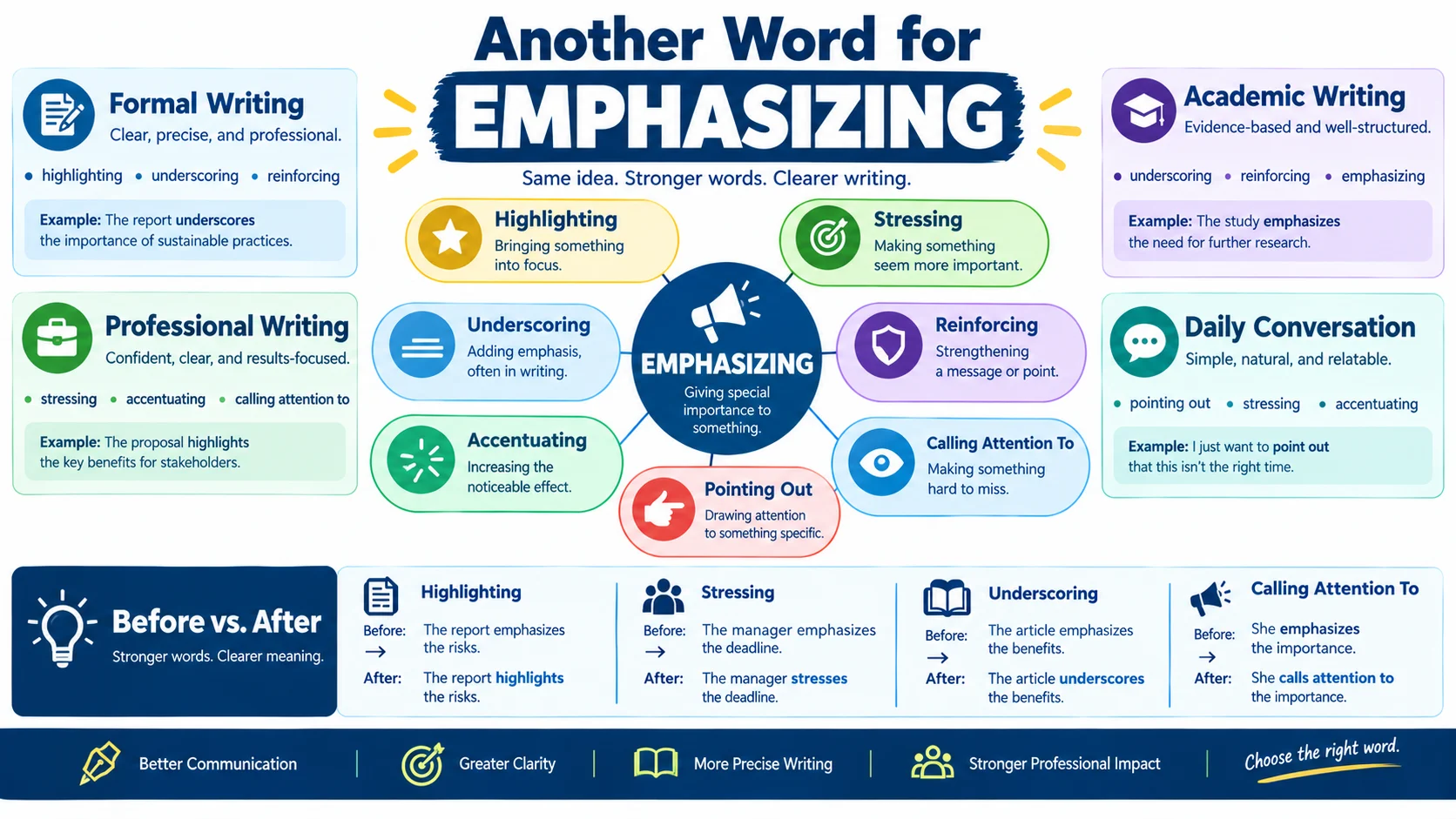
Another word for emphasizing is highlighting, especially when you want to draw attention to something important. Other useful alternatives include stressing, underscoring, reinforcing, accentuating, pointing out, calling attention to, and focusing on. The best choice depends on whether you are writing formally, professionally, academically, or conversationally.
What Does Emphasizing Mean?
Definition
Emphasizing means giving extra attention, importance, or prominence to something. When you emphasize an idea, fact, point, word, or feature, you make it stand out so that other people notice or understand its importance.
For example:
- The teacher is emphasizing the importance of proper citation.
- The report emphasizes the need for better customer service.
- She kept emphasizing that the deadline was Friday.
The word can describe spoken communication, writing, presentations, business discussions, academic work, and everyday conversations.
Common Uses
“Emphasizing” is commonly used when someone wants to:
- Draw attention to an important point
- Make an idea more noticeable
- Show that something matters
- Reinforce a message
- Stress a particular fact
- Make a feature stand out
- Give additional importance to something
The most natural replacement depends on your sentence. Highlighting is usually a safe general alternative, while underscoring sounds more formal and stressing is common in both professional and everyday English.
Best Synonyms for Emphasizing
| Synonym | Meaning | Best Used When | Example |
|---|---|---|---|
| Highlighting | Drawing attention to something important | General writing and presentations | The report is highlighting major safety concerns. |
| Stressing | Giving strong importance to something | Professional and everyday communication | The manager is stressing the importance of teamwork. |
| Underscoring | Making the importance of something especially clear | Formal or academic writing | The findings underscore the need for further research. |
| Reinforcing | Making an idea, message, or belief stronger | Business and academic writing | The data reinforces the importance of early intervention. |
| Accentuating | Making a feature more noticeable or prominent | Descriptive and polished writing | The lighting accentuates the room’s architectural details. |
| Pointing out | Directing someone’s attention toward something | Conversation and simple writing | She pointed out the most important error. |
| Calling attention to | Deliberately directing attention toward something | Formal and general communication | The campaign calls attention to environmental concerns. |
| Focusing on | Giving particular attention to something | Academic, professional, and everyday use | The study focuses on workplace safety. |
Highlighting
Meaning: Drawing attention to something so it becomes more noticeable or important.
Best Used For: Reports, presentations, essays, articles, emails, and general communication.
Tone: Neutral and professional.
Difficulty: Easy
Usage Frequency: Very Common
Best for: Resume, Email Writing, Essay Writing, Marketing Copy, Business Writing
Business Example: The presentation highlights three major opportunities for growth.
Academic Example: The study highlights the relationship between sleep and academic performance.
Daily Conversation Example: I just wanted to highlight one important detail.
Stressing
Meaning: Giving special importance to a particular point.
Best Used For: Strong reminders, instructions, workplace communication, and conversation.
Tone: Neutral to strong.
Difficulty: Easy
Usage Frequency: Very Common
Best for: Email Writing, Business Writing, Daily Communication
Business Example: The CEO stressed the importance of meeting the quarterly target.
Academic Example: The professor stressed the importance of using reliable sources.
Daily Conversation Example: I’m stressing this because I don’t want you to miss the deadline.
Underscoring
Meaning: Making the importance of something particularly clear.
Best Used For: Academic papers, reports, journalism, professional documents, and formal writing.
Tone: Formal and authoritative.
Difficulty: Advanced
Usage Frequency: Common
Best for: Essay Writing, Academic Writing, Business Writing, Marketing Copy
Business Example: The new figures underscore the need to reduce operating costs.
Academic Example: These results underscore the importance of additional research.
Daily Conversation Example: The situation really underscores how important preparation is.
Reinforcing
Meaning: Strengthening an existing idea, message, argument, or belief.
Best Used For: Arguments, evidence, business communication, education, and persuasive writing.
Tone: Professional and analytical.
Difficulty: Medium
Usage Frequency: Common
Best for: Academic Writing, Business Writing, Marketing Copy
Business Example: The survey results reinforce our decision to improve customer support.
Academic Example: The evidence reinforces the argument that early education matters.
Daily Conversation Example: That experience reinforced what I already believed.
Accentuating
Meaning: Making a particular quality or feature more noticeable.
Best Used For: Appearance, design, descriptive writing, art, fashion, and visual subjects.
Tone: Polished and descriptive.
Difficulty: Advanced
Usage Frequency: Less Common
Best for: Marketing Copy, Creative Writing, Descriptive Writing
Business Example: The new design accentuates the brand’s modern identity.
Academic Example: The author uses contrast to accentuate the central theme.
Daily Conversation Example: That color really accentuates the shape of the room.
Synonyms by Context
Formal Writing
For formal writing, choose words that clearly communicate importance without sounding overly conversational.
The strongest choices include:
- Underscoring
- Emphasizing
- Highlighting
- Reinforcing
- Calling attention to
- Demonstrating the importance of
Example:
Original: The report is emphasizing the need for reform.
Formal: The report is underscoring the need for reform.
“Underscoring” works particularly well in research reports, policy documents, professional analyses, and formal articles.
Professional Writing
In business writing, highlighting, stressing, reinforcing, and underscoring are useful alternatives.
For example:
Original: The manager emphasized the importance of customer satisfaction.
Professional: The manager highlighted the importance of customer satisfaction.
For a stronger tone:
The manager stressed the importance of customer satisfaction.
For an analytical report:
The findings underscore the importance of customer satisfaction.
Academic Writing
Academic writing often benefits from precise alternatives such as underscoring, highlighting, reinforcing, and demonstrating.
Example:
Original: The study emphasizes the importance of early intervention.
Academic: The study underscores the importance of early intervention.
When evidence supports an existing argument, reinforces may be more accurate:
The results reinforce the researchers’ original conclusion.
Daily Conversation
In everyday speech, simpler alternatives usually sound more natural.
Good choices include:
- Stressing
- Pointing out
- Focusing on
- Calling attention to
- Making clear
Example:
Original: She kept emphasizing that she was busy.
Natural: She kept stressing that she was busy.
Or:
She kept pointing out that she was busy.
Professional Alternatives for Emphasizing
If you are writing a report, resume, business email, or professional document, consider these alternatives:
Highlighting is the safest all-purpose choice.
Underscoring is stronger and more formal.
Reinforcing works when additional evidence or information strengthens an existing message.
Calling attention to is useful when you deliberately direct someone’s focus toward an issue.
Demonstrating the importance of is useful when evidence supports the significance of something.
For example:
The report emphasizes the company’s commitment to sustainability.
Could become:
The report highlights the company’s commitment to sustainability.
Or:
The report underscores the company’s commitment to sustainability.
The second version sounds more formal and authoritative.
Simple Alternatives for Emphasizing
If you want an easy replacement, use:
- Highlighting
- Stressing
- Pointing out
- Focusing on
- Showing
- Noting
- Calling attention to
These words are easier for general audiences to understand.
For example:
Complex: The findings underscore the significance of employee engagement.
Simple: The findings highlight the importance of employee engagement.
The simpler version is often better for websites, emails, instructional content, and general audiences.
Stronger Alternatives for Emphasizing
When you want to communicate strong importance, consider:
- Stressing
- Underscoring
- Reinforcing
- Insisting on
- Calling particular attention to
- Making clear
- Giving priority to
The right choice depends on what you mean.
Stressing suggests strong verbal or written emphasis.
Underscoring suggests that evidence or circumstances make something important.
Reinforcing suggests that something strengthens an existing idea.
For example:
The manager emphasized the deadline.
This could become:
The manager stressed the deadline.
The second sentence suggests a stronger reminder.
Difference Between Similar Synonyms
Although these words are related, they are not always interchangeable.
Emphasizing vs. Highlighting
Emphasizing means giving something special importance. Highlighting means drawing attention to something.
They are often interchangeable.
The report emphasizes the main risks.
The report highlights the main risks.
Both sound natural.
Emphasizing vs. Stressing
Stressing often carries a stronger sense of urgency or insistence.
The doctor emphasized the importance of exercise.
The doctor stressed the importance of exercise.
Both work, but “stressed” can sound more forceful.
Emphasizing vs. Underscoring
Underscoring is generally more formal. It often suggests that facts, evidence, or circumstances clearly demonstrate importance.
The results underscore the need for reform.
This sounds particularly natural in academic and professional writing.
Emphasizing vs. Reinforcing
Reinforcing means strengthening an existing idea rather than simply drawing attention to it.
The survey reinforces the importance of employee training.
Here, the survey provides additional support for an already established idea.
Emphasizing vs. Accentuating
Accentuating often describes making a visual, physical, or stylistic feature more noticeable.
The lighting accentuates the artwork.
“Emphasizing” is broader and can refer to ideas, facts, arguments, or features.
Opposite Words
The opposite of emphasizing is generally related to reducing attention or importance.
Common antonyms include:
- Minimizing
- Downplaying
- Ignoring
- Overlooking
- Neglecting
- De-emphasizing
- Understating
- Diminishing
For example:
The article emphasizes the risks.
Opposite:
The article downplays the risks.
“Downplaying” is especially useful when someone deliberately makes an issue seem less important than it is.
FAQs
What is another word for emphasizing?
The best general synonym for emphasizing is highlighting. Depending on context, you can also use stressing, underscoring, reinforcing, accentuating, pointing out, or calling attention to.
What is a formal synonym for emphasizing?
Underscoring is one of the best formal synonyms for emphasizing. It works especially well in academic papers, reports, research writing, journalism, and professional documents.
What is a professional alternative for emphasizing?
Highlighting is a natural professional alternative. Underscoring and reinforcing are also useful when you want a more formal or analytical tone.
What word can replace emphasizing in an essay?
Good choices include highlighting, underscoring, stressing, reinforcing, demonstrating, and drawing attention to. Choose the word based on whether you are simply pointing something out or strengthening an argument.
What is another word for strongly emphasizing?
Use stressing, underscoring, reinforcing, or calling particular attention to. “Stressing” is especially natural when the speaker wants to make an important point unmistakable.
Is highlighting the same as emphasizing?
Usually, yes. Both words can mean giving special attention to something. However, “highlighting” often focuses more on making something noticeable, while “emphasizing” can also mean giving it greater importance.
Is underscoring a synonym for emphasizing?
Yes. Underscoring means making something especially clear or showing that it is important. It is a particularly useful synonym in formal and academic writing.
What is a simple word for emphasizing?
Simple alternatives include highlighting, stressing, showing, pointing out, and noting.
What is a strong synonym for emphasizing?
Stressing and underscoring are strong alternatives. The best choice depends on whether you want to communicate urgency or formal importance.
What is the opposite of emphasizing?
Common opposites include downplaying, minimizing, ignoring, overlooking, and understating. The most appropriate antonym depends on the sentence.
Conclusion
The best alternative to emphasizing depends on your intended meaning and audience. Highlighting is the most versatile choice, while stressing works well for stronger reminders. Underscoring is ideal for formal and academic writing, and reinforcing is best when evidence strengthens an existing idea. For visual or descriptive contexts, accentuating can be a more precise choice.
Choosing the right synonym is not only about avoiding repetition. The replacement should match the tone, purpose, and meaning of your sentence. When you choose a word based on context, your writing becomes clearer, more natural, and more precise.