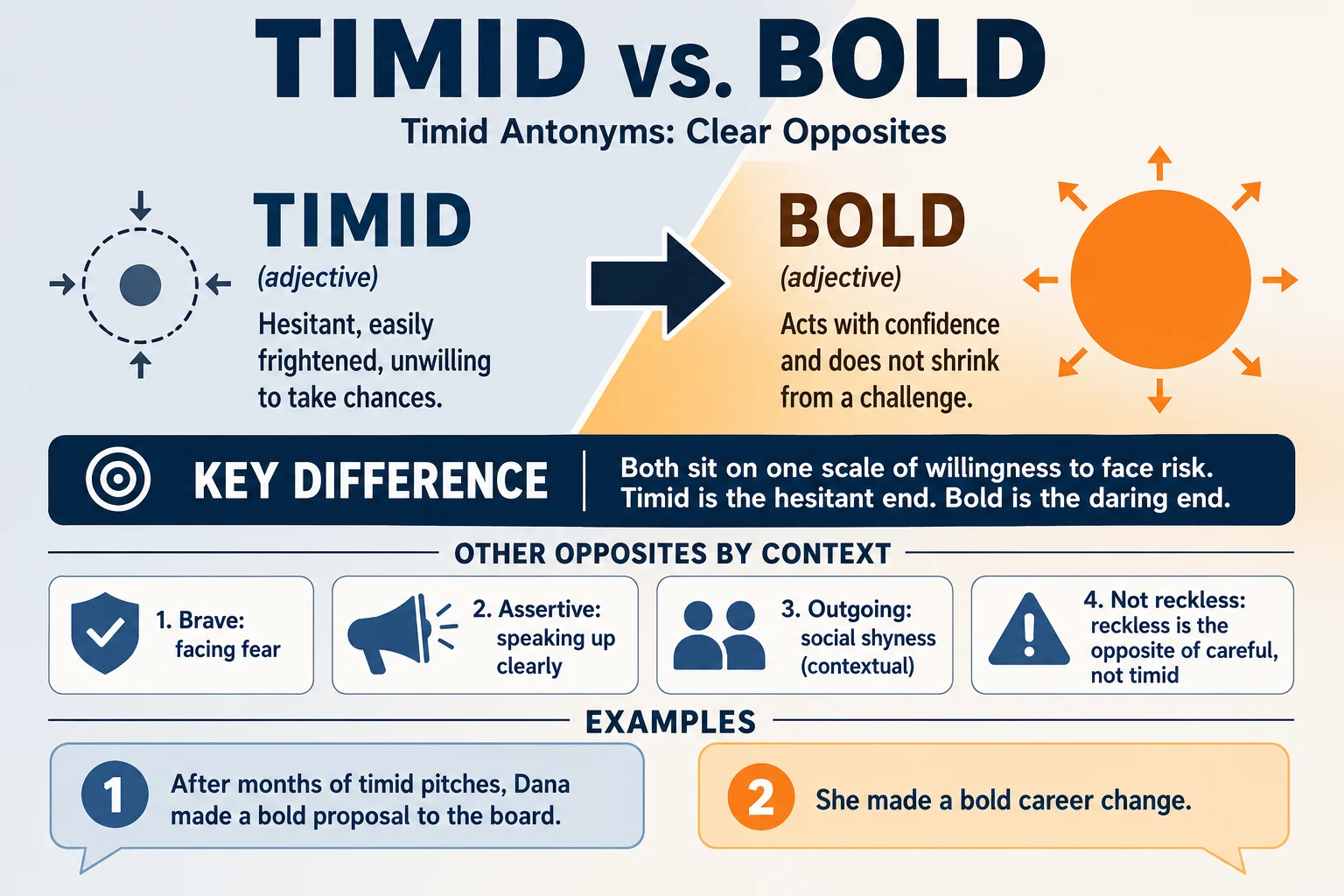
The opposite of timid is bold. Timid describes someone who lacks courage or confidence and hesitates to take risks or speak up. Bold means willing to act with confidence and courage. Depending on context, brave, confident, fearless, assertive, or outgoing can also work as opposites.
Part of speech: adjective
Primary opposite: bold
Timid means easily frightened, hesitant, or unwilling to take chances. When it describes how willing someone is to face risk or act decisively, bold is the strongest direct opposite. Bold describes a person or choice that moves forward with confidence and does not shrink from a challenge.
The pair works because both words sit on the same scale of willingness to face risk. Timid marks the hesitant end, and bold marks the daring end.
No single antonym fits every use, though. Timid covers two overlapping senses: fearful of danger or risk, and shy in social settings. Each sense has its own best opposite, so the right choice depends on what you mean.
Direct and Strong Antonyms
These words work as genuine opposites of timid when it describes courage, confidence, or willingness to act.
| Antonym | Tone or Nuance | Example Sentence |
|---|---|---|
| Bold | Direct and versatile; fits people, choices, and plans | “After months of timid pitches, Dana finally made a bold proposal to the board.” |
| Brave | Warm and personal; stresses facing fear | “The brave little boy admitted he had broken the neighbor’s window.” |
| Courageous | Formal and serious; suits high stakes or moral choices | “It was courageous of the nurse to report the safety violation.” |
| Fearless | Strongest of the group; suggests almost no fear | “The fearless rookie volunteered to take the final shot.” |
| Confident | Calm and neutral; contrasts with self-doubt | “Her confident answer surprised the interviewers who expected a nervous student.” |
| Assertive | Professional; contrasts with holding back opinions | “Marcus became more assertive in meetings once he trusted his data.” |
Notice that these words are not interchangeable. Fearless is much stronger than timid is weak, so it can sound exaggerated for everyday situations. Confident and assertive fit workplace and communication settings best, while brave and courageous fit moments that involve real fear.
Contextual and Subtle Opposites
Because timid has more than one sense, the best opposite changes with the situation. The table below organizes contextual opposites by meaning.
| Context | Best Opposite | Why It Fits |
|---|---|---|
| Facing danger or risk | Brave, fearless | These directly contrast with being afraid to act. |
| Social shyness | Outgoing, sociable (contextual) | They describe ease around others rather than courage. |
| Workplace communication | Assertive, confident | They contrast with hesitating to speak or ask. |
| Plans, designs, or strategies | Bold, daring | They describe an approach that accepts risk. |
| Manner or voice | Firm, self-assured (contextual) | They describe delivery rather than character. |
The words outgoing, sociable, firm, and self-assured are contextual opposites. They work in specific situations but are not direct antonyms of timid in every use.
Here is how the shift looks in practice. A timid investor avoids risk, so a bold investor is the natural contrast. A timid new student who rarely talks in class contrasts best with an outgoing classmate who joins every discussion. A timid knock on a door contrasts with a firm one.
In each case, the opposite you choose depends on whether you are describing fear, shyness, or hesitation.
Words That Seem Opposite But Are Not
Common Grammatical or Semantic Confusions
Reckless. Many writers treat reckless as the opposite of timid because it suggests ignoring fear. But reckless is the opposite of careful or cautious. A reckless person ignores danger, while a bold person understands the risk and acts anyway. Someone can be neither timid nor reckless, such as a skilled climber who takes calculated risks.
Arrogant. Arrogant belongs on a different scale entirely. It contrasts with humble or modest, not with timid. A bold person can be perfectly modest, and a timid person can be quietly full of themselves. The two traits answer different questions: how willing someone is to act, and how highly someone thinks of themselves.
Subtle Tone Differences
Related words carry different strength, formality, and emotion, so choosing precisely matters.
Bold vs. brave. Bold often describes style and decisiveness, while brave focuses on facing something frightening. “She made a bold career change” is about decisiveness. “She was brave through the surgery” is about enduring fear.
Courageous vs. fearless. Courageous implies someone felt fear and acted anyway. Fearless suggests fear was absent. A parent might call a firefighter courageous, but a toddler leaping off the couch is fearless.
Assertive vs. aggressive. Assertive is the healthy contrast to timid, since it means stating needs clearly and respectfully. Aggressive overshoots into forceful or hostile behavior. “He was assertive about his deadline” sounds professional. “He was aggressive about his deadline” sounds like a complaint.
Confident vs. bold. Confident describes an inner state of self-trust, while bold describes visible action. A confident person might still choose a quiet, careful path.
Frequently Asked Questions
What is the opposite of timid?
The strongest direct opposite of timid is bold, which describes someone willing to take risks and act decisively. Brave, courageous, confident, and fearless also work, depending on whether you want to stress fear, self-assurance, or the complete absence of hesitation.
What is the opposite of timid when it means shy?
When timid means shy or reserved around people, outgoing and sociable are the best contextual opposites. Confident also works when the issue is self-doubt. Bold fits less naturally here because it describes risk-taking more than social ease.
Can I use aggressive as the opposite of timid in writing?
Usually not. Aggressive suggests hostility or excessive force, which goes beyond the simple opposite of hesitant. In most writing, assertive is the better choice because it describes clear, respectful confidence without implying intimidation.
Suggested Reading and Internal Links
- Antonyms for shy
- Words that describe confidence
Practical Word Choice
1. Identify the intended meaning. Ask whether timid means afraid of risk, shy around people, or hesitant in speech. Fear points toward brave or bold, shyness points toward outgoing, and hesitant communication points toward assertive.
2. Match the context, tone, strength, and formality. Use courageous for serious or formal writing, brave for personal and emotional moments, and assertive for the workplace. Save fearless for situations where fear is truly absent, since it is the strongest option.
Final Thoughts
Timid has one clear primary opposite, bold, but no single word covers every sense. The right antonym depends on whether you are contrasting fear, shyness, or hesitation, which is why brave, outgoing, and assertive each earn a place in different sentences.
Context matters because these words differ in strength and tone, not just in meaning. A word that sounds natural in a casual conversation can feel exaggerated or too formal in a report, and a near match can quietly change your message.
When you are unsure, name the quality you want to highlight before choosing the word. That one step usually points you to the most accurate opposite.
What is the best example of a timid person turning bold that you have seen or written about?