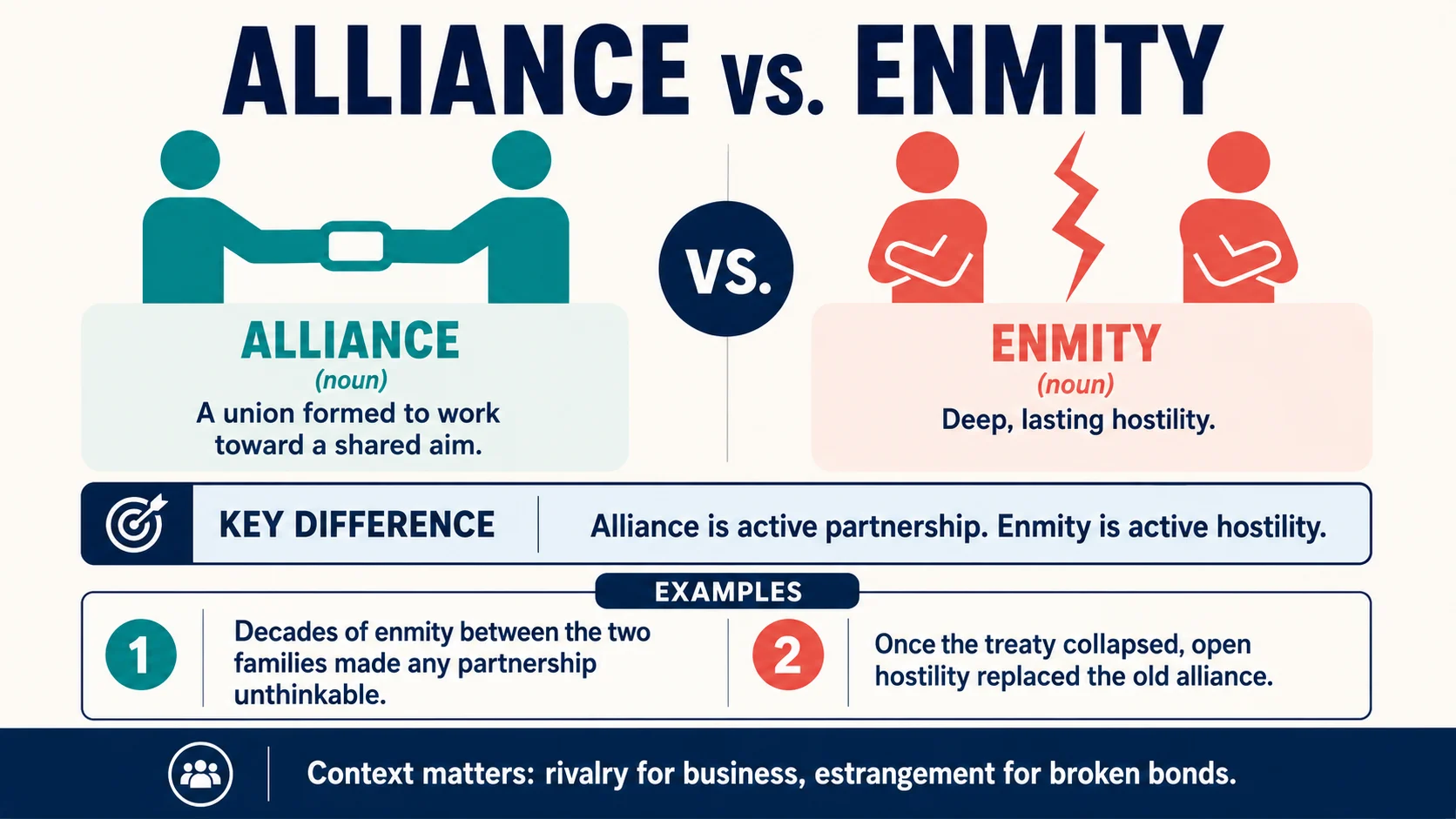
The opposite of alliance is enmity when the word means a cooperative partnership between nations or groups. An alliance is a formal union formed for shared goals. Disunion is the closest formal antonym, while rivalry fits business or competitive settings, and estrangement fits broken relationships.
Part of speech: noun
Primary opposite: enmity
An alliance is a union between countries, organizations, or people who agree to work together toward a shared aim. When alliance means a cooperative bond, enmity is the strongest opposite. An alliance names active partnership, and enmity names active hostility.
English has no single perfect antonym for alliance. Disunion is the closest formal lexical opposite, but it is uncommon in everyday American speech. The best choice depends on whether you are describing politics, business, or personal relationships.
Direct and Strong Antonyms
These words oppose the core idea of an alliance: a deliberate bond between parties.
| Antonym | Tone or Nuance | Example Sentence |
|---|---|---|
| Enmity | Formal and strong. Deep, lasting hostility. | Decades of enmity between the two families made any partnership unthinkable. |
| Hostility | Everyday and strong. Open unfriendliness or conflict. | Once the treaty collapsed, open hostility replaced the old alliance. |
| Disunion | Formal and somewhat dated. A lack of unity. | The senator warned that the vote would deepen disunion within the coalition. |
Enmity and hostility oppose the relationship itself. Disunion opposes the idea of being united. All three are natural opposites, but none is a perfect mirror image, which is why context matters.
Contextual and Subtle Opposites
Alliance has several senses, and each one calls for a different opposite. The words below are contextual, not universal.
| Context | Best Opposite (Contextual) | Why It Fits |
|---|---|---|
| Formal pact between nations | Enmity, hostility | Allies cooperate. Enemies oppose each other. |
| Business or organizational partnership | Rivalry, competition | Partners share goals. Rivals pursue the same prize against each other. |
| Personal or political bonds | Estrangement, discord | Estrangement describes people who were once close and have grown apart. |
| Bond by marriage or kinship (formal) | Estrangement | The tie of family is replaced by distance. |
Some words describe the end of an alliance rather than its opposite. Split, rift, and breakup name the moment a bond breaks. They do not name the opposed condition. For example, “The two parties suffered a split” describes an event, while “The two parties live in open enmity” describes a state.
Strength also varies. Discord is mild and suggests friction. Hostility suggests active opposition. Enmity suggests bitterness that lasts.
Words That Seem Opposite But Are Not
Two terms are often treated as antonyms of alliance, but they are related contrasts.
Neutrality. A neutral party stays out of alliances but does not oppose anyone. A neutral country can be friendly with everyone. Example: “The small nation declared neutrality, refusing to join either alliance or treat anyone as an enemy.”
Isolationism. This is a policy of avoiding international commitments. It contrasts with alliance-building, but it does not mean hostility. A country can avoid alliances and still trade peacefully with its neighbors.
Neither word names an opposing bond. They name the absence of one.
Subtle Tone Differences
Rivalry, hostility, and enmity can sound similar, but they differ in warmth and intensity.
Rivalry can be playful. “The two bakeries have a friendly rivalry” works because rivals compete without hatred. Hostility is colder: “The committee met the proposal with open hostility.” Enmity is the heaviest of the three and often implies a long history: “Their enmity dated back to a bitter business dispute.”
Formality also shifts the choice. In a news report or academic paper, enmity and disunion fit comfortably. In casual conversation, most speakers would say “they’re enemies now” or “they fell out.” Match the weight of the word to the weight of the situation.
Frequently Asked Questions
What is the direct opposite of alliance?
No single word is a perfect opposite. Enmity is the strongest contextual antonym when alliance means a cooperative bond between nations or groups. Disunion is the closest formal opposite, though it is less common in everyday American English.
What is the opposite of alliance in business?
In a business setting, rivalry or competition is the best opposite. An alliance joins companies toward a shared goal, while rival firms pursue the same customers against each other. Hostility fits only when the competition turns openly aggressive.
Should I use enmity or rivalry in a sentence?
Use enmity for deep, lasting hostility, such as a feud or a bitter political divide. Use rivalry for competition, which can be friendly or fierce. If the two sides respect each other, rivalry is usually the more accurate word.
Practical Word Choice
1. Identify the intended meaning. Ask whether you mean a formal pact, a business partnership, or a personal bond. A treaty points toward enmity or hostility. A joint venture points toward rivalry. A broken friendship points toward estrangement.
2. Match the context, tone, strength, and formality. Choose discord for mild friction and enmity for lasting bitterness. Choose disunion for formal writing and “enemies” or “rivals” for casual speech.
Final Thoughts
The key point is that alliance has no single mirror word. Enmity is the strongest contextual opposite when alliance means a cooperative bond. Disunion is the closest formal opposite, and rivalry and estrangement fit narrower settings.
Context shapes the right answer because alliance covers politics, business, and personal life, and each setting carries its own kind of opposition. A word that works in a diplomatic report can sound stiff in a conversation, and the reverse is also true.
One last habit helps: before you reach for an opposite, decide whether you mean hostility, competition, or simply the absence of a bond. That choice usually points to the right word. Can you think of a sentence where “enmity” or “rivalry” captured an alliance gone wrong? Share your example in the comments.