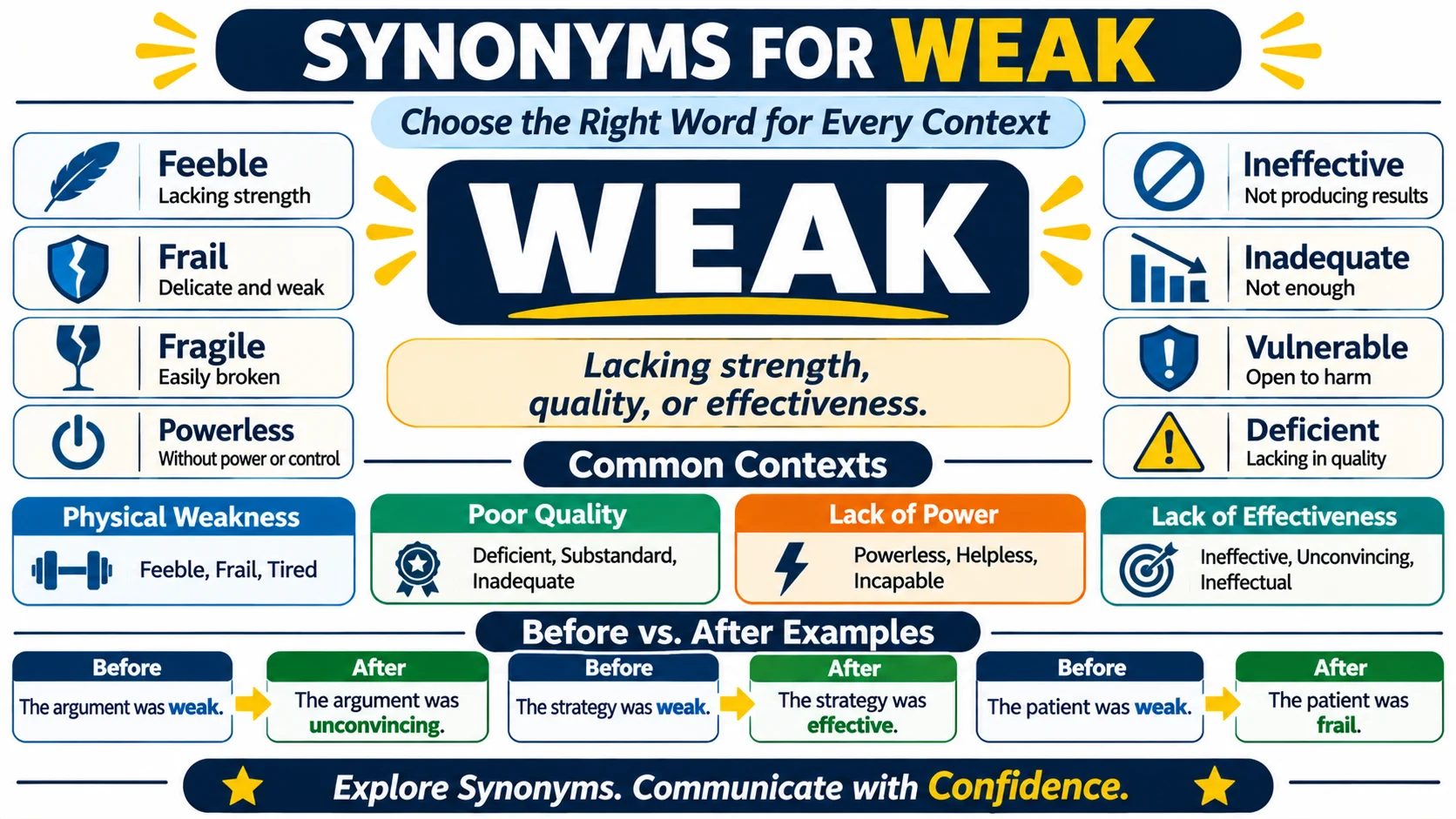
Another word for weak is feeble, frail, or fragile, depending on what you are describing. Use frail or feeble for a person’s body, flimsy for objects, ineffective for arguments, and vulnerable for security or defenses. The best replacement depends on whether you mean physical, structural, or logical weakness.
What Does Weak Mean?
Definition
Weak is an adjective that describes something lacking strength, power, or effectiveness. It can refer to a body, a structure, a signal, an argument, a skill, or a personality trait. Because its meaning shifts with context, one replacement rarely fits every sentence.
Common Uses
People use weak in five main ways: physical (a weak immune system), structural (a weak bridge), logical (a weak argument), personal (weak willpower), and technical (a weak signal or password). Deciding which sense you mean is the first step toward a better word choice.
Best Synonyms for Weak
| Synonym | Meaning | Best Used When | Example |
|---|---|---|---|
| Feeble | Lacking physical or moral strength | Describing a person, voice, or effort | The patient’s pulse was feeble. |
| Frail | Physically delicate and easily harmed | Describing age or illness | Her frail grandfather needs help on the stairs. |
| Fragile | Easily broken or damaged | Objects, systems, or situations | The ceasefire remains fragile. |
| Flimsy | Poorly made or lightly built | Materials, excuses, or evidence | He offered a flimsy excuse for missing the deadline. |
| Ineffective | Failing to produce the desired result | Methods, tools, or strategies | The old policy proved ineffective. |
| Vulnerable | Open to attack or harm | Security, finances, or people at risk | The network is vulnerable to attack. |
| Faint | Not strong or clear | Sounds, light, or signals | The phone picked up only a faint signal. |
| Powerless | Without power or control | Situations with no options | She felt powerless to stop the decision. |
| Unconvincing | Not persuasive | Arguments or performances | The closing argument was unconvincing. |
| Lackluster | Lacking energy or spark | Results or performances | The company reported a lackluster quarter. |
Synonym Analysis: Key Words in Detail
Feeble
Tone: sympathetic or critical. Difficulty: Medium. Usage frequency: Common. Best for: essay writing and everyday description.
Business example: The marketing team made a feeble attempt to defend the campaign. Academic example: The study offers only feeble evidence for the claim. Daily conversation: I gave a feeble excuse and left early.
Frail
Tone: gentle and compassionate. Difficulty: Medium. Usage frequency: Common. Best for: essay writing and storytelling.
Business example: The firm’s frail finances left little room for expansion. Academic example: Frail older adults were included in the clinical sample. Daily conversation: My neighbor is frail, so I carry her groceries.
Flimsy
Tone: dismissive. Difficulty: Easy. Usage frequency: Common. Best for: email writing, marketing copy, and critique.
Business example: The vendor’s flimsy packaging caused damage in transit. Academic example: The author builds a theory on flimsy assumptions. Daily conversation: That tent looks too flimsy for a storm.
Ineffective
Tone: neutral and professional. Difficulty: Easy. Usage frequency: Very Common. Best for: resumes, business writing, and reports.
Business example: The previous onboarding process was ineffective, so we redesigned it. Academic example: The intervention was ineffective at reducing dropout rates. Daily conversation: The bug spray was totally ineffective.
Synonyms by Context
Formal Writing
Choose feeble, frail, or inadequate when you want a measured, respectful tone. These words suit reports, letters, and published articles where weak might sound too blunt.
Professional Writing
Ineffective, underperforming, and vulnerable work best in business documents. They name the problem precisely without sounding emotional, which makes feedback easier to act on.
Academic Writing
Use tenuous, unsubstantiated, or insufficient for arguments and evidence. For example, a tenuous link between two variables is more precise than a weak link.
Daily Conversation
In casual speech, people say flimsy, shaky, or wimpy. These are vivid and informal, so they fit chats with friends more than workplace messages.
Professional Alternatives for Weak
For resumes and workplace communication, underperforming, ineffective, and deficient sound measured and objective. If you are describing your own growth, try developing or less established instead, as in “I am strengthening my developing skills in data analysis.”
Simple Alternatives for Weak
When clarity matters most, short words win. Faint, thin, frail, and shaky are easy to understand and work well for students, English learners, and general audiences.
Stronger Alternatives for Weak
If weak feels too mild, reach for powerless, helpless, spineless, or decrepit. Powerless stresses a total lack of control, helpless suggests a need for rescue, spineless criticizes a lack of courage, and decrepit describes something worn down by age. These words carry emotional weight, so use them with care.
Difference Between Similar Synonyms
Feeble vs. frail. Frail describes a body that is delicate and easily hurt, often because of age or illness. Feeble is broader and can describe effort, light, or a voice. A frail person may still make a strong argument, but a feeble argument is simply poor.
Fragile vs. flimsy. Fragile things break under pressure but may be valuable, like glass or a peace agreement. Flimsy things are poorly made and not trustworthy, like a cheap chair or a thin excuse. Fragile can feel careful. Flimsy feels critical.
Vulnerable vs. defenseless. Vulnerable means open to harm, whether or not harm is coming. Defenseless means having no means of protection at all, which makes it the stronger and more emotional choice.
Opposite Words
The most common antonyms of weak are strong, powerful, sturdy, robust, and resilient. Choose sturdy for objects, robust for systems, powerful for influence, and resilient for people or organizations that recover from setbacks.
FAQs
What is another word for weak? Feeble, frail, fragile, and flimsy are the most common alternatives. The right one depends on whether you describe a person, an object, or an idea.
What is a formal synonym for weak? Feeble, frail, and inadequate suit formal writing. In academic work, tenuous and insufficient are also strong choices.
What is a professional alternative for weak? Ineffective, underperforming, and vulnerable are professional options. They describe results or risks clearly without sounding personal.
What word can replace weak in an essay? Use tenuous or unconvincing for arguments, frail for people, and fragile for situations or systems. Each one is more specific than weak.
What is a stronger word than weak? Powerless, helpless, and decrepit all express a deeper degree of weakness. Use them only when the situation justifies the intensity.
Conclusion
Weak is a useful word, but it rarely says exactly what you mean. Frail points to the body, flimsy to poor construction, ineffective to results, and vulnerable to risk. Matching the synonym to the situation makes your writing clearer, more precise, and more persuasive.