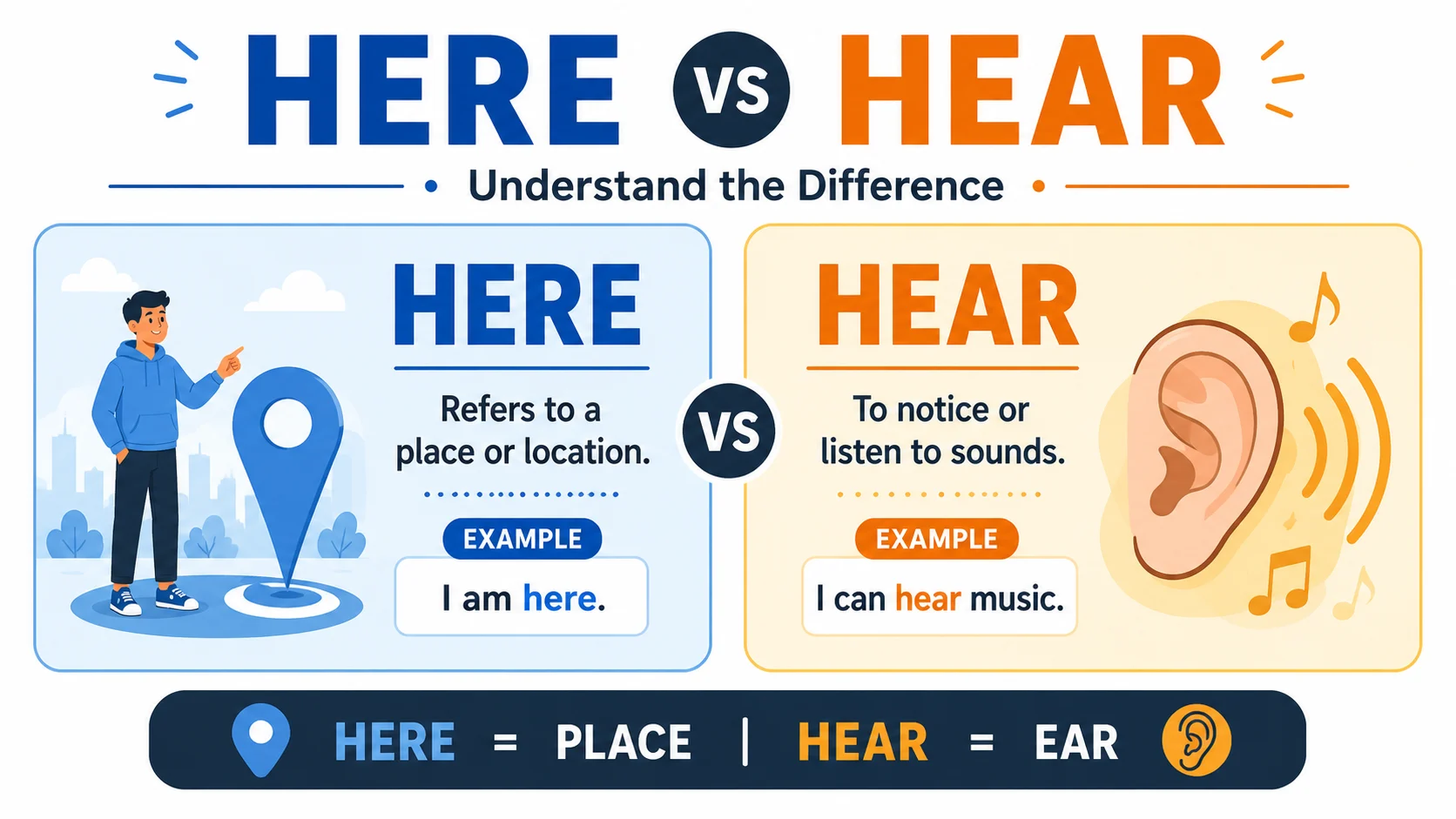
Here and hear sound the same, but they have different meanings and uses. Here refers to a place or position, while hear means to notice or listen to a sound. Both words are pronounced the same but are spelled differently and used in different ways.
English has many words that sound alike but have different meanings. These words can make writing difficult, even for people who speak English every day. Here and hear are two common examples. They sound exactly the same, but they do not mean the same thing.
The confusion between here vs hear often happens because both words have the same pronunciation. When someone speaks, listeners cannot always tell which word they mean from the sound alone. However, the difference becomes clear when these words appear in a sentence.
Here is used when talking about a place, position, or location. Hear is used when talking about sound, listening, or the ability to notice something through your ears.
For example, you might say, “Come here and hear this song.” In this sentence, here tells someone where to go, while hear tells them what to do.
Learning the difference between here and hear can help you avoid spelling mistakes, write better sentences, and communicate more clearly. This guide explains their meanings, grammar rules, examples, common mistakes, and practical exercises.
Quick Answer: Here vs Hear
The main difference between here and hear is their meaning and grammatical use.
- Here: An adverb that refers to a place, position, or location.
- Hear: A verb that means to notice, receive, or understand a sound through your ears.
Although these words sound alike, they cannot replace each other.
| Word | Meaning | Part of Speech | Example |
|---|---|---|---|
| Here | In this place | Adverb | I live here. |
| Hear | To notice a sound | Verb | I can hear music. |
Easy way to remember:
- Here has the word here in it and points to a place.
- Hear contains the word ear, which helps you connect it with listening and sound.
Remember this simple rule: If you are talking about a place, use here. If you are talking about sound, use hear.
What Does Here Mean?
Here means in, at, or toward the place where someone is or where something is happening. It is commonly used to describe a person’s location, the position of an object, or a place being discussed.
Here is an adverb. It answers questions such as:
- Where are you?
- Where is the object?
- Where should someone go?
- Where is something happening?
For example:
- I am here.
- Please come here.
- Your keys are here.
- We have everything we need here.
In each example, here refers to a location or position.
Definition of Here
According to its common English usage, here means in this place or at this location.
It can also refer to a point in a conversation, a situation, or a particular stage of an activity.
For example:
- Here is your book.
- We are here to help you.
- Let’s stop here for today.
- Here comes the bus.
In these examples, the word identifies a place, introduces something, or points to a moment or situation.
Here as an Adverb
The most common grammatical role of here is an adverb of place.
An adverb of place gives information about where an action happens.
Examples:
- My brother is waiting here.
- Please sit here.
- I work here every day.
- The children are playing here.
- We stayed here last night.
In these sentences, here tells the reader or listener where something happens.
Here in Different Contexts
The meaning of here can change slightly depending on the sentence.
Physical location
This is the most common use of here.
Examples:
- I am here at the office.
- Your package is here.
- Come here for a moment.
Introducing something
Here can introduce an object, person, or piece of information.
Examples:
- Here is your coffee.
- Here are the documents.
- Here comes your teacher.
Offering help or support
Here can describe someone’s willingness to help.
Examples:
- I am here for you.
- We are here to support our students.
- Our team is here to answer your questions.
Referring to a point in time or discussion
Here can also refer to a particular stage or point.
Examples:
- We are here to discuss your project.
- Here is where the problem begins.
- Let’s start here and move forward.
These examples show why understanding the context is important when choosing the correct word.
What Does Hear Mean?
Hear means to notice, receive, or become aware of sounds through your ears. It is a verb that describes the ability or action of listening to something.
You use hear when talking about music, voices, conversations, noise, or other sounds.
For example:
- I can hear you.
- Did you hear that noise?
- She hears music every morning.
- We hear birds outside.
In these sentences, hear describes the act of receiving sound.
Definition of Hear
Hear means to perceive sound through the ears.
It can describe something you hear naturally or something you become aware of because another person makes a sound.
For example:
- I hear someone knocking.
- Did you hear the news?
- He could hear the rain.
- We heard a loud explosion.
The word can also describe receiving information from another person.
Examples:
- I heard that you got a new job.
- She heard the announcement.
- Have you heard about the meeting?
In these cases, hear refers to receiving information rather than simply noticing a physical sound.
Hear as a Verb
Hear is an irregular verb. Its basic forms are:
| Verb Form | Word | Example |
|---|---|---|
| Base form | Hear | I hear music. |
| Third-person singular | Hears | She hears music. |
| Past tense | Heard | I heard music. |
| Past participle | Heard | I have heard that song. |
| Present participle | Hearing | I am hearing strange noises. |
Notice that the past tense of hear is heard, not heared.
This is important because English has many irregular verbs that do not follow the usual rules for forming the past tense.
Hear in Different Contexts
Hear can be used in several situations.
Listening to sounds
Examples:
- I hear the birds singing.
- Can you hear the alarm?
- She hears a strange noise.
Receiving information
Examples:
- I heard the good news.
- Have you heard about the new school?
- We heard the announcement yesterday.
Understanding someone’s opinion
Examples:
- I hear what you are saying.
- We hear your concerns.
- The manager heard the employee’s complaint.
Learning something indirectly
Examples:
- I heard that the store is closing.
- She heard that he moved abroad.
- We have heard good things about this company.
These examples show that hear is not limited to physical sounds. It can also refer to receiving information or understanding someone’s words.
Here vs Hear: Main Differences
The easiest way to understand here vs hear is to compare their meanings, grammar, and uses.
| Feature | Here | Hear |
|---|---|---|
| Meaning | In this place | To notice a sound |
| Part of speech | Adverb | Verb |
| Main purpose | Shows location | Describes hearing |
| Pronunciation | /hɪr/ | /hɪr/ |
| Related idea | Place or position | Ear or sound |
| Past tense | Not applicable | Heard |
| Example | Come here. | I hear you. |
The most important difference is that here tells someone where something is, while hear describes what someone can hear.
Difference in Meaning
Here is connected with location.
Example:
“I am here.”
This sentence tells someone where the speaker is.
Hear is connected with sound.
Example:
“I can hear you.”
This sentence tells someone that the speaker can notice their voice.
Difference in Grammar
Here usually functions as an adverb.
Example:
“Please wait here.”
The word here describes where someone should wait.
Hear functions as a verb.
Example:
“Please hear my explanation.”
The word hear describes the action of listening to or receiving something.
Difference in Sentence Structure
Here often appears after a verb or at the beginning of a sentence.
Examples:
- Come here.
- Stay here.
- Here is your answer.
Hear often appears after a subject or a helping verb.
Examples:
- I hear music.
- She can hear me.
- They heard the announcement.
Difference in Writing
The spelling difference is small, but using the wrong word can change the entire meaning of a sentence.
Compare these examples:
- “I am here.” means I am at this place.
- “I can hear.” means I can notice sounds.
Another example:
- “Come here.” asks someone to move to a particular place.
- “Come hear.” asks someone to come and listen.
Both sentences are grammatically possible, but they communicate different ideas.
Advantages and Disadvantages of Here and Hear
Here and hear are useful words in everyday communication. However, their identical pronunciation can sometimes create confusion.
It is important to understand both their benefits and the challenges they create.
Advantages of Using Here
Here is useful because it helps people describe places and give directions.
Its advantages include:
- Clear location: It tells someone where a person or object is.
- Simple communication: It makes instructions short and easy.
- Everyday use: It works in conversations, messages, and professional writing.
- Flexible meaning: It can introduce information or refer to a situation.
- Easy sentence construction: It can be used in many simple sentence patterns.
Examples:
- Your order is here.
- Please meet me here.
- We are here to help.
Disadvantages of Using Here
Here has some limitations.
- It does not always identify an exact location.
- Its meaning may depend on the speaker’s position.
- It can be unclear when the reader does not know where the speaker is.
- It may be confused with hear in writing.
For example, “Leave it here” may be unclear if the person does not know which place the speaker means.
Advantages of Using Hear
Hear is useful for describing sounds and receiving information.
Its advantages include:
- Sound awareness: It describes the ability to notice sounds.
- Communication: It helps explain whether someone receives spoken information.
- Emotional expression: It can show that someone understands another person’s concerns.
- Wide application: It works in personal, educational, and professional situations.
- Flexible use: It can describe physical sounds and information received indirectly.
Examples:
- I hear your voice.
- We heard the announcement.
- I hear your concerns.
Disadvantages of Using Hear
Hear also has some limitations.
- It can be confused with here because both words sound alike.
- It is an irregular verb, so its past forms need to be learned.
- It does not always mean active listening.
- Its meaning can depend on the surrounding words.
For example, hearing someone speak does not always mean that you are paying attention to what they say.
Here vs Hear: Pronunciation and Spelling
One reason people confuse here and hear is that both words have the same pronunciation.
They are examples of homophones.
Homophones are words that sound the same but have different spellings and meanings.
How to Pronounce Here and Hear
In standard American English, both words are pronounced:
/hɪr/
The sound begins with the letter H, followed by a long vowel sound and an R sound.
In some English accents, especially certain British varieties, the final R may not be pronounced unless a vowel follows.
Despite regional differences in accent, here and hear remain homophones in common English pronunciation.
Why Do Here and Hear Sound the Same?
English spelling has developed over many centuries. Some words kept similar pronunciations even though their spellings and meanings developed differently.
Here and hear have different historical origins, but modern English pronunciation makes them sound alike.
This is why spelling based only on sound is not a reliable method.
A Simple Spelling Trick
Use these memory tricks:
- Here = Place: Think of the location where you are.
- Hear = Ear: The word hear contains the letters E-A-R, which are also found in ear.
This simple connection makes it easier to remember the correct spelling.
For example:
- Come here. You are moving to a place.
- Come hear this. You are listening to something.
When to Use Here
Use here when you want to describe a place, position, or situation.
It is common in everyday conversations, business communication, schoolwork, and written instructions.
Use Here for Location
Use here when referring to the place where you or another person is.
Examples:
- I live here.
- My parents are here.
- We are waiting here.
- Your bag is here.
Use Here for Directions
Use here when guiding someone toward a location.
Examples:
- Come here.
- Put your phone here.
- Please stand here.
- Turn here to reach the main road.
Use Here to Introduce Something
Here can introduce an object, document, or idea.
Examples:
- Here is your ticket.
- Here are your results.
- Here is the information you requested.
Use Here in Professional Communication
Here is also useful in professional messages and emails.
Examples:
- Here is the updated report.
- I am here to discuss the project.
- Please find the requested details here.
- Here are the documents for your review.
These sentences are suitable for workplace communication because they are clear and direct.
When to Use Hear
Use hear when you are describing the ability to notice sounds or receive information.
Use Hear for Physical Sounds
Examples:
- I hear the phone ringing.
- Can you hear the music?
- We hear birds every morning.
- She can hear the rain outside.
Use Hear for Conversations
Examples:
- I can hear you clearly.
- Did you hear what he said?
- We heard their conversation.
- Please speak louder so I can hear you.
Use Hear for News and Information
Examples:
- I heard the good news.
- Have you heard about the new job?
- We heard that the school is closed.
- She has heard the announcement.
Use Hear to Show Understanding
Hear can also describe acknowledging someone’s feelings, concerns, or opinions.
Examples:
- I hear your concerns.
- We hear what you are saying.
- The teacher wants to hear every student’s opinion.
- The manager heard the employee’s complaint.
Real-World Examples of Here vs Hear
Understanding grammar rules is useful, but real-world examples make the difference easier to remember.
Here are some common situations where you may need to choose between here and hear.
Everyday Conversations
Imagine you are talking to a friend.
You want your friend to come closer.
Correct: “Come here.”
Incorrect: “Come hear.”
However, if you want your friend to listen to a song, you can say:
“Come hear this song.”
Both sentences are correct, but their meanings are different.
At School or College
Students and teachers often use both words.
Examples:
- The teacher is here.
- Please come here.
- Can you hear the teacher?
- I heard the instructions.
Here describes the teacher’s location, while hear describes receiving the teacher’s voice.
At Work
Both words are common in professional communication.
Examples:
- I am here for the meeting.
- Here is the final report.
- Can everyone hear me?
- I heard your suggestions.
A person may be here for a meeting and hear the information shared during it.
During Phone Calls
Phone conversations provide some of the clearest examples.
Examples:
- “Are you here?” asks whether someone is at a location.
- “Can you hear me?” asks whether someone can receive your voice.
Other examples:
- I cannot hear you clearly.
- I am here now.
- Can you hear the background noise?
- Your colleague is here.
In Online Meetings
These words are especially useful during video calls.
Examples:
- I am here, but my camera is off.
- Can everyone hear me?
- I can hear the presenter.
- Here is the meeting link.
In Social Media Messages
People often use short sentences in text messages.
Examples:
- I am here.
- Are you here yet?
- Can you hear this?
- Here is the picture.
- Did you hear the news?
Because these messages are short, choosing the correct spelling is important.
Here vs Hear in Different Types of Writing
Although here and hear are common in speech, their written use depends on the context.
Academic Writing
Students may use here to identify a location, section, or point in an explanation.
Examples:
- The results are presented here.
- Here, we examine the main causes.
- The researcher discusses the findings here.
Hear is used when describing sound or information received.
Examples:
- Participants could hear the recorded instructions.
- The researchers heard feedback from students.
- The witness heard a loud noise.
Business Writing
Here is often used to introduce information or direct readers to a document.
Examples:
- Here is the revised proposal.
- The requested information is available here.
- Here are the updated project details.
Hear can appear in reports about communication and feedback.
Examples:
- We heard feedback from our customers.
- The management team wants to hear your suggestions.
- Employees were heard during the meeting.
Creative Writing
Writers use both words to create clear scenes.
Examples:
- “Come here,” she whispered.
- I could hear the wind outside.
- He stood here for hours.
- She heard footsteps behind her.
Using the correct word helps readers understand where characters are and what they experience.
Regional and Global Usage of Here vs Hear
Here and hear are used in many forms of English around the world.
Both words are common in American English, British English, Canadian English, Australian English, and other English-speaking communities.
Their meanings and spellings remain the same across these varieties.
American English
In American English, here and hear are generally pronounced alike.
Examples:
- Come here.
- Can you hear me?
- Your package is here.
- I heard the news.
American English speakers use both words in everyday speech, academic writing, and professional communication.
British English
British English also uses here for location and hear for sound.
Examples:
- Please come here.
- I can hear the music.
- Here is your answer.
- Have you heard the announcement?
Some British accents do not pronounce the final R in the same way as American English. However, the words are still considered homophones in those accents.
Canadian English
Canadian English follows the same spelling and meaning rules.
Examples:
- I am here.
- Can you hear the children?
- Here is your coffee.
- I heard about the event.
Australian English
Australian English also uses here and hear in the same way.
Examples:
- Come here.
- Can you hear that?
- Here is the information.
- We heard the news.
English as a Second Language
People learning English may find these words confusing because their pronunciation is identical.
The best way to learn them is through context and repeated practice.
Remember:
- Here refers to a place.
- Hear refers to sound or receiving information.
These rules apply regardless of the country or English variety being used.
Common Mistakes When Using Here and Hear
Even experienced English writers sometimes confuse here and hear.
Most mistakes happen when someone focuses on pronunciation instead of meaning.
Here are common errors and their corrections.
Using Hear Instead of Here
Incorrect: Please come hear.
Correct: Please come here.
Explanation: The sentence gives a direction. It asks someone to move toward a place, so here is correct.
Using Here Instead of Hear
Incorrect: I can here you.
Correct: I can hear you.
Explanation: The sentence describes receiving someone’s voice. Therefore, hear is the correct verb.
Confusing Here Is and Hear Is
Incorrect: Hear is your book.
Correct: Here is your book.
Explanation: Here introduces or presents an object. Hear is a verb and cannot be used in this sentence.
Confusing Here and Hear in Questions
Incorrect: Can you here me?
Correct: Can you hear me?
Explanation: The speaker wants to know whether the listener can receive their voice.
Using Hear in Location-Based Sentences
Incorrect: I am hear with my friends.
Correct: I am here with my friends.
Explanation: The sentence describes where the speaker is located.
Forgetting the Past Tense of Hear
Incorrect: I heared a strange sound.
Correct: I heard a strange sound.
Explanation: Hear is an irregular verb. Its past tense is heard, not heared.
Using Here When Talking About Listening
Incorrect: I want to here your opinion.
Correct: I want to hear your opinion.
Explanation: The sentence describes receiving someone’s thoughts or opinion.
Using Hear When Introducing Information
Incorrect: Hear are the documents.
Correct: Here are the documents.
Explanation: Here introduces the documents being presented.
Related Concepts: Here vs Hear vs Homophones
To understand here and hear fully, it helps to learn about homophones and other commonly confused English words.
What Are Homophones?
Homophones are words that have the same pronunciation but different meanings and spellings.
Here and hear are examples of homophones.
Other common examples include:
| Word Pair | Meaning |
|---|---|
| There / Their | A place / Belonging to them |
| To / Too | Direction or infinitive marker / Also or excessively |
| Two / Too | Number 2 / Also or excessively |
| Right / Write | Correct or a direction / To form words |
| Sea / See | Large body of water / To look |
| Pair / Pear | Two matching items / A fruit |
| Son / Sun | Male child / The star that gives Earth light |
| Flour / Flower | Baking ingredient / Part of a plant |
| Know / No | Understand or be aware / Negative response |
| Weak / Week | Lacking strength / Seven days |
Learning homophones helps improve spelling, reading, and writing.
Here vs There
Here and there are both adverbs of place, but they refer to different locations.
- Here means at this place.
- There means at that place.
Examples:
- I am here.
- Your bag is there.
Hear vs Listen
Hear and listen are related, but they are not exactly the same.
- Hear means to notice sound, often without making an effort.
- Listen means to pay attention to sound intentionally.
Examples:
- I can hear the radio.
- I listen to the radio every morning.
You may hear a sound without actively listening to it.
Hear vs Heard
Hear is the base form of the verb, while heard is its past tense and past participle.
Examples:
- I hear music every day.
- I heard music yesterday.
- I have heard that song before.
Here vs Over Here
Both expressions refer to a location.
However, over here often emphasizes a particular position or direction.
Examples:
- Come here.
- Come over here.
The second expression may sound more conversational or emphasize the speaker’s location.
Practical Tips to Remember Here vs Hear
If you often confuse these words, a few simple techniques can help you remember the correct spelling.
Remember the Word Ear
The easiest trick is to connect hear with ear.
The word hear contains the letters E-A-R.
Since your ears help you hear sounds, this connection makes the spelling easier to remember.
Think About Location
Whenever you are talking about a place, use here.
Examples:
- Stay here.
- Sit here.
- I am here.
- Your phone is here.
Check the Action
If the sentence describes receiving or noticing a sound, use hear.
Examples:
- I hear music.
- Can you hear me?
- We heard a noise.
- She wants to hear the answer.
Read the Full Sentence
Do not choose a word based only on how it sounds.
Read the sentence and ask yourself what you want to communicate.
For example:
“I want to ___ your voice.”
The sentence is about sound, so hear is correct.
“Please come ___.”
The sentence is about location, so here is correct.
Practice With Short Sentences
Write five sentences using here and five using hear.
This simple activity can improve your spelling and help you remember the difference.
Exercises: Test Your Understanding of Here vs Hear
The best way to master here and hear is to practice using them in different sentences.
Complete the following exercises by choosing the correct word.
Exercise One: Fill in the Blanks
Choose either here or hear to complete each sentence.
- Please come ______ and sit beside me.
- Can you ______ the birds singing?
- I am ______ to help you.
- Did you ______ the announcement?
- Your books are ______ on the table.
- I cannot ______ you clearly.
- We are ______ for the meeting.
- She wants to ______ your opinion.
- Put your bag ______.
- I could ______ a strange noise outside.
Exercise Two: Choose the Correct Answer
Select the correct word in each sentence.
1. I can (here / hear) the music.
2. Please come (here / hear).
3. (Here / Hear) is your notebook.
4. Did you (here / hear) about the new school?
5. We are waiting (here / hear).
6. Can you (here / hear) what I am saying?
7. Your teacher is (here / hear).
8. I want to (here / hear) your story.
9. (Here / Hear) are the results.
10. I (here / hear) someone knocking at the door.
Exercise Three: Correct the Mistakes
Each sentence contains an incorrect use of here or hear. Rewrite the sentence correctly.
- I can here the children playing.
- Please come hear for a moment.
- Hear is your lunch.
- I am hear with my family.
- She wants to here the truth.
- Can you here the phone ringing?
- Your keys are hear.
- We are hear to help you.
Exercise Four: Identify the Meaning
Read each sentence and decide whether the bold word refers to a place or sound.
- I am here with my friends.
- Can you hear the music?
- Please wait here.
- I heard someone calling my name.
- Here is the information.
- We want to hear your opinion.
Answers to the Exercises
Exercise One: Fill in the Blanks
- Here
- Hear
- Here
- Hear
- Here
- Hear
- Here
- Hear
- Here
- Hear
Exercise Two: Choose the Correct Answer
- Hear
- Here
- Here
- Hear
- Here
- Hear
- Here
- Hear
- Here
- Hear
Exercise Three: Correct the Mistakes
- I can hear the children playing.
- Please come here for a moment.
- Here is your lunch.
- I am here with my family.
- She wants to hear the truth.
- Can you hear the phone ringing?
- Your keys are here.
- We are here to help you.
Exercise Four: Identify the Meaning
- Place
- Sound
- Place
- Sound
- Place or introduction
- Sound or receiving information
Frequently Asked Questions About Here vs Hear
What is the difference between here and hear?
Here refers to a place or location, while hear means to notice or receive sound through your ears. Both words sound the same but have different meanings and spellings.
Are here and hear homophones?
Yes. Here and hear are homophones because they have the same pronunciation but different spellings and meanings. Here refers to a location, while hear refers to sound.
Is it correct to say come here or come hear?
Both expressions can be correct, but they have different meanings. Come here tells someone to move toward a location. Come hear tells someone to come and listen to something.
How do you remember the difference between here and hear?
Remember that hear contains the letters E-A-R, just like the word ear. Your ears help you hear sounds. Use here when talking about a place or location.
Can here and hear be used in the same sentence?
Yes. Both words can appear in the same sentence because they have different meanings.
Example: “Come here so you can hear the announcement.”
Here describes a location, while hear describes listening to sound.
Is hear a verb or an adverb?
Hear is a verb. It describes the action or ability to notice sounds or receive information.
Example: “I can hear the birds.”
Is here a noun or an adverb?
Here is most commonly used as an adverb of place. It describes the location where something happens.
Example: “Please sit here.”
It can also be used in other grammatical structures, such as “Here is your answer.”
What is the past tense of hear?
The past tense of hear is heard. It is an irregular verb, so you should not write heared.
Example: “I heard a strange noise last night.”
Why do here and hear sound the same?
Here and hear are pronounced alike in many English accents because their modern sound patterns have developed similarly. However, their spelling and meanings remain different.
Should I write I am here or I am hear?
The correct expression is “I am here.” It tells someone that you are at a particular place. Hear is a verb used for receiving sounds, so it does not fit this sentence.
What is the difference between I hear you and I am here?
“I hear you” means that you can receive someone’s voice or understand what they are saying. “I am here” means that you are present at a particular location.
Can hear mean understand?
Yes. Hear can sometimes mean that you understand or acknowledge someone’s message, opinion, or concern.
Example: “I hear what you are saying.”
However, the exact meaning depends on the context.
Conclusion:
Understanding here vs hear is simple once you know what each word means. Although both words have the same pronunciation, they serve different purposes in English sentences.
Here is an adverb that refers to a place, position, or location. You use it when telling someone where you are, giving directions, or introducing something. For example, “I am here” tells someone that you are present at a particular place.
Hear is a verb that describes noticing sounds or receiving information. You use it when talking about voices, music, conversations, or news. For example, “I can hear you” means that you can receive someone’s voice.
The easiest way to remember the difference is to connect hear with ear. Your ears help you hear, while here tells you about a place.
Whenever you are unsure which word to use, look at the meaning of your sentence instead of relying on pronunciation. Practice these words in everyday conversations, emails, and written messages. With regular use, choosing between here and hear will become natural and easy.