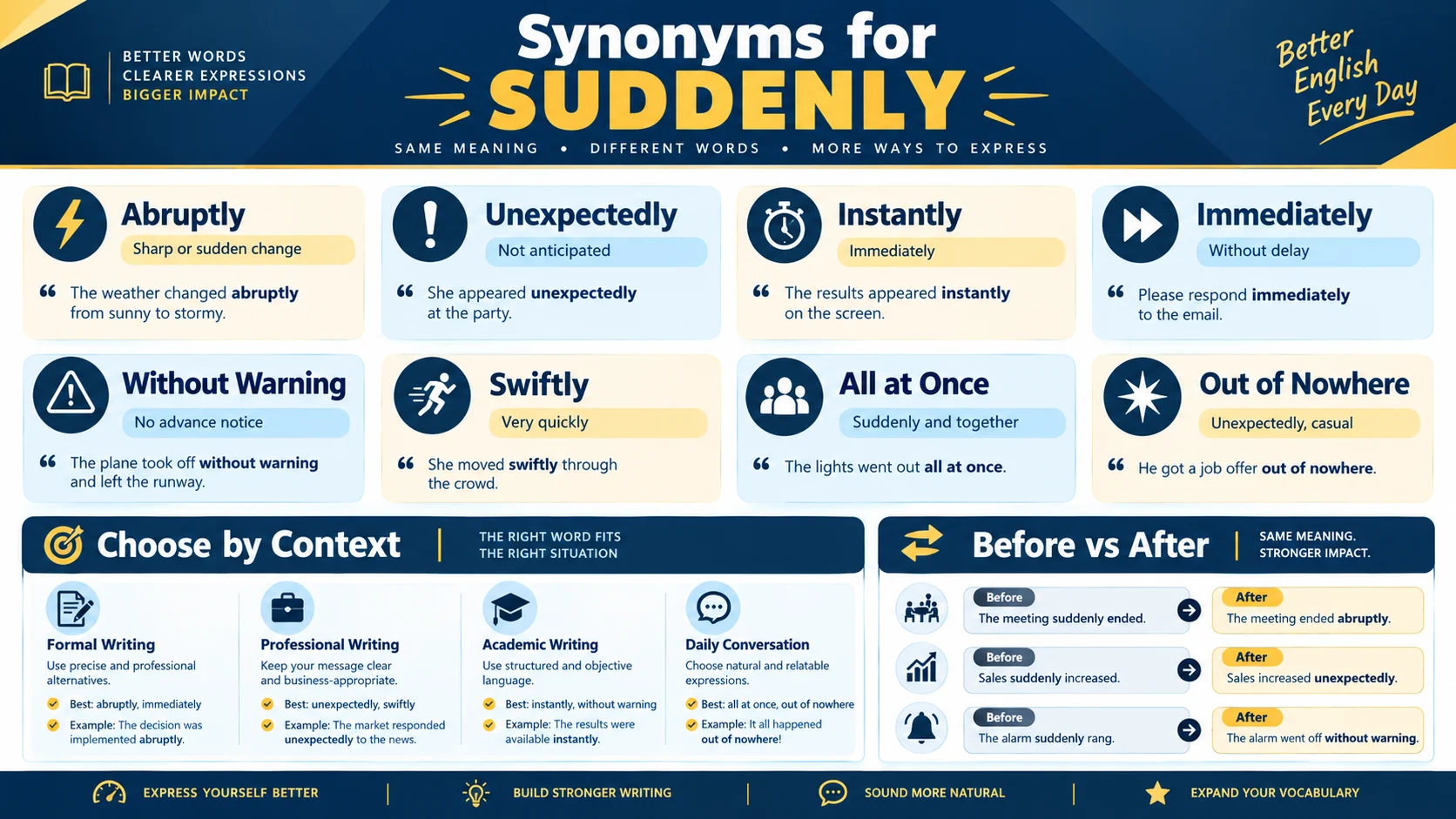
Another word for suddenly is abruptly, especially when something happens quickly or without warning. Other synonyms include unexpectedly, instantly, immediately, swiftly, all at once, without warning, and out of nowhere. The best choice depends on whether you want to emphasize speed, surprise, or an abrupt change.
What Does Suddenly Mean?
Definition
Suddenly means something happens quickly, unexpectedly, or without warning. It describes an event or change that occurs abruptly rather than gradually.
For example:
The lights suddenly went out.
Depending on the context, you can replace suddenly with words such as abruptly, unexpectedly, instantly, all at once, without warning, swiftly, or out of nowhere.
The best alternative depends on what you want to emphasize. Some synonyms focus on speed, while others highlight surprise, lack of warning, or an abrupt change.
Common Uses
The word suddenly commonly describes:
- An unexpected event
- A rapid change
- Something happening without warning
- A quick physical action
- A surprising realization
- A change in someone’s behavior or situation
For example:
- She suddenly stood up.
- The weather suddenly changed.
- He suddenly realized his mistake.
- The company suddenly announced its closure.
Best Synonyms for Suddenly
| Synonym | Meaning | Best Used When | Example |
|---|---|---|---|
| Abruptly | In a sudden, sharp way | A noticeable interruption or change | The meeting ended abruptly. |
| Unexpectedly | In a way that was not anticipated | Surprise is important | The package arrived unexpectedly. |
| Instantly | Immediately or at once | Emphasizing speed | She instantly recognized him. |
| Swiftly | Very quickly | Describing fast action | The team responded swiftly. |
| Immediately | Without delay | Formal or professional contexts | The issue was immediately reported. |
| Without warning | With no advance notice | An event was unforeseen | The alarm went off without warning. |
| All at once | At the same moment or quickly | Conversational descriptions | All at once, everyone became silent. |
| Out of nowhere | Unexpectedly, with little indication | Informal conversation | A storm appeared out of nowhere. |
| On the spot | Immediately | Immediate action or decisions | She made the decision on the spot. |
| In an instant | Extremely quickly | Narrative or descriptive writing | The room changed in an instant. |
Abruptly
Meaning: In a sudden and often sharp or unexpected manner.
Best Used For: Changes, interruptions, endings, movements, and shifts in behavior.
Tone: Neutral to formal
Difficulty: Medium
Usage Frequency: Common
Business example: The negotiations ended abruptly.
Academic example: The population declined abruptly after the environmental change.
Daily conversation: He abruptly left the party.
Abruptly often suggests that something stopped or changed in a noticeably sudden way.
Unexpectedly
Meaning: In a manner that was not expected or predicted.
Best Used For: Surprising events, results, arrivals, or developments.
Tone: Neutral
Difficulty: Easy
Usage Frequency: Very Common
Business example: Sales increased unexpectedly during the final quarter.
Academic example: The treatment group responded unexpectedly well.
Daily conversation: She showed up unexpectedly.
Use unexpectedly when surprise matters more than speed.
Instantly
Meaning: Immediately or almost immediately.
Best Used For: Reactions, recognition, decisions, or events that happen extremely quickly.
Tone: Neutral
Difficulty: Easy
Usage Frequency: Very Common
Business example: The system instantly generated a confirmation.
Academic example: The substance instantly reacted with the solution.
Daily conversation: I instantly knew something was wrong.
Unlike unexpectedly, instantly primarily emphasizes speed.
Synonyms by Context
Formal Writing
For formal writing, stronger alternatives to suddenly include:
- Abruptly
- Unexpectedly
- Without warning
- Immediately
- Instantly
- With little warning
Example:
The policy was abruptly changed.
This sounds more precise and formal than:
The policy suddenly changed.
However, suddenly is not incorrect in formal writing. Choose an alternative only when it communicates your intended meaning more accurately.
Professional Writing
In business communication, avoid overly dramatic expressions when precision matters.
Instead of:
The project suddenly failed.
You might write:
The project failed unexpectedly.
Or:
The project encountered an abrupt interruption.
For professional emails and reports, unexpectedly, immediately, abruptly, and without warning are usually more appropriate than conversational expressions such as out of nowhere.
Academic Writing
Academic writing benefits from precise descriptions.
Consider:
The temperature suddenly increased.
Depending on the intended meaning, you could write:
The temperature increased abruptly.
or:
The temperature increased rapidly.
These words are not interchangeable in every situation. Abruptly emphasizes a sharp change, while rapidly emphasizes the rate of change.
Daily Conversation
Everyday speech gives you more flexibility.
Common alternatives include:
- Out of nowhere
- All at once
- In an instant
- Without warning
- Unexpectedly
- All of a sudden
Example:
All of a sudden, the dog started barking.
Another natural option is:
The dog started barking out of nowhere.
These expressions sound more conversational than abruptly.
Professional Alternatives for Suddenly
If you’re writing a resume, report, business email, or workplace document, consider these alternatives:
Unexpectedly works well when an outcome was not anticipated.
The project was unexpectedly delayed.
Abruptly works when something stops or changes sharply.
The negotiations ended abruptly.
Immediately works when the important point is that there was no delay.
The issue was immediately addressed.
Without warning works when people received no advance notice.
The service was discontinued without warning.
Rapidly works when something changes at a high rate rather than simply being surprising.
Demand increased rapidly.
This distinction is especially useful in professional writing because replacing suddenly with a more specific word can make the sentence clearer.
Simple Alternatives for Suddenly
If you need an easy replacement, use:
- Quickly
- Unexpectedly
- Immediately
- All at once
- Without warning
- All of a sudden
- In an instant
For example:
Original:
The door suddenly opened.
Simple:
The door opened without warning.
Conversational:
All of a sudden, the door opened.
More formal:
The door opened abruptly.
Stronger Alternatives for Suddenly
Some alternatives create a stronger sense of surprise or drama.
Out of nowhere
This is highly conversational and emphasizes that something seemed to appear without any indication.
A car came out of nowhere.
Without warning
This highlights the absence of advance notice.
The storm arrived without warning.
All of a sudden
This is an informal expression that emphasizes an unexpected change.
All of a sudden, everyone started laughing.
In an instant
This creates a vivid sense of speed.
In an instant, the situation changed.
These choices are particularly useful in storytelling, social media writing, and informal content.
Difference Between Similar Synonyms
The synonyms of suddenly are related, but they do not all mean exactly the same thing.
Suddenly vs. Abruptly
Suddenly means something happens quickly or unexpectedly.
Abruptly often suggests a sharp, rough, or noticeably interrupted change.
She suddenly left the room.
She abruptly left the room.
The second sentence can suggest that her departure felt particularly abrupt or unexplained.
Suddenly vs. Unexpectedly
Suddenly can emphasize speed or surprise.
Unexpectedly specifically emphasizes that something was not anticipated.
The price suddenly increased.
The price unexpectedly increased.
The first can emphasize a quick increase. The second emphasizes that the increase was not expected.
Suddenly vs. Instantly
Suddenly describes an unexpected or rapid occurrence.
Instantly emphasizes immediate timing.
He suddenly understood the problem.
He instantly understood the problem.
The second version puts more emphasis on how quickly understanding occurred.
Suddenly vs. Quickly
Quickly means at a fast rate or with little time.
Suddenly means unexpectedly or without gradual development.
The river suddenly rose.
The river quickly rose.
The first may emphasize that the rise happened unexpectedly. The second focuses more directly on the rate of the rise.
Opposite Words
Words that express ideas opposite to suddenly include:
- Gradually
- Slowly
- Progressively
- Steadily
- Incrementally
- Eventually
- Over time
- Little by little
For example:
Suddenly: The weather changed suddenly.
Gradually: The weather changed gradually.
The contrast is between a change that happens unexpectedly or rapidly and one that develops over a period of time.
FAQs
What is another word for suddenly?
Common alternatives for suddenly include abruptly, unexpectedly, instantly, immediately, without warning, all at once, swiftly, and out of nowhere. The best choice depends on whether you want to emphasize surprise, speed, interruption, or lack of warning.
What is a formal synonym for suddenly?
Abruptly, unexpectedly, immediately, and without warning are useful formal alternatives. Abruptly is especially suitable when describing a sharp change, interruption, or sudden ending.
What is a professional alternative for suddenly?
In professional writing, unexpectedly is often useful for unexpected events, while immediately works when you mean without delay. Abruptly is appropriate for sudden stops or sharp changes.
What word can replace suddenly?
Depending on the sentence, you can replace suddenly with abruptly, unexpectedly, instantly, quickly, immediately, swiftly, or without warning.
What is another word for suddenly in an essay?
For an essay, consider abruptly, unexpectedly, immediately, rapidly, or without warning. Select the word that matches the exact relationship you want to describe instead of changing suddenly automatically.
What is a synonym for suddenly in a sentence?
In “The lights suddenly went out,” possible alternatives include “The lights went out without warning” and “The lights went out unexpectedly.” The best option depends on whether the sentence emphasizes surprise or lack of warning.
Is abruptly the same as suddenly?
Not exactly. Abruptly is a type of sudden action that often suggests a sharp, unexpected, or interrupted change. Suddenly is broader and can describe many types of unexpected or rapid events.
Is unexpectedly the same as suddenly?
They overlap, but their emphasis differs. Suddenly can emphasize sudden timing, while unexpectedly emphasizes that the event was not anticipated.
What is a casual way to say suddenly?
Common casual expressions include all of a sudden, out of nowhere, and all at once.
What is the opposite of suddenly?
Common opposites include gradually, slowly, steadily, progressively, and little by little. These words describe changes that develop over time rather than occurring suddenly.
Conclusion
The best synonym for suddenly depends on the meaning you want to emphasize.
Use abruptly for a sharp or sudden change, unexpectedly for something that was not anticipated, instantly for immediate action, and without warning when there was no advance notice. For casual conversation, all of a sudden and out of nowhere sound natural.
Choosing the right alternative is more useful than simply replacing one word with another. Consider whether your sentence is emphasizing speed, surprise, interruption, immediacy, or lack of warning, then choose the synonym that communicates that idea most precisely.