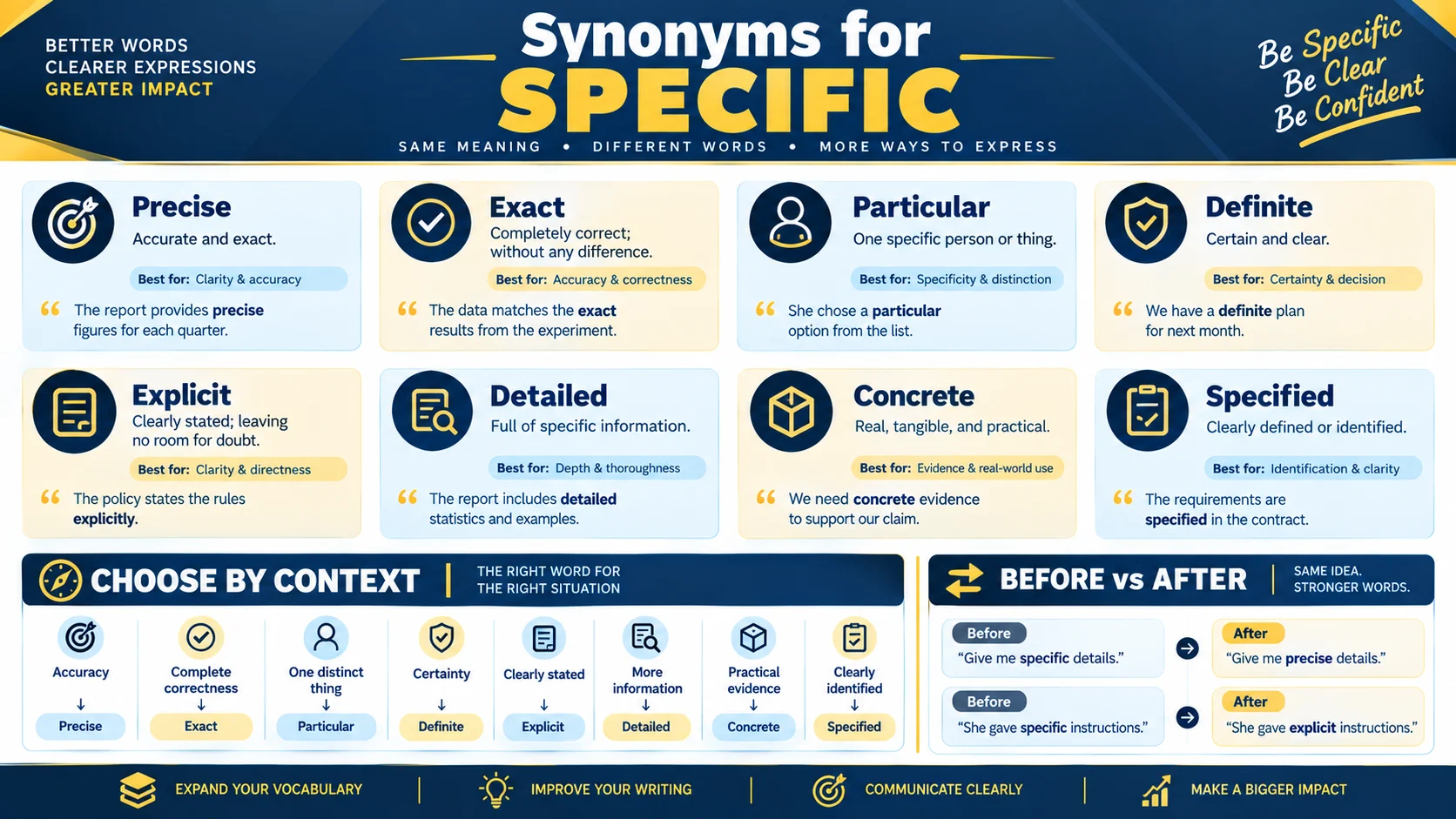
Another word for specific is particular, precise, exact, definite, explicit, detailed, or clearly stated. The best choice depends on context. Use precise for accuracy, particular for one distinct thing, exact for complete accuracy, and explicit when something is clearly stated.
What Does Specific Mean?
Definition
Specific generally means relating to one particular thing rather than something general. It can also mean clear, exact, or detailed, especially when describing information, instructions, questions, or explanations.
For example:
Please give me a specific example.
Here, specific means an example that is clearly identified rather than a broad or general example.
The word can also describe something limited or connected to one particular person, purpose, group, place, or situation. For example, “specific requirements” refers to requirements that have been clearly identified for a particular purpose.
Common Uses
You commonly see specific with words such as:
- specific details
- specific information
- specific requirements
- specific goals
- specific instructions
- specific examples
- specific questions
- specific reasons
- specific problems
- specific needs
- specific time
- specific location
The right synonym depends on what specific is emphasizing: accuracy, distinctness, clarity, limitation, or detail.
Best Synonyms for Specific
| Synonym | Meaning | Best Used When | Example |
|---|---|---|---|
| Precise | Exact and accurate | Accuracy matters | Give me the precise measurements. |
| Exact | Completely accurate or matching | Referring to an exact fact, number, or detail | What is the exact date? |
| Particular | One distinct thing or person | Identifying one thing from others | I have a particular reason for asking. |
| Definite | Clearly established or certain | Something is settled or clearly identified | We need a definite answer. |
| Explicit | Clearly expressed | Instructions or statements must be unambiguous | The policy gives explicit instructions. |
| Detailed | Containing many relevant details | Descriptions, reports, explanations | She provided a detailed explanation. |
| Clear-cut | Very clear and without ambiguity | Decisions, distinctions, or categories | The evidence is not clear-cut. |
| Concrete | Definite and practical rather than abstract | Plans, examples, evidence, or results | We need concrete evidence. |
| Specified | Clearly stated or identified | Requirements, conditions, quantities | Follow the specified procedure. |
| Particularized | Made specific or detailed | Formal or specialized writing | The report particularized the concerns. |
Not every synonym works in every sentence. Cambridge, Oxford, and Collins all distinguish between the “particular” sense of specific and its “exact or clearly stated” sense.
Synonyms by Context
Formal Writing
For formal writing, strong alternatives include:
precise, definite, explicit, specified, particular, concrete, detailed, unequivocal
Examples:
- Specific: The report provides specific recommendations.
- Precise: The report provides precise recommendations.
- Explicit: The report provides explicit recommendations.
- Detailed: The report provides detailed recommendations.
Precise works especially well when accuracy matters. Explicit is better when the point is that something has been clearly stated. Detailed emphasizes the amount of information.
Professional Writing
In business and workplace writing, the most natural alternatives are usually specific, precise, clear, definite, detailed, and explicit.
Business Example:
Original: Please provide specific information about the project.
Possible alternatives:
Please provide detailed information about the project.
Please provide precise information about the project.
Please provide clear information about the project.
The choice changes the emphasis. Detailed asks for more information, while precise asks for greater accuracy.
Academic Writing
Academic writing often benefits from precise, particular, specific, clearly defined, detailed, and explicit.
Academic Example:
The study examines specific factors that influence student performance.
Possible revision:
The study examines particular factors that influence student performance.
Or:
The study examines precisely defined factors that influence student performance.
In academic writing, precise is particularly useful when discussing definitions, measurements, variables, terminology, or methodology.
Daily Conversation
For everyday conversation, simpler alternatives include:
particular, exact, clear, certain, definite, and specific.
For example:
“Do you have a specific time in mind?”
You could say:
“Do you have a particular time in mind?”
Or:
“Do you have an exact time in mind?”
The original sentence is often the most natural because specific is common and conversational.
Professional Alternatives for Specific
If you’re writing a resume, email, report, proposal, or business document, consider these alternatives:
Precise
Meaning: Exact and accurate.
Best Used For: Measurements, descriptions, data, instructions, and technical information.
Tone: Professional and polished.
Difficulty: Medium
Usage Frequency: Very Common
Best For: Resume, email writing, academic writing, business writing.
Business Example:
“The analyst provided precise estimates for the upcoming quarter.”
Academic Example:
“The experiment required precise measurements.”
Daily Conversation Example:
“Can you give me the precise location?”
Explicit
Meaning: Clearly expressed and leaving little room for misunderstanding.
Best Used For: Instructions, rules, expectations, statements, and requirements.
Tone: Formal and direct.
Difficulty: Medium
Usage Frequency: Common
Best For: Business writing, academic writing, professional emails.
Business Example:
“The manager gave explicit instructions about the new procedure.”
Academic Example:
“The research paper provides explicit criteria for participant selection.”
Daily Conversation Example:
“She was explicit about what she wanted.”
Definite
Meaning: Clearly established, certain, or fixed.
Best Used For: Decisions, answers, plans, dates, and commitments.
Tone: Professional and confident.
Difficulty: Easy
Usage Frequency: Very Common
Best For: Emails, business writing, daily conversation.
Business Example:
“We need a definite deadline before beginning the project.”
Academic Example:
“The findings do not provide a definite explanation.”
Daily Conversation Example:
“Do you have a definite answer yet?”
Simple Alternatives for Specific
If you want a simpler word, try:
- clear
- exact
- particular
- certain
- definite
- detailed
For example:
Original: “Can you be more specific?”
Simple: “Can you be more clear?”
However, clear and specific are not always interchangeable. A statement can be clear while still being broad. Specific usually narrows the subject or identifies exactly what is meant. Oxford specifically distinguishes the “detailed and exact” sense from the sense of being connected with one particular thing.
Stronger Alternatives for Specific
When you want language that sounds more exact or forceful, consider:
- precise
- exact
- explicit
- definite
- unequivocal
- clear-cut
- specified
- concrete
Precise vs. Exact
These two words are close, but they often emphasize different things.
Precise focuses on accuracy and careful definition.
The engineer provided precise measurements.
Exact emphasizes complete correctness or an identical match.
What is the exact amount?
Cambridge lists precise and exact among alternatives associated with the “complete and true in every detail” sense of specific.
Specific vs. Particular
Particular is one of the closest alternatives to specific when you mean one distinct person, thing, group, or situation.
I need a specific book.
I need a particular book.
The two sentences can be very similar, but particular often emphasizes one selected or distinguished item, while specific can emphasize identification or precision. Merriam-Webster notes that particular stresses the distinctness of something as an individual.
Specific vs. Explicit
Use specific when something is narrowly identified or detailed.
Use explicit when something is directly and clearly stated.
The assignment has specific requirements.
The professor gave explicit instructions.
The first emphasizes the requirements themselves. The second emphasizes how clearly the instructions were communicated.
Difference Between Similar Synonyms
Choosing the right synonym depends on the intended meaning.
| Word | Main Idea | Example |
|---|---|---|
| Specific | Particular or clearly identified | Give me a specific example. |
| Precise | Accurate and exact | Give me the precise measurement. |
| Exact | Completely accurate | What is the exact amount? |
| Particular | One distinct item or case | I have a particular concern. |
| Definite | Certain or firmly established | We need a definite decision. |
| Explicit | Clearly stated | The instructions were explicit. |
| Detailed | Rich in information | She wrote a detailed report. |
| Concrete | Definite and practical | We need concrete evidence. |
| Unequivocal | Leaving no doubt | The statement was unequivocal. |
A useful rule is:
Specific = narrow or identified
Precise = accurate
Exact = completely accurate
Particular = one distinct thing
Definite = certain or established
Explicit = clearly stated
Detailed = containing many details
This distinction is especially useful when choosing words for professional or academic writing.
Opposite Words
Common antonyms of specific include:
- general
- vague
- indefinite
- uncertain
- approximate
- broad
- unclear
- nonspecific
For example:
Specific: The meeting starts at 9:00 a.m.
Vague: The meeting starts sometime in the morning.
Cambridge lists words such as approximate, indefinite, uncertain, vague, and general among antonyms associated with specific.
FAQs
What is the best synonym for specific?
The best synonym depends on context. Particular works well when referring to one distinct thing, while precise works better when emphasizing accuracy. Exact, definite, and explicit are also strong alternatives.
What is a formal synonym for specific?
Precise, explicit, definite, specified, and unequivocal can work as formal alternatives, depending on the sentence.
What is a professional alternative for specific?
In professional writing, precise, clear, detailed, specified, and explicit are useful alternatives.
What word can replace specific?
Common replacements include particular, precise, exact, definite, explicit, detailed, and specified.
What is another word for specific information?
Depending on meaning, you can use precise information, detailed information, exact information, particular information, or clearly stated information.
What is another word for a specific person?
Particular person, individual, or identified person may work depending on the context.
What is another word for a specific goal?
Possible alternatives include particular goal, defined goal, precise goal, specific objective, or clearly defined objective.
Is precise the same as specific?
Not always. Precise mainly emphasizes accuracy, while specific can mean particular, narrowly identified, or detailed. The words overlap in contexts involving exact information.
Is particular a synonym for specific?
Yes, in many contexts. Both can identify one thing rather than something general. However, particular often emphasizes distinctness, while specific can emphasize precision or clear identification.
What is the opposite of specific?
Common opposites include general, vague, indefinite, uncertain, approximate, and nonspecific.
Conclusion
The best synonym for specific depends on what you want to emphasize. Choose particular when identifying one distinct thing, precise when accuracy matters, exact when complete correctness matters, definite when something is settled, and explicit when information is clearly stated.
For professional and academic writing, replacing specific with a more precise alternative can make your sentence communicate its intended meaning more clearly. The goal is not simply to find a different word, but to choose the word that preserves the exact idea you want to express.