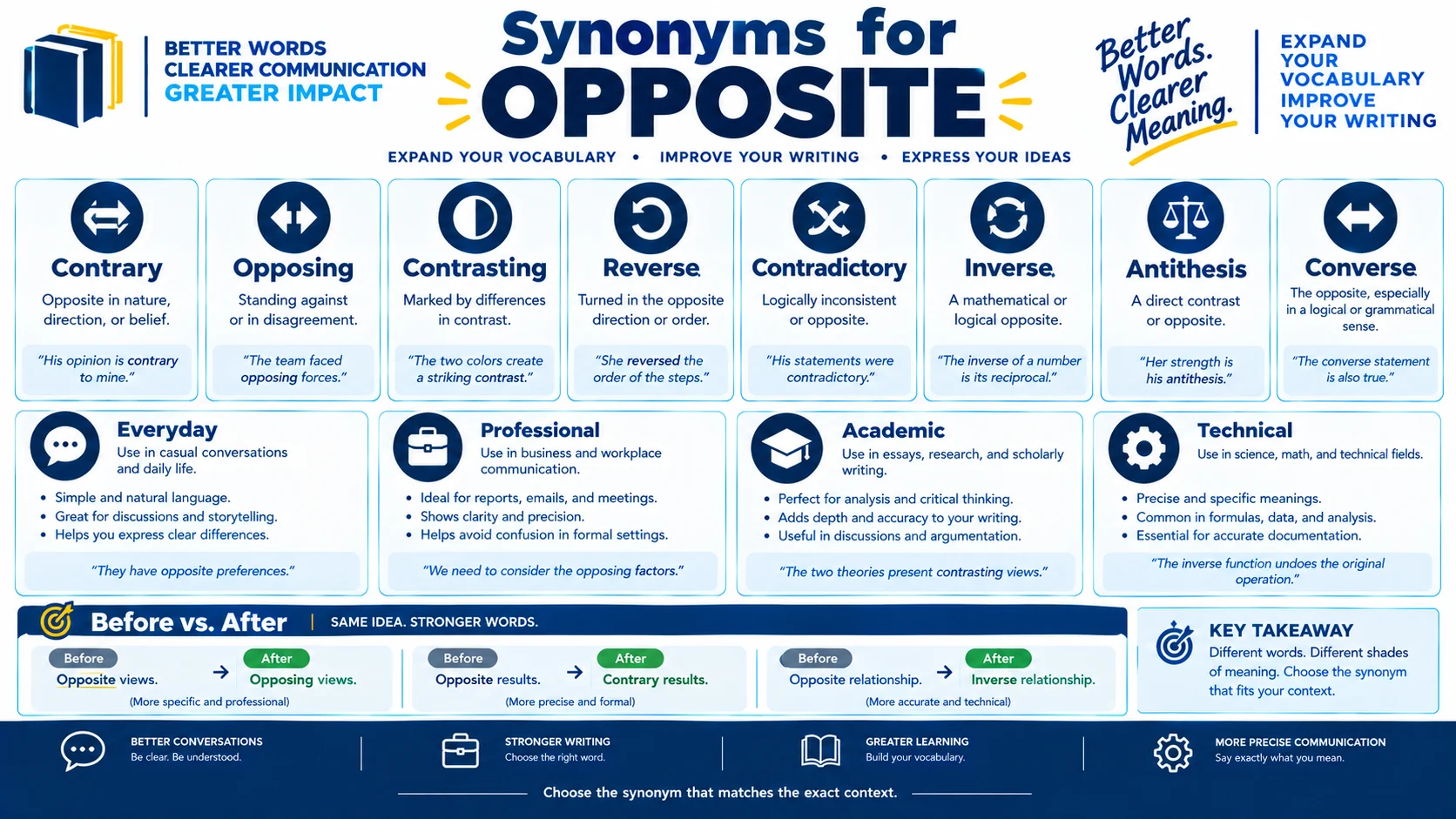
Another word for opposite depends on the context. Common synonyms include contrary, opposing, reverse, contrasting, contradictory, inverse, antithesis, converse, and antipodal. For everyday writing, contrary, opposing, reverse, and contrasting are useful choices, while antithesis and inverse work better in formal or specialized contexts.
What Does Opposite Mean?
Definition
Opposite refers to something that is completely different from, directly against, or positioned across from something else.
The word can describe ideas, qualities, actions, directions, positions, people, or things.
For example:
- Hot is the opposite of cold.
- The bank is opposite the library.
- Her opinion was the opposite of mine.
- He chose to move in the opposite direction.
As a noun, opposite can mean something that contrasts directly with another thing. As an adjective, it describes something located or positioned across from another object or person.
Common Uses
The meaning of opposite changes slightly depending on how it is used.
For contrasting ideas:
“The two candidates had opposite views.”
For physical location:
“The pharmacy is opposite the hospital.”
For direction:
“Turn in the opposite direction.”
For contrasting qualities:
“Her personality is the opposite of his.”
For reversed relationships or processes:
“The second result was the opposite of what researchers expected.”
Because of these different meanings, no single synonym works perfectly in every sentence.
Best Synonyms for Opposite
| Synonym | Meaning | Best Used When | Example |
|---|---|---|---|
| Contrary | Completely different or conflicting | Ideas, opinions, beliefs | His actions were contrary to his promises. |
| Opposing | Directly against something | Opinions, forces, positions | The two groups had opposing views. |
| Reverse | Going in the opposite direction or order | Direction, sequence, process | The company decided to reverse the policy. |
| Contrasting | Clearly different | People, styles, ideas, qualities | The two designs have contrasting colors. |
| Contradictory | In conflict with another statement or idea | Claims, evidence, statements | The witness gave contradictory accounts. |
| Inverse | Reversed in relationship or effect | Mathematics, science, technical writing | The variables have an inverse relationship. |
| Antithesis | The complete contrast of something | Formal and academic writing | Her approach was the antithesis of traditional management. |
| Converse | The reverse or opposite of a proposition or relationship | Logic, mathematics, formal writing | The converse of the original statement is also true. |
| Antipodal | Situated at the opposite point or extremely different | Geography or figurative formal writing | Their political philosophies were antipodal. |
Synonyms by Context
Formal Writing
For formal writing, choose a synonym that clearly describes the type of contrast.
Contrary is useful when one thing conflicts with another.
The findings were contrary to the original hypothesis.
Contrasting works well when two things differ noticeably without necessarily being in conflict.
The study examined two contrasting approaches to education.
Antithesis is stronger and more rhetorical.
The proposed system represents the antithesis of centralized control.
Inverse is appropriate when two things have a reversed relationship.
The results showed an inverse relationship between the two variables.
Professional Writing
In business and workplace communication, opposing, contrasting, contrary, and reverse are usually clearer than highly technical alternatives.
Instead of:
The departments have opposite priorities.
You could write:
The departments have contrasting priorities.
For disagreement:
The managers expressed opposing views.
For changing a previous decision:
The company decided to reverse its earlier decision.
For conflict with a policy:
The proposal is contrary to current company policy.
These alternatives make professional writing more precise without sounding unnecessarily complicated.
Academic Writing
Academic writing often requires a distinction between simple difference and direct contradiction.
Use contrasting when comparing different characteristics:
The researchers compared two contrasting theories.
Use contradictory when statements or findings conflict:
The studies produced contradictory results.
Use inverse when describing a reversed mathematical or statistical relationship:
The researchers observed an inverse relationship between age and reaction time.
Use antithesis when describing something as the complete conceptual opposite:
The theory is presented as the antithesis of conventional thinking.
Daily Conversation
In everyday American English, simple words are usually best.
Good alternatives include:
- reverse
- contrary
- different
- opposing
- backward
- reverse side
For example:
“Take the opposite road.”
can become:
“Take the other road.”
Or:
“They have opposite opinions.”
can become:
“They have different opinions.”
Not every synonym needs to sound sophisticated. The best replacement is the one that communicates the intended meaning naturally.
Professional Alternatives for Opposite
If you’re replacing opposite in a resume, report, email, or business document, consider these options:
Contrary is best for something that conflicts with a statement, expectation, rule, or belief.
The results were contrary to initial expectations.
Opposing is best for people, groups, positions, or opinions that directly disagree.
The committee considered two opposing proposals.
Contrasting is best for differences that can be compared.
The report highlights contrasting customer preferences.
Contradictory is best when two statements, findings, or claims cannot easily coexist.
The report contains contradictory information.
Reverse is best when direction, order, action, or a decision is changed to its opposite.
Management decided to reverse the previous decision.
Simple Alternatives for Opposite
For simple writing, these words can often replace opposite:
- Different
- Other
- Against
- Reverse
- Contrary
- Opposing
- Across from
- Backward
However, these words are not interchangeable in every sentence.
For example, different means “not the same,” but it does not necessarily mean “directly opposite.”
Compare:
Their opinions are different.
This only tells us that the opinions are not the same.
Their opinions are opposite.
This suggests that the opinions directly conflict.
That distinction matters when choosing a synonym.
Stronger Alternatives for Opposite
When you need a stronger or more precise word, consider:
Antithesis
Meaning: The complete or direct contrast of something.
Tone: Formal and rhetorical
Difficulty: Advanced
Usage Frequency: Less Common
Best for: Essays, literary analysis, formal arguments, and academic writing.
Her leadership style was the antithesis of authoritarian management.
Contradictory
Meaning: Directly conflicting or inconsistent.
Tone: Formal
Difficulty: Medium
Usage Frequency: Common
Best for: Academic writing, reports, arguments, and evidence.
The two explanations were contradictory.
Antipodal
Meaning: Directly opposite or extremely different.
Tone: Very formal
Difficulty: Advanced
Usage Frequency: Rare
Best for: Specialized, literary, geographical, or highly formal contexts.
Their approaches were almost antipodal.
Difference Between Similar Synonyms
The most important distinction is between opposite, different, contrasting, contrary, opposing, and contradictory.
Opposite vs. Different
Different simply means not the same.
Opposite suggests a much stronger contrast.
Blue and green are different colors.
But:
Black and white are often described as opposite colors.
Opposite vs. Contrasting
Contrasting means noticeably different in a way that makes comparison useful.
The designer used contrasting colors.
The colors do not necessarily have to be exact opposites.
Opposite vs. Contrary
Contrary often means conflicting with an expectation, statement, belief, rule, or position.
Contrary to expectations, sales increased.
This is different from simply describing two things as opposite.
Opposite vs. Opposing
Opposing usually describes two sides that are actively against each other.
The opposing teams competed for the championship.
It is especially useful for arguments, positions, forces, groups, and viewpoints.
Opposite vs. Contradictory
Contradictory means that two statements, claims, pieces of evidence, or ideas conflict with each other.
The witnesses provided contradictory accounts.
This word is stronger and more specific than different.
Opposite vs. Reverse
Reverse often describes direction, order, movement, or an action that has been turned around.
The car moved in reverse.
It can also function as a verb:
The company reversed its decision.
Synonym Profile: Choosing the Right Word
| Word | Tone | Difficulty | Best For |
|---|---|---|---|
| Different | Neutral | Easy | Daily conversation, general writing |
| Other | Neutral | Easy | Everyday communication |
| Contrary | Formal | Medium | Business, essays, reports |
| Opposing | Neutral/Formal | Medium | Opinions, groups, arguments |
| Contrasting | Neutral/Formal | Medium | Comparisons and descriptions |
| Contradictory | Formal | Medium | Claims, evidence, statements |
| Reverse | Neutral | Easy | Direction, action, sequence |
| Inverse | Technical/Formal | Advanced | Science, math, statistics |
| Antithesis | Formal | Advanced | Essays, rhetoric, literary analysis |
| Antipodal | Very Formal | Advanced | Specialized or literary contexts |
Real Examples of Opposite Synonyms
Business Example
Original:
The two departments have opposite priorities.
More precise:
The two departments have contrasting priorities.
If the departments actively disagree:
The two departments have opposing priorities.
Academic Example
Original:
The results were opposite to what researchers expected.
More precise:
The results were contrary to what researchers expected.
For a statistical relationship:
The variables showed an inverse relationship.
Daily Conversation Example
Original:
We went in the opposite direction.
Simple alternative:
We went in the other direction.
Another natural option:
We went the wrong way.
The last option changes the meaning slightly because it adds the idea that the direction was incorrect.
What Is a Formal Synonym for Opposite?
Contrary, opposing, contrasting, contradictory, antithesis, and inverse can serve as formal alternatives, depending on context.
For most professional and academic writing, contrary, opposing, and contrasting are practical choices. Antithesis and inverse have more specific meanings and should not be used simply to make writing sound sophisticated.
What Is a Professional Alternative for Opposite?
The best professional alternative depends on the sentence.
Use contrasting for differences, opposing for disagreement, contrary for conflict with an expectation or rule, contradictory for conflicting statements, and reverse for a reversed action or direction.
What Word Can Replace Opposite?
Possible replacements include contrary, opposing, reverse, contrasting, contradictory, inverse, antithesis, and converse.
For simple everyday writing, different, other, or reverse may sound more natural.
Opposite Words
If you are looking for words that mean the opposite of opposite, common choices include:
- Same
- Similar
- Identical
- Alike
- Matching
- Equivalent
- Corresponding
For example:
The two answers are different.
The opposite idea would be:
The two answers are the same.
Remember that the correct antonym depends on the meaning of opposite in the original sentence.
FAQs
What is the most common synonym for opposite?
Contrary, opposing, reverse, and contrasting are among the most useful synonyms. The best choice depends on whether you are describing ideas, directions, physical positions, or differences.
What is a synonym for opposite in an essay?
Contrary, contrasting, contradictory, antithesis, and inverse can work in essays. Choose based on the exact relationship you are describing rather than replacing opposite automatically.
What is a synonym for opposite in a sentence?
Common options include contrary, opposing, reverse, contrasting, and different. Each has a slightly different meaning.
Is “contrary” the same as “opposite”?
Not always. Contrary usually emphasizes conflict with an idea, expectation, statement, rule, or position. Opposite has broader uses, including physical location and direction.
Is “different” a synonym for opposite?
Sometimes, but different is weaker. Something can be different without being directly opposite.
What is a strong word for opposite?
Antithesis is a strong formal word for something that represents a complete or direct contrast. Contradictory is stronger when describing conflicting claims or statements.
What is the opposite of opposite?
Depending on context, possible antonyms include same, similar, identical, alike, matching, and equivalent.
What is a synonym for opposite in business writing?
Contrasting, opposing, contrary, and reverse are useful professional alternatives. The choice depends on whether you are discussing differences, disagreement, conflict, or reversal.
What is a synonym for opposite in academic writing?
Contrasting, contrary, contradictory, inverse, and antithesis can be appropriate. Academic writing benefits from choosing the word that precisely describes the relationship.
Is “inverse” a synonym for opposite?
Inverse can mean opposite or reversed, but it has a more specialized meaning. It is especially common in mathematics, science, statistics, and technical writing.
Conclusion
The best synonym for opposite depends on what kind of contrast you mean. Different works for a general lack of similarity, contrasting works for noticeable differences, opposing works for disagreement, contrary works for conflict with an expectation or position, and contradictory works for conflicting statements or evidence.
For technical contexts, inverse can describe a reversed relationship, while antithesis is useful when something represents a complete conceptual contrast. Choosing the right synonym makes your writing more precise, natural, and effective.